How to Prioritize Tasks Effectively and Reclaim Your Day
Ever feel like you're running on a hamster wheel all day, only to get to the end and wonder what you actually accomplished? That feeling of being busy but not productive is a classic sign of poor prioritization.
The secret isn't working more hours; it's learning to separate what feels urgent from what's truly important. It’s about channeling your energy into the high-impact stuff that actually moves you closer to your goals.
Why Mastering Prioritization Is a Game Changer

If you’ve ever ended a workday completely drained but with nothing meaningful to show for it, you know exactly what I’m talking about. This isn't just about wasted time—it’s a psychological drain that kills your focus, motivation, and confidence.
This is especially true when you're managing something as high-stakes as a job search. Every application, networking email, and interview prep session can feel critical. Without clear priorities, you either freeze up or spin your wheels doing a little bit of everything and not much of anything.
The Real Cost of Poor Prioritization
The gap between a full workday and actual productive output is pretty shocking when you see the numbers. We’re often pulled in a dozen directions, and our focus pays the price.
| Area of Impact | Weekly Time Lost | Key Statistic |
|---|---|---|
| Productive Work | ~25 hours | Employees are productive for only 2 hours and 53 minutes in an 8-hour day. |
| Context Switching | ~10 hours | Workers spend 25 minutes refocusing after a single notification. |
| Unnecessary Meetings | ~6 hours | 31 hours a month are spent in unproductive meetings. |
These stats paint a clear picture: without a system, your time gets eaten alive by distractions and low-value demands. Simply spending 10 minutes planning your day can reclaim up to two hours of productive time—a massive return on a tiny investment.
Shifting From Busy to Productive
The real goal here is to make the leap from being busy to being genuinely productive. It's all about working smarter, not harder. This means making conscious, deliberate choices about where to put your attention.
Without a system, you’ll naturally fall into bad habits:
- Reacting to urgent but unimportant tasks, like that non-critical email that just popped up.
- Putting off important, long-term goals because they don't have a fire lit under them.
- Burning out from decision fatigue, spending more energy deciding what to do than actually doing it.
Prioritization isn't about perfectly managing every minute. It’s about building a framework that protects your most valuable resources—time and energy—for the work that truly counts.
For job seekers, this means structuring your search with intention. Using a career goals template to define what success looks like is a great first step. From there, you can use the prioritization techniques we’ll cover to align your daily activities with those big-picture objectives.
This approach turns a chaotic process into a manageable, strategic campaign, helping you land your next role faster and with a lot less stress.
Putting the Eisenhower Matrix Into Practice
The Eisenhower Matrix is more than just a cool diagram; it's a gut-check for your to-do list. It slices through the noise and forces you to get honest about what’s truly moving the needle versus what’s just making a lot of noise. It's built on two simple ideas: urgency and importance.
Sorting your tasks into four quadrants turns that overwhelming "I have so much to do" feeling into a clear, actionable game plan. Let's walk through what actually goes in each box, using some real-world examples you've probably run into.
Quadrant 1: Do First (Urgent & Important)
This is the "fire-fighting" quadrant. These are the tasks with hard deadlines and real consequences if you drop the ball. They aren't just important; they're happening right now.
Think of things like:
- A dream job application that closes at midnight tonight.
- That project report your boss needs on their desk by 5 PM.
- An email from a key client with an urgent problem that could jeopardize the account.
These are your non-negotiables. Knock them out quickly so you can clear your head and move on to more strategic work.
Quadrant 2: Schedule (Important, Not Urgent)
Welcome to the land of big wins. The tasks here are the ones that actually build your future, but since they don't have a siren blaring, they're tragically easy to ignore. This is where real growth happens.
Examples include:
- Finally updating your resume with that new certification you earned.
- Grabbing coffee with a contact in an industry you're trying to break into.
- Blocking off time to take that online course on a high-demand skill.
- Doing deep-dive research on the top 5 companies you'd love to work for.
This quadrant is where proactive people spend their time. Ignoring these tasks won’t cause a crisis today, but it’s a surefire way to create more fires to fight down the road. You have to actively protect the time in your calendar for this stuff.
Quadrant 3: Delegate (Urgent, Not Important)
This quadrant is full of distractions disguised as work. These tasks scream for your attention, but they don't actually align with your goals. They're often someone else's priorities masquerading as your own.
A few classics:
- That non-critical email that just popped up, begging for a reply.
- The meeting you were invited to "just as an FYI" where you have nothing to add.
- A request from a coworker for information they could easily look up themselves.
The goal here is to delegate, automate, or just politely decline. Every minute you claw back from this quadrant is a minute you can invest in Quadrant 2.
Quadrant 4: Delete (Not Urgent, Not Important)
And here we have it—the black hole of productivity. These are the tasks and activities that add zero value to your life. They’re pure time-wasters.
This is stuff like:
- Mindlessly scrolling through social media for 30 minutes.
- Spending an hour organizing ancient digital files you'll never touch again.
- Binge-watching another episode of a show when you know you should be working on your portfolio.
Be ruthless. The more you eliminate from this bucket, the more time and energy you’ll free up for what really counts. For a more visual way to manage all this, a lot of people use a personal Kanban board to see where their tasks are at a glance.
More Prioritization Techniques to Add to Your Toolkit
The Eisenhower Matrix is a beast for sorting your high-level tasks, but having a full toolkit lets you adapt to whatever the day throws at you. Knowing how to prioritize effectively really just means picking the right tool for the job.
Let's dig into a few more battle-tested frameworks you can start using today.
The grid below breaks down the core decision-making behind the Eisenhower Matrix. It's a fantastic visual for understanding how to slot any task into the right category.
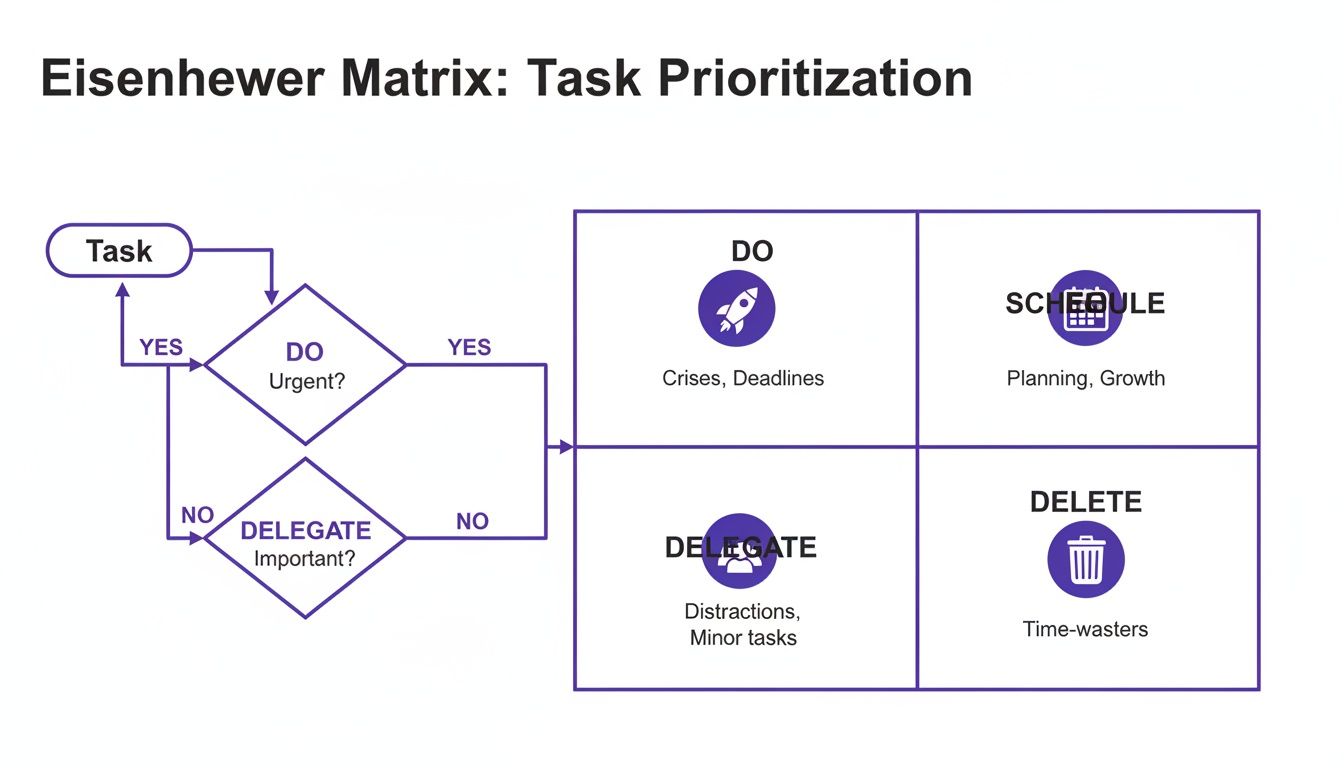
This simple grid is a powerful way to train yourself to focus on what actually matters, not just what feels loud and urgent in the moment.
Get Crystal Clear with the MoSCoW Method
The MoSCoW method, born out of the software development world, is a lifesaver for projects with a ton of moving parts or multiple stakeholders. It’s all about forcing you to define what’s truly essential.
Here’s how it works:
- Must-Have: These are the non-negotiables. The project completely fails without them.
- Should-Have: Important, but not absolutely vital. The project can still launch without these, but it might not pack the same punch.
- Could-Have: Desirable, but not necessary. Think of these as the "nice-to-haves" you’d add if you have extra time and resources.
- Won't-Have (This Time): Stuff you’re explicitly shelving for now. This step is key for avoiding confusion and scope creep down the line.
Imagine you're a freelance web designer. You could use this to agree with a client that a contact form is a Must-Have, while a flashy animated logo is a Could-Have. That kind of clarity up front saves so many headaches.
Build Unstoppable Momentum with Eat That Frog
This one is brilliantly simple and comes from a Mark Twain quote. He said that if you eat a live frog first thing in the morning, you can go through the rest of the day knowing that's probably the worst thing that will happen.
Your "frog" is your biggest, most important task—the one you're most likely to procrastinate on. If you tackle it first thing, you build incredible momentum. No matter what else goes wrong, you’ve already won the day.
This is a direct assault on procrastination. That psychological boost you get from knocking out your hardest task first thing is real, and it often fuels your productivity for hours.
Beyond these specific frameworks, building solid effective time management skills for adults is what sets you up for long-term success. The small wins add up, and they add up fast.
The connection between clear priorities and high performance isn’t just a feeling; it’s backed by data. Engaged employees—the ones focused on high-value work—are 18% more productive, which translates to 23% higher profits. Yet, with only 27% of team time spent on core tasks, it's clear that fuzzy priorities are costing companies a fortune in lost potential.
Using Technology to Sharpen Your Focus
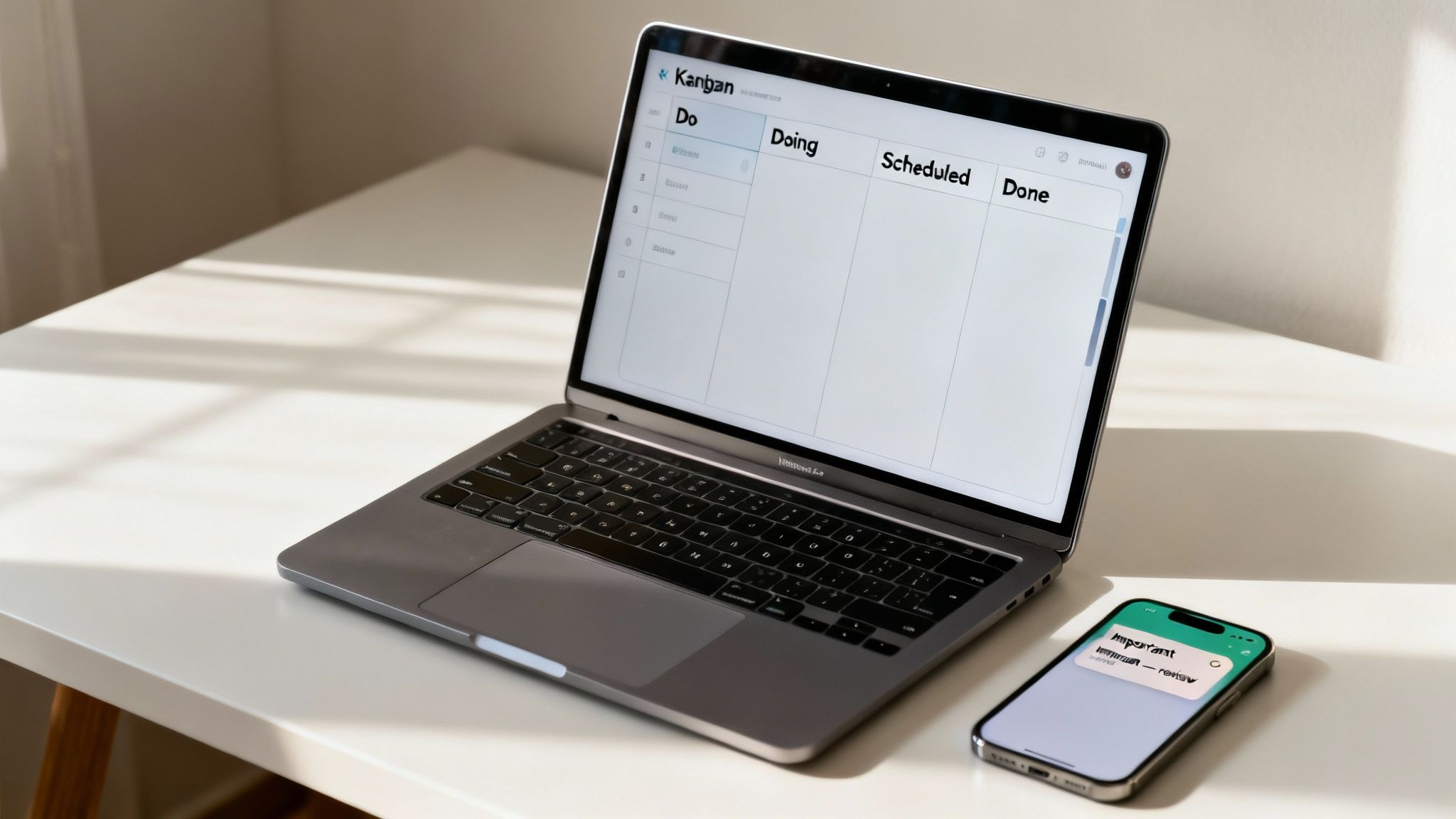
Let's be real—frameworks are great, but manually shuffling sticky notes is a job in itself. This is where technology completely changes the game. The right digital tools turn these methods from abstract concepts into dynamic, automated systems that work for you.
They don't just organize your to-do list; they handle the mental heavy lifting of sorting and tracking. This frees up your brainpower for the high-value work that actually demands your creativity and critical thinking. Instead of constantly wondering, "What's next?" you can just trust the system you've built.
Pairing Your Method with the Right Tools
Different prioritization frameworks really come alive when you pair them with the right kind of digital support. The trick is to find a tool that mirrors the logic of your chosen system, making the whole process feel natural instead of clunky.
To make this easier, here’s a quick guide on matching popular prioritization methods with the digital tools that make them shine.
Matching Prioritization Methods with Digital Tools
| Prioritization Method | Core Principle | Helpful Tech Features |
|---|---|---|
| Eisenhower Matrix | Sort tasks by urgency and importance | Tags, labels, or separate columns (Kanban boards) |
| ABCDE Method | Rank tasks by value (A, B, C) and sequence (1, 2, 3) | Drag-and-drop lists, custom priority levels |
| Eat That Frog | Tackle the most difficult task first | Scheduled daily reminders, task pinning, "Today" view |
| MoSCoW Method | Categorize tasks into Must, Should, Could, Won't | Custom labels, color-coding, filtering capabilities |
| Kanban | Visualize workflow and limit work-in-progress | Digital boards with columns, drag-and-drop cards |
Finding a tool with features that naturally align with your chosen method is the key to making prioritization stick. It removes the friction and helps you build a lasting habit.
How to Build Your Tech-Powered System
Think about bringing your Eisenhower Matrix to life with a digital Kanban board like Trello or Asana. You could create four distinct columns: Do, Schedule, Delegate, and Delete. As new tasks come in, you just drag and drop them into the right place. Instantly, you have a high-level visual of your entire workload.
This approach is so much more dynamic than a static list. You can spot bottlenecks at a glance. Is your "Do" column overflowing? Maybe it's a signal to start delegating more aggressively or to push some "Important, Not Urgent" items to next week.
Building a tech-supported prioritization habit is a skill that gets better with practice. The more you use your system, the faster and more intuitive your decision-making will become.
This isn't just a feeling; it's backed by research. A 2019 review exploring how people prioritize found that it's a constant balancing act between a task's length, urgency, importance, and potential rewards. More importantly, the study showed that workers who consistently practiced ranking their tasks became 20-30% faster at making these decisions over time.
Weaving Tools into Your Daily Workflow
The most powerful systems often blend a few carefully chosen tools. A dedicated task manager can be your central command for to-do lists, while a calendar app is perfect for time-blocking your deep work sessions on those "Important, Not Urgent" projects.
And don't forget about the role your browser plays in either helping or hurting your focus.
To keep distractions at bay, think about adding some of the best Chrome extensions for productivity into the mix. They can help you block time-wasting websites, organize tabs, and capture stray ideas without pulling you away from the task at hand. It's all about making sure you stay locked in on what truly matters.
Building a Sustainable Prioritization Habit
Knowing all the fancy frameworks is one thing. Actually using them consistently is another game entirely. The real goal is to turn effective prioritization into a durable, almost automatic habit—a system that sticks because it’s simple and doesn’t add more stress to your day.
Let's be clear: this isn't about achieving perfection. It's about consistency. You're building the muscle memory for knowing what to focus on next, especially when everything feels like it's on fire.
The Power of the Weekly Review
If you're going to build just one new habit, make it the weekly review. This is your secret weapon. All it takes is a dedicated 30-minute block of time—maybe Friday afternoon or first thing Monday morning—to zoom out and see the big picture.
Think of it as your personal strategy session. During this time, you can:
- Look back: How did you do on last week's goals? Did you make real progress?
- Find the friction: What bottlenecks kept you stuck? Which tasks kept getting pushed back?
- Plan ahead: Adjust your priorities for the upcoming week based on what you learned and any new deadlines.
This simple ritual stops you from running on autopilot. It’s your chance to hit reset and start the week with absolute clarity, ensuring your daily grind actually connects to your long-term goals.
Handling Interruptions Without Derailing Your Day
Let's face it, unexpected tasks are going to happen. A last-minute request from your boss or a sudden client issue can vaporize a perfectly planned day. The trick isn't to prevent these interruptions—it's to have a plan for them.
When a surprise task lands on your plate, just pause. Take a breath and quickly run it through your prioritization filter. Ask yourself: "Is this genuinely urgent and important, or is it just loud?"
If it absolutely has to be done now, do it. If not, make a conscious decision about where it belongs on your to-do list and schedule it for later.
A common trap is treating every interruption like a five-alarm fire. A sustainable habit means fiercely protecting your planned, high-value work from the constant stream of low-impact "emergencies."
Overcoming the Mental Hurdles
Prioritization is as much a mental game as it is a tactical one. Two huge challenges often trip people up: procrastinating on the big, important stuff and feeling that nagging "productivity guilt" whenever you take a break.
To fight procrastination, break down those intimidating Quadrant 2 goals into ridiculously small first steps. Instead of a task like, "Build new portfolio website," your first action could be, "Draft a list of 5 projects to include." See how much easier that is to start?
As for the guilt, you have to remember that rest is productive. Your brain needs downtime to perform at its peak. Scheduling breaks is just as critical as scheduling tasks. To really sharpen your focus, it's worth exploring some proven workplace productivity hacks that can help you get more done in less time.
A system that lasts values both deep work and intentional rest. It's about creating a balanced approach that moves you toward your goals without burning you out.
Still Have Questions About Task Prioritization?
Even with the best frameworks in your back pocket, you're going to have questions. Getting good at prioritizing isn't just about learning the systems; it's about knowing how to handle the curveballs that real life throws your way.
Let's dig into some of the most common hurdles people run into. Getting these answers right can be the difference between a system that actually works and one that just creates more noise.
What’s the Most Effective Method for Prioritizing Tasks?
Honestly, there's no magic bullet. The "best" method is the one you’ll actually use day in and day out. It all comes down to finding a system that clicks with your work style and the kind of projects on your plate.
- For big-picture clarity: The Eisenhower Matrix is a classic for a reason. It’s fantastic for quickly sorting what's urgent from what's truly important, giving you a strategic view of everything you need to do.
- For a daily shot of motivation: You can't beat the "Eat the Frog" technique. Knocking out your biggest, ugliest task first thing in the morning creates momentum that carries you through the rest of the day.
- For project-based work: When you've got multiple stakeholders and moving parts, the MoSCoW method brings incredible clarity. It forces everyone to agree on what's a non-negotiable "Must-Have" versus a "Nice-to-Have."
The trick is to experiment. Try a method for a week. See how it feels. Don't be afraid to ditch it or even mix and match elements to create a hybrid system that's a perfect fit for you.
How Should I Handle Unexpected Urgent Tasks?
Surprise tasks are a fact of life, but they don't have to torpedo your entire day. The goal is to absorb them without letting them completely hijack your plans. When something urgent lands on your desk, the very first thing to do is pause and give it a hard look.
Ask yourself: is this genuinely important to my goals, or is it just someone else's fire drill?
An interruption only becomes a priority if you let it. A quick evaluation—is this a real fire or just a spark?—is the habit that keeps you in control of your schedule, not the other way around.
If the task is both urgent and important, you might have to bump something else. But if it's urgent and not that important? Your best moves are to delegate it, politely push back, or schedule a specific, short time block to deal with it later. Building a little buffer time into your day—even just 30 minutes—can make these interruptions a whole lot less stressful.
How Often Should I Re-evaluate My Priorities?
Your priorities aren't carved in stone. They're living, breathing things that need regular check-ins to stay relevant. Sticking to outdated priorities is just as bad as having no priorities at all.
I've found a two-part rhythm works best.
- Daily Check-In (5 minutes): At the start of every day, give your list a quick scan. Lock in your top 1-3 priorities. This simple step ensures you're starting your day with purpose.
- Weekly Review (30 minutes): This one is non-negotiable if you want to make real progress. Set aside time to look at the week ahead, review how you're tracking against your bigger goals, and adjust your focus based on what you've finished or what's new.
This cadence stops you from getting stuck on autopilot and makes sure your daily actions are always pointed toward your most important objectives.
Ready to stop juggling and start achieving? Eztrackr transforms your job search from a chaotic list of tasks into a streamlined, manageable process. Save jobs in one click, track your progress on a visual kanban board, and use powerful AI to craft standout applications. Take control of your career journey today at https://eztrackr.app.