How to include internship in resume: The Right Way to Stand Out
Think of your internship as your first "real" job, because that's exactly how recruiters see it. It belongs right there in your Work Experience section, formatted just like any other professional role. Give it a title (like Marketing Intern), list the company and dates, and then back it up with 2-3 bullet points that scream "I made an impact."
Why Your Internship Is a Resume Game Changer
An internship is way more than just a summer gig or a line item to fill space. It’s a massive green flag for recruiters, signaling that you're not just a student with a degree—you're a vetted professional who's already been tested in the real world.
You've navigated an office, turned classroom theory into actual results, and proven you can contribute from day one. In a sea of similar resumes, that hands-on experience is what makes yours stand out.
Seriously, knowing how the job market for students is performing really puts into perspective how much of an edge this gives you. An internship instantly moves your application from the "has potential" pile straight into the "proven performer" stack.
Turning Experience Into Opportunity
Hiring managers love interns. Why? Because you're a known quantity. You’ve already been trained, mentored, and trusted with meaningful work, which takes a ton of the guesswork out of hiring someone for an entry-level position.
The numbers don't lie. Completing an internship makes you 85% more likely to land a full-time job after you graduate. It's a pipeline. The average conversion rate for interns to full-time hires was a staggering 66.4% in 2021. This just goes to show that companies are leaning heavily on their internship programs to find their next great employees.
An internship isn't just about what you did; it's about proving what you can do. Frame it as your first professional role, not just a learning experience, to show hiring managers you're ready for the next step.
Showcasing Professional Readiness
A well-described internship does more than just show off the hard skills you learned. It’s your best evidence for all those crucial soft skills that are so hard to prove on paper.
When you detail your internship experience, you’re giving concrete proof that you can:
- Jump into a team and collaborate on real projects.
- Manage your time and hit deadlines in a business environment.
- Communicate like a pro with colleagues and even clients.
- Adapt to a company's culture and unwritten rules.
These are the exact qualities what employers look for in resumes. It tells them you won't need hand-holding and can start adding value right away. Every single bullet point you write should reinforce this story: you're ready, you're capable, and you've already done it.
Where to Place Your Internship for Maximum Impact
Deciding where to put your internship on a resume isn't just a formatting choice—it's a strategic move. Get it right, and recruiters instantly see your most valuable qualifications. Get it wrong, and you might as well have buried your best experience.
The goal is always to present yourself as a capable professional, not just a student. For almost everyone, that means putting your internship right into your Work Experience or Professional Experience section.
Think of it this way: you did real work, gained real skills, and had real responsibilities. Treat it like the legitimate job it was.
This flowchart breaks down the decision process.
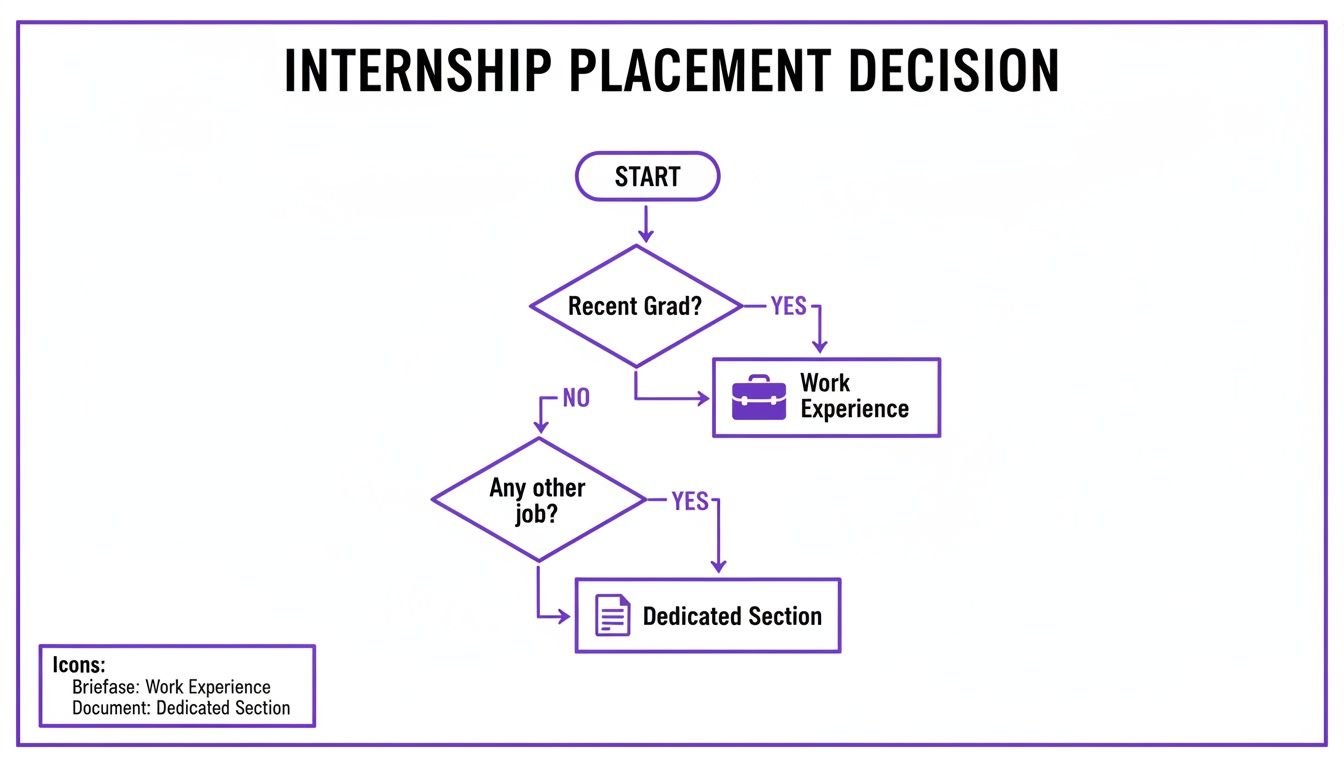
The main takeaway here? If your internship is relevant to the job you want, it belongs front and center in your work history. No exceptions.
Weaving Internships Into Your Work Experience
If you're a recent grad or just starting out, this isn't optional. Your internship is the proof that you can apply what you've learned in a real-world setting. It’s your single strongest piece of evidence.
Here’s what that looks like on the page:
- Title: Digital Marketing Intern
- Company: Creative Solutions Inc.
- Location: Austin, TX
- Dates: May 2023 – August 2023
Formatting it this way frames the internship as a serious role. You're telling employers that the skills you picked up are just as valid as those from any other job. Plus, this structure is exactly what resume-scanning software (the ATS) is built to understand.
When a Separate "Internships" Section Actually Works
While blending it into your main experience is the go-to move, there are a few rare cases where a dedicated "Internships" or "Relevant Experience" section is the smarter play.
The only time you should create a separate section is when you have a long, unrelated work history that could drown out a highly relevant internship.
This is a classic career-changer scenario. Imagine you have ten years in retail management but just finished a data analytics internship to break into tech. A separate section puts a spotlight on that internship, making it impossible for the hiring manager to miss. It prevents your most important qualification from getting lost in the shuffle.
If you’re thinking about how to best organize your resume for your specific situation, our guide on the best categories on a resume can help you figure out the optimal layout.
At the end of the day, it all comes down to clarity and impact. Just ask yourself: "Where can I put this so my most relevant experience is impossible to ignore?"
For over 90% of people, the answer is right inside the main work experience section. That’s how you give it the weight it deserves.
Writing Internship Bullet Points That Get Noticed

This is where the magic really happens. Your internship title gets a recruiter's attention, but your bullet points are what land you the interview.
I see it all the time—vague descriptions like "assisted with marketing campaigns" or "responsible for data entry." These are resume killers. They tell a recruiter what you were assigned to do, not what you actually accomplished.
To really stand out, you need to shift your mindset. Don't just list your duties; showcase your accomplishments. You weren't just a helper. You were a real contributor who delivered results, even if they feel small to you.
The Formula for Impactful Bullet Points
The best way I've found to frame your contributions is with a simple but powerful formula: Action Verb + What You Did + Quantifiable Result. This structure forces you to think about the outcome, transforming a boring statement into compelling proof of your skills.
Let's break that down.
- Action Verb: Start with a punch. Use dynamic words like Managed, Developed, Optimized, Launched, or Analyzed. Ditch the passive "Was responsible for…"
- What You Did: Get straight to the point. Briefly describe the project or task you owned.
- Quantifiable Result: This is the game-changer. Add a number, percentage, or specific outcome to show your impact. How much? How many? How often?
This simple change turns your resume from a list of chores into a portfolio of achievements. If you're looking for more ways to frame these wins, check out our guide on powerful resume accomplishments examples.
Finding Your Metrics
"But I don't have any numbers!" I hear this all the time, but trust me, the metrics are there if you know where to look. You don't need to have saved the company millions to prove your worth.
Think about the context of your work. Did you make a process better? Save someone time? Increase social media engagement? These all have hidden numbers.
Your goal isn't just to list tasks but to tell a story of contribution. Even if the numbers seem small, they provide concrete proof that you can deliver value, which is exactly what hiring managers are looking for.
Here are a few places to dig for those crucial metrics:
- Efficiency: Did you make something faster? "Streamlined the weekly reporting process, cutting manual data entry by 2 hours per week."
- Volume: How much work did you actually handle? "Processed and categorized over 500 customer feedback tickets using Zendesk."
- Engagement: Worked on social media? "Contributed to a content calendar that boosted Instagram engagement by 15% over one quarter."
- Scale: Who was your audience? "Developed a training presentation delivered to a team of 25 new hires."
Even if you can't find hard data, just showing that you think about results puts you leagues ahead of other candidates.
Weak vs Strong Internship Bullet Points
Seeing the formula in action makes all the difference. Let’s take a look at how to transform some weak, duty-focused bullet points into strong, achievement-oriented ones that recruiters will actually read.
| Industry | Weak Bullet Point (What you did) | Strong Bullet Point (How you made an impact) |
|---|---|---|
| Marketing | Was responsible for the company blog. | Authored 5 SEO-driven blog posts, which generated over 2,000 organic page views and increased web traffic by 10%. |
| Tech/IT | Helped with testing the new app. | Identified and documented 12 critical software bugs during UAT, improving application stability for a successful launch. |
| Finance | Assisted with financial reports. | Supported the finance team by preparing 15+ weekly expense reports with 100% accuracy, ensuring timely budget tracking. |
See the difference? The strong examples use specific numbers and powerful action verbs. They tell a clear story of what you accomplished and the value you brought to the team. This is exactly how you make your internship an undeniable asset on your resume.
Navigating Tricky Internship Scenarios
Let's be real—not every career path is a straight line. That's totally normal. Your work history, especially when you're starting out, might be a mix of short-term gigs, unrelated jobs, or even multiple stints at the same company. The secret to including these internships on your resume isn't about hiding the details; it's about framing them strategically.
The key is to present every single experience as a strength. Whether it was a quick two-week project or a summer job in a completely different field, you gained skills. Your job now is to connect the dots between those skills and the role you're targeting.
Framing Short-Term and Micro-Internships
The world of work is changing, and "micro-internships" or short-term projects are becoming more common. Don't ever discount these opportunities just because they were brief. The duration is way less important than the impact you made.
When you're listing a short-term role, cut right to the chase and focus on your achievements.
- Get Specific: Instead of a vague description, spotlight a key project. Think something like, "Completed a 2-week project analyzing competitor social media strategies, delivering a report that identified three new content opportunities."
- Show the Results: Quantify what you did, no matter how small it seems. Even a quick project can have a measurable outcome.
This approach shows you can get up to speed fast and deliver results on a tight deadline—a skill every hiring manager loves. In fact, some research on fake résumés showed that including just a two-week study abroad experience boosted interview requests by 5 percentage points, jumping from 19% to 24%. It just goes to show that recruiters value focused, impactful experiences. You can learn more about the study on global experience advantages.
Handling Internships Unrelated to Your Career Goals
So, you interned at a coffee shop but now you’re applying for a marketing analyst role. Don't just hit delete, especially if it's your only work experience. Instead, you need to mine that experience for the powerful, transferable skills that every employer is looking for.
Think beyond the job title. Your unrelated internship is proof of your work ethic, problem-solving skills, and ability to communicate with actual humans.
Focus on the skills that work in any industry:
- Customer Service: This is a goldmine for showing off communication, empathy, and grace under pressure. Frame it as "Resolved 20+ customer inquiries daily, maintaining a 95% satisfaction rating."
- Teamwork: Did you collaborate with coworkers to manage inventory or run a promotion? That's teamwork in action.
- Responsibility: If you handled cash or had keys to open the store, that shows you're trustworthy and reliable.
By highlighting these core professional skills, you prove you have the foundation to succeed anywhere. If you're really starting from scratch, our guide on how to write a resume with no experience has even more strategies.
Listing Multiple Internships at the Same Company
Did you go back to the same company for a second or third internship? That’s a huge win, and you need to show it off. It screams, "They liked my work so much, they brought me back!" You can format this to highlight your growth and the trust they placed in you.
The cleanest way to do this is to create one main entry for the company, then list each internship as a separate role underneath it. This keeps your resume from getting cluttered and clearly shows your progression.
Here’s how that looks:
TechForward Inc., San Francisco, CA (May 2022 – Aug 2023)
Software Engineering Intern (May 2023 – Aug 2023)
- Developed a new user authentication feature for the main mobile app, used by 100,000+ users.
- Collaborated with senior engineers to debug and resolve 15+ tickets in an Agile environment.
IT Support Intern (May 2022 – Aug 2022)
- Provided technical support to 200+ employees, resolving an average of 10 tickets per day.
- Authored documentation for common IT issues, reducing repeat support requests by 20%.
This structure instantly tells a compelling story of loyalty, growth, and a company that believed in you.
Common Internship Resume Mistakes and How to Fix Them
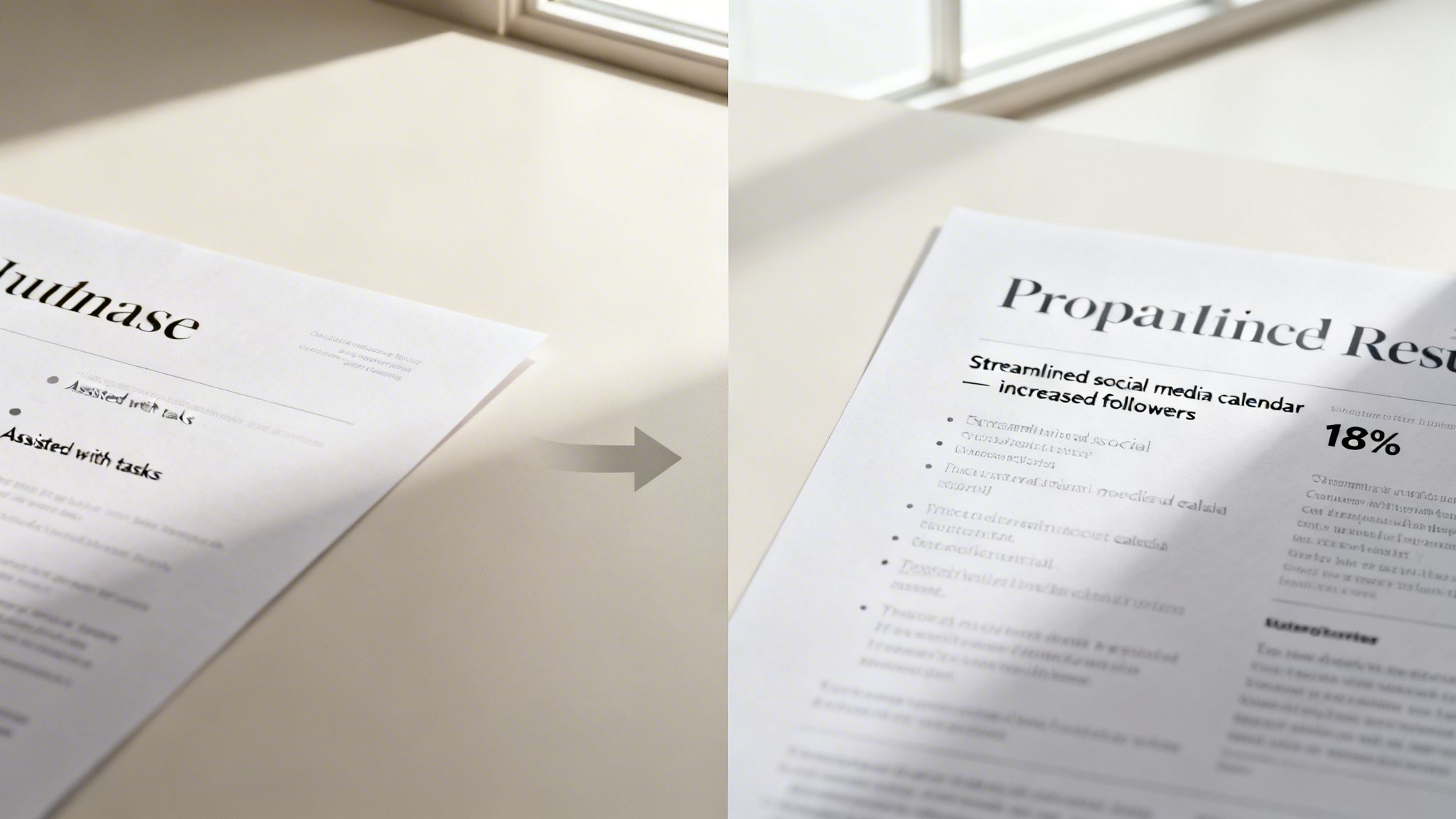
It’s one thing to land a great internship; it’s another to make it shine on your resume. Even the most incredible experience can get overlooked if it’s not presented well. Let's walk through some of the most common stumbles I see and, more importantly, how to fix them so your hard work actually gets noticed.
One of the biggest red flags? Passive, generic language. Phrases like "assisted with" or "was responsible for" are resume killers. They tell a recruiter what you were supposed to do, but say nothing about what you actually accomplished.
Another common misstep is burying your internship in the wrong section. Unless you have a long and winding career path that's totally unrelated, your internship belongs in your Work Experience section. Sticking it under "Education" makes it feel like just another class project instead of the real-world job it was.
Vague Descriptions Without Impact
Recruiters are scanning for results, not just a list of your duties. A bullet point that describes a task without showing the outcome is a massive missed opportunity. Your job is to prove your value, and the best way to do that is with cold, hard proof.
The Fix: Quantify everything. Seriously, everything you can. Instead of a bland "worked on social media," try something like, "Grew the company's Instagram follower count by 15% in just three months." Find those numbers that tell a compelling story about your impact.
Misunderstanding the Value of All Experience
Not everyone has the same access to internships. We know there are demographic gaps, with data showing that only 50% of first-generation students complete an internship, compared to 66% of their peers. For many, financial pressures are a real barrier. You can learn more about the changing landscape of internships in higher education. This makes it absolutely critical to document any and all experience you have.
The Fix: Don't ever write off an internship just because it was short or seems unrelated to your target role. Every experience teaches you something. Pull out those transferable skills—communication, problem-solving, time management—from every single role. Then, frame them in a way that directly aligns with the job you’re applying for now.
Think of your resume as a marketing document, not a historical transcript. Every single line should be there for a reason: to sell your skills for the specific job you want. If it doesn't strengthen that message, cut it.
By dodging these common mistakes, you can transform your internship entry from a simple list of tasks into a powerful showcase of your achievements. It's a small change in mindset that makes a world of difference to a hiring manager.
Frequently Asked Questions About Listing Internships
Even with the best game plan, a few tricky questions always pop up right when you're about to hit "send." I get it. You want to be sure every detail is perfect. Let's run through some of the most common "what ifs" I hear from job seekers.
Think of this as a final gut check to clear up any lingering doubts.
Should I Include an Internship From Several Years Ago?
This really comes down to where you are in your career right now.
If you've got 3-5 years of solid, full-time work under your belt, those old internships can probably come off. Your resume has limited real estate, and you want to use that space to showcase your most recent and impressive accomplishments.
But there's always an exception. Did you intern at a huge name in your industry, like Google or a major consulting firm? Or is that old internship perfectly aligned with the job you’re applying for now? If so, it might be worth keeping. Just ask yourself: does it add more value than my recent roles? If not, let it go.
Does It Matter if My Internship Was Unpaid?
Not one bit. And you should never mention whether you were paid or not on your resume.
The value of an internship comes from the skills you learned, the projects you worked on, and the results you helped create. The paycheck (or lack thereof) is completely irrelevant to a hiring manager.
Calling an experience "unpaid" can subtly devalue it in a recruiter's eyes. Treat it like any other professional role on your resume, because that's exactly what it was.
How Do I List an Internship That Is Still in Progress?
This one's easy. If you're still in the middle of your internship, just list the end date as "Present." For example: "June 2024 – Present." This tells recruiters that the role is current.
When it comes to your bullet points, use a mix of tenses:
- For ongoing tasks, use the present tense. (e.g., "Analyze market data and create weekly reports…")
- For specific projects you've already finished, use the past tense. (e.g., "Launched a social media campaign that increased follower engagement by 15%…")
This hybrid approach gives a really clear, up-to-the-minute picture of what you're doing.
Quick Pro-Tip: Whatever you do, don't list the same internship under both your "Education" and "Experience" sections. It's a waste of space and can confuse recruiters and the automated systems (ATS) that scan your resume. Pick one place—and for 99% of people, that place should be 'Work Experience.'
Can I Put an Internship in Both Education and Experience?
Please don't. It's a common mistake, but listing the same role twice just clutters your resume and can actually make your experience look thinner than it really is.
It creates redundancy and can even trip up the software that hiring managers use to scan applications.
Pick one spot and commit. By putting your internship in the Work Experience section, you're telling the world it was a real, professional role where you gained valuable, hands-on skills. Give it the credit it deserves.
Ready to stop juggling spreadsheets and start landing interviews? Eztrackr is your all-in-one job search command center. Save jobs, build your resume with AI, and track every application in a visual, easy-to-use dashboard. Try Eztrackr today and organize your job hunt.