How to Describe Yourself on a Resume to Stand Out
The best way to describe yourself on a resume isn't in a long, drawn-out paragraph. It's in a short, punchy statement right at the top—think of it as a Resume Summary or a bold Headline.
This little section, placed just below your contact info, is your elevator pitch. It’s your chance to immediately showcase your best skills, biggest wins, and the unique value you'd bring to this specific job.
Why Those First Few Words on Your Resume Are Everything

Let's be real. In today's job market, your resume has to get past two gatekeepers: first the Applicant Tracking Systems (ATS) that scan for keywords, and then a human recruiter with a mountain of applications to get through.
That initial human scan is lightning-fast. Most recruiters give a resume just 6-8 seconds of their time before deciding if it's a "yes" or a "no." This tiny window is why you absolutely have to put your most impressive, quantifiable achievements right at the top.
Recruiters consistently say that seeing measurable results upfront grabs their attention immediately. Vague lists of duties? Not so much. A statement showing you increased sales by 20%? Now you're talking.
The Power of a Strong Opening
Think of your self-description like a movie trailer. If the trailer is dull, nobody is going to stick around for the whole film—and in this case, the film is the rest of your carefully crafted resume.
A powerful opening does more than just list your skills. It instantly answers the hiring manager's biggest question: "So what? Why should I care?"
To get this right, you need to grab their attention in under eight seconds. Here’s a quick breakdown of what makes an intro work.
Elements of a High-Impact Resume Introduction
| Component | What It Is | Why It Works |
|---|---|---|
| Headline/Title | Your professional identity (e.g., "Senior Marketing Manager"). | Instantly tells the reader who you are and what you do. |
| Key Skills | 2-3 of your most relevant skills for the target role. | Aligns your qualifications directly with the job description. |
| Quantifiable Achievements | Your top accomplishments backed by numbers or metrics. | Provides concrete proof of your value and past success. |
| Keywords | Terms pulled directly from the job posting. | Helps you get past ATS filters and shows you're a match. |
A well-crafted introduction isn't just a summary; it's a hook. It validates your expertise from the first line and shows you’ve done your homework by aligning your profile with their needs.
Getting that initial impression right is a game-changer. For a deeper dive, check out these tips on how to write a resume that will actually get a recruiter's attention. Without that strong opening, even an amazing work history might never get a second look.
Choosing the Right Format: Headline, Summary, or Objective?
How you introduce yourself on a resume isn't just about the words you pick—it's about the format you use to deliver them. That top section of your resume is prime real estate, and deciding whether to use a headline, summary, or objective is the first critical choice you'll make.
Each one sends a different signal and is built for a specific purpose. Get this right, and you’ll immediately frame your story in a way that makes the recruiter lean in.
Think of it like this: a Resume Summary is your career’s highlight reel. A Resume Headline is the bold, punchy title of your professional story. And an Objective? That’s a clear statement about the future you’re aiming to build. Your choice tells a recruiter where you are in your career before they even get to the details.
The Resume Summary: Your Professional Highlight Reel
If you’ve got some solid experience under your belt, the resume summary is your best friend. This isn't the time for modesty. It's a tight, 3-4 line paragraph that puts your biggest wins and core skills front and center, showing exactly what value you bring to the table. It’s all about drawing from your proven successes to make a powerful promise about future performance.
A great summary cuts right to the chase and answers the hiring manager’s biggest question: “Why should I even consider this person?” It does this by leading with quantifiable results.
- Who it’s for: Professionals with 2+ years of relevant, solid experience.
- What it does: Boils your entire career narrative down into a potent pitch that focuses on past accomplishments.
- Example: "Data-driven Marketing Manager with 8+ years of experience leading high-growth B2B SaaS campaigns. Grew lead generation by 45% in 18 months by overhauling the content strategy and rolling out marketing automation. Expert in SEO, PPC, and team leadership focused on one thing: driving measurable revenue."
The Resume Headline: A Bold and Direct Title
A resume headline is exactly what it sounds like: a short, sharp title that sits right under your name and contact info. It’s the perfect tool for specialists or anyone making a career change because it immediately clarifies your value. No fluff, no guesswork.
This format works wonders when your last job title doesn't quite match the role you’re targeting. It lets you reframe your entire professional identity in a single, powerful line.
A headline like "Certified Scrum Master & Agile Project Manager" instantly screams expertise. A generic job title just doesn't have the same punch. This is your chance to define yourself on your own terms.
The Career Objective: A Forward-Looking Statement
Let’s be honest: the career objective has mostly been pushed aside in favor of the summary. But it isn't completely obsolete. An objective is a 1-2 sentence statement that zeros in on your career goals and what you hope to do in this specific role.
For recent grads or people making a major career pivot, a well-crafted objective can signal ambition and genuine interest. The key is to avoid sounding self-serving. You have to connect your personal goals directly to the company's needs. If you fall into this camp, check out our guide on how to write a resume objective that actually resonates with hiring managers.
How to Write a Resume Summary That Actually Gets Read
Alright, you've decided a resume summary is the right move. Now, how do you write one that doesn't just take up space but actively works for you?
Think of your summary as your professional highlight reel, condensed into 3-4 powerful lines. Its only job is to make a recruiter pause, lean in, and think, "Okay, this person knows what they're doing." It's not about fluff; it's about connecting your skills directly to what the employer desperately needs.
The best summaries aren't written by chance. They follow a simple, yet incredibly effective formula designed to pack a punch and get you past both the bots and the humans.
The Go-To Formula for a High-Impact Summary
The recipe for a killer resume summary is surprisingly straightforward. It’s all about mixing four key ingredients to cook up a short, powerful story that tells recruiters exactly who you are and what you can do for them.
Here's the breakdown:
- Your Title & Experience: Lead with your professional title and years in the game. For example, "Senior Digital Marketer with 8+ years of experience…" This immediately sets the stage for your expertise.
- Your Core Skills: Name-drop 2-3 of your most important skills, making sure they're the ones plastered all over the job description. These are your essential keywords.
- Your Quantifiable Wins: This is the big one. Add a hard-hitting, number-backed accomplishment. Think something like, "…grew organic traffic by 40% in one year…"
- Your Value Proposition: Wrap it up by explaining how you’ll use those skills to help them. For instance, "…specializing in driving lead generation and boosting ROI through data-driven SEO strategies."
This structure takes your intro from a sleepy list of job duties to an active, can't-ignore pitch. For a deeper dive, check out our guide on what to include in a resume summary.
Stop Listing Duties. Start Showcasing Achievements.
This is the most common mistake I see, and it’s a resume killer. Nobody cares that you were "responsible for managing social media." They want to know if you blew up the follower count, drove a ton of engagement, or generated actual sales from your posts.
It's time to put on your detective hat and dig for the numbers. Even if you weren't in sales, the metrics are there. Did you make a process more efficient? Talk about the time saved (e.g., "Slashed report generation time by 15% by automating data entry"). Did you improve a workflow? Measure the increase in output.
Every single job has metrics. Your mission is to find them. Just ask yourself: "How did I make things better, faster, or cheaper?" The answer to that question is where your most powerful summary statements are hiding.
Making this simple shift from responsibilities to results is what separates a resume that gets a call from one that gets deleted. It gives them cold, hard proof of your value.
Weaving in Keywords to Beat the Bots
Let's be real: your resume has to impress a robot before it ever gets to a human. With a staggering 82% of job seekers worried about AI tossing their resume in the digital trash can, you can't afford to ignore keywords.
The trick is to make it sound natural. Carefully scan the job description and pull out the top 3-5 must-have skills and qualifications. These are your golden keywords.
Now, sprinkle them into your summary where they fit organically. It's not just about listing skills; it's about context. Understanding how to list skills on your resume properly is a huge piece of this puzzle. It ensures the skills you highlight in your opening summary are presented in a way that both the Applicant Tracking System (ATS) and the hiring manager can easily digest.
Tailoring Your Introduction for Each Application
Sending out the same generic resume for every single job application is probably the fastest way to get your application tossed in the “no” pile. Seriously. You have to think of your resume summary as a laser-targeted message, not a generic billboard you’ve put up on the side of a highway.
A one-size-fits-all introduction screams that you're just spamming applications, not that you're genuinely interested in this specific role.
The whole point is to craft a punchy, customized opening that speaks directly to the needs you see in the job description. Doing this turns your resume from a boring history lesson into a compelling pitch for why you are the perfect solution to their problem. It’s your first and best chance to show you’ve actually read the description and understand what they’re looking for.
Deconstructing the Job Description
Before you even think about writing, put on your detective hat. Your first job is to dissect the job description and hunt for clues that reveal what the employer really cares about.
Your mission, should you choose to accept it, is to pinpoint the most critical requirements. Scan for keywords that keep popping up, specific software they mention, and the top responsibilities they list. You want to isolate the top 3-5 absolute must-haves—these are the pillars you'll build your entire summary around.
Let's say you're looking at a marketing role, and you see "SEO strategy," "lead generation," and "HubSpot" mentioned over and over. Boom. Those are your golden keywords. A bland summary that just says "digital marketing" isn't going to grab anyone's attention. Your tailored version needs to hit those exact terms.
This simple flow shows how to connect the dots between the job's needs, your skills, and your accomplishments to create a summary that actually works.
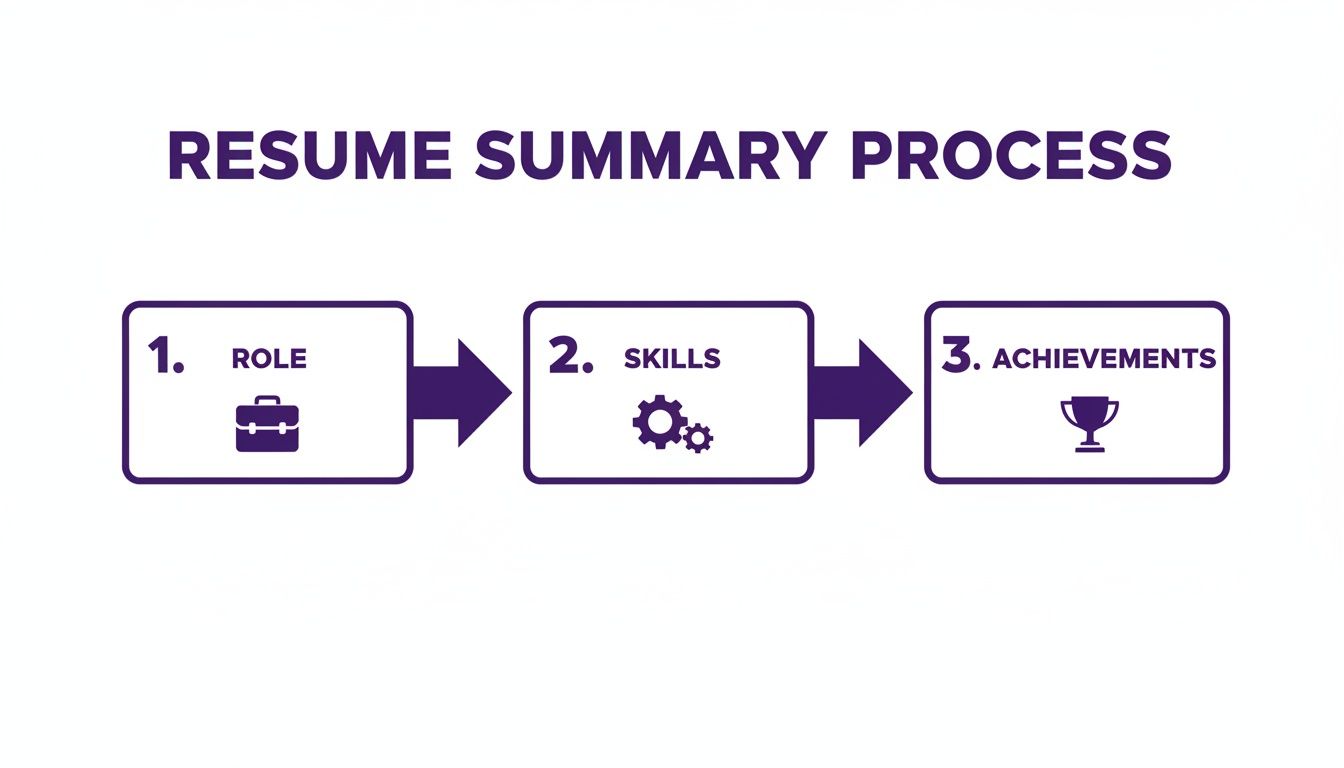
As you can see, it all starts with the target role. You use its required skills as a filter to pick out your most relevant achievements.
Mapping Your Achievements to Their Needs
Once you’ve got your target keywords, the next move is to connect them directly to your own accomplishments. Think of it like a matching game. For every keyword you pulled from the job description, find a specific, measurable achievement from your career that proves you’ve mastered it.
Let's put this into practice with that marketing role example.
Generic Summary (Before):
"Experienced marketing professional with a background in digital campaigns and team leadership. Skilled in various marketing tactics and dedicated to achieving company goals."
Honestly? It’s forgettable. It could be anyone. Now, let’s inject our keywords ("SEO strategy," "lead generation," "HubSpot") and tie them to real, tangible results.
Targeted Summary (After):
"Senior Marketing Manager with 8+ years of experience driving B2B lead generation. Proven expert in developing and executing data-driven SEO strategy that increased organic traffic by 45%. Proficient in HubSpot for marketing automation, contributing to a 20% increase in qualified leads."
See the difference? The "after" version is so much more powerful because it directly mirrors the language from the job description and, more importantly, backs it all up with hard numbers. This is exactly how you make an impression.
If you want to dive deeper, we have a whole guide on perfecting your resume and job description match. That little bit of extra time you spend tailoring each application is what dramatically boosts your chances of actually getting that first call.
Real-World Examples for Different Professions
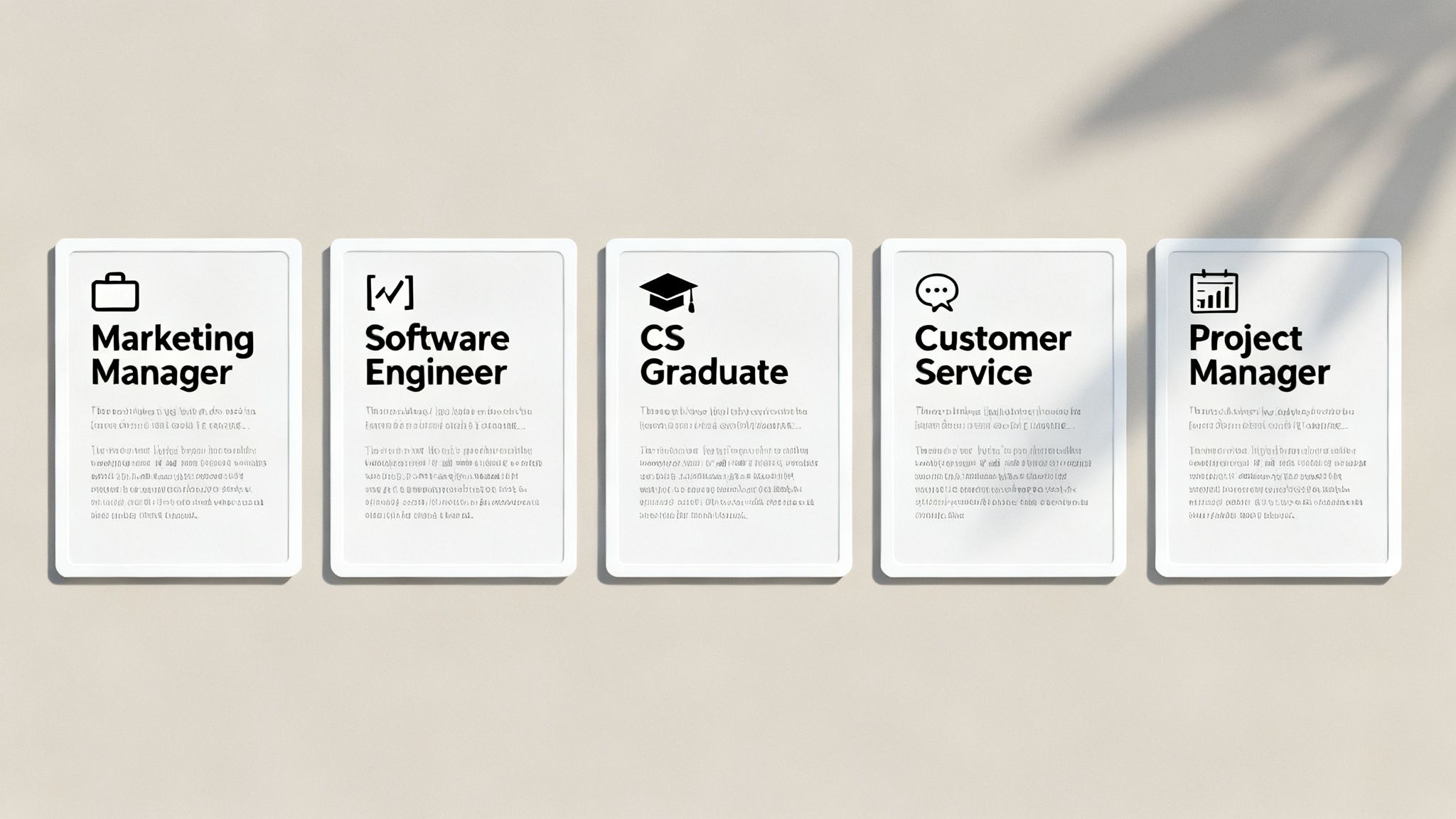
Theory is great, but seeing how this all works in practice is what really counts. Let's break down that formula with some specific, annotated examples from a few different industries and experience levels.
Think of these as a framework you can adapt to build your own standout professional story. Each one is designed to be short, sharp, and packed with the right keywords and metrics to get a recruiter's attention.
Marketing Manager Example
For a marketing manager, your summary needs to scream results. Vague claims about "brand awareness" just won't fly. You have to connect your work to tangible outcomes like lead generation, conversion rates, and, most importantly, revenue.
Example: "Data-driven Marketing Manager with 8+ years of experience developing and executing high-impact digital campaigns for B2B SaaS companies. Grew marketing-qualified leads (MQLs) by 45% in 18 months by overhauling content strategy and implementing marketing automation. Expert in SEO, PPC, and team leadership, focused on driving measurable ROI."
Why It Works:
- Quantifiable Results: It kicks off with a massive number (45% MQL growth).
- Industry Keywords: It's loaded with relevant terms like "B2B SaaS," "SEO," and "PPC."
- Value Proposition: The summary clearly links actions to the ultimate business goal: driving measurable ROI.
Software Engineer Example
If you're in a technical role like software engineering, your summary should immediately highlight your tech stack, the impact of your projects, and your problem-solving chops. You need to show that you don't just write code—you build solutions that work, scale, and solve real business problems.
Example: "Senior Software Engineer with 6 years of experience in full-stack development, specializing in Python, React, and AWS. Architected and launched a new microservices-based platform that improved system uptime to 99.9% and reduced page load times by 30%. Passionate about writing clean, scalable code and mentoring junior developers."
Why It Works:
- Specific Tech Stack: It gets straight to the point with core technologies (Python, React, AWS).
- Project Impact: It directly connects technical work to business outcomes (99.9% uptime, 30% speed increase).
- Shows Soft Skills: The mention of mentoring is a huge plus, signaling leadership potential.
Recent Computer Science Graduate Example
Don't have years of professional experience under your belt? No problem. If you're a recent grad, your objective needs to lean heavily on your academic projects, technical skills, and a genuine, specific desire to contribute to the company's mission.
Your goal as a grad is to sell your potential. Frame your academic work and internships as real-world experience, showing you have the foundational skills and drive to learn quickly and make an impact from day one.
Example: "Driven and detail-oriented Computer Science graduate with a strong foundation in Java, C++, and database management. Developed a full-stack e-commerce application for a senior capstone project, demonstrating expertise in both front-end and back-end development. Eager to apply my problem-solving skills and passion for software engineering to contribute to innovative projects at [Company Name]."
Why It Works:
- Highlights Projects: It cleverly uses a capstone project to demonstrate practical, hands-on skills.
- Tailored to the Company: Including the company's name shows you've done your homework and aren't just spamming applications.
- Focuses on Eagerness: The language conveys ambition and a readiness to hit the ground running.
Project Manager Example
For project managers, everything comes down to delivering on time and on budget. Your summary must showcase your methodology, the scope of projects you've handled, and your knack for leading a team to a successful outcome.
For a deeper dive into this specific field, our guide on construction project manager resume examples has a ton of extra insights.
- Example: "PMP-certified Project Manager with over 10 years of experience leading cross-functional teams to deliver complex IT projects on schedule and 15% under budget. Successfully managed a $2M software implementation, coordinating with stakeholders across three departments. Expert in Agile methodologies and risk mitigation."
Now that you've seen the formula in action, here are a few quick templates you can adapt for your own role.
Role-Specific Resume Summary Templates
This table provides some plug-and-play snippets to get you started. Just swap in your own details!
| Role | Summary Example Snippet | Key Elements Highlighted |
|---|---|---|
| Sales Representative | "Results-driven Sales Rep with 5+ years of experience exceeding quotas by an average of 25% quarterly. Expert in solution selling and CRM…" | Achievement (25% over quota), Specialty (solution selling), Keywords (CRM) |
| Graphic Designer | "Creative Graphic Designer with 7 years of experience in branding and digital media. Led a rebrand that increased user engagement by 40%…" | Title + Years, Value (40% engagement), Specialty (branding) |
| Registered Nurse | "Compassionate RN with 4 years of experience in fast-paced ER settings. Managed a 12-patient caseload while maintaining a 98% patient satisfaction…" | Value (patient care), Achievement (98% satisfaction), Specialty (ER) |
| Accountant | "CPA with 10+ years of experience in corporate finance. Identified $500K in annual cost savings through process optimization. Proficient in…" | Title + Years, Achievement ($500K savings), Keywords (CPA, finance) |
Use these examples not as a strict script, but as inspiration. The key is to grab the recruiter's attention instantly by proving your value with hard numbers and relevant skills.
Don’t Make These Resume-Killing Mistakes
Crafting that perfect little self-description is as much about what you leave out as what you put in. It's surprisingly easy to sabotage your chances with a few small, avoidable slip-ups. I've seen even the most qualified candidates turn a powerful summary into a forgettable one with these simple blunders.
The biggest trap? Relying on tired, overused buzzwords. Phrases like "team player," "results-oriented," or "hard worker" have been seen so many times they've lost all meaning. They're just generic filler that says absolutely nothing specific about you. Don't tell them you're a "go-getter"—show them with a hard-hitting achievement.
Focusing on Duties Instead of Wins
This one is critical. So many people just list their old responsibilities. A recruiter scanning your resume doesn't care that you were "responsible for managing social media." They want to know if you grew the audience by 30% or if you increased engagement by launching a killer new video series.
You have to shift your mindset from what you did to what you achieved.
- Don't say: "Managed the company blog."
- Do say: "Revitalized the company blog, increasing monthly readership by 5,000 through targeted SEO and content promotion."
See the difference? That simple change transforms your summary from a passive, boring job description into an active showcase of your impact.
The golden rule is to show, not just tell. Every claim you make about your skills needs to be backed up by a specific example or a number. It's the difference between being ignored and being irresistible.
Overlooking the Small Stuff: Proofreading and Conciseness
Finally, a couple of seemingly minor mistakes can have a massive impact: typos and length. A single spelling or grammar mistake screams "I don't pay attention to detail," which is a huge red flag for pretty much any job. Always, always read your summary out loud and get a second pair of eyes on it.
Your summary also needs to be tight—no more than four lines. A long, rambling paragraph is an instant skip for a busy recruiter. Keep it sharp, focused, and packed with value. Your goal is to deliver a powerful punch in just a few seconds.
Ready to build a resume that avoids these mistakes and gets you noticed? The AI-powered tools from Eztrackr, including our resume builder and skill-match analyzer, help you craft a professional and impactful application every time. Get started for free at https://eztrackr.app and land your next opportunity faster.