What Is a Professional Portfolio? what is professional portfolio and Build It
Think of your resume as a list of ingredients. It tells a potential employer you have flour, sugar, and eggs. Your professional portfolio? That's the finished, three-tiered cake, complete with photographic evidence. It’s the tangible proof that you know exactly what to do with those ingredients.
Your Career Highlight Reel Explained
A professional portfolio isn't just a scrapbook of old projects; it's a strategic, curated collection of your best work that shows off what you can actually do.

Relying on a resume alone is like trying to convince someone you’re a great filmmaker by just showing them a list of camera equipment. It doesn't work. The resume tells them about your skills and experience, but the portfolio shows them.
It’s your personal gallery, a highlight reel of your career’s greatest hits. This can be anything from design mockups and code repositories to marketing campaign results and published articles. It’s your evidence locker, proving you can deliver on the promises your resume makes. A powerful portfolio is also a cornerstone when you want to build a strong personal brand, making you memorable to recruiters and hiring managers.
Why It’s A Non-Negotiable Tool Today
The job market has changed. Big time. Employers are ditching old-school metrics like GPA and are now laser-focused on what you can bring to the table right now. This shift toward skills-based hiring makes a portfolio absolutely essential.
In fact, according to the NACE Job Outlook Report, only 42% of employers plan to screen candidates by GPA anymore. That's a massive drop from 73% back in 2019. The message is loud and clear: companies care more about what you can do than where you studied. A portfolio speaks directly to that need.
Your portfolio is your silent advocate, working behind the scenes to validate your skills. It answers the crucial question on every recruiter's mind: "Can this person actually do the job?"
Resume vs Portfolio At a Glance
So, how do these two documents fit together? They aren't in competition; they're a tag team. Each one has a distinct job to do in your application strategy.
Let's break down the key differences to see how they complement each other.
| Attribute | Resume | Professional Portfolio |
|---|---|---|
| Purpose | To summarize your professional history and qualifications in a concise, text-based format. | To showcase tangible proof of your skills and accomplishments through real-world examples. |
| Content | Bullet points detailing job responsibilities, skills, education, and work experience. | A curated collection of your best projects, case studies, testimonials, and work samples. |
| Focus | Tells the recruiter what you have done in the past. | Shows the recruiter what you are capable of doing in the future. |
| Format | Typically a one or two-page text document (PDF). | A digital website, a presentation deck, or a physical book with visual and descriptive content. |
In short, your resume gets your foot in the door, but your portfolio is what closes the deal. It gives hiring managers the confidence to move you to the top of the "yes" pile.
The Core Components of a Winning Portfolio
A truly great professional portfolio is more than just a collection of your work. Think of it as building a compelling case for why you're the right person for the job, with each piece playing a specific, strategic role. It's not about checking off boxes; it's about telling your career story in a way that resonates with a hiring manager.
Let's break down the essential elements that work together to make your portfolio convincing.
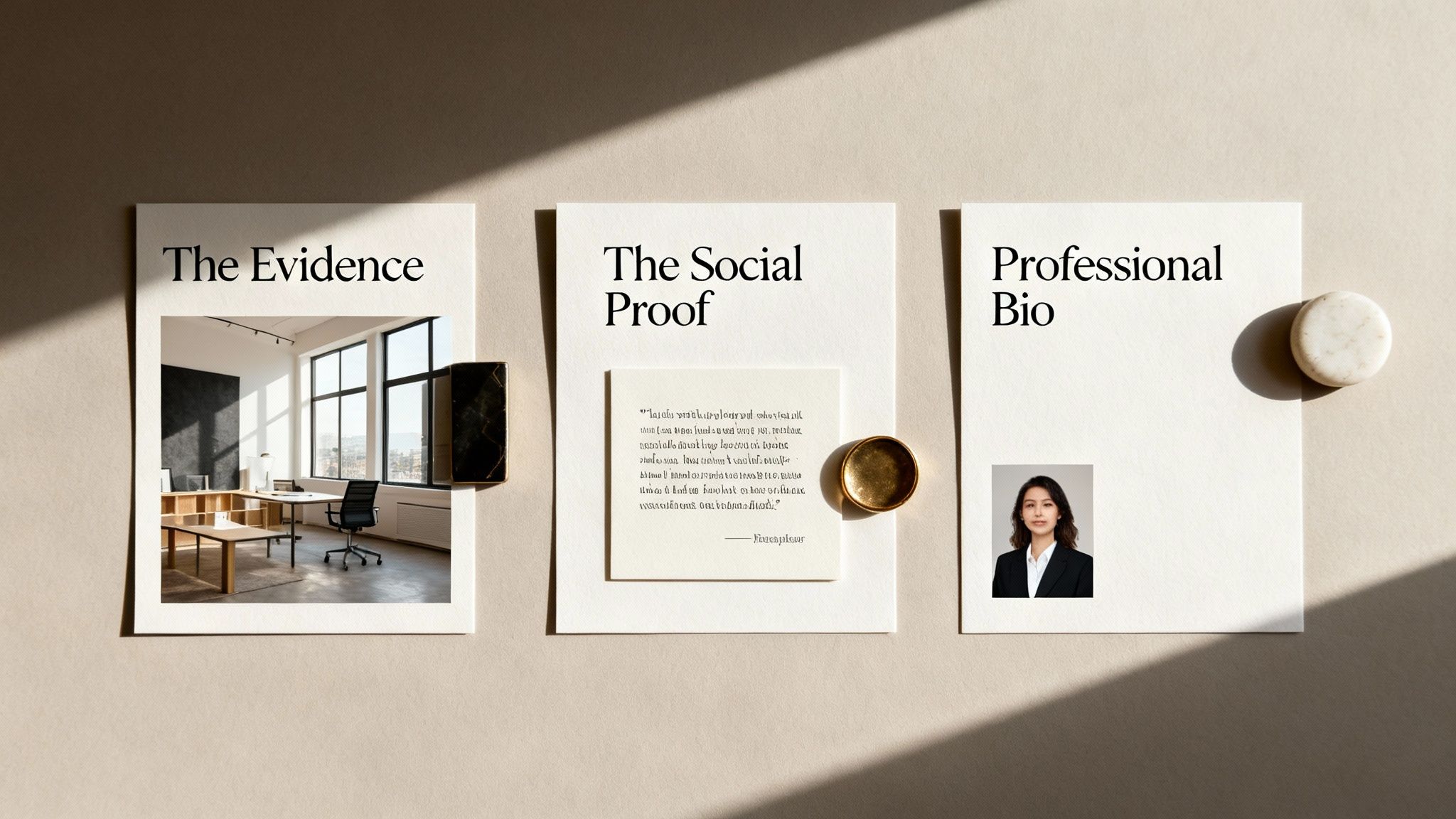
Each of these parts has a job to do. When you understand how they fit together, you can build a portfolio that doesn’t just show what you've done—it actively argues on your behalf, leaving a lasting impression.
The Evidence: Your Work Samples
This is the main event. Your work samples are the hard proof that you can actually do what your resume claims. If you say you're a killer graphic designer, this is where you show off those brilliant logos and branding projects.
But don't just dump everything you've ever created. Be selective. Pick 3-5 of your absolute best projects that line up with the kind of roles you're chasing. When it comes to your portfolio, quality always beats quantity.
And remember, context is king. Don't just show the finished piece. Tell the story behind it. Briefly explain the problem you were trying to solve, what your specific role was, and how you knocked it out of the park. That little bit of narrative turns a simple image into a powerful case study of your skills.
The Social Proof: Testimonials and Recommendations
Your work is the evidence, but testimonials are the validation from a trusted source. There's a reason social proof is so powerful—when other people sing your praises, it builds instant credibility. A fantastic quote from a former boss or a happy client can often say more than you ever could about yourself.
Aim for testimonials that are specific and talk about results. "They were great to work with" is nice, but "Their marketing campaign boosted our leads by 40% in just one quarter" is what really gets attention.
A well-chosen testimonial acts as a third-party endorsement, confirming that you not only have the skills but can also apply them effectively in a real-world setting to deliver tangible value.
You can sprinkle these endorsements near the relevant work samples or gather them on a dedicated "Praise" page. Even screenshots of positive feedback from emails or performance reviews can work wonders (just make sure you get permission first!).
The Narrative: Your Professional Bio and Resume
Your professional bio or "About Me" section is your chance to make a personal connection. It's where you introduce yourself, share your professional mission, and let your personality shine through. This isn't a boring recap of your job history; it's a tight, engaging story that ties your skills, passion, and career goals together.
To round out the story, make sure you include a link to your up-to-date resume. Your portfolio shows the what, but your resume provides the chronological when and where. To get this foundational piece just right, check out our guide on what to include in a resume summary for some pro tips.
By combining concrete evidence, credible social proof, and a compelling personal narrative, you give hiring managers a complete picture of who you are and the incredible value you’re ready to bring to their team.
Choosing the Right Showcase for Your Work
How you present your portfolio is just as important as what’s inside it. Think of it like this: a world-class musician wouldn't play a gig in a noisy subway station if they could book a legendary concert hall. The right venue changes everything.
Choosing your portfolio’s "stage" is a strategic move. It hinges on your industry, your career goals, and the story you’re trying to tell. A format that’s perfect for a software developer might completely miss the mark for a graphic designer. Your mission is to find a showcase that not only makes your work look great but also clicks with how your industry operates.
Personal Websites: The Ultimate Brand Control
A personal website is your own digital headquarters. It’s a space you own, top to bottom. This gives you total freedom to craft a design, layout, and user experience that is 100% you. You control the narrative from start to finish.
This is the go-to option for creatives, marketers, and consultants—anyone who needs to build a strong, memorable brand. It sends a clear signal of professionalism and serious dedication. If you're going this route, it's smart to check out some good portfolio website builders to see what's possible. Plus, you get a permanent, professional URL to put on your resume, email signature, and social profiles.
Of course, with great power comes some responsibility. Building and maintaining a site takes time and, occasionally, a small investment for hosting and a domain name.
Dedicated Platforms: The Industry-Standard Stages
For many fields, specialized platforms are simply the standard. These sites are built for specific needs and already have a built-in audience of peers, hiring managers, and recruiters who know exactly where to look for top talent.
- For Creatives (Designers, Artists, Photographers): Platforms like Behance and Dribbble are visual playgrounds. They’re built to show off high-resolution work and get you noticed by creative directors.
- For Developers and Programmers: A clean, active GitHub profile is non-negotiable. It’s a living, breathing portfolio of your coding skills, how you collaborate, and the way you solve problems.
- For Writers and Journalists: Sites like Contently or even a polished blog on Medium are fantastic for displaying your articles and establishing yourself as a thought leader.
Using an industry-standard platform shows recruiters you get it. You speak their language. It makes it way easier for them to size up your skills in a context they already know and trust.
LinkedIn: The Dynamic, Living Portfolio
Finally, don't sleep on your LinkedIn profile. It’s no longer just an online resume; it has morphed into a dynamic, interactive portfolio. The "Featured" section, in particular, is prime real estate to show off your greatest hits.
You can link to your personal website, upload PDF case studies, share slide decks, or connect to published articles. This transforms your profile into a one-stop shop for anyone curious about what you can do. To really make it shine, learn how to optimize your LinkedIn profile and draw in the right people. It’s incredibly effective because recruiters are already on the platform every single day, making your best work easy to find.
A Step-by-Step Guide to Building Your Portfolio
The idea of building a professional portfolio can feel massive, but it's really just a series of small, manageable steps. Let's break it down into a clear roadmap you can start on today, transforming that pile of accomplishments into a powerful career tool.
The goal here is simple: build a compelling business case for why someone should hire you.
The whole process starts not with your work, but with your audience. Before you pick a single project, you have to know who you’re trying to impress and what you want them to do. Are you trying to catch the eye of a scrappy startup that lives for innovation, or an established corporation that values reliability above all else?
Answering that question is everything. A portfolio for a creative agency will look and feel completely different from one aimed at a financial services firm.
Define Your Audience and Goals
Think of yourself as a marketer. Your skills are the product, and your portfolio is the ad campaign. And any good campaign starts with a deep understanding of the target customer.
Your #1 job is to answer the viewer's biggest question: "Why should I hire you?" Every single thing in your portfolio should work together to provide a clear, convincing answer.
To get started, ask yourself these questions:
- Who am I actually talking to? (Recruiters, hiring managers, potential clients?)
- What industry am I targeting? (Tech, healthcare, marketing?)
- What specific roles do I want? (Senior Project Manager, UX Designer?)
- What is the one thing I want them to remember about me? ("I drive results," or "I'm a creative problem-solver.")
Your answers will shape every decision you make, from the projects you feature to the words you use. This isn't just a scrapbook—it's a precision-targeted marketing tool.
Curate Your Absolute Best Work
Now that you know your audience, it's time to choose your content. This is not the place for every project you've ever touched. You need to be ruthless. Only pick the pieces that scream "this is what I'm capable of" and align perfectly with your goals.
Always remember: quality over quantity. A tight portfolio with five killer, relevant projects is infinitely more powerful than a sprawling one with twenty mediocre examples. You're showing off the peak of your abilities, not your entire work history.
Your chosen projects should hit these three marks:
- Relevance: It directly relates to the skills needed for the jobs you want.
- Impact: It achieved real, measurable, positive results.
- Pride: It's work you are genuinely proud to put your name on.
This collection becomes the undeniable proof that you have what it takes to solve your future employer's problems.
Write Compelling Project Descriptions
Showing your work is one thing, but you have to give it context. Every project needs a short, compelling description that tells its story. This narrative is what turns a static image or a boring document into a dynamic case study of what you can do.
A fantastic framework for this is the STAR method:
- Situation: Briefly set the scene. What was the challenge?
- Task: What was your specific goal or responsibility?
- Action: What exact steps did you take to get it done?
- Result: What was the outcome of your actions?
Using this structure forces you to focus on results—which is exactly what hiring managers are looking for. It makes your contributions crystal clear. While you're crafting these stories, don't forget that a polished resume is still a must-have. You can find some of the best free resume builders available online to make sure it's just as sharp as your portfolio.
Quantify Your Achievements with Data
In today's job market, vague claims are just noise. The single most powerful way to make your portfolio pop is to back up your achievements with cold, hard data. Numbers turn a simple claim into undeniable proof.
Quantifying what you've done isn't optional anymore. A weak statement like "managed a project" becomes instantly impressive when you rephrase it as "oversaw a $500K project budget, boosting revenue by 25%." This approach is crucial in an era of skills-based hiring, where 70% of employers now demand proof of ability. You can find more great tips on how to strategically update your professional portfolio with metrics on Her Agenda.
By translating your accomplishments into numbers—percentages, dollar amounts, or time saved—you provide concrete proof of the value you deliver. It makes it dead simple for a hiring manager to see the tangible return they'd get by bringing you on board.
Portfolio Examples Across Different Industries
The core ideas behind a professional portfolio are universal, but what they look like in the wild? That changes dramatically from one field to the next.
The best portfolios aren't generic, one-size-fits-all documents. They're carefully tuned to speak the specific language of an industry, showing off the exact skills and results that a hiring manager in that world is dying to see. What a marketing director needs to prove is worlds away from what a software engineer needs to show.
Let's make this real. We'll walk through what a standout professional portfolio looks like in a few different careers. Think of this as a blueprint to help you figure out what to prioritize and how to frame your own work for the biggest impact.
For Creatives and Designers
If you’re a graphic designer, photographer, or UX/UI pro, your portfolio isn't just part of the application—it is the application. It's a visual feast where style and function have to shine. Your goal is to create an experience that shows off not just your technical chops, but your unique creative vision.
- Key Focus: Visual impact, process demonstration, and project storytelling.
- Essential Content: High-res images of final projects, sketches, wireframes, and quick case studies explaining the "why" behind your design choices.
- Best Platforms: A custom website is ideal, but Behance and Dribbble are also industry standards.
A UX designer, for instance, might show an app redesign with before-and-after screens, user flow diagrams, and hard data proving a 20% increase in engagement. That blend of beautiful visuals and concrete results is what separates the good from the great.
For Developers and Engineers
In the tech world, code is king. A developer’s portfolio has one primary job: prove you can write clean, efficient, and functional code. It’s less about flashy design and more about showing off your problem-solving brain and technical expertise in a way that’s easy to understand.
- Key Focus: Code quality, project functionality, and problem-solving skills.
- Essential Content: Links to live demos, well-documented code on a platform like GitHub, and descriptions of the technical hurdles you overcame.
- Best Platforms: GitHub is non-negotiable, often paired with a personal website to showcase projects.
A solid developer portfolio could feature a link to a web app they built from scratch, complete with a detailed README file on GitHub explaining the tech stack and architecture. That transparency lets a technical recruiter dig in and see what you're really made of.
For Marketers and Strategists
Marketing is all about results. Period. If you work in this field, your portfolio needs to be a data-driven story of your success. It must draw a straight line from your actions—like campaigns, strategies, or content—to real business outcomes like more leads, higher revenue, or stronger brand awareness.
The most effective marketing portfolios are not just a collection of pretty ads; they are a series of business case studies. Each project should answer the question, "How did your work move the needle for the business?"
This infographic nails the essential steps for building any great portfolio, no matter your industry.
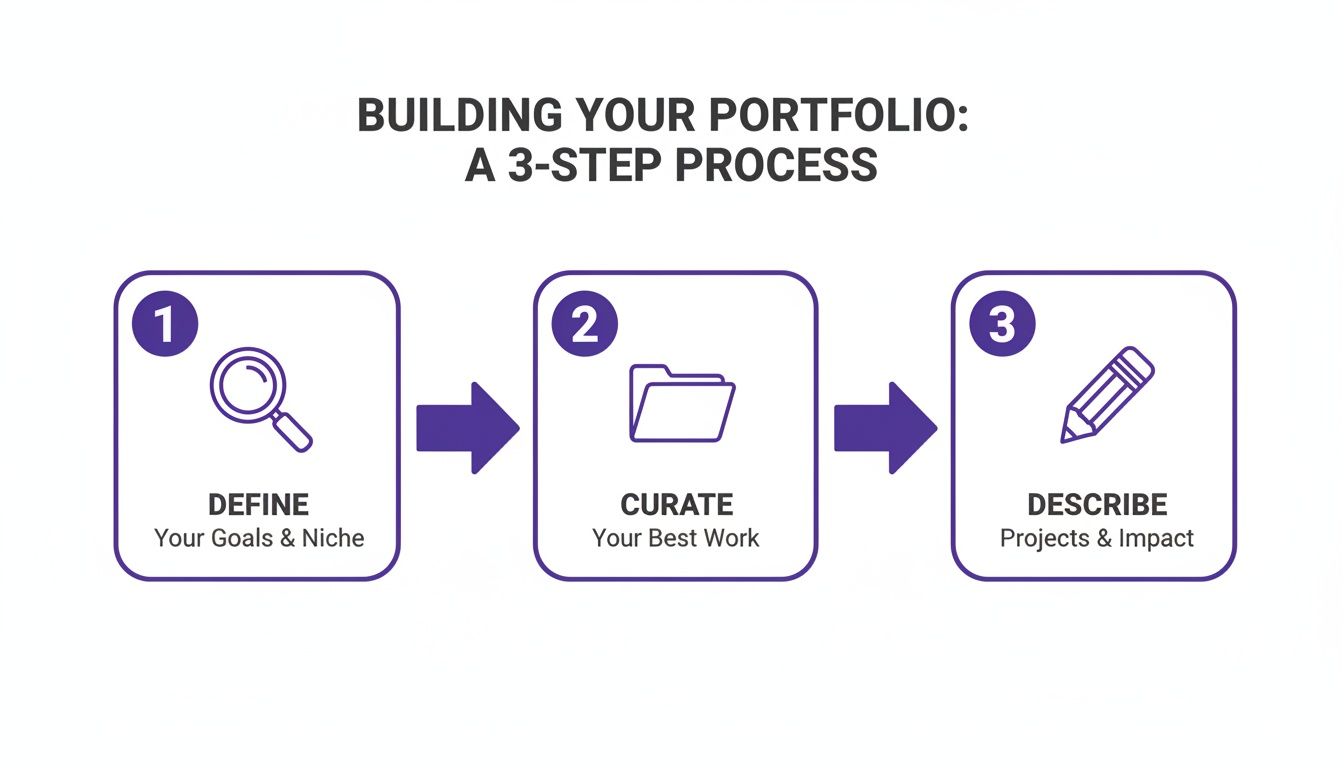
The process is clear: defining your audience and curating your best work are the critical first steps. A marketer might show a campaign that led to a 150% increase in qualified leads, presenting the ad creative, the targeting strategy, and the analytics dashboard that proves the ROI.
For Writers and Content Creators
For writers, editors, and content strategists, the words are the work. Your portfolio has to prove you have a command of language, a flexible style, and the skill to connect with a specific audience. It's all about showing your versatility and a deep understanding of tone and purpose.
A great approach is to organize your work by type. This makes it easy for potential clients or employers to find what they’re looking for.
- Blog Posts and Articles: To show off your research and storytelling abilities.
- Ad Copy or Social Media Posts: To prove you can write concisely and persuasively.
- White Papers or Case Studies: To showcase your talent for deep-dive analysis and long-form writing.
Always add a brief description for each piece. Explain the client's goal and who the target audience was. This little bit of context adds so much value and makes your work far more impressive.
To give you an even clearer picture, here’s a quick-glance guide for a few key professions.
Industry-Specific Portfolio Blueprint
This table breaks down what matters most for different roles, helping you focus your efforts where they'll have the most impact.
| Profession | Key Focus | Essential Content | Recommended Platform |
|---|---|---|---|
| Graphic Designer | Visuals & Process | High-res projects, case studies | Custom Website, Behance |
| Software Developer | Code & Functionality | GitHub repos, live demos | GitHub, Personal Site |
| Digital Marketer | Results & ROI | Campaign data, case studies | Custom Website, PDF |
| Writer/Editor | Quality & Versatility | Organized writing samples | Custom Website, Contently |
| Photographer | Style & Technique | Curated photo galleries | Custom Website, Instagram |
| Project Manager | Process & Outcomes | Project plans, success metrics | Custom Website, PDF |
Think of this as your starting point. The key is to adapt these guidelines to your unique experience and the specific jobs you're targeting.
Putting Your Portfolio to Work in Your Job Search
Building a killer professional portfolio is a huge milestone, but it's really only half the job. Think of it like a masterpiece locked away in a gallery—it’s pointless if no one ever sees it. Your portfolio needs to be an active, breathing part of your job search strategy, working around the clock to open doors for you.
You can't just sit back and wait for someone to ask for it. You have to be proactive and put it right in front of recruiters and hiring managers at every turn. It’s your silent salesperson, always ready to make the case for why you're the one for the job.
Weave Your Portfolio into Your Applications
First things first: get that portfolio link into all your essential documents. This makes sure that anyone who glances at your resume or opens your email is just one click away from seeing concrete proof of your skills.
Here are the non-negotiable spots to drop your link:
- On Your Resume: Add a clean, clickable link right in your contact section, next to your email and LinkedIn profile.
- In Your Email Signature: Every single email you send—whether it's an application or a networking follow-up—should have your portfolio link clearly visible.
- Across Your Social Profiles: Your LinkedIn "Featured" section is prime real estate. Make your portfolio the main event.
This simple strategy transforms your portfolio from a passive document into an active tool that’s constantly validating your expertise. And if you want to keep all that outreach organized, our guide on how to track job applications can help you manage everything in one place.
Activate Your Portfolio During Interviews
Once you’ve landed an interview, your portfolio’s work isn't done. In fact, it's just getting started. This is your moment to bring your projects to life and use them as a powerful storytelling tool.
When the hiring manager asks, "Can you tell me about a time you solved a complex problem?" don't just tell them—show them. Be ready to say, "Absolutely. A great example is the project in my portfolio where we boosted user engagement by 35%." Then, be prepared to share your screen and walk them through exactly how you did it.
This simple pivot from telling to showing is a game-changer. It makes you more memorable, more credible, and proves you don’t just have the skills on paper—you know how to use them to get real results.
Today’s career paths are rarely straight lines. Many professionals are embracing the portfolio career model, juggling multiple roles to diversify their income and experience. A professional portfolio is the perfect way to capture this dynamic journey, showcasing projects from different gigs—which is crucial, since 70% of employers are now focused on skills-based hiring. You can read more about the rise of portfolio careers on bluesky-thinking.com. By putting your portfolio to work, you’re not just showing what you’ve done; you’re showing you’re ready for the future of work.
Got Questions About Portfolios? We’ve Got Answers.
Jumping into building a portfolio usually sparks a few questions. That's totally normal. Getting those nagging doubts cleared up is the best way to move forward and build something you're truly proud of.
Let's clear the air on some of the most common questions job seekers ask.
How Many Projects Should I Actually Include?
This is a big one, but the answer is simple: quality over quantity. Always. A hiring manager would much rather see five knockout projects than a messy pile of twenty so-so ones.
The sweet spot is usually 5-10 of your absolute best, most relevant projects. This shows you have great judgment and respect their time. It makes a much stronger statement than just dumping your entire work history on them.
Seriously, Do I Need a Portfolio If I'm Not a Designer?
Yes, you absolutely do. The idea that portfolios are just for creative types is a total myth. A portfolio is your chance to prove you can do the job, no matter what that job is.
Think of it this way—it’s about showing, not just telling.
- A finance pro can show off a complex financial model they built.
- A project manager can share a project plan that brought a chaotic project to a successful finish.
- A logistics expert can include a process map that saved their company thousands.
It’s all about providing concrete evidence of your skills.
How Often Should I Update This Thing?
Your portfolio isn't a statue you build once and forget about. It's a living, breathing document that should grow with your career. To keep it sharp, you need to revisit it regularly.
A good rule of thumb is to give it a refresh every quarter. But more importantly, update it the moment you finish a major project you're excited about. Don't wait!
Can I Use School Projects?
For sure, especially if you're a recent grad or new to your field. The key is how you frame them. Don't just present it as "Assignment #3 for Professor Smith."
Instead, pull out the professional skills you learned. Talk about the real-world problems you solved and the results you delivered. Connect that academic work directly to the value you can bring to a business.
Stop drowning in spreadsheets and start landing interviews. Eztrackr helps you organize your job search with a powerful Kanban board, AI-powered application tools, and insightful analytics, giving you back the time to focus on what matters. Take control of your career journey by visiting https://eztrackr.app to get started for free.