Write a Cover Letter for a Job That Actually Gets Read
A great cover letter is the bridge that connects the facts on your resume to the specific problems an employer needs to solve. It’s less about repeating your work history and more about starting a conversation—a compelling narrative that shows a hiring manager you’re the right person for this job.
Why Your Cover Letter Is More Than Just a Formality

Let's be real—writing a cover letter can feel like a total drag, especially when you're deep in the application grind. But in today’s job market, skipping it or just sending a generic template is one of the biggest mistakes you can make.
Your resume lists what you've done. Your cover letter explains why it matters to your next employer. It's your one shot to tell a story that a bulleted list just can't, connecting the dots between your wins and their needs. It shows you’ve actually done your homework and are genuinely fired up about this specific role.
Stand Out in a Crowded Field
The modern job search is an absolute numbers game. With the average job seeker firing off approximately 16 applications per week, recruiters are drowning in resumes. This firehose of applications means that anything generic just gets lost in the noise. A personalized cover letter is your secret weapon.
A thoughtful letter instantly proves you’re not just spray-and-praying your resume across the internet. It signals that you made a deliberate choice to apply. It’s the perfect place to:
- Explain your “why”: Show your passion for the company’s mission or the specific challenges you see in the role.
- Address potential red flags: Directly tackle a career change, an employment gap, or how your non-traditional background is actually a perfect fit.
- Showcase your personality: Demonstrate your communication style, professional tone, and attention to detail.
Your cover letter is the bridge between your experience and the company's pain points. It answers the silent question every recruiter has: "Why should I care about this applicant over all the others?"
The job search today faces some unique hurdles, but a strong cover letter can help you clear them.
Cover Letter Impact At a Glance
Here’s a quick breakdown of how a well-written cover letter directly tackles the biggest challenges in the modern job search.
| Challenge | How a Strong Cover Letter Helps |
|---|---|
| High Application Volume | It immediately separates you from the generic, mass-applied resumes. |
| Impersonal ATS Screening | It adds a human touch and context that a machine can't fully process. |
| Resume Gaps or Career Changes | It provides the perfect space to explain your story and connect the dots. |
| Demonstrating Soft Skills | It showcases your communication skills, enthusiasm, and cultural fit. |
A great cover letter makes a recruiter’s job easier by giving them a clear reason to champion your application.
While your resume is essential for getting past that initial screening, your cover letter is what convinces a real person to fight for you. It adds a layer of personality and intent that automated systems can't measure but people value immensely. For a deeper dive into strategy, check out this guide on how to write a cover letter that gets you hired. This human element is just as critical as knowing what employers look for in resumes.
Laying the Groundwork Before You Write

Here’s a secret the best job seekers know: great cover letters aren’t written, they’re assembled. The real work happens before you even type "Dear Hiring Manager." It's all about doing a little detective work first.
Think of it as gathering intel. This prep work is what turns a generic, forgettable letter into one that makes a recruiter stop scrolling and actually read. You need to understand the role beyond the bullet points and see the company as a living, breathing thing. And of course, having a solid grasp of how to write professional emails in general will set the right tone from the start.
Decode the Job Description
First things first, treat the job description like a treasure map. Don't just skim it. You need to read it like a codebreaker, looking for clues that reveal what the company really needs right now.
- Find the Buzzwords: Do they mention “client-facing” or “data analysis” over and over? That’s your signal. These are the skills they’re desperate for.
- Spot the Pain Points: Look for phrases like “seeking a candidate to build,” “responsible for improving,” or “streamline processes.” These aren’t just duties; they’re problems they need you to solve.
- Know the Dealbreakers: The first few bullet points under "Requirements" or "Qualifications" are almost always the must-haves. The rest might be nice, but those top few are non-negotiable.
A job description is a wish list. Your job is to read between the lines to figure out which wishes are actually non-negotiable business problems that need immediate solutions.
Once you’ve identified these key themes, you can start framing your experience as the exact solution to their biggest headaches. It’s a simple trick that makes a world of difference.
Research Beyond the Job Posting
Okay, you’ve dissected the job post. Now, zoom out and look at the company itself. Your goal is to find a few specific, current details that prove you’ve done your homework.
Spend just 15-20 minutes on this—it’s a great investment.
- Check the "About Us" and "Mission" Pages: What are they all about? Find a phrase or value that genuinely connects with you.
- Scan Recent Press Releases or Company Blogs: Did they just launch a new product? Win an award? Mentioning it shows you’re plugged in.
- Scroll Their Social Feeds (Especially LinkedIn): Get a feel for their culture. Are they buttoned-up and formal, or do they crack jokes and post team photos?
This isn't about sucking up. It's about finding real connection points you can weave into your story to show you’re a great fit. For more ideas on how to kick off your application, check out our guide on what to say when sending a resume.
Alright, you've done the prep work. Now it's time to actually build the thing.
Think of writing a cover letter less like filling out a form and more like constructing a short, powerful argument for why you're the right person for the job. Each part—the opening, the body, and the closing—has a specific mission to accomplish.
Let's break it down, piece by piece.
Nailing the Opening Salvo
You get about three seconds. Seriously. That's all the time you have to grab a recruiter’s attention, which is why your first few lines are everything.
Kicking things off with a generic "To Whom It May Concern" or "Dear Hiring Manager" is the fastest way to land in the "no" pile. It just screams that you couldn't be bothered to do even five minutes of research.
Your goal is to be specific and show genuine enthusiasm right away. Dig around on LinkedIn or the company's "About Us" page for the hiring manager's name. If you come up empty, don't sweat it. These modern alternatives work just as well:
- By Department: "Dear Marketing Hiring Team"
- By Company: "Dear Eztrackr Team"
Right after the greeting, hit them with a hook. Connect your excitement for the role directly to their needs. Ditch the tired "I am writing to apply for…" and try something with a bit more punch.
Here’s what that looks like:
"When I saw the Project Coordinator opening at Eztrackr, I was immediately drawn to your mission of simplifying the job search—a goal that dovetails perfectly with my background in streamlining complex workflows for SaaS products."
See the difference? It's personal. It names the role and immediately connects your experience to their company mission. That's how you get them to keep reading.
Building the Body with Stories, Not Just Statements
This is where you make your case. The body of your cover letter is your chance to leap off the resume page and show them what you can do. Forget just listing your old responsibilities; anyone can do that.
Instead, tell a mini-story that proves your impact. The STAR method (Situation, Task, Action, Result) is your best friend here. Pick one or two non-negotiable requirements from the job description and weave a quick narrative around how you've successfully handled something similar.
This is also your moment to shine a spotlight on your skills. The game is changing, and skills-based hiring is the new reality. In fact, a whopping one in four companies has already started ditching degree requirements for certain roles. They care more about what you can deliver. If you want to dive deeper, the latest research on national hiring trends is pretty eye-opening.
To get the ball rolling, you can use a tool to knock out a solid first draft.
Something like Eztrackr's AI Cover Letter Generator can analyze the job description and give you a structured starting point. From there, all you have to do is inject your own personality, metrics, and stories.
Closing with a Confident Call to Action
How you end your letter matters. A weak, passive closing like "I look forward to hearing from you" puts the ball entirely in their court. You want to end on a strong, proactive note that gently nudges them toward the next step.
First, quickly restate your enthusiasm and your belief that you can help them achieve a specific goal. Then, propose what comes next.
- Get Specific: Mention a challenge you read about in the job description and say you're excited to share your ideas on how to tackle it.
- Sound Confident: Use action-oriented language that shows you’re ready to talk.
- Stay Professional: A simple "Sincerely" or "Best regards" is all you need before your name.
Putting it all together:
"I'm confident my experience with user retention strategies can directly help you achieve your goal of expanding your customer base. I'm eager to discuss how my approach to data analysis could benefit the Eztrackr team, and I appreciate your time and consideration."
This closing does three things perfectly: it restates your value, ties it to a company goal, and politely prompts a conversation. It leaves the recruiter with a clear sense of your confidence and purpose.
Writing for Both Robots and Humans
Before a hiring manager ever lays eyes on your cover letter, it has to get past the bouncer at the door: the Applicant Tracking System (ATS). Pretty much every time you apply online, your application gets scanned by software that’s programmed to filter candidates based on keywords and formatting. This means you have to learn how to write a cover letter that speaks two languages—one for the robot, and one for the human who actually makes the hiring decision.
It's a bigger deal than you might think. Artificial intelligence is changing how companies hire, and it's not always in your favor. A jaw-dropping 63 percent of job seekers say they've been rejected by an AI screening system, often without a person ever seeing their application. This means your first audience isn't a person at all; it's an algorithm. If you're curious about the numbers, you can check out some recent job search statistics and insights.
This whole process can feel like a balancing act. You need to be technical enough for the software but personable enough for the recruiter.
Here’s a look at how to approach both sides of the coin.
| Element | For the ATS | For the Human Reader |
|---|---|---|
| Language | Use exact keywords and phrases from the job description. | Use natural, engaging language that shows personality. |
| Focus | Keyword matching and qualifications. | Storytelling, cultural fit, and problem-solving skills. |
| Formatting | Simple, standard fonts (Arial, Times New Roman). Avoid columns or graphics. | Clean, readable layout with white space. Bold text for emphasis is fine. |
| Content Goal | Pass the initial screening and get flagged as a match. | Connect on a personal level and prove you're the best candidate for the team. |
Getting this right means your application doesn't just get seen—it makes an impact when it does.
Speaking the Language of the ATS
Your first goal is simple: get past the machine. The ATS isn't reading for tone or witty anecdotes. It’s playing a matching game, scanning your cover letter for specific keywords, skills, and qualifications it was told to look for—all pulled directly from the job description.
To beat this digital gatekeeper, you have to think like it does.
- Mirror Key Phrases: Look for the most important skills and responsibilities in the job posting. Weave those exact phrases into your letter. If the description asks for "cross-functional project management," don't just say you "worked with other teams." Use their words.
- Keep Formatting Simple: Fancy fonts, columns, or text boxes can scramble an ATS. Stick to a clean, standard format with common fonts.
- Spell It Out: The system might be looking for "Customer Relationship Management" but not "CRM." Spell out titles or technologies first, then put the acronym in parentheses.
The point isn't to stuff your letter with so many keywords it sounds like a robot wrote it. It’s about strategically placing the right terms so the software flags you as a strong match and moves your application into the "human review" pile.
The core structure that works for both systems and people is actually pretty straightforward.
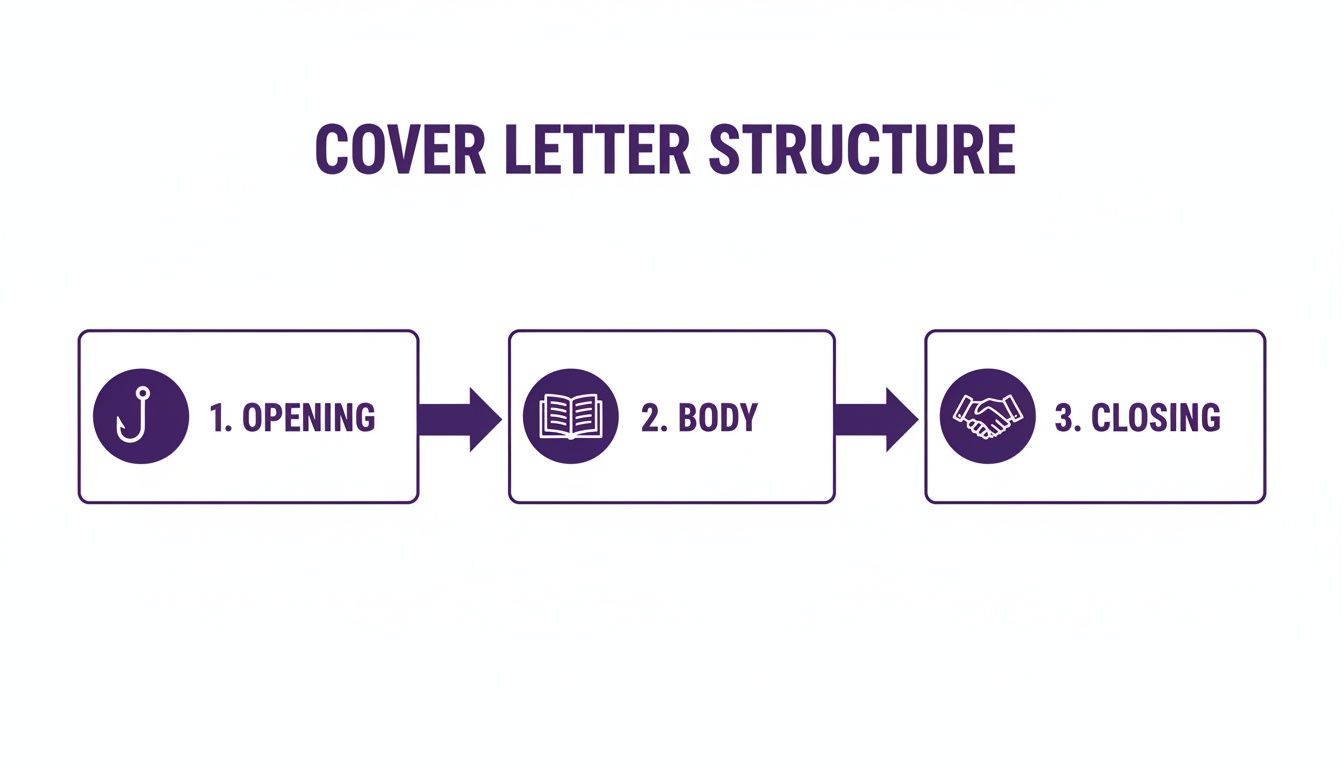
This flow—a strong opening, a storytelling body, and a clear closing—creates a framework that software can parse and humans can easily follow. You can get more tips on crafting documents that clear this hurdle in our guide to passing the applicant tracking system.
Engaging the Human Reader
Once your letter clears the ATS, the real challenge begins. Now you have to connect with a person.
This is where all your research, personality, and storytelling skills finally get to shine. A human reader wants context. They’re looking for passion, a genuine interest in their company, and a clear reason to believe you’re the right person for their team.
Now you can move beyond just listing keywords and start showing your value. Use the body of your letter to share a quick, compelling story about a time you solved a problem similar to one the company is facing. This is how you prove you can do the job, not just say you can.
Cover Letter Examples You Can Actually Use
Theory is great, but let's be real—seeing it in action is what makes it click. Forget the abstract rules for a minute. Let’s break down a few cover letter snippets for specific, and often tricky, situations.
We'll look at three common scenarios: the entry-level applicant selling potential, the career changer building a bridge to a new industry, and the internal candidate who can play the "insider" card. Notice how each one frames its story to make the biggest splash.
Example for an Entry-Level Applicant
If you're just starting out, you might feel like you don't have enough "real" experience. That's a common trap. The secret is to reframe what you do have—internships, academic projects, even volunteer work—as genuine professional wins. Your goal is to showcase transferable skills and an eagerness to learn.
Why this works:
"While finishing my marketing degree, I led a capstone project developing a digital strategy for a local non-profit. By identifying and targeting their key audience segments, our team boosted social media engagement by 45% in just three months. That's exactly the kind of hands-on skill I’m excited to bring to your Junior Marketing Associate role."
This example is powerful because it doesn't just mention a school project. It quantifies the achievement (a 45% boost is hard to ignore) and directly links that success to the job they're applying for. It screams capability, not just coursework.
Example for a Career Changer
When you're switching careers, your number one job is to connect the dots for the hiring manager. Don't make them guess how your past fits in. Your cover letter is the perfect place to spell it out and build that narrative bridge.
- Acknowledge the shift: A quick mention of your transition shows you're self-aware and intentional.
- Translate your skills: Reframe what you did in the language of the new industry. "Managing client accounts" in sales easily becomes "stakeholder management" in a project management role.
- Lean on universal strengths: Emphasize the stuff that matters everywhere, like problem-solving, clear communication, and leadership.
Why this works:
"For the last five years in hospitality, my job has revolved around one thing: creating exceptional client experiences, often under intense pressure. Managing a team of 20 taught me everything about rapid problem-solving and resource allocation. I’m confident that this background in high-stakes operational management has prepared me to excel as a Customer Success Coordinator."
This statement is a masterclass in translation. It takes hospitality skills and reframes them perfectly for a customer success role, turning a potential question mark into a unique strength. It shows the recruiter exactly how their seemingly unrelated experience is a huge asset.
If you’re having a tough time telling your own story, our guide on using a job cover letter generator can be a huge help in getting a solid first draft down. It’s a great way to structure your thoughts before you polish it with your personal touch.
Got Questions? We’ve Got Answers.
Even with the best game plan, a few nagging questions can pop up when you're writing a cover letter. Let's tackle some of the most common ones so you can get back to applying with total confidence.
How Long Should a Cover Letter Be?
Keep it short and punchy. Recruiters are skimming, not settling in with a cup of tea to read your life story. A massive wall of text is a guaranteed way to get your application tossed aside.
Your sweet spot is 250-400 words. That’s about half to three-quarters of a page. It's just enough room to hook them, drop a compelling example or two, and make a strong closing argument. Think of it as the trailer for your career, not the full-length feature film.
If your cover letter is bleeding onto a second page, it's time to make some serious cuts. Brevity is your best friend here.
Are Cover Letter Templates Okay to Use?
Templates are a great starting point for getting the structure right, but don't just fill in the blanks and hit send. That’s a rookie mistake. Recruiters can spot a generic, copy-paste job from a mile away, and it screams "low effort."
Think of a template as the basic framework:
- A killer opening that grabs attention.
- A body paragraph that proves your value.
- A confident closing that asks for the interview.
The real impact comes when you inject your personality, your research, and your specific success stories into that framework. Use the template as a guide, not a script.
What if I Can't Find the Hiring Manager's Name?
Don't sweat it. Seriously. We've all been down that rabbit hole, spending way too much time trying to hunt down a name that's just not public. It's better to move on and use a modern, professional alternative.
Forget the stuffy "To Whom It May Concern." Instead, aim for something that acknowledges the team you're trying to join. It shows you're thinking about the bigger picture.
Try one of these:
- "Dear Marketing Hiring Team"
- "Dear Eztrackr Team"
It's respectful, professional, and gets the job done without the wild goose chase.
PDF or Paste into an Email?
Simple: do what they tell you to do. The application instructions are your bible. If they want you to paste the text into a box, do it. If they ask for an attachment, a PDF is your only move.
Why PDF? It locks in your formatting. A PDF looks the same on a Mac, a PC, a phone—everywhere. Sending a Word doc is risky; formatting can go haywire on different computers, making you look sloppy. When in doubt, always go with a PDF. It's the professional standard for a reason.
Tired of fussing with formats and just want to focus on writing a killer letter? The Eztrackr AI Cover Letter Generator gives you a powerful, personalized draft in seconds. Get your whole job search organized and create applications that actually stand out.