10 Key Things What Employers Look For in Resumes in 2025
Ever feel like your resume vanishes into a digital black hole after you hit "submit"? You're not alone. Recruiters and hiring managers often spend mere seconds scanning each application, making it crucial to understand exactly what employers look for in resumes to make an immediate impact. The old approach of simply listing job duties is no longer enough. Today, a successful resume must first navigate sophisticated Applicant Tracking Systems (ATS) before it can capture a human reader's attention by demonstrating tangible value and telling a compelling career story, quickly.
This guide is your blueprint for achieving just that. We're moving beyond generic advice to provide a prioritized, scannable list of the 10 most critical elements that both hiring software and human decision-makers are programmed to find. You will learn how to articulate your worth with quantifiable achievements, optimize your content with relevant keywords, and structure your document for maximum readability. Before you even begin tailoring your resume for a specific role, understanding your core strengths is foundational. To truly decode the recruiter's wishlist and create a winning resume, starting with a thorough career assessment can help you identify your strongest assets and ideal career path.
Forget the guesswork. This comprehensive roundup is packed with actionable strategies, concrete examples, and the specific language needed to transform your resume from a passive document into a powerful, interview-generating tool. We will cover everything from crafting a clear professional summary and using dynamic action verbs to showcasing technical skills and ensuring your formatting creates a strong visual hierarchy. Let’s dive in and build a resume that gets you noticed and, ultimately, gets you hired.
1. Clear Professional Summary or Objective
Your professional summary is the first thing a recruiter reads, acting as a powerful 15-second elevator pitch. This concise 2-3 sentence statement at the top of your resume must immediately convey your core qualifications, career goals, and the unique value you bring. It's a critical component of what employers look for in resumes, as it frames your entire professional story and sets the tone for the rest of the document.

This section has evolved from the outdated "Objective" statement, which focused on the candidate's desires, to a "Professional Summary" that highlights their achievements and skills relevant to the employer's needs. A strong summary acts as a hook, compelling the hiring manager to read further.
Examples of Effective Summaries
- For a Marketing Manager: "Results-driven marketing manager with 8+ years of experience driving revenue growth through data-backed campaigns and team leadership. Proven track record of increasing conversion rates by 35% and expanding market share by 15% at TechCorp."
- For a Software Developer: "Full-stack developer skilled in React, Node.js, and AWS with 5 years of experience building scalable SaaS applications. Successfully led a platform migration project that reduced infrastructure costs by 40% and improved system uptime to 99.98%."
Actionable Tips for Crafting Your Summary
- Lead with quantifiable achievements. Instead of saying "improved sales," say "drove a 20% increase in quarterly sales." Numbers provide concrete evidence of your impact.
- Customize for every application. Mirror the language and keywords from the job description to show you are a direct match for the role's requirements.
- Keep it brief and powerful. Stick to a maximum of three lines or 50 words. Every word should justify its place.
- Focus on value proposition. Clearly state what you can do for the company, not just what you've done in the past.
A well-crafted summary is your best tool for making a strong first impression. If you need help generating a powerful opening statement, you can find more examples and guidance on how to craft the perfect resume summary on eztrackr.app.
2. Quantifiable Achievements and Metrics
Beyond listing job duties, employers want to see the tangible impact you made in your previous roles. Quantifiable achievements use specific numbers, percentages, and dollar amounts to prove your value and provide concrete evidence of your capabilities. This is a critical factor in what employers look for in resumes because it transforms your responsibilities into a compelling story of success and contribution.
Simply stating you "managed social media" is vague. Stating you "grew social media engagement by 150% over six months, resulting in a 25% increase in web traffic" is a powerful, memorable statement. Metrics make your accomplishments credible, allowing hiring managers to quickly grasp the scope and scale of your contributions.
Examples of Effective Metrics
- For a Sales Associate: "Exceeded quarterly sales targets by an average of 30%, generating over $500K in new business revenue in 2023."
- For an Operations Manager: "Reduced operational costs by 18% in the first year by renegotiating vendor contracts and streamlining a key workflow process, saving the company $220K annually."
- For a Project Manager: "Led a team of 12 to deliver a complex software project 3 weeks ahead of schedule, resulting in a 15% budget surplus."
Actionable Tips for Adding Metrics
- Lead with the result. Start your bullet points with the most impressive number or outcome to immediately grab the reader's attention.
- Use the STAR method. Think about the Situation, Task, Action, and Result for each project. Your resume bullet point should focus on the 'R' (Result), supported by the 'A' (Action).
- Frame results in business terms. Connect your achievements to key business goals like revenue growth, cost savings, efficiency improvements, or customer satisfaction.
- Don't guess. Ensure all your metrics are accurate and you can confidently speak to them during an interview.
Quantifying your experience is one of the most effective ways to show, not just tell, an employer what you can do for them. For more strategies on enhancing your resume with impactful data, you can learn more about how to make my resume better on eztrackr.app.
3. Relevant Keywords and ATS Optimization
Before a human ever sees your resume, it’s likely to be scanned by an Applicant Tracking System (ATS). These software applications parse resumes for specific keywords, skills, and qualifications to filter candidates. This makes strategic keyword integration one of the most crucial aspects of what employers look for in resumes, as it determines whether you even make it to the review stage.
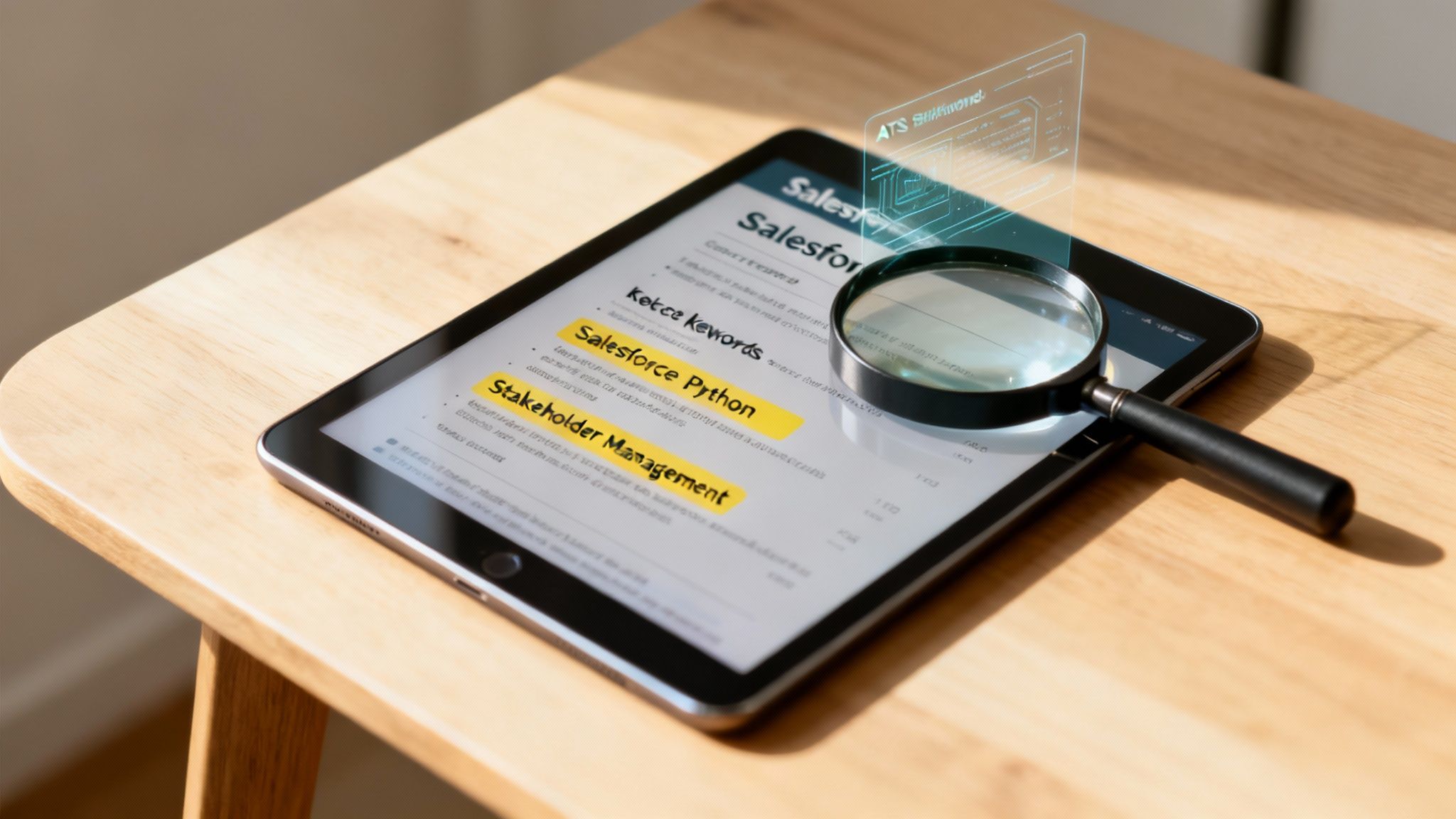
Optimizing for an ATS isn't about stuffing your document with buzzwords. It's about meticulously aligning your language with the terminology used in the job description. This demonstrates a direct match between your qualifications and the employer’s needs, ensuring your resume gets the attention it deserves from both software and hiring managers.
Examples of Effective Keyword Integration
- Instead of 'good communicator': Use specific terms from the job description like "stakeholder management," "cross-functional communication," or "executive presentations."
- Instead of 'managed team': Use targeted phrases such as "team leadership," "people management," or "direct supervision of 8+ team members."
- Include specific tools: Don't just list "CRM proficiency." Name the exact software mentioned, like "Salesforce CRM," "Google Analytics," "Tableau," or "Microsoft Azure."
Actionable Tips for ATS Optimization
- Analyze the job description. Extract 10-15 of the most important keywords related to skills, responsibilities, and qualifications, and weave them naturally into your professional summary and experience sections.
- Mirror the employer's language. If the posting asks for "project management," use that exact phrase rather than "handled projects."
- Include both acronyms and full terms. For example, list both "Search Engine Optimization" and "(SEO)" to ensure you match the ATS query, no matter how it is phrased.
- Use keywords in context. Avoid creating a "keyword" section. Instead, embed these terms within your achievement-oriented bullet points to provide context and demonstrate proficiency.
A well-optimized document significantly increases your visibility. To be certain your resume is compliant, utilizing an ATS Resume Checker can provide valuable feedback and significantly improve your chances of passing initial screening. If you need a deeper dive, you can discover more essential resume keywords to use on eztrackr.app.
4. Strong Action Verbs and Dynamic Language
The words you choose to describe your experience can dramatically alter a recruiter's perception of your capabilities. Using strong, specific action verbs at the beginning of each bullet point is a crucial part of what employers look for in resumes. Instead of passive phrases like "responsible for," dynamic verbs immediately convey agency, accomplishment, and impact, making your contributions feel more significant and engaging.
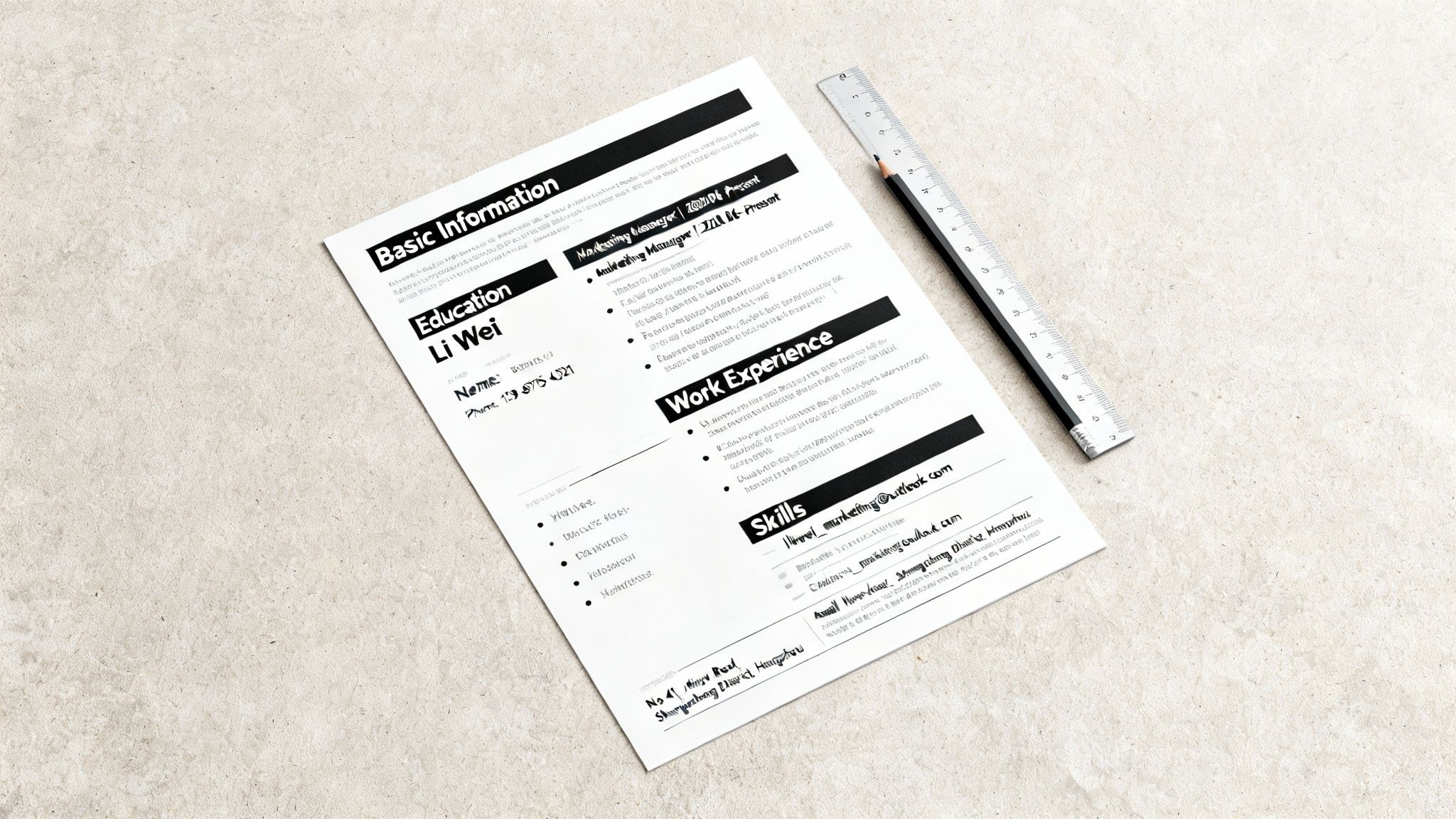
This strategic language transforms your resume from a simple list of duties into a compelling narrative of your achievements. It frames you as a proactive contributor who drives results, not just someone who passively fulfills a role. This simple change can make the difference between a resume that gets a second look and one that gets discarded.
Examples of Effective Action Verb Usage
- Weak: "Responsible for managing social media accounts and content."
- Strong: "Orchestrated social media strategy for three platforms, generating 250K followers and a 45% increase in user engagement."
- Weak: "Helped improve customer satisfaction scores."
- Strong: "Spearheaded a new customer retention program, resulting in a 32% improvement in Net Promoter Scores (NPS) over six months."
Actionable Tips for Choosing Your Verbs
- Start every bullet point with an action verb. This immediately focuses the reader on your specific accomplishment.
- Vary your verb choices. Avoid repeating the same verb (like "Managed" or "Led") multiple times. Use a thesaurus to find more powerful synonyms.
- Match verbs to your contributions. Use words that accurately reflect your role. Did you "analyze," "negotiate," "streamline," or "innovate"? Be precise.
- Avoid weak or overused words. Eliminate passive phrases like "responsible for," "duties included," and vague verbs like "worked on" or "helped."
Using dynamic language ensures your resume is not just read, but felt. It paints a vivid picture of your professional impact. To find the right words that capture your achievements, you can explore tools like the eztrackr.app resume builder, which can help suggest impactful language as you write.
5. Relevant Work Experience with Clear Progression
Your work experience section is the backbone of your resume, providing concrete proof of your capabilities. Employers meticulously scan this section not just for relevant job titles, but for a clear narrative of professional growth and increasing responsibility. This reverse-chronological history (most recent job first) is a key element of what employers look for in resumes, as it demonstrates your career trajectory and readiness for future challenges.
A well-structured employment history shows a logical progression. It tells a story of you taking on more complex projects, leading larger teams, or managing bigger budgets over time. This upward momentum is a powerful indicator of your ambition, competence, and value as a potential employee.
Examples of Clear Progression
- Senior Product Manager | TechCorp Inc. | June 2021-Present: Led a cross-functional team of 15 to launch three major features, increasing user engagement by 58% and driving a 22% uplift in subscription renewals.
- Product Manager | TechCorp Inc. | March 2019-May 2021: Managed the product roadmap for the company's flagship mobile app, which generated $2.1M in annual recurring revenue.
- Associate Product Manager | StartupXYZ | January 2018-February 2019: Supported two major product launches by gathering user feedback from over 500 customers to inform feature prioritization and bug fixes.
Actionable Tips for Showcasing Your Experience
- Prioritize relevance. Tailor your bullet points for each application, highlighting the duties and accomplishments that directly align with the target job's requirements.
- Demonstrate growth. Even if your titles were similar, use your bullet points to show how your scope and impact expanded. Did you manage larger projects, mentor junior staff, or handle more significant client accounts?
- Use the CAR formula. Structure your bullet points using the Challenge, Action, Result (CAR) method to create compelling, achievement-oriented statements.
- Keep it concise. Aim for 3-5 powerful bullet points for each role. Focus on your most impressive and relevant contributions, not a comprehensive list of all your duties.
By carefully curating this section, you provide employers with a clear, compelling narrative of your professional journey. If you need assistance structuring this crucial section, the resume builder at eztrackr.app can help you organize your experience for maximum impact.
6. Education, Certifications, and Credentials
Your education and professional credentials provide the foundational proof of your knowledge and expertise. This section is a critical part of what employers look for in resumes, as it validates your qualifications, demonstrates a commitment to ongoing learning, and can be a non-negotiable requirement for many technical or regulated roles. It’s where you formally list your degrees, relevant certifications, licenses, and specialized training that align directly with the job.
For some fields, like law, medicine, or finance, this section is paramount. For others, it may be secondary to experience but still offers crucial context about your background and specialized skills. A well-organized credentials section proves you have the required theoretical knowledge and have invested in your professional development, making you a more credible and competitive candidate.
Examples of Effective Credential Listings
- For a Project Manager: "Project Management Professional (PMP) | Project Management Institute | License #987654 | Valid through 2026" followed by "Bachelor of Business Administration | University of Texas | Austin, TX | 2018"
- For a Data Analyst: "Google Data Analytics Professional Certificate | Coursera | Completed 2023" and "Master of Science in Data Science | New York University | New York, NY | 2022"
- For an Accountant: "Certified Public Accountant (CPA) | California Board of Accountancy | License #123456 | Active"
Actionable Tips for Presenting Your Credentials
- Prioritize relevance. Place the most relevant qualification at the top. If a specific certification like AWS Certified Solutions Architect is a key requirement, list it before your university degree.
- Include key details. For certifications and licenses, always include the issuing authority, your license number (if applicable), and the expiration or renewal date to show it's current.
- Be strategic with GPA. Only include your GPA if it is 3.5 or higher and you have graduated within the last five years. Otherwise, it's best to omit it.
- Add ongoing education. If you are currently enrolled in a program, list it with your expected graduation date (e.g., "Expected May 2025") to show your proactive efforts.
Properly showcasing your education and certifications provides tangible evidence of your capabilities. If you need help formatting this section or determining which credentials to include, the eztrackr.app resume builder can help you organize and present your qualifications for maximum impact.
7. Technical Skills and Competencies Section
In a tech-driven job market, a dedicated skills section is non-negotiable. This scannable, organized list acts as a quick-reference guide for recruiters and a keyword goldmine for Applicant Tracking Systems (ATS). It’s a vital part of what employers look for in resumes because it immediately validates your technical qualifications for a role without forcing a hiring manager to hunt through your experience section.
This section provides a clear, at-a-glance snapshot of your tangible abilities, from programming languages to project management software. A well-organized skills section proves you have the specific tools and knowledge required to perform the job effectively from day one, making you a more attractive candidate.
Examples of Effective Skills Sections
- For a Data Analyst:
- Languages: Python (Pandas, NumPy), SQL, R
- Databases: MySQL, PostgreSQL, MongoDB
- Visualization Tools: Tableau, Power BI, Google Data Studio
- Cloud/Big Data: AWS S3, Google BigQuery
- For a Project Manager:
- Methodologies: Agile, Scrum, Waterfall, Kanban
- Software: Jira, Asana, Trello, Microsoft Project
- Certifications: PMP, Certified ScrumMaster (CSM)
Actionable Tips for Crafting Your Skills Section
- Organize into logical categories. Group related skills under subheadings like "Programming Languages," "Cloud Platforms," or "Marketing Tools" to improve readability.
- Tailor it to the job description. Analyze the role's requirements and prioritize the skills mentioned. If the listing emphasizes "Docker" and "Kubernetes," ensure those are prominently featured.
- Be honest about proficiency. Only list skills you can confidently discuss and demonstrate in an interview. Some candidates add levels like "Proficient" or "Advanced," but only do this if you can back it up.
- Remove outdated technologies. Unless applying for a role maintaining legacy systems, remove skills like Flash or older software versions to show your knowledge is current and relevant.
A strong skills section can be the deciding factor that gets your resume past an ATS and into the hands of a human reviewer. To ensure your skills are formatted for maximum impact and ATS compatibility, you can use the intuitive builder at eztrackr.app to structure this critical section.
8. Tailored Content for Each Application
Submitting a generic, one-size-fits-all resume is one of the most common yet significant mistakes a job seeker can make. Employers are looking for candidates who have taken the time to understand their specific needs. Tailoring your content for each application demonstrates a genuine interest in the role and shows that you are a precise fit for their requirements, making it a crucial factor in what employers look for in resumes.
This strategic customization involves adjusting your resume’s content, skills, and achievements to align directly with the job description and company culture. Instead of just listing everything you've ever done, you are curating your professional story to answer the employer’s primary question: “Why are you the best person for this job?” A tailored resume will always outperform a generic one because it speaks the employer's language.
Examples of Effective Tailoring
- For a Sales Role: Lead with bullet points highlighting sales achievements like "Exceeded quarterly sales targets by 25%" or "Generated $2M in new business revenue." De-emphasize unrelated experience, such as internal product development projects.
- For a Leadership Role: Prioritize accomplishments that showcase team management, mentoring, and strategic impact. Feature bullet points like "Managed a team of 10 engineers, increasing productivity by 18%" or "Led a company-wide initiative that improved operational efficiency."
- For a Startup vs. a Fortune 500 Company: For a startup, highlight your adaptability and ability to wear multiple hats. For a large corporation, emphasize your experience with established processes, scalability, and cross-functional collaboration.
Actionable Tips for Customizing Your Resume
- Maintain a "master resume." Keep a comprehensive document with all your experiences, skills, and achievements. Pull from this master list to create tailored versions for each application.
- Mirror the job description. Identify keywords and key qualifications from the job posting and integrate them naturally into your professional summary, skills, and experience sections.
- Reorder bullet points. Under each role, list the most relevant achievements first. If the job requires project management, ensure your project management accomplishments are at the top.
- Research the company. Understand their values, recent projects, and culture. A brief mention of how your skills align with their mission can make a significant impact.
By investing a few extra minutes to customize your resume, you drastically increase its relevance and your chances of securing an interview. Tools can help streamline this process, allowing you to create and manage multiple resume versions efficiently.
9. Clear Formatting and Visual Hierarchy
Recruiters spend an average of just 7 seconds scanning a resume. This means the document's design isn't just about aesthetics; it's about functionality. Clear formatting and a strong visual hierarchy are crucial elements of what employers look for in resumes because they guide the reader’s eye to the most important information, making your qualifications easy to grasp in a short amount of time. A cluttered, inconsistent, or hard-to-read resume can be dismissed before its content is ever fully appreciated.
Professional presentation signals attention to detail and respect for the hiring manager's time. By using consistent fonts, adequate white space, and a logical structure, you ensure your most compelling achievements stand out immediately. This strategic design choice makes the difference between a resume that gets a thorough review and one that gets discarded.
Examples of Effective Formatting
- Font Choices: Stick to professional, readable fonts like Calibri, Arial, Helvetica, or Garamond. Avoid overly casual or decorative fonts like Comic Sans or script styles that hinder readability.
- Visual Hierarchy: Use font size and weight to create a clear structure. For example: Main Headers (16-18pt bold) > Job Titles (12-14pt bold) > Body Text/Bullet Points (10-12pt regular).
- Color Usage: Maintain a professional black-and-white color scheme. If you choose to add color, use a single, subtle accent for headers to add a touch of personality without distracting the reader.
Actionable Tips for Formatting Your Resume
- Standardize Your Fonts. Use one professional font throughout the document. Set your body text to a readable 10-12pt size and headers between 14-18pt.
- Embrace White Space. Maintain margins of 0.5 to 1 inch on all sides. This prevents a cluttered look and makes the text easier to scan.
- Use Bullet Points. List your achievements and responsibilities using bullet points instead of long paragraphs. This format is scannable and helps recruiters quickly identify key accomplishments.
- Save and Send as a PDF. Always save your final resume as a PDF to preserve its formatting across all devices and operating systems.
- Test for ATS Compatibility. Avoid using tables, columns, or graphics that can confuse Applicant Tracking Systems. A clean, single-column layout is safest.
A well-organized resume is fundamental to making a positive first impression. For those looking to streamline the design process, you can build a professional, ATS-friendly document with the eztrackr.app resume builder.
10. Relevant Project Work and Portfolio Links
While your work history describes your responsibilities, a portfolio or project section provides tangible proof of your skills. Including links to relevant projects, a personal portfolio, a GitHub repository, or published articles offers concrete evidence of your capabilities. This is a crucial element of what employers look for in resumes, especially in technical, creative, and results-oriented fields, as it allows them to see your work firsthand.
This section moves beyond claims and provides demonstrable achievements. For roles in design, development, content creation, or data science, a strong portfolio can be more persuasive than any bullet point. It shows initiative, passion, and the ability to produce high-quality work, giving you a significant advantage over other candidates.
Examples of Effective Project/Portfolio Entries
- For an Engineer: "MyWeatherApp (Python/React) – Built a real-time weather application utilizing the OpenWeather API, deployed on AWS. See the code on GitHub: github.com/username/weather-app."
- For a UX/UI Designer: "SaaS Brand Redesign Case Study – Led a complete visual identity and user experience overhaul for a B2B productivity tool, resulting in a 25% increase in user engagement. Full case study: myportfolio.com/case-studies/brand-redesign."
- For a Content Writer: "Technical Writing Portfolio – Published over 25 long-form articles on cloud infrastructure and DevOps topics for leading industry blogs like TechBlog.com. View clips: myportfolio.com/writing."
Actionable Tips for Showcasing Your Work
- Curate your best examples. Select 2-4 of your most impressive projects that align directly with the target job's requirements. Quality over quantity is key.
- Ensure all links are live and professional. Double-check that every URL works and leads to a polished, well-organized portfolio or repository.
- Add URLs to your contact section. Place your primary portfolio or GitHub link at the top of your resume with your contact information for immediate visibility.
- Clearly define your contribution. For team projects, specify your exact role and responsibilities. For instance, "Led front-end development using React" or "Responsible for all user research and wireframing."
A well-presented collection of your work provides undeniable proof of your skills, allowing employers to visualize you succeeding in the role. If you need help organizing your projects, consider using a tool like eztrackr.app to manage your application materials, including different versions of your resume tailored with specific project highlights.
Top 10 Resume Criteria Comparison
| Component | 🔄 Implementation complexity | ⚡ Resource requirements & time | 📊 Expected outcomes / impact | Ideal use cases | ⭐ Key advantage / 💡 Quick tip |
|---|---|---|---|---|---|
| Clear Professional Summary or Objective | Low — straightforward to write but needs tailoring | Low (15–30 min per version) | Improves immediate recruiter attention and ATS keyword match | Mid-career and targeted applications | ⭐ Positions you quickly as a fit — 💡 Keep to 2–3 sentences and include a metric if possible |
| Quantifiable Achievements and Metrics | Medium — requires data collection and validation | Medium — time to gather records; may need approvals | High — differentiates candidates and demonstrates ROI | Sales, finance, product, operations, consulting | ⭐ Provides concrete proof of impact — 💡 Verify and contextualize all numbers |
| Relevant Keywords and ATS Optimization | Medium — job-by-job research needed | Low–Medium (10–20 min per posting) | High — increases pass rate through ATS and recruiter searches | Any ATS-screened roles or high-volume hiring | ⭐ Boosts visibility to systems/recruiters — 💡 Mirror exact job language without stuffing |
| Strong Action Verbs and Dynamic Language | Low — copy-editing and word choice | Low — quick rewrite of bullets | Moderate — raises engagement and perceived ownership | All resumes; especially leadership and impact roles | ⭐ Enhances tone and clarity — 💡 Start bullets with diverse, accurate verbs |
| Relevant Work Experience with Clear Progression | Medium — structuring and selecting content | Medium — craft 3–7 bullets per role | High — shows growth, credibility, and role fit | Mid-to-senior roles, promotion-oriented applications | ⭐ Demonstrates career trajectory — 💡 Use reverse-chronological order and highlight promotions |
| Education, Certifications, and Credentials | Low — factual listing | Low — gather certificates and dates | Variable — critical in regulated/technical fields; less so later in career | Healthcare, finance, tech, law, entry-level roles | ⭐ Validates qualifications — 💡 Include expirations and omit old/irrelevant degrees after ~5 years |
| Technical Skills and Competencies Section | Low–Medium — selection and organization | Low — periodic updates (monthly/quarterly) | High for technical roles — improves ATS matches and screening speed | Tech, data science, engineering, specialized roles | ⭐ Quickly signals technical fit — 💡 Limit to 15–20 defendable skills and indicate proficiency where helpful |
| Tailored Content for Each Application | High — per-application customization | High (15–30 min per application) | Very high — can 2–3x interview callback rates | Competitive roles and targeted company applications | ⭐ Maximizes relevance to each role — 💡 Maintain a master resume and 3–5 role-specific versions |
| Clear Formatting and Visual Hierarchy | Medium — design + ATS compatibility decisions | Low–Medium — initial setup then reuse templates | High — improves scanability and first impression | All resumes; critical for recruiters with brief review windows | ⭐ Improves readability and professionalism — 💡 Use standard fonts, test PDF/ATS parsing |
| Relevant Project Work and Portfolio Links | Medium — curate, host, and summarize work | Medium–High — create portfolio and maintain links | High for creative/technical roles — provides tangible evidence | Software dev, design, writing, data science, portfolios | ⭐ Offers direct proof of ability — 💡 Include 2–5 best examples and verify all links before sending |
Putting It All Together: Your Next Steps to an Interview-Winning Resume
You’ve now explored the ten fundamental pillars of a resume that commands attention. From crafting a razor-sharp professional summary and quantifying your achievements to optimizing for Applicant Tracking Systems, you understand the anatomy of a document that works for you, not against you. Understanding what employers look for in resumes is no longer a mystery; it’s a strategic blueprint you can follow.
The difference between a resume that gets shortlisted and one that’s archived often comes down to a handful of critical adjustments. It’s the difference between listing duties and showcasing impact, between using generic phrases and deploying powerful action verbs, and between a one-size-fits-all document and a tailored masterpiece. Each element we've discussed, from clear formatting to showcasing relevant project work, contributes to a single, powerful narrative: that you are the ideal candidate for this specific role.
From Blueprint to Action: Your Three-Step Plan
Think of your resume not as a static historical record but as a dynamic marketing tool. It must evolve, adapt, and speak directly to the needs of each employer. To transition from knowledge to application, here are your immediate next steps:
-
Conduct a Self-Audit: Use the insights from this article as a checklist. Go through your current resume section by section. Where are the gaps? Are your achievements quantified? Is your language passive? Is it optimized with keywords from your target job descriptions? Be honest and critical.
-
Create a "Master Resume": Develop a comprehensive document that includes every accomplishment, skill, project, and certification you have. This isn't the version you send out; it's your personal database. When you apply for a new role, you can pull the most relevant details from this master file, making the tailoring process exponentially faster and more effective.
-
Tailor, Tailor, Tailor: For every single application, dedicate 15-20 minutes to customization. Swap out keywords, reorder bullet points to match the job description's priorities, and tweak your professional summary to mirror the company’s language and values. This targeted effort is the single most impactful thing you can do to increase your interview rate.
The Ultimate Goal: Opening Doors to Opportunity
Mastering these resume principles does more than just get you past the initial screening. It builds a foundation of professionalism and strategic thinking that will serve you throughout your career. A well-crafted resume demonstrates your communication skills, your attention to detail, and your ability to connect your experience to an organization's goals. It tells an employer you’re not just looking for a job; you’re looking to provide value.
By investing the time to build a resume that truly reflects your potential, you are taking control of your job search. You're moving from a passive applicant to a strategic contender. The goal isn't just to list your history; it's to shape your future, one carefully crafted application at a time. You have the knowledge and the tools. Now it's time to build the key that will unlock your next opportunity.
Ready to stop guessing and start getting interviews? Eztrackr uses AI to help you build, tailor, and track your applications, ensuring your resume aligns perfectly with what employers are looking for. Transform your job search strategy and land your dream role faster by visiting Eztrackr today.