How to Write a Resume with No Experience That Gets Noticed
Staring at a blank resume can feel like you're standing at the bottom of a mountain, especially when you don't have a traditional job history to list. But here's the thing: you probably have way more to offer than you realize. It's all about a simple but powerful mindset shift—stop thinking "I have no experience" and start thinking "Here’s what I can do for you."
A New Game Plan for Resumes Without Work History

First, forget everything you've heard about a standard, chronological resume. That model is built for people with a 9-to-5 track record. Your resume needs to tell a completely different story—one about your potential, your skills, and your hunger to learn.
Instead of a list of jobs you haven't had yet, you're going to build a resume that puts your abilities front and center. This is often called a skills-based or functional resume, and it's designed to grab a hiring manager's attention by showing what you can do right now.
With the average U.S. small business getting around 180 applications for a single hire, standing out is non-negotiable. Highlighting skills like communication, teamwork, and problem-solving is your secret weapon to get noticed.
It All Starts with a Mindset Shift
Honestly, the biggest hurdle is usually in your own head. It's easy to feel like you have nothing to offer without paid work experience, but that’s just not true. Your value is a mosaic of everything you've done, not just a list of jobs.
Think of these areas as your new "experience" goldmines:
- Academic Projects: Did you lead a team to build an app for a class? Or maybe you spent a semester researching a complex topic and presenting your findings?
- Volunteer Work: Have you organized a fundraiser, managed a social media page for a local charity, or tutored younger students?
- Extracurriculars: Were you the treasurer for a student club, responsible for a budget? Did you captain a sports team and learn leadership on the fly?
- Personal Projects: Maybe you taught yourself to code and built a website, started a blog about a passion, or created an impressive portfolio of graphic design work.
Each one of these is proof of skills that employers desperately want.
The goal is to reframe your background. Instead of seeing a "gap" where work history should be, see an opportunity to highlight your initiative, problem-solving abilities, and dedication through non-traditional experiences.
Let's dive into how to turn these experiences into a resume that actually gets you in the door. We'll break down the structure, what to put where, and how to word it all to prove you’re ready for the job. And if you're looking for more general pointers, there are some essential rules for writing an effective CV that are always good to keep in mind.
Building Your Resume Foundation With a Powerful Summary
Think of your resume summary as the trailer to your movie. It’s the very first thing a recruiter sees, and you have just a few seconds to convince them to stick around for the main feature. This short paragraph, sitting right at the top under your name, is your elevator pitch.
When you don't have a long list of jobs to back you up, this section becomes your MVP. It’s not about highlighting a career you haven't had yet. It’s about projecting confidence and showing off your ambition, your core skills, and a clear vision for where you're headed.
Essentially, your summary needs to answer one question for the hiring manager: "Why should I keep reading?"
Ditch the Objective and Write a Summary Instead
You might still see advice out there about writing a "resume objective." Don't do it. An objective is all about what you want from a job, which, frankly, the employer doesn't care much about. A modern resume summary flips the script—it focuses on the value you bring to them.
It’s a subtle but crucial difference.
An old-school objective sounds needy: "Seeking an entry-level marketing role to gain professional experience."
A powerful summary, however, showcases your potential: "Ambitious and creative marketing student with a strong foundation in social media campaign development and content creation from academic projects. Eager to apply skills in digital analytics and brand strategy to help drive engagement for an innovative company."
See the difference? One asks for an opportunity. The other demonstrates what you can do right now.
A strong resume summary is your chance to frame the narrative. It tells the recruiter exactly how to view the rest of your resume, connecting your projects, volunteer work, and skills to the job they need to fill.
How to Craft a Compelling Summary
A great summary is short and sweet—aim for 2-4 sentences. And please, don't use a generic one for every application. Customizing it for the specific role you're applying for shows you've actually read the job description and are genuinely interested.
Here's a simple, no-fail formula to get you started:
- Who You Are: Kick things off with a strong adjective and your current status. Think "Motivated Recent Computer Science Graduate" or "Detail-oriented Aspiring Graphic Designer."
- What You Bring: Name 2-3 of your most relevant skills, pulling keywords directly from the job description. This could be a mix of hard and soft skills.
- How You Got Them: Briefly give context to your skills. Where did you learn them? Mention things like "through rigorous academic projects," "via leadership roles in student organizations," or "by managing a personal coding blog."
- Where You're Going: Wrap it up by connecting your ambition to the company's goals. Show them you want to grow with them.
If you’re staring at a blank page and the words just aren't coming, a good resume summary generator can be a lifesaver. It can give you a solid foundation that you can then tweak and personalize, helping you get past writer's block and create something truly impactful.
Put Your Skills Front and Center

If your resume summary is the movie trailer, your skills section is the main event. This is where you prove you can do the job, even if you haven't held a similar title before. It’s easily the most important piece of real estate on the page when you're starting out.
And here’s the good news: hiring is changing. A lot.
Globally, 65% of employers are now putting skills ahead of formal education. Even more telling, a whopping 75% of talent acquisition leaders believe skills are about to become the main way candidates are measured. Your resume needs to lean into this shift, hard.
This section isn’t a throwaway list of things you’re good at. It’s a targeted marketing tool—your chance to mirror the job description and show a hiring manager, in a matter of seconds, that you have exactly what they’re looking for.
Split Up Your Hard and Soft Skills
The best way to make your skills pop is to break them into two categories: Hard Skills and Soft Skills.
This simple tweak makes your resume incredibly easy to scan. A recruiter can glance at it and immediately get a sense of your qualifications. Plus, it helps you get past the Applicant Tracking Systems (ATS) that companies use to filter candidates, since they're often programmed to hunt for specific skill keywords.
Hard skills are the technical, teachable abilities you need for a specific role. Think of them as the "what" you can do.
Soft skills are your interpersonal traits—the "how" you go about your work. These are valuable in pretty much any job, anywhere.
Pro Tip: Match your wording to the job description. If they ask for "content strategy," don't just put "writing." Using their exact phrasing is a game-changer for getting past both the bots and the humans.
How to Uncover and Showcase Your Skills
First, dissect the job posting. Seriously, print it out or copy it into a doc and highlight every single skill they mention.
Now, think about your own life. Where have you used those skills? Don't limit yourself to paid work. Think about class projects, volunteer gigs, personal passion projects—anything.
Let’s say a marketing student is gunning for a social media coordinator role. After reviewing the job description, they might list:
-
Hard Skills:
- Social Media Management (Hootsuite, Buffer)
- Content Creation (Canva, Adobe Express)
- Data Analysis (Google Analytics, Instagram Insights)
- SEO Keyword Research
-
Soft Skills:
- Written Communication
- Creativity
- Time Management
- Team Collaboration
Laying it out like this gives the hiring manager clear, undeniable proof of what you can do. It smartly sidesteps the lack of a formal job history by focusing on your actual capabilities.
Our complete guide has even more strategies on how to get hired with no experience, helping you connect the dots between the skills you have and the job you want.
Turning Education and Projects Into Compelling Experience
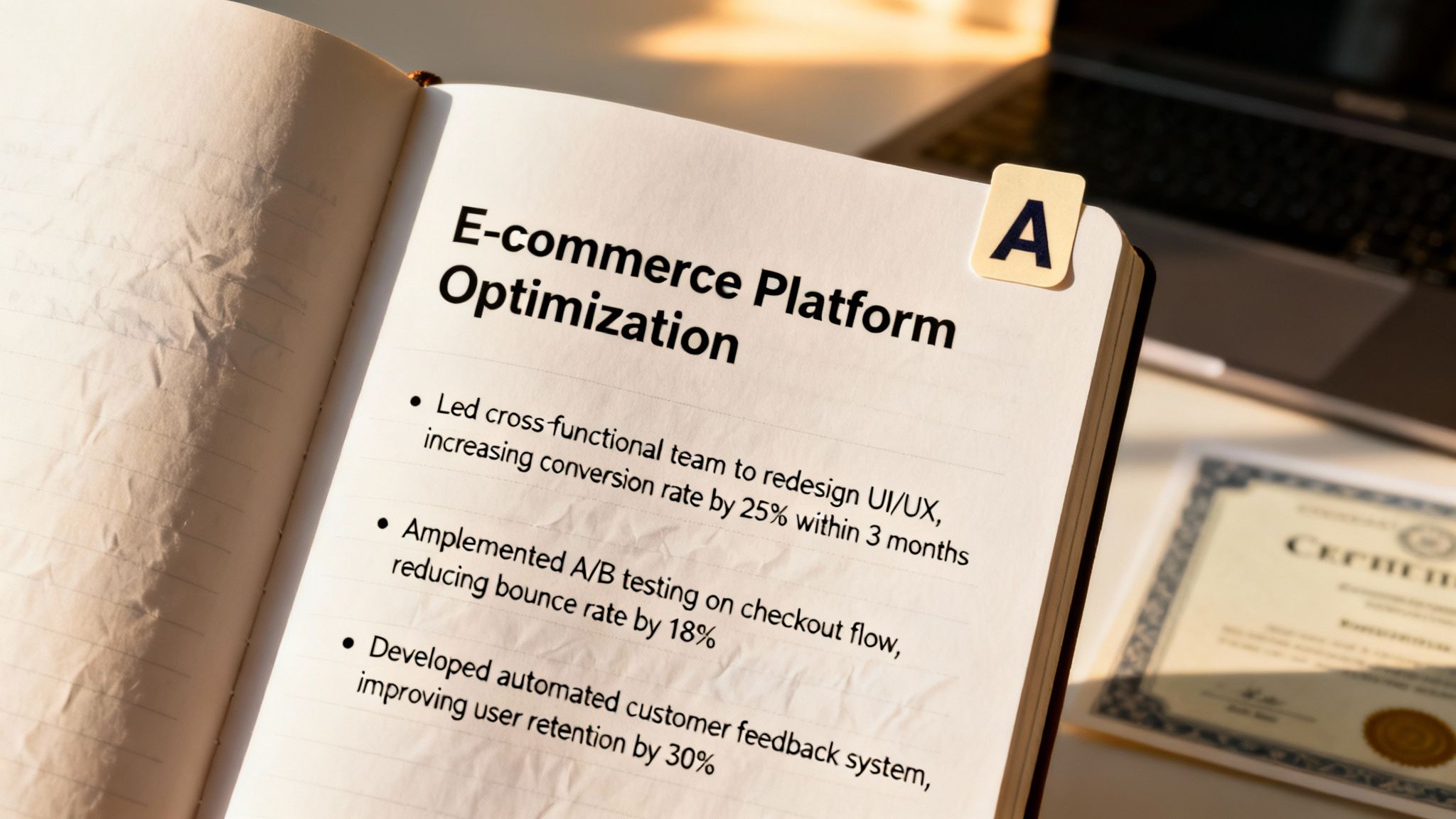
When you don't have a list of job titles to fall back on, your education and personal projects become your heavy hitters. A lot of people just list their degree and graduation date, and that's it. This is a huge missed opportunity to show a hiring manager what you can actually do.
Think of your education section as a mini-experience section. It's your chance to prove you have the foundational knowledge and practical skills to hit the ground running. Honestly, mastering this is the secret to writing a resume with no experience that gets you noticed.
Maximize Your Education Section
Let's go beyond the basics. The goal here is to draw a straight line from your academic background to the job you want. You can do that by adding a few specific details that paint a much clearer picture of your skills and drive.
Consider beefing up your education entry with these:
- Relevant Coursework: Pick 3-5 classes that directly relate to the job description. Applying for a marketing role? Courses like "Digital Media Strategy" or "Consumer Behavior" are gold.
- GPA: If you’ve got a GPA of 3.5 or higher, don't be shy—include it. A strong academic record can signal a great work ethic.
- Awards and Honors: Did you make the Dean's List or land any academic scholarships? Mention them. These little details show a commitment to excellence.
This extra context turns your education from a simple fact into active proof of your abilities.
Frame Projects as Professional Accomplishments
This is where you can really shine. Your academic and personal projects are tangible proof that you can apply what you've learned, solve problems, and get things done. The trick is to describe them just like you would a professional role.
So, instead of a vague line like, "Wrote a research paper," you need to reframe it to highlight the skills you used.
A change in mindset is all it takes. You didn't just do a project; you managed a process from concept to completion. You researched, analyzed, created, and produced a final result. That’s real experience.
To structure your project descriptions, I always recommend the PAR method: Problem, Action, Result. What was the challenge? What specific actions did you take? And, most importantly, what was the measurable outcome?
Let's walk through an example.
Imagine a computer science student who built a website for a class project. A weak description would be something like: "Created a website for a class."
Now, let's inject the PAR method for a description that actually has some punch:
- Project Title: E-Commerce Platform Optimization
- Problem: Tasked with designing and launching a fully functional, user-friendly e-commerce site to drive online sales for a mock local business.
- Action:
- Developed a responsive front-end using HTML, CSS, and JavaScript to guarantee a smooth user experience on any device.
- Engineered a secure back-end with Python and Django to manage product inventory and process transactions safely.
- Integrated a third-party payment gateway and ran comprehensive tests to squash bugs before the final presentation.
- Result: Delivered a complete, functional prototype that earned a 98% grade and was highlighted by the professor for its clean code and intuitive design.
See the difference? This detailed breakdown showcases technical skill, project management, and a focus on results—all without needing a formal job title. When you treat your projects with this level of professional detail, you give employers the concrete evidence they're desperately looking for.
Translating Academic Work Into Professional Achievements
It can be tough to see how a term paper or a class presentation translates to the "real world." This table gives a few examples of how to reframe your academic work to spotlight the professional skills hiding within.
| Academic Activity | Weak Resume Description | Strong Resume Description (With Quantifiable Results) |
|---|---|---|
| Group Marketing Project | "Worked with a team on a marketing plan." | "Collaborated in a 4-person team to develop a comprehensive marketing strategy for a new product, conducting market analysis that identified a 15% growth opportunity in a key demographic." |
| History Research Paper | "Wrote a 20-page paper on WWII." | "Conducted in-depth primary and secondary source research to produce a 20-page analytical paper, synthesizing complex information and presenting a unique thesis that received departmental honors." |
| Personal Coding Project | "Built a mobile app." | "Independently designed and developed a mobile scheduling app using Swift, resulting in over 100 downloads in the first month and achieving a 4.8-star user rating on the App Store." |
| Student Government Role | "Treasurer for the student club." | "Managed a $5,000 annual budget for the university's largest student club (200+ members), reducing operational expenses by 10% through strategic vendor negotiations and resource allocation." |
By translating your academic and personal projects into the language of professional achievements, you're not just filling space—you're proving your value before you even have a traditional job on your record.
Turn Volunteer Work and Extracurriculars into Real Experience
Don’t make the mistake of thinking your experiences outside a 9-to-5 job don't count. They absolutely do. In fact, volunteer work and extracurricular activities can be a goldmine for showing a hiring manager the exact skills they’re desperately looking for.
These aren't just resume "fillers." They're solid proof of your work ethic, your ability to lead, and your knack for working with others.
Put yourself in a recruiter’s shoes for a second. When they see you dedicated your free time to a cause or stepped up to lead a club, it screams initiative. That's a quality you can't really teach, and it’s a massive green flag for any employer looking for someone who takes charge.
How to Frame Activities as Achievements
The trick is to stop thinking about these roles as hobbies and start treating them like informal work. Your job is to connect the dots for the hiring manager, showing them precisely how being a club treasurer or an event volunteer translates into the skills they need on their team.
Don't just list the activity. You need to describe it with the same professional language you’d use for a paid gig. Use bullet points to break down what you were responsible for and—this is the important part—what you actually accomplished. Always kick off each point with a strong action verb.
Let’s walk through a real-world example. Imagine someone is applying for an administrative assistant role, but their only "office" experience was as the secretary for their university’s debate club.
A weak entry looks like this:
- Secretary, University Debate Club
But a strong entry looks like this:
- Secretary, University Debate Club (2022–2023)
- Managed and coordinated schedules for 30+ club members, ensuring seamless meeting and event logistics.
- Authored and distributed weekly newsletters to over 150 subscribers, which boosted meeting attendance by 20%.
- Maintained detailed meeting minutes and organized the club’s digital files, improving information accessibility for all members.
See the difference? We’ve shifted the focus from a simple title to concrete, transferable skills: organization, communication, and digital literacy. It’s no longer just a club position; it’s directly relevant experience.
Uncovering Hidden Skills in Everything You Do
And don't just stop at formal clubs or official organizations. Almost any activity you’ve been involved in has skill potential.
Did you organize a charity car wash for a local shelter? That’s event planning and fundraising. Did you captain your intramural soccer team? That’s leadership and team motivation.
The secret is to break down the activity into its core parts. Just ask yourself a few simple questions:
- Did I manage a budget? (Financial acumen)
- Did I lead a team or delegate tasks? (Leadership)
- Did I plan an event from start to finish? (Project management)
- Did I have to persuade people or promote an idea? (Communication and marketing)
When you start analyzing your volunteer and extracurricular roles this way, you'll suddenly find you have a ton of compelling proof of your abilities. You can populate your resume with this evidence and make that lack of formal work history a complete non-issue.
Finalizing and Tailoring Your Resume for Each Application
You've put in the work to build a solid resume, highlighting your skills, education, and projects. Awesome. But don't hit "send" just yet. The final steps—proofreading and tailoring—are what separate a decent resume from one that actually lands you an interview.
Seriously, sending a generic, one-size-fits-all document is one of the biggest mistakes you can make.
A clean, professional format is your first line of defense. Remember, one out of five recruiters might reject a resume in under a minute without even reading it fully. Simple formatting mistakes can get your application tossed aside instantly. You can see more of these eye-opening resume stats over at Novoresume.
This means your resume has to be flawless. No typos, no grammatical weirdness, and absolutely no inconsistent formatting. Read it out loud, run it through a grammar checker, and then—this is key—have a friend or mentor give it a once-over for a fresh perspective.
Customizing for Every Single Job
I can't stress this enough: tailoring your resume for each specific application is non-negotiable. It's all about mirroring the language in the job description to show the hiring manager that you're the perfect fit they've been looking for.
Start by digging into the job posting. What are the key skills and qualifications they keep mentioning? Your job is to strategically weave those exact keywords throughout your resume.
Here’s a quick checklist to run through every time you apply:
- Update Your Summary: Tweak your professional summary to reflect the company’s values and the specific role's most important duties.
- Swap Keywords: Adjust the skills in your skills section to match the most important ones listed in the job description.
- Reframe Project Descriptions: Got a project or volunteer gig on your resume? Re-word the description to highlight accomplishments that directly solve the problems mentioned in the job ad.
Customizing your resume isn't just about getting past automated filters. It's about showing a genuine, specific interest in that particular role and company, proving you’ve done your homework and are a dedicated candidate.
Making Your Resume ATS-Friendly
A huge number of companies use an Applicant Tracking System (ATS) to screen resumes before a human ever lays eyes on them. These systems are basically robots scanning for specific keywords and qualifications, filtering out anyone who doesn't seem like a good match.
It’s a brutal process. Up to 88% of employers admit they might lose qualified candidates simply because their resumes aren't optimized for these systems.
To avoid getting filtered out, stick to a clean, simple format with standard fonts and clear headings. Our guide on creating a document that passes a resume ATS scanner goes way deeper into this critical step. By making these small but vital adjustments, you dramatically increase your odds of landing in the "yes" pile.
A Few Common Questions About Writing a Resume With No Experience
When you're writing a resume for the first time, a few questions always pop up. It's completely normal. Getting a straight answer to these can be the difference between feeling totally lost and hitting "submit" with confidence.
Let's break down some of the most common ones.
First up, length. This is a big one. For anyone without a formal work history, your resume should be one page. Period. This gives you more than enough room to highlight your skills, projects, and education without a hiring manager’s eyes glazing over. A tight, focused resume shows you know how to prioritize what's important.
Another one I hear all the time is about the resume objective. Old-school advice might tell you it's a must-have, but honestly, a strong summary usually works better these days. That said, if you're aiming for a very specific role and want to include one, our guide on how to write a resume objective will show you how to do it right, so it actually adds value.
So, Should I Put My Hobbies on There?
This is a great question, and the answer is a classic "it depends." Just listing generic hobbies like "reading" or "hiking" is a waste of precious space.
But, if your interests genuinely connect to the job, they can be a secret weapon.
- Going for a developer role? You better believe your personal coding projects should be on there.
- Trying to land a graphic design internship? Your passion for digital art or photography is absolutely relevant.
The golden rule here is relevance. Only include interests that back up the skills and passion you're selling for that specific role. Everything else is just noise.
As you get your resume ready and start applying, you might also run into recruitment agencies. Taking a moment for understanding how recruitment agencies work from their side of the desk can give you a real edge as you start navigating the job market.
Ready to stop juggling spreadsheets and start landing interviews? Eztrackr is your all-in-one job search command center. Track applications, generate AI-powered cover letters, and optimize your resume in one seamless platform. Take control of your job hunt today.