Top 12 Skills Gap Analysis Tools to Bridge Talent Divides in 2026
In today's fast-paced economy, the chasm between the skills your workforce possesses and the skills your business needs is wider than ever. This gap isn't just a minor inconvenience; it's a critical business risk that directly impacts innovation, productivity, and your bottom line. Unaddressed skill deficiencies often lead to project delays, decreased competitiveness, and higher employee attrition. It's not just technical skill gaps that impact retention; understanding the critical role of soft skills and employee turnover is vital for effective talent management.
A formal skills gap analysis is the strategic solution, transforming guesswork into a data-driven action plan for targeted training, smarter hiring, and effective internal mobility. However, performing this analysis manually with spreadsheets is inefficient, prone to error, and nearly impossible to scale. This is where dedicated skills gap analysis tools become essential.
This guide provides an in-depth look at the 12 best platforms designed to automate the process, offering powerful insights to future-proof your organization. We will explore a curated selection of tools, each with screenshots and direct links, to help you find the perfect fit. Whether you're an HR leader managing enterprise-wide workforce planning, an L&D professional building learning pathways, or an individual job seeker aiming for a career transition, this listicle will help you navigate your options. We’ll break down key features, pricing, and ideal use cases to help you select the right tool to build a resilient, competitive team.
1. LinkedIn Talent Insights
LinkedIn Talent Insights is an enterprise-grade platform that leverages the massive dataset of the world’s largest professional network to provide deep workforce analytics. Rather than assessing individual employees, it offers a macro view of the entire talent landscape, making it one of the most powerful strategic skills gap analysis tools for large organizations. HR leaders can analyze talent supply and demand, track skill trends across industries, and benchmark their company’s talent composition against direct competitors.
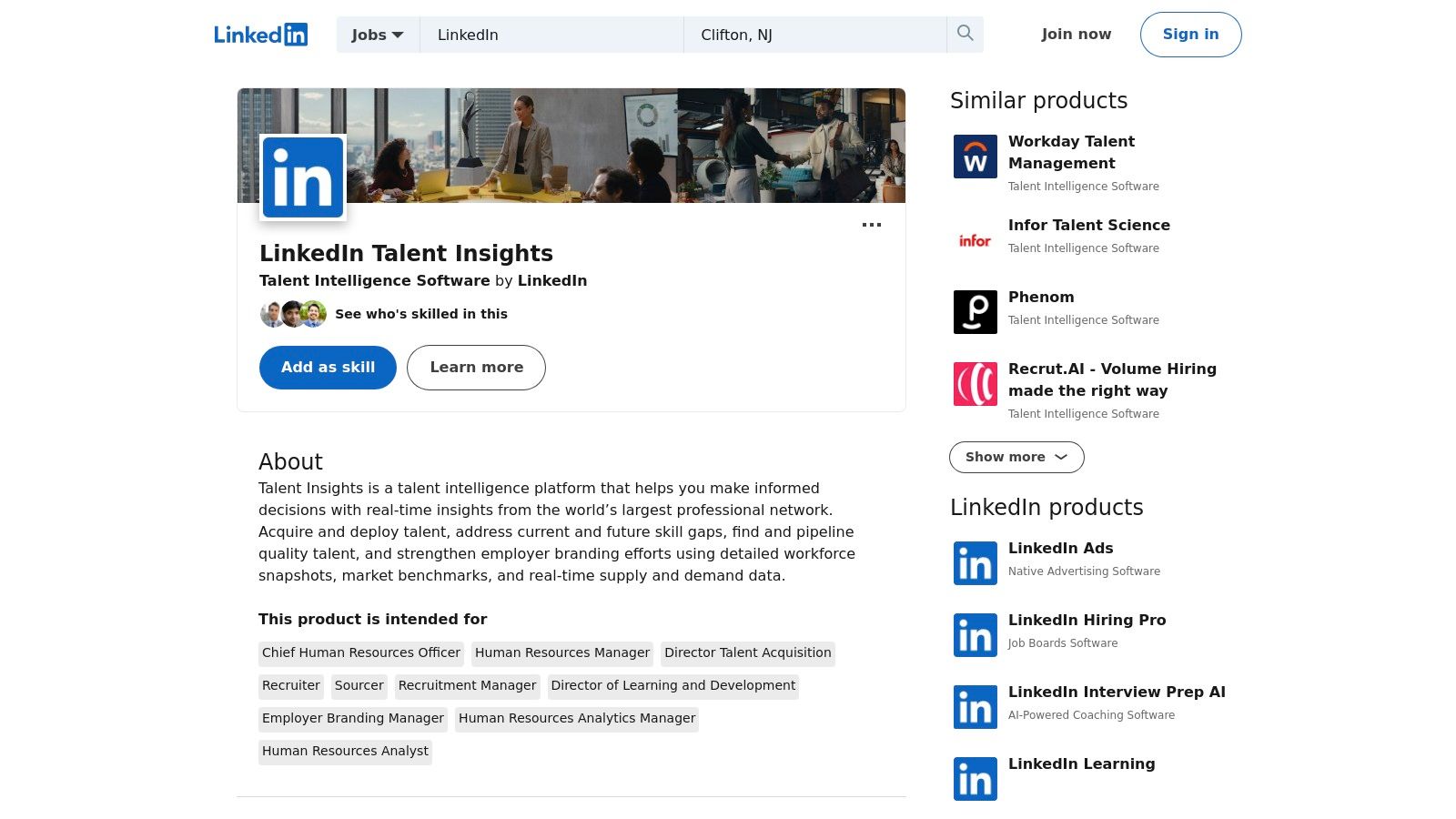
This tool excels at answering high-level strategic questions. For instance, an L&D team can identify emerging skills in their industry and geography to inform future training programs, while a recruitment team can pinpoint locations with a high concentration of specific talent to guide sourcing efforts.
Key Features & Use Cases
- Talent Pool Reports: Analyze the availability of specific skills in any given market, helping you understand the feasibility of hiring for niche roles.
- Company Reports: Benchmark your organization’s skills inventory against competitors to identify critical gaps and competitive advantages.
- Real-time Benchmarking: Access live data on talent migration, hiring demand, and skill saturation to make informed workforce planning decisions.
- Ideal Use Case: Best suited for large HR, talent acquisition, and learning & development teams needing to make data-driven decisions about workforce strategy, location planning, and competitive talent intelligence.
Pros and Cons
| Pros | Cons |
|---|---|
| Unparalleled data from over a billion professionals. | Enterprise-only licensing with no public pricing. |
| Granular filtering by industry, location, and skill. | Access is limited to licensed users, making collaboration harder. |
| Strong reporting and data export capabilities. | Primarily for strategic planning, not individual assessments. |
Access to LinkedIn Talent Insights requires a corporate subscription, with pricing available upon request. Learn more at their official website.
2. Workday Skills Cloud
For organizations already embedded in the Workday ecosystem, Workday Skills Cloud offers a deeply integrated approach to skills intelligence. It acts as the connective tissue across the entire Workday Human Capital Management (HCM) suite, using AI to infer, validate, and harmonize skills data from various HR processes. This makes it a powerful internal tool for understanding the capabilities of your current workforce and identifying critical skills gaps in real-time.
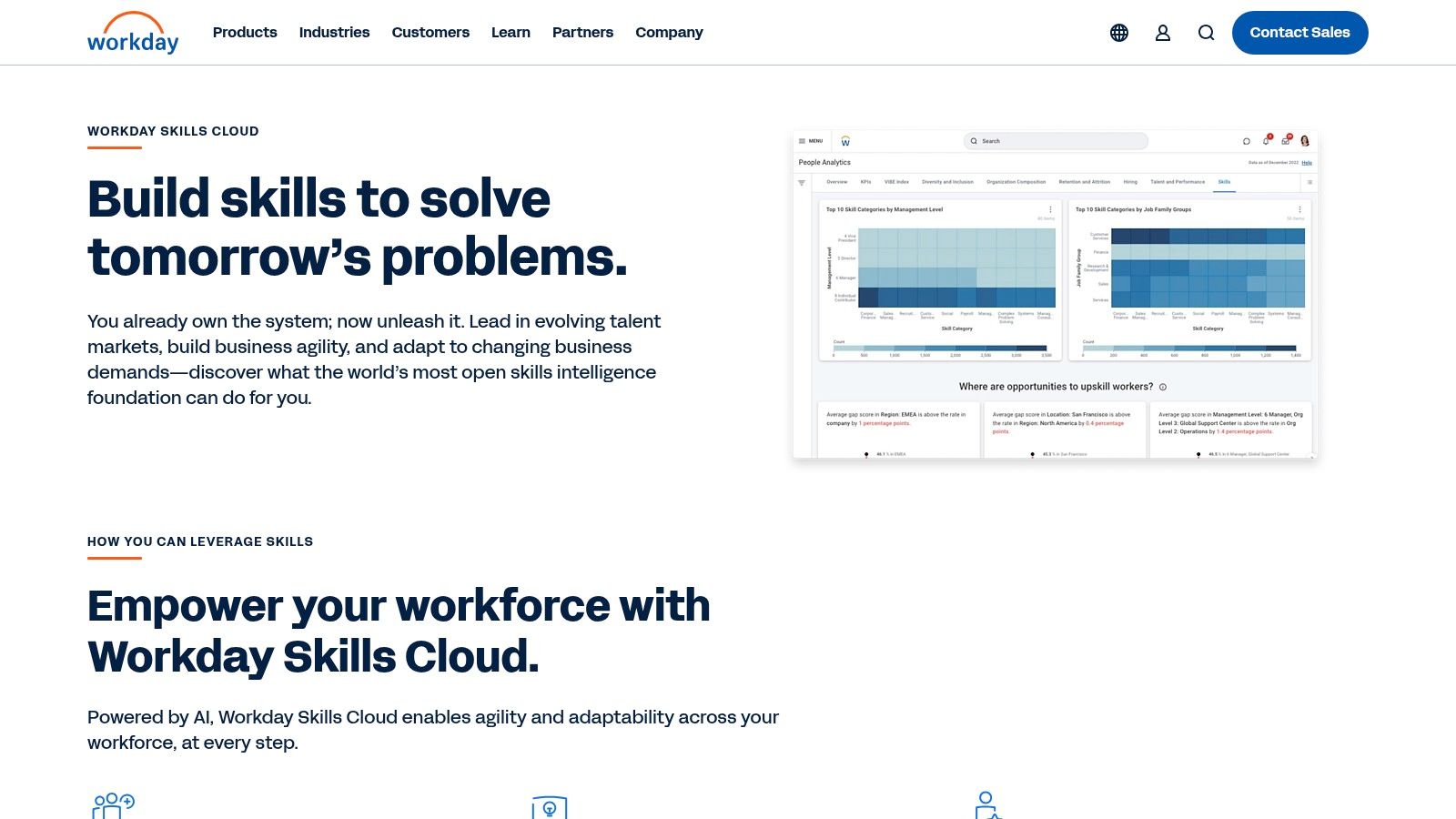
Unlike standalone platforms, Skills Cloud leverages data from recruiting, performance reviews, and learning activities to build a dynamic skills profile for each employee. This allows HR and L&D leaders to seamlessly connect talent supply with internal opportunities, power personalized learning recommendations, and inform strategic workforce planning without ever leaving their core HR system. It's one of the most cohesive skills gap analysis tools for existing Workday customers.
Key Features & Use Cases
- AI-Powered Skills Ontology: Automatically normalizes and categorizes skills from across the HCM suite, creating a single, consistent skills language for the entire organization.
- Integrated HR Workflows: Embeds skills data directly into recruiting, internal mobility, and learning modules to match talent to opportunities and suggest relevant training.
- Workforce Planning Analytics: Use Workday People Analytics and Prism Analytics to visualize skills distribution, identify departmental gaps, and model future talent needs.
- Ideal Use Case: Best for mid-to-large enterprises using the Workday HCM platform that need to operationalize skills data across all talent management functions, from hiring to development.
Pros and Cons
| Pros | Cons |
|---|---|
| Deep, native integration with the Workday HCM suite. | Not a standalone product; requires a Workday subscription. |
| Creates a unified skills language across the organization. | Primarily focused on internal workforce data. |
| AI-driven automation reduces manual skills-tagging. | Pricing is enterprise-level and not publicly available. |
Workday Skills Cloud is available as part of the broader Workday HCM platform. Pricing is customized and available upon request through their official website.
3. Cornerstone Skills Graph (Cornerstone)
Cornerstone Skills Graph is an AI-powered skills engine embedded within the broader Cornerstone talent management suite. It operates as the intelligent layer that maps employee skills, automatically tags learning content, and powers internal mobility. This makes it one of the most integrated skills gap analysis tools for organizations aiming to connect skill deficiencies directly to learning interventions and career development opportunities within a single ecosystem.
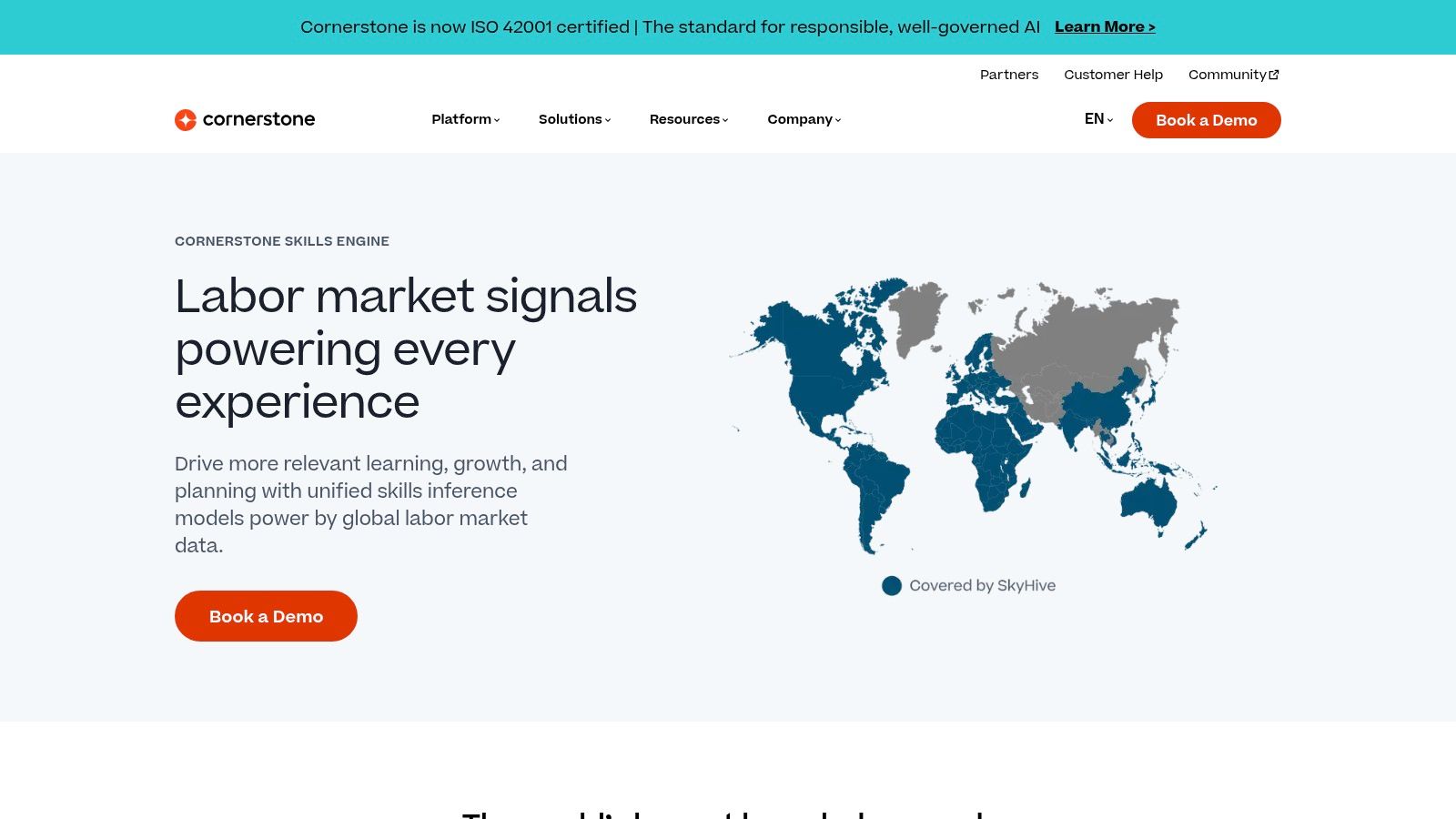
The platform moves beyond simple gap identification by actively prescribing solutions. When a gap is found, the system can recommend specific courses, projects, or mentors from the Cornerstone platform to help an employee bridge that gap. This direct link between analysis and action is crucial for creating an effective career development plan template that employees can follow.
Key Features & Use Cases
- Expansive Skills Ontology: Utilizes a vast library of over 50,000 verified skills to accurately infer and validate employee capabilities from various data sources.
- Automatic Content Tagging: AI automatically analyzes and tags internal and third-party learning content with relevant skills, making it easy to find development resources.
- Career Pathing & Mobility: Recommends new roles and career paths to employees based on their current and adjacent skills, highlighting gaps they need to close for advancement.
- Ideal Use Case: Best for mid-to-large enterprises already using or planning to adopt the Cornerstone ecosystem for learning (LMS), performance, and talent management, creating a unified upskilling experience.
Pros and Cons
| Pros | Cons |
|---|---|
| Tight integration with Cornerstone Learning and content. | Can be complex and require significant implementation effort. |
| Mature, widely deployed enterprise-grade platform. | Pricing and modules are enterprise-led and not transparent. |
| Directly connects gap analysis to learning solutions. | Best value is realized when using the full Cornerstone suite. |
Access to Cornerstone's platform is designed for enterprise clients. Pricing and module information are available upon request through their sales team. Learn more at their official website.
4. Degreed
Degreed is an enterprise learning experience platform (LXP) that positions skill development at the core of corporate learning. It moves beyond traditional course completion metrics to focus on measuring, developing, and certifying employee skills. For organizations looking to bridge critical capability gaps, it serves as one of the most comprehensive skills gap analysis tools by connecting individual skill assessments to a vast ecosystem of curated learning content. HR and L&D leaders can build a unified skills taxonomy, track proficiency levels across the workforce, and guide employees toward personalized development pathways.
The platform excels at creating a culture of continuous learning by empowering employees to own their development. By integrating content from thousands of providers, Degreed ensures that the resources needed to close identified skill gaps are readily available, making it a powerful tool for driving effective career transition planning within an organization.
Key Features & Use Cases
- Skills Assessment & Proficiency Tracking: Measure employee skills against a defined taxonomy using self-ratings, peer feedback, and formal assessments.
- Personalized Learning Pathways: Automatically recommends articles, videos, courses, and projects from a massive content library to help employees close their specific skill gaps.
- Organization-wide Skills Analytics: Provides dashboards and reports that give leadership a clear view of the company's collective skills inventory, highlighting strengths and critical gaps.
- Ideal Use Case: Best for mid-to-large enterprises committed to building a skills-based organization, where L&D teams need to connect skill analysis directly to development opportunities.
Pros and Cons
| Pros | Cons |
|---|---|
| Strong ecosystem and vast content coverage. | Enterprise pricing with limited public transparency. |
| Integrates learning with real-world skill application. | Requires thoughtful configuration and content governance. |
| Regular research on in-demand skills trends. | Can feel complex without a dedicated implementation strategy. |
Degreed is an enterprise solution with pricing available upon request. You can find more information at their official website.
5. Pluralsight Skills (Skill IQ / Role IQ)
Pluralsight Skills is a technology workforce development platform designed to close critical tech skill gaps. It combines adaptive skill assessments with an extensive library of expert-led courses and hands-on labs. By using its proprietary Skill IQ and Role IQ assessments, organizations can precisely measure existing capabilities, benchmark teams against industry standards, and deploy targeted learning paths to address deficiencies, making it one of the most effective skills gap analysis tools for technical upskilling.
The platform moves beyond theoretical knowledge by allowing users to apply new skills in sandboxed cloud environments. This hands-on approach ensures that L&D teams can not only identify gaps but also verify that employees have measurably improved their practical abilities, translating directly to on-the-job performance and project readiness.
Key Features & Use Cases
- Skill IQ Assessments: Adaptive tests that quickly baseline proficiency in specific technologies (e.g., Python, AWS, Azure), providing a score from 0 to 300.
- Role IQ Mapping: Assesses an individual's fitness for a specific job role by evaluating their skill set across multiple required technologies, highlighting exact gaps.
- Analytics & Reporting: Provides managers with detailed dashboards to track team-wide skill progression, identify at-risk areas, and measure the ROI of training initiatives.
- Ideal Use Case: Best for tech leaders, L&D managers, and engineering teams needing to upskill or reskill their workforce in cloud computing, software development, data science, and cybersecurity.
Pros and Cons
| Pros | Cons |
|---|---|
| Clear, quantifiable skill metrics for individuals and teams. | Heavily focused on technology; limited for non-technical roles. |
| Integrates assessments directly with learning paths. | Business plans are priced per-user and billed annually. |
| Self-serve plans are available for individual learners. | Enterprise-level pricing is quote-based and not public. |
Pluralsight offers individual and team plans with pricing available on their website, while enterprise solutions require a custom quote. Learn more at their official website.
6. Coursera for Business (Skills Dashboard)
Coursera for Business transitions from a learning content provider to a strategic L&D partner with its Skills Dashboard. This platform allows organizations to not only provide access to a vast catalog of courses but also to measure, benchmark, and close critical skills gaps. It connects learning activities directly to proficiency levels, making it one of the most practical skills gap analysis tools for companies focused on upskilling their existing workforce to meet business objectives.
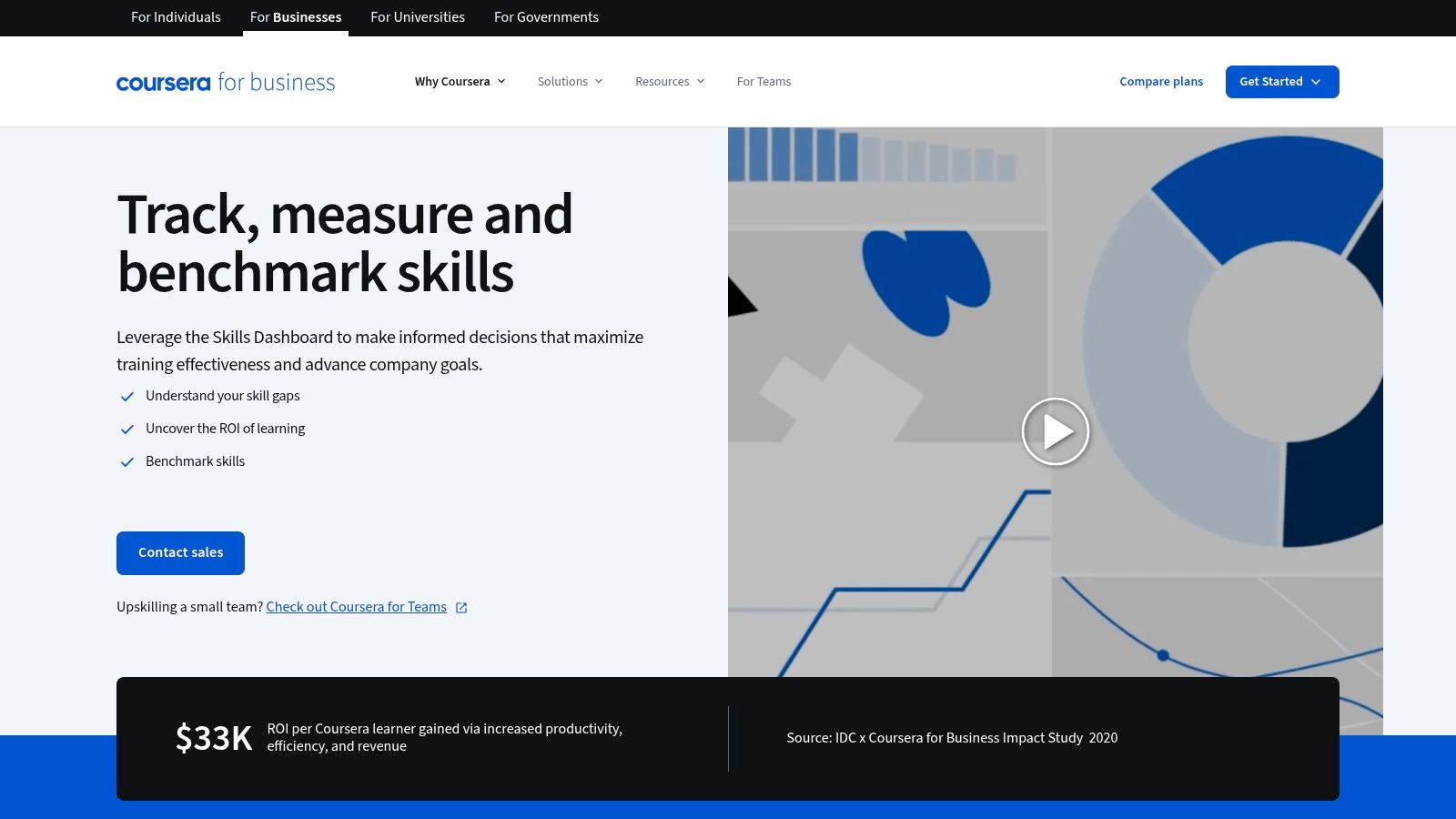
Unlike platforms focused purely on assessment, Coursera provides an end-to-end solution. An HR manager can identify a team’s deficiency in data science, assign a curated learning path with courses from top universities, and then use the dashboard to track progress and skill mastery over time, demonstrating a clear return on their training investment.
Key Features & Use Cases
- Skills Dashboard: Provides analytics on skill proficiency, mastery levels, and hours invested across teams and the entire organization.
- Industry Benchmarking: Compare your workforce’s skill levels against industry peers to identify where you are ahead or falling behind.
- Role-Based Learning Paths: Access pre-built or custom learning programs aligned with specific job roles to target development efforts effectively.
- Ideal Use Case: Perfect for L&D and HR teams in small to large businesses that need a unified platform to both identify skills gaps and provide the necessary training content to close them.
Pros and Cons
| Pros | Cons |
|---|---|
| Combines skill analysis with a world-class content library. | Deeper analytics are restricted to the higher-tier business plans. |
| Content from leading universities and companies like Google. | Skill data accuracy depends entirely on learner engagement and completion. |
| SMB-friendly "Teams" plan makes it accessible for smaller groups. | Primarily focused on closing gaps, not on pre-hire assessments. |
Coursera for Business offers a "Teams" plan for 5-125 users and a custom "Enterprise" plan for larger organizations. Pricing is available upon request. Learn more at their official website.
7. Eightfold AI
Eightfold AI is a comprehensive, AI-native talent intelligence platform designed to manage the entire talent lifecycle. It leverages a massive, continuously updated dataset combining public profiles, enterprise data, and market trends to provide deep insights into workforce skills. Unlike tools that focus solely on existing employee data, Eightfold’s strength lies in its ability to infer adjacent skills and predict future talent needs, positioning it as one of the most forward-thinking skills gap analysis tools for large, dynamic organizations.
The platform helps organizations identify skills gaps not just for current roles but also for future strategic initiatives. Its AI models can map an employee's existing capabilities to potential new roles within the company, facilitating internal mobility and personalized development plans. This holistic approach connects skills analysis directly to talent acquisition, development, and retention strategies.
Key Features & Use Cases
- Skills Intelligence: Provides a unified view of skills across the entire workforce, including both validated and inferred capabilities. This helps in understanding the depth of specific hard skills within the organization.
- Talent Marketplace: Creates an internal mobility platform where employees are matched to projects, mentors, and open roles based on their skills and development goals.
- Adjacent Skills Modeling: Identifies employees with skills closely related to those in high-demand roles, highlighting a hidden talent pool ready for upskilling.
- Ideal Use Case: Best for large enterprises seeking an end-to-end talent management solution that integrates skills gap analysis with recruitment, internal mobility, and diversity and inclusion initiatives.
Pros and Cons
| Pros | Cons |
|---|---|
| End-to-end platform covering multiple HR functions. | Enterprise-only sales model with no public pricing. |
| Very large, continuously refreshed global talent dataset. | AI-based hiring tools face evolving regulatory and ethical scrutiny. |
| Powerful AI for inferring adjacent skills and potential. | Implementation can be complex and requires significant data integration. |
Eightfold AI operates on an enterprise subscription model. Pricing details are available upon scheduling a demonstration through their official website.
8. Gloat
Gloat is an AI-powered talent marketplace that shifts the focus from simply identifying skills gaps to actively closing them through internal mobility. It functions as a dynamic internal ecosystem, connecting employees to projects, gigs, mentorships, and full-time roles based on their skills and development goals. This makes it a proactive tool for workforce agility and one of the most action-oriented skills gap analysis tools available for large enterprises.
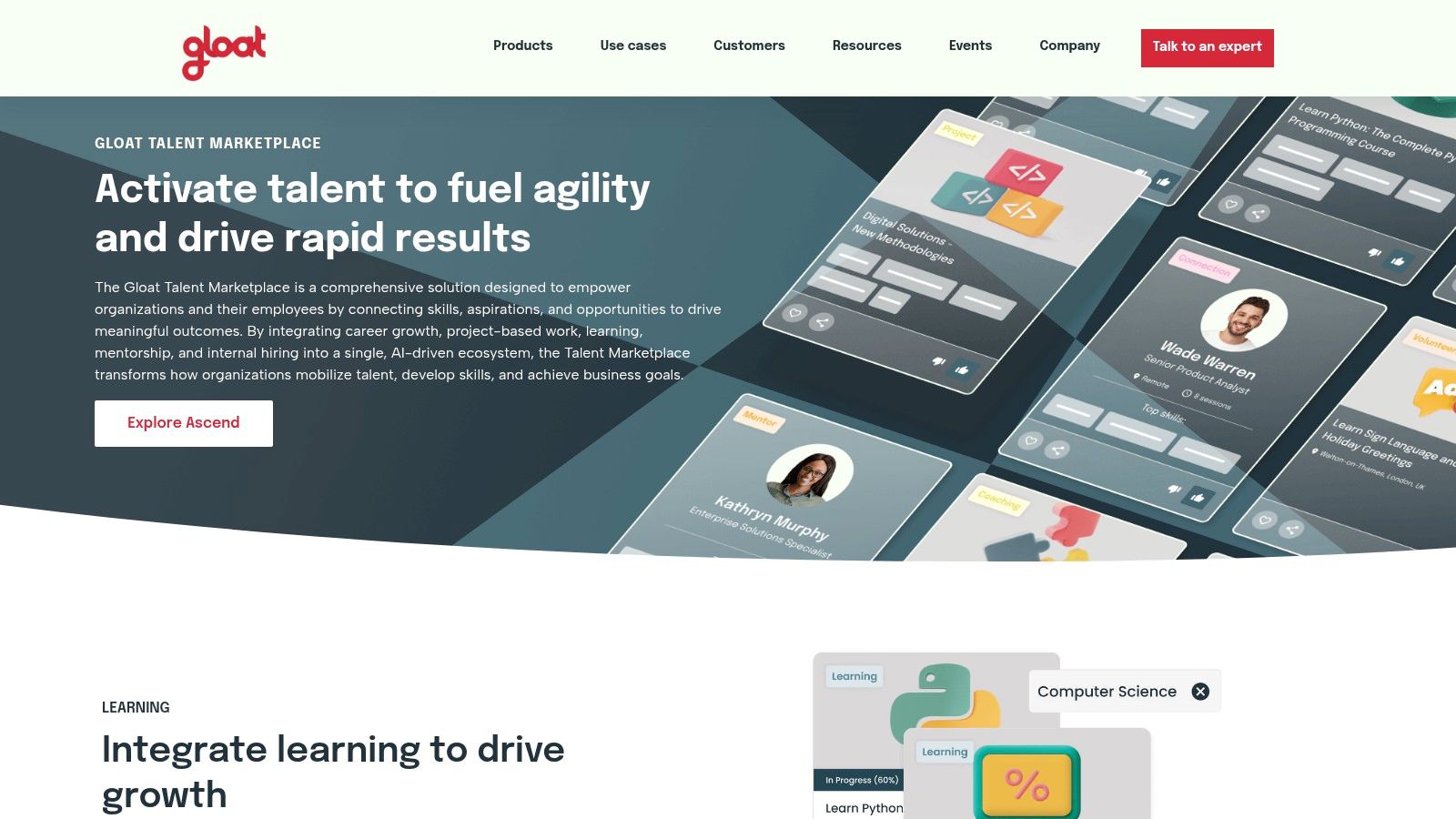
The platform’s "Skills Landscape" provides a powerful visualization of an organization's collective skill supply against current and future business needs. HR and L&D leaders can use this data to pinpoint critical shortages and surpluses, then deploy targeted development opportunities directly within the Gloat marketplace to upskill or reskill their workforce in the natural flow of work.
Key Features & Use Cases
- Talent Marketplace: Enables employees to find and apply for short-term projects, gigs, and mentorship opportunities that help them build new skills.
- Workforce Insights: Delivers dashboards that visualize skills supply versus demand, helping leaders make data-backed decisions on talent development and deployment.
- Career Agility: Empowers employees to self-assess their skills against different career paths within the company, identifying gaps they can close via the marketplace.
- Ideal Use Case: Best for large, forward-thinking organizations looking to foster a culture of internal mobility, continuous learning, and talent fluidity to address skills gaps dynamically.
Pros and Cons
| Pros | Cons |
|---|---|
| Directly links gap analysis to gap-closing actions. | Enterprise-first platform with pricing available on request. |
| Integrates into the flow of work (e.g., Microsoft Teams). | Requires significant change management to adopt a skills-based culture. |
| Boosts employee engagement and retention. | Implementation can be complex for traditionally structured companies. |
Gloat is designed for enterprise clients, and pricing is provided upon consultation. Learn more at their official website.
9. SkyHive
SkyHive is an advanced skills intelligence platform designed to deconstruct jobs and labor markets into their core skill components. It uses ethical AI to build dynamic "Skill Passports" for individuals and comprehensive skill profiles for entire organizations. This approach makes it a powerful diagnostic tool, not just for identifying what skills are missing but for prescribing clear, actionable pathways to close those gaps through learning and internal mobility.
The platform stands out by providing employees with clear match-to-role percentages and concrete guidance on the exact skills or training needed to improve their fit for a target position. This user-centric approach empowers employees while giving HR leaders the data needed for strategic workforce planning, reskilling initiatives, and creating more equitable career pathways.
Key Features & Use Cases
- Skill Passport & Profiles: Creates a verified, real-time skills profile for every employee, showing their strengths and opportunities for growth.
- Gap-to-Role Guidance: Analyzes an employee's profile against a target role and recommends specific learning resources or experiences to bridge the identified gaps.
- APIs & Enterprise Deployment: Offers robust integration options to connect with existing HRIS, LMS, and talent management systems for a seamless data flow.
- Ideal Use Case: Best for large enterprises focused on future-proofing their workforce through internal mobility, reskilling, and data-driven learning and development programs.
Pros and Cons
| Pros | Cons |
|---|---|
| Clear, user-facing visualizations of matches and gaps. | Primarily enterprise deployments with pricing via sales. |
| Emphasis on bias reduction and ethical AI practices. | Requires quality input data and stakeholder enablement. |
| Prescriptive guidance helps both employees and managers. | Implementation can be complex in siloed organizations. |
SkyHive is an enterprise-level solution, and pricing is provided through a direct sales consultation. Learn more at their official website.
10. Visier
Visier is a people analytics platform that provides powerful skills intelligence capabilities to help organizations quantify gaps and strategically plan for the future. Unlike tools focused solely on individual assessments, Visier connects skills data to broader business outcomes like cost, retention, and diversity. This makes it an essential tool for HR and finance leaders looking to build a data-backed, skills-based organizational strategy.
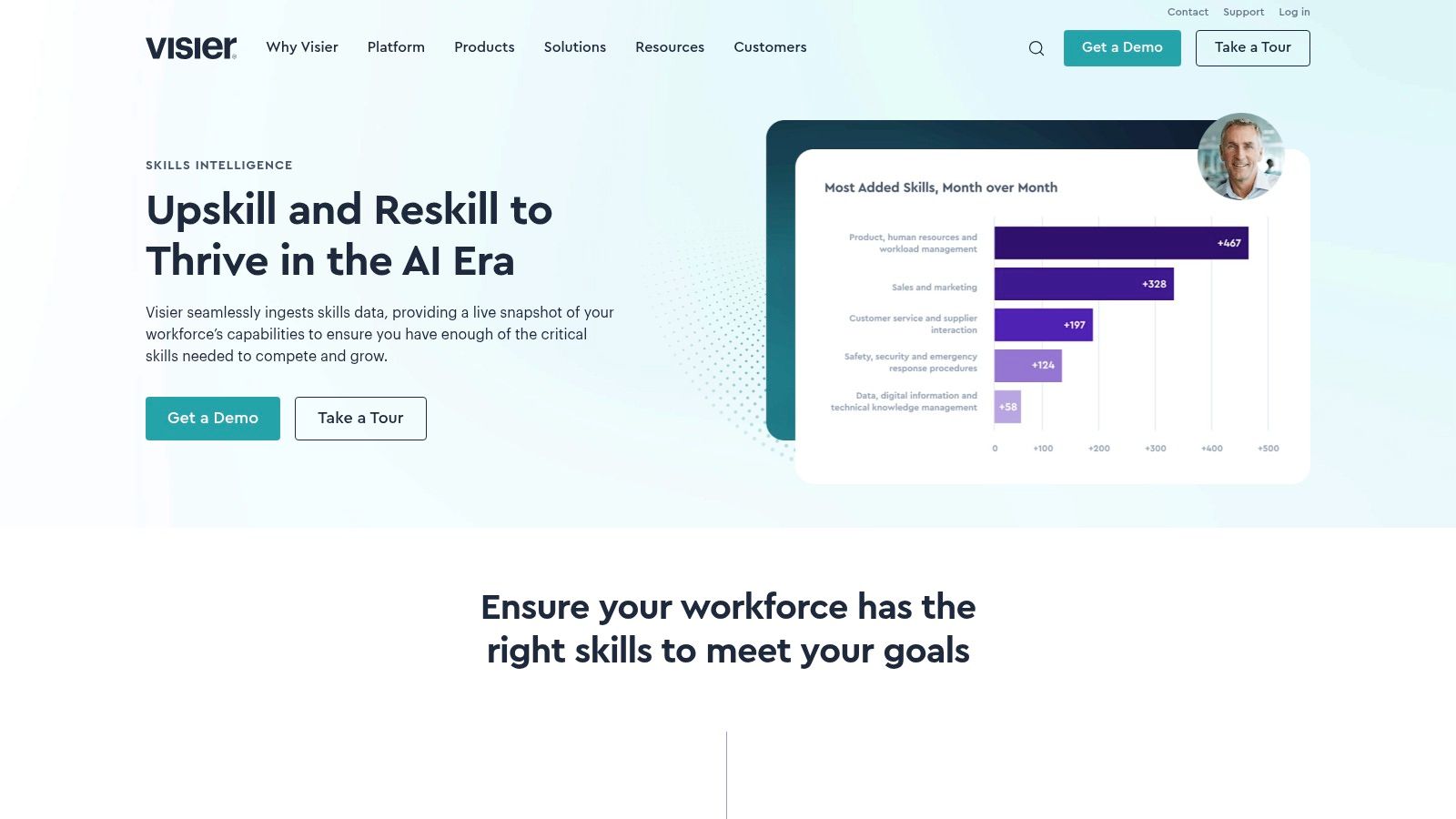
The platform excels at forward-looking analysis, allowing teams to model future scenarios and estimate which skills will be needed, by when, and in what quantity. By integrating with your existing HR systems, Visier transforms raw data into actionable insights, providing a clear path from identifying a skills gap to developing a plan to close it through hiring, training, or internal mobility.
Key Features & Use Cases
- Skills Dashboards: Analyze the workforce through a skills lens, assessing the impact of skills on business metrics like performance and employee turnover.
- Forward-looking Modeling: Quantify future skill needs based on business forecasts, helping you proactively address upcoming talent shortages or surpluses.
- Skills Intelligence APIs: Integrate Visier's skills data and analytics into other platforms and workflows for faster time-to-value and a more connected ecosystem.
- Ideal Use Case: Best for enterprise-level people analytics, HR, and finance teams that need to connect skills data to strategic business planning and prove the ROI of talent initiatives.
Pros and Cons
| Pros | Cons |
|---|---|
| Strong analytics depth and connector ecosystem. | Enterprise sales cycle with no public pricing. |
| Links skills directly to measurable business outcomes. | Best results require robust, harmonized HR data. |
| Useful for people analytics teams bridging HR and finance. | Can have a steep learning curve for non-analysts. |
Visier's pricing is available through a direct sales consultation. Learn more at their official website.
11. Lightcast
Lightcast offers market-leading labor market intelligence and skills analytics, providing a powerful external lens for strategic workforce planning. Instead of focusing on internal employee data, it analyzes millions of job postings and professional profiles to map skill trends, demand, and career pathways. This makes it an essential resource for organizations aiming to align their talent strategy with real-world market dynamics and one of the most comprehensive skills gap analysis tools for macroeconomic insights.
The platform is trusted by corporations, government agencies, and educational institutions to understand which skills are growing, which are declining, and how roles are evolving. An L&D department could use Lightcast data to validate its reskilling priorities, ensuring training investments are directed toward skills with high future demand, not just internal perceptions of need.
Key Features & Use Cases
- Skills Taxonomy and Insights: Access a comprehensive open skills library to understand skill relationships, similarity, and career pathways.
- Labor Market Analytics: Analyze real-time job posting trends to identify in-demand skills, top employers, and salary benchmarks by location.
- Strategic Workforce Planning: Complement internal HR data with external market intelligence to build future-proof roles and prioritize critical skill development.
- Ideal Use Case: Perfect for HR strategy teams, corporate L&D leaders, and educational planners who need to make data-driven decisions based on broad labor market trends, not just internal assessments.
Pros and Cons
| Pros | Cons |
|---|---|
| Deep US labor market coverage trusted by government. | Pricing is quote-based and not publicly available. |
| Excellent for validating internal data against external trends. | Some advanced modules are sold as add-ons. |
| Strong research and reports on skill velocity. | Data limitations should be verified for major decisions. |
Access to Lightcast's platform is available via custom subscription plans. Learn more at their official website.
12. Skills Base
Skills Base offers a practical and accessible approach to skills management, positioning itself as a streamlined alternative to complex enterprise systems. It enables organizations, particularly small to mid-sized businesses, to track, assess, and report on employee skills using intuitive matrices and proficiency targets. The platform is designed for clear visibility, providing managers and HR teams with the data needed to conduct an effective skills gap analysis without a steep learning curve or heavy administrative overhead.
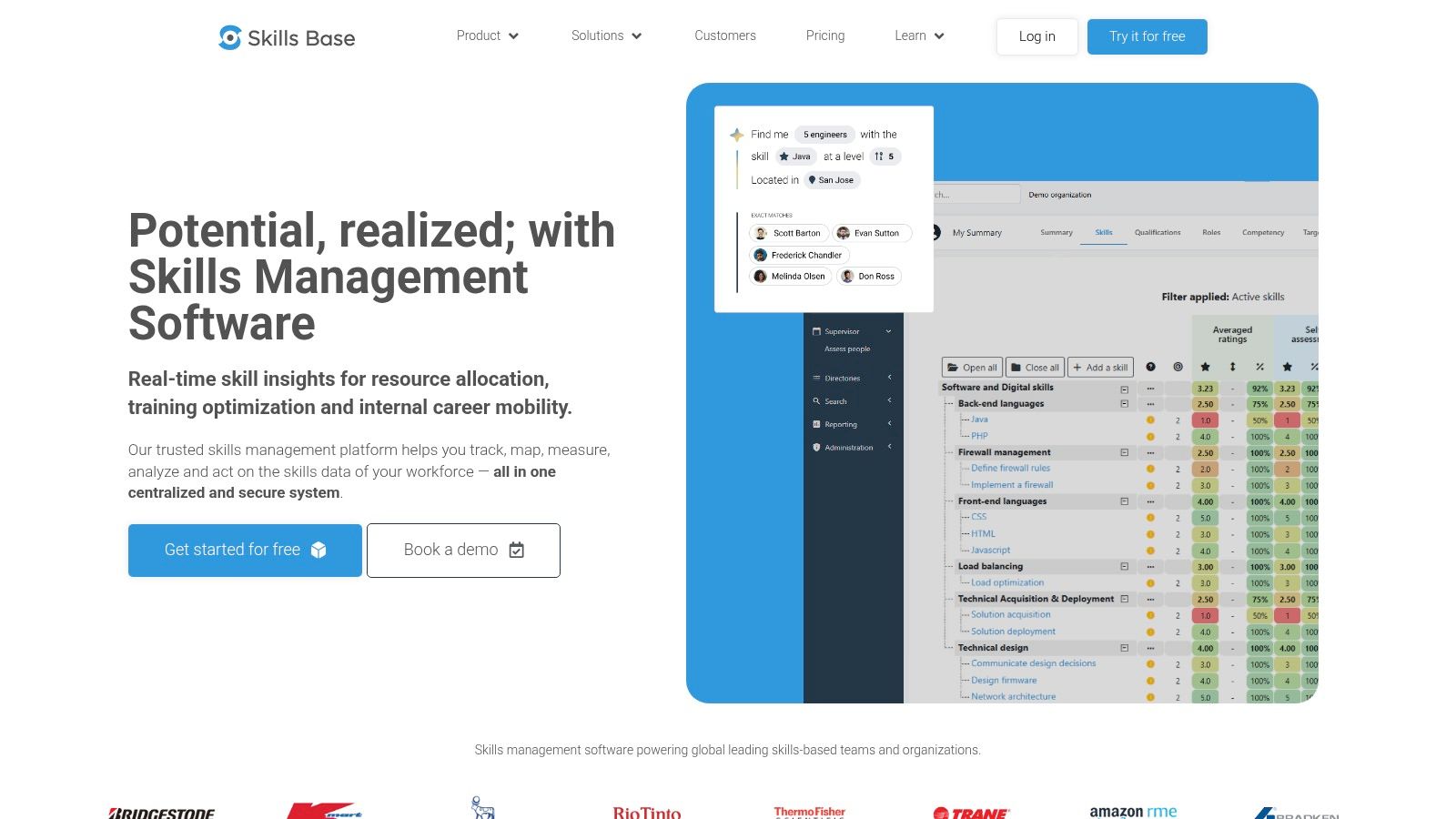
The platform focuses on internal competency mapping through self-assessments and supervisor evaluations, which helps in identifying specific training needs and succession planning opportunities. Its straightforward reporting tools help teams visualize strengths and weaknesses across departments, making it one of the more user-friendly skills gap analysis tools for teams that need to get started quickly. For those wondering about the fundamental steps, you can learn more about how to identify skill gaps in your own processes.
Key Features & Use Cases
- Skills Matrix: Visualize team capabilities with a clear matrix that tracks current proficiency against target levels for specific roles.
- Self & Supervisor Assessments: Facilitate a 360-degree view of an employee’s skills by combining personal input with managerial evaluation.
- Pre-built Reports: Generate reports on team capabilities, skill gaps, and training needs to inform L&D budget allocation and strategic planning.
- Ideal Use Case: Best for SMBs and departmental teams within larger organizations that require a straightforward, easy-to-implement tool for internal skills tracking and development planning.
Pros and Cons
| Pros | Cons |
|---|---|
| Transparent pricing, including a free tier for small teams. | Less external market data compared to larger platforms. |
| Quick to deploy and easier to administer than enterprise suites. | Advanced AI analytics require a separate add-on. |
| Strong focus on practical internal skills management. | The user interface is more functional than cutting-edge. |
Skills Base offers several pricing tiers, starting with a free plan for up to 25 users. Paid plans scale with features and user count. Learn more at their official website.
Skills Gap Analysis Tools — 12-Tool Feature Comparison
| Product | ✨ Core features | 👥 Target audience | 🏆 Unique selling points | ★ UX / Quality | 💰 Pricing / Value |
|---|---|---|---|---|---|
| LinkedIn Talent Insights | Talent pool & company reports, real-time benchmarking, exportable reports ✨ | HR & recruiting teams, enterprises 👥 | Unmatched network data & market coverage 🏆 | ★★★★★ enterprise-grade analytics | 💰💰💰 Enterprise license, quote-based |
| Workday Skills Cloud | AI skills normalization, native Workday integrations, external data ingest ✨ | Workday customers, large orgs 👥 | Deep HCM integration across HR workflows 🏆 | ★★★★☆ seamless within Workday | 💰💰💰 Quote-based (enterprise) |
| Cornerstone Skills Graph | 50k+ skills graph, auto content tagging, career pathing ✨ | L&D & HR teams, enterprises 👥 | Tight LMS/content ecosystem & mature platform 🏆 | ★★★★☆ proven at scale | 💰💰💰 Module-based, enterprise pricing |
| Degreed | Skills assessment, personalized learning pathways, org analytics ✨ | L&D teams, enterprises 👥 | Broad content ecosystem & benchmarking research 🏆 | ★★★★☆ learner-focused UX | 💰💰💰 Enterprise pricing, custom |
| Pluralsight Skills | Adaptive Skill IQ & Role IQ, hands-on labs, analytics ✨ | Tech teams, developers, individual learners 👥 | Quantifiable tech skill measures (Skill/Role IQ) 🏆 | ★★★★☆ focused technical UX | 💰💰💰 Per-user annual; team plans |
| Coursera for Business | Skills Dashboard, 12k+ courses, role-based learning paths ✨ | SMBs, L&D, enterprises 👥 | Academic & corporate course breadth 🏆 | ★★★☆☆ strong content; engagement-dependent | 💰💰💰 Teams/enterprise plans; scalable |
| Eightfold AI | Skills intelligence, inferred & adjacent-skills modeling, talent marketplace ✨ | Enterprise talent & recruiting teams 👥 | Large refreshed talent dataset; end-to-end AI 🏆 | ★★★★☆ powerful AI-driven insights | 💰💰💰 Enterprise sales, quote |
| Gloat | Skills Landscape, internal gigs/projects, workforce insights ✨ | Enterprises focused on internal mobility 👥 | Activation via projects & marketplace integration 🏆 | ★★★★☆ user-centric mobility tools | 💰💰💰 Quote-based enterprise |
| SkyHive | Skill Passport, match-to-role %, gap-to-role recommendations ✨ | Enterprises, people analytics teams 👥 | Clear match visualizations + ethical AI emphasis 🏆 | ★★★★☆ intuitive visual UX | 💰💰💰 Enterprise pricing |
| Visier | Skills dashboards, forward-looking modeling, APIs ✨ | People analytics, HR & finance 👥 | Deep analytics & connector ecosystem 🏆 | ★★★★☆ analytics-first experience | 💰💰💰 Quote-based, enterprise |
| Lightcast | Labor-market intelligence, skills taxonomy, career-path models ✨ | Government, education, enterprises 👥 | Research-grade market coverage & trend reports 🏆 | ★★★★☆ robust data tooling | 💰💰💰 Quote-based, modules/add-ons |
| Skills Base | Skill matrices, assessments, prebuilt reports, APIs ✨ | SMBs & enterprises; quick pilots 👥 | Transparent pricing tiers & fast pilots 🏆 | ★★★☆☆ practical, easy to admin | 💰 / 💰💰 Free tier + paid tiers/add-ons |
Beyond Tools: Building Your Skills-First Strategy
Navigating the landscape of modern talent management requires more than just good intentions; it demands the right technology. Throughout this guide, we've explored a dozen of the most powerful skills gap analysis tools available, from enterprise-grade AI platforms like Eightfold and SkyHive to specialized learning ecosystems like Pluralsight and Degreed. Each offers a unique lens through which organizations and individuals can view, measure, and ultimately close critical skill deficiencies.
We’ve seen how platforms like LinkedIn Talent Insights provide invaluable market-level data, while tools like Workday Skills Cloud integrate skills intelligence directly into your HRIS. For L&D teams, the dashboards within Coursera for Business or the assessments from Pluralsight Skills offer a direct path from gap identification to skill development. Meanwhile, talent marketplaces like Gloat empower internal mobility, turning potential skill gaps into opportunities for growth. The core takeaway is clear: there is no single "best" tool, only the best fit for your specific context and goals.
Synthesizing Your Strategy: From Data to Action
Choosing a tool is just the beginning. The real transformation happens when you embed its insights into a holistic, skills-first culture. Simply identifying a gap is a passive act; building a bridge across it requires a proactive strategy. This involves not just deploying software but fundamentally shifting how you approach talent development, recruitment, and career progression.
To make your chosen skills gap analysis tool truly effective, consider these crucial implementation factors:
- Stakeholder Buy-In: Ensure that leaders from HR, L&D, and individual departments understand the "why" behind the initiative. Communicate how a skills-first approach drives business outcomes, from faster innovation to higher employee retention.
- Data Integration: The most powerful insights come from connected data. Your chosen tool should integrate smoothly with your existing HRIS, LMS, and ATS to create a unified, dynamic picture of your workforce's capabilities.
- Clear Career Pathways: Use the data from your analysis to build transparent career lattices, not just ladders. Show employees how acquiring specific skills can unlock new roles and opportunities within the organization, fostering a sense of ownership over their development.
Choosing the Right Platform for Your Needs
Selecting the ideal platform from this extensive list depends entirely on your primary objectives. To simplify your decision-making process, consider which of these user profiles best describes you or your organization:
- For Large Enterprises Seeking a Unified Talent Intelligence Platform: Look towards comprehensive solutions like Eightfold AI, Gloat, or SkyHive. These tools leverage AI to manage the entire talent lifecycle, from acquisition to internal mobility and development.
- For HR and L&D Teams Focused on Upskilling and Reskilling: Platforms like Degreed, Pluralsight Skills, and Coursera for Business are excellent choices. They seamlessly connect skills assessment with curated learning content, making the path from identification to resolution clear and actionable.
- For Data-Driven People Analytics and Strategic Workforce Planning: If your goal is high-level strategic insight and forecasting, Visier and Lightcast provide robust analytics and labor market data to inform long-term decisions.
- For Individual Job Seekers and Career Changers: While most of these tools are enterprise-focused, the principles are universal. Your goal is to conduct a personal skills gap analysis against every job description. This involves meticulously identifying the required skills and comparing them to your own, a process that can be streamlined with dedicated career management tools.
Once you’ve identified the gaps, the next logical step is to source the right training to close them. With countless options available, finding the best fit can be challenging. For a detailed breakdown of leading educational providers, this ultimate online course platform comparison can help you select the most effective resources to implement targeted training initiatives.
Ultimately, the goal is not merely to fill gaps but to build a resilient, agile, and forward-thinking workforce. Whether you are an HR leader shaping the future of your company or a job seeker navigating your own career path, the focus remains the same: understand the skills you have, identify the skills you need, and create a deliberate plan to bridge the distance. This continuous cycle of assessment and development is the true engine of sustainable growth in the modern world of work.
Ready to take control of your personal skills gap analysis? While enterprise tools map the organization, Eztrackr empowers you, the job seeker. Use its skill-match analyzer to instantly compare your resume against any job description, pinpointing exact skill gaps and keywords you're missing. Stop guessing and start targeting your applications with data-driven confidence by trying Eztrackr today.