Career Transition Planning: Mastering career transition planning for a new role
Welcome to your roadmap for a successful career change. Think of career transition planning as the deliberate process of figuring out what you want, what you have, and what you need to get there. It’s how you turn that nagging feeling of "what's next?" into a clear, confident path forward.
Why Career Transition Planning Matters Now More Than Ever
Let's be honest—the days of a straight-line career are over. In today's fast-moving job market, being proactive isn't just a good idea; it's essential for your long-term happiness and growth. Success now means intentionally navigating shifts, picking up new skills, and making sure your work actually aligns with your values.
This guide is designed to break that big, scary idea of a "career change" into a series of manageable steps. We'll walk through the essentials of a smart pivot:
- Getting Real with Yourself: It all starts here. We'll dig into your true motivations, define your non-negotiables, and figure out what a fulfilling career actually looks like for you.
- Mapping Your Skills: This is about taking a clear-eyed inventory of the skills you already have and identifying the specific ones you need to bridge the gap to your dream role.
- Making It Happen: We'll build a practical plan covering everything from networking and polishing your personal brand to absolutely nailing the interview process.

The Ground is Shifting Beneath Our Feet
The need for a solid plan is more urgent than ever, thanks to some major shifts in the global job market. Projections show that between 2025 and 2030, an estimated 22% of today's jobs will either be brand new or displaced entirely.
What's more, the average worker can expect that nearly 39% of their current skills will need a major update or become obsolete in that same period. That's a huge number, and it underscores just how critical it is to keep adapting.
A career transition isn't just about finding a new job; it's about designing the next chapter of your professional life with intention and purpose.
This reality makes a thoughtful approach to change absolutely essential. If you’re thinking about a big move mid-career, you’ll find that having a structured plan is the key to getting it right. The high-achiever's guide to career change at 35 dives deep into this very topic and is well worth a read.
Your Framework for a Confident Change
To make this all a bit more concrete, think of your career transition in four distinct phases. Each one builds on the last, moving you from initial thoughts to landing your new role.
The Four Phases of Career Transition Planning
| Phase | Key Objective | Primary Activities |
|---|---|---|
| 1. Discovery & Reflection | Gain clarity on your values, interests, and non-negotiables. | Self-assessment, journaling, career coaching, informational interviews. |
| 2. Research & Exploration | Identify viable new career paths and roles. | Market research, exploring job descriptions, networking with professionals in target fields. |
| 3. Skill Bridging & Branding | Close any skill gaps and update your professional materials. | Taking courses, earning certifications, updating your resume/LinkedIn, crafting your story. |
| 4. Execution & Launch | Actively apply, interview, and land your new role. | Job searching, networking for referrals, interview prep, negotiating offers. |
This framework isn't rigid, but it provides a reliable structure. It empowers you to take control rather than just reacting to whatever comes your way.
By following a clear process, you build momentum, stay focused, and handle the inevitable bumps in the road with much more confidence. For more actionable advice, be sure to check out our guide filled with practical career change tips.
Start With Yourself: Finding Your Career Compass
Diving headfirst into job applications without a clear sense of direction is like setting sail without a map. I've seen it time and time again: the most fulfilling career changes always start with some deep, honest self-reflection. Before your browser history fills up with job boards, you need to define your personal career compass—that internal guide pointing you toward work that actually fits.
This isn't about generic advice. It's about doing a personal "life audit" to figure out your core values, your absolute non-negotiables, and what genuinely sparks your interest. So many people skip this step because they're eager for action, but this foundation is what stops you from landing in another ill-fitting role a year from now.

Uncovering Your Core Career Values
Your values are the beliefs that drive your satisfaction at work. When your job lines up with them, you feel motivated and engaged. When it doesn’t, you feel drained, even if the paycheck is great. The goal here is to nail down your top three to five non-negotiable values.
Get out a notebook and start asking yourself some pointed questions. Don't just think about the answers; writing them down makes them real.
- What accomplishments—inside or outside of work—have made you proudest?
- Think about a peak moment at work. What were you doing? What made it so great?
- On the flip side, what tasks or environments just completely suck the life out of you?
For example, a project manager battling constant burnout might realize that the relentless deadlines and rigid processes are the real problem. Their best moments were always in brainstorming sessions, solving problems creatively. That insight points directly to a core value of creative autonomy—a critical piece of their new career compass.
Identifying Your Non-Negotiables
Beyond those big-picture values, we all have practical, real-world needs. These are your non-negotiables—the deal-breakers that no amount of interesting work can make up for. Ignoring them is a surefire way to end up miserable.
Think about the nuts and bolts of your work life:
- Work Environment: Do you need the buzz of a collaborative office, or are you most productive in a quiet, remote setup?
- Compensation and Benefits: What’s the absolute minimum salary you need? Are things like health insurance or a retirement plan must-haves?
- Work-Life Balance: Is a predictable 9-to-5 schedule sacred, or do you crave the flexibility to make your own hours?
A software developer might value a high salary but realize their true non-negotiable is working remotely to be there for their family. That one factor immediately cuts out a huge chunk of potential jobs, saving them a ton of time and energy in their career transition planning.
Pinpointing what energizes you versus what drains you is the most critical first step. This self-awareness acts as a filter, ensuring that every subsequent decision—from the industries you explore to the companies you target—is aligned with your authentic needs.
Mapping Your Interests and Passions
Last but not least, what do you actually enjoy doing? This isn't just about hobbies. It’s about the kinds of problems you love to solve and the topics you find yourself learning about for fun. These interests often hold clues to fulfilling career paths you've never even considered.
Try a mind map. Start with a central idea like "What Energizes Me?" and just branch out with everything that comes to mind, no matter how small. A financial analyst might jot down "organizing complex data," "teaching others," and "writing." Suddenly, this could reveal a hidden passion for a role in instructional design or technical writing within the finance world.
Practical Self-Assessment Tools
While reflection is key, a few structured tools can give you a solid framework for your thoughts. They can help validate what you’re feeling and maybe even introduce new ideas.
- Values, Interests, Personality, Skills (VIPS): This is a great holistic framework. You’ve already dug into values and interests; now think about your personality (are you an introvert or an extrovert?) and your skills (what are you actually good at?).
- O*NET Interest Profiler: This is a free tool from the U.S. Department of Labor. It helps you connect your interests to real-world jobs.
- Myers-Briggs Type Indicator (MBTI): While it's not the final word on career choice, it can offer some really useful insights into how you process information and interact with the world, which can help define your ideal work environment.
When you combine deep personal reflection with these kinds of tools, you build a solid, detailed understanding of yourself. That's your career compass. With it, you're not just looking for any job anymore—you're looking for the right one, and you'll know it when you see it. This groundwork changes your job search from a frantic scramble into a focused, intentional journey.
Mapping Your Skills and Bridging the Gaps
Alright, you’ve picked a new direction for your career. Awesome. Now comes the real work: figuring out how to actually get there. This is where we move from the daydreaming phase to the "roll up your sleeves" phase. It's all about taking a good, hard look at the skills you have right now and identifying what you need to learn to make your target role a reality.
Think of it less as a critique of your resume and more as building a bridge. You're on one side, your dream job is on the other, and we're about to lay down the planks to get you across.
Creating Your Personal Skills Inventory
First things first, let's take stock of what you're already working with. You’d be surprised how much of your expertise is more valuable and transferable than you think, even if you're jumping into a totally different industry.
Get a document open and create two lists. This isn't just busywork; it's about seeing your professional worth from every angle, not just what your last job title was.
Hard Skills: These are the concrete, teachable things you can do.
- Software you know: Salesforce, Adobe Creative Suite, Python, etc.
- Languages you speak: Fluency in Spanish, basic HTML/CSS, you name it.
- Technical know-how: Data analysis, project management, graphic design.
- Certifications you've earned: PMP, Google Analytics IQ, AWS Cloud Practitioner.
Soft Skills: This is the good stuff—how you operate as a human being at work. These skills are gold because they're valuable everywhere.
- Communication: Public speaking, crisp technical writing, actually listening to people.
- Leadership: Motivating a team, mentoring junior colleagues, making tough calls.
- Problem-solving: Thinking on your feet, adapting to chaos, coming up with creative fixes.
- Collaboration: Playing well with others, resolving disagreements, having empathy.
I've seen a retail manager feel totally unqualified for a tech job, but when we dug in, we found a goldmine. They had years of experience in team leadership, conflict resolution, and inventory management—which is just another name for project management. Seeing those connections is the first step to telling your new career story.
Performing a Strategic Gap Analysis
Now that you know what you've got, it's time to figure out what you need. This is the gap analysis. It’s a simple comparison of your skills list against what companies are actually asking for in your target role.
Your mission, should you choose to accept it, is to find 10 to 15 job descriptions for the exact role you want. Don't just skim them. Copy and paste the "Requirements" or "Qualifications" sections into one big document. Pretty soon, you'll see the same keywords and required skills popping up over and over.
Pay close attention to the must-haves. If every single "Digital Marketing Specialist" job demands a "Google Ads certification" and "SEO experience," you’ve just found your top priorities. These are the gaps you absolutely have to fill.
Your gap analysis isn't just a to-do list; it's a data-driven roadmap. It turns a vague goal like "I need to learn marketing" into a concrete objective like, "I will earn my Google Ads certification and complete three hands-on SEO projects."
This completely removes the guesswork. You're no longer just learning skills you think might be useful. You're strategically acquiring the exact qualifications that hiring managers have on their checklist. If you want to dive deeper into making these kinds of smart moves, our guide on how to pivot careers effectively has even more practical tips.
Crafting Your Personalized Development Plan
Okay, you've identified the gaps. The final piece of the puzzle is building a plan to fill them. There’s no single right way to do this; the best path for you depends on your budget, timeline, and how you learn best.
Here’s a quick comparison to help you weigh your options:
Bridging Your Skill Gaps A Comparison of Learning Methods
| Method | Best For | Typical Cost | Time Commitment |
|---|---|---|---|
| Formal Education | Fields requiring degrees/licenses (nursing, law) or major career resets. | $10,000 – $100,000+ | 1-4+ years |
| Online Certifications | Filling specific, in-demand skill gaps quickly (e.g., Google Ads, PMP). | $50 – $2,000 | 1-6 months |
| Self-Paced Courses | Gaining foundational knowledge on a budget (e.g., platforms like Coursera, Udemy). | $15 – $500 | Flexible |
| Freelance/Volunteer Work | Building a portfolio and getting crucial hands-on experience. | Free | Varies |
A mix-and-match approach is usually the most effective. You might take an online course for the theory, then find a small freelance project to prove you can apply it in the real world.
The key is to be specific and set deadlines. Don't just say, "I'll learn content marketing." Instead, make a real plan: "Complete the HubSpot Content Marketing certification by the end of this month, then write and publish three guest blog posts for industry websites within the next quarter."
This is how you turn an overwhelming dream into a series of small, manageable wins.
Building Your Strategic Action Plan
An idea without a plan is just a daydream. This is the part where your soul-searching and skills mapping finally become a concrete, time-bound strategy. We're moving from “what if” to “here’s how,” creating a clear roadmap with manageable milestones that will actually get you from where you are today to where you want to be.
Think of this action plan as your single source of truth. It's what will keep you focused when you feel overwhelmed and give you a tangible way to see how far you've come.
Setting SMART Goals for Your Transition
A good plan is built on clear, measurable objectives. Vague goals like "find a new job" are a recipe for procrastination and burnout. Instead, we’ll lean on the tried-and-true SMART framework—Specific, Measurable, Achievable, Relevant, and Time-bound—to break things down.
Your transition isn't one giant goal; it's a project with a bunch of smaller phases. You need distinct SMART goals for each one.
- Upskilling: Don't just say, "learn SEO." A much better goal is, "Complete the Google Analytics IQ certification by October 31st and write one SEO-optimized blog post per week for my personal portfolio."
- Networking: Instead of a fuzzy goal like "network more," try this: "Conduct two informational interviews per week for the next month with professionals in the user experience design field."
- Job Applications: Forget "apply for jobs." The real goal is, "Apply to 10 well-researched, targeted roles each week using a tailored resume and cover letter."
This approach turns a mountain into a series of small, climbable hills. For more guidance on structuring these objectives, looking at a detailed career development plan template can give you a fantastic starting point.
Calculating Your Financial Runway
Okay, let's talk about the big one: money. One of the most critical parts of your plan is figuring out your "transition runway"—the amount of time you can afford to manage with a reduced or even zero income while you make your move.
Start by tracking your essential monthly expenses: housing, utilities, food, insurance, and any debt payments. Multiply that number by the number of months you think your transition will take. A buffer of 3-6 months of living expenses is a common recommendation, but this really depends on your personal risk tolerance and the industry you're trying to break into.
Your financial runway isn't just a safety net; it's a source of confidence. Knowing you have a buffer allows you to make decisions from a place of strategy, not desperation, giving you the freedom to wait for the right opportunity.
It also helps to visualize where your skill development fits into this timeline. You need to know what steps come first before you can even think about earning in your new field.
This graphic breaks down the skill-mapping journey into three clear phases: Inventory, Analyze, and Develop.
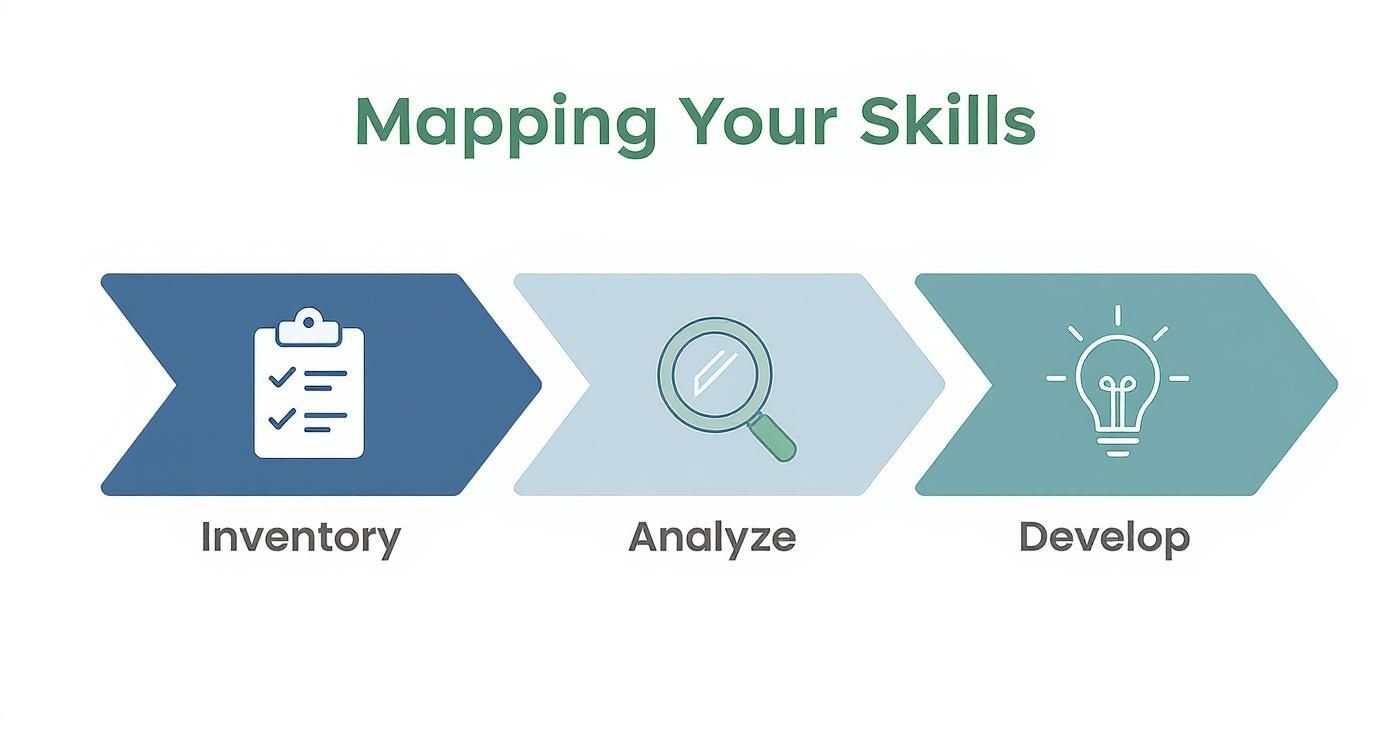
The flow here is important—it shows that developing new skills is the final, actionable step that only comes after a thorough inventory and analysis of what you already bring to the table.
Creating a Tangible Timeline
With your goals set and your finances sorted, it's time to build a timeline. This isn't about creating a rigid, stressful schedule that makes you feel bad if you fall behind. It's about breaking your plan down into weekly and monthly milestones so you can see you're making steady progress.
A simple spreadsheet or a digital tool like Trello can work wonders here. Create columns for each month of your transition and slot in your SMART goals.
- Month 1: Finalize skills gap analysis. Enroll in that key certification course. Conduct four informational interviews.
- Month 2: Complete the certification. Build a small portfolio project. Update your LinkedIn profile and resume with your new skills.
- Month 3: Begin applying to 5-10 targeted jobs per week. Continue networking and attending virtual industry events.
And hey, if your strategic plan involves launching your own thing, you'll need to think about the formal business steps, too. This complete guide to incorporating a business in Canada is a great resource for that.
This kind of timeline keeps you accountable and helps you see how all those small, consistent actions build some serious momentum over time.
Executing Your Career Change with Confidence
All that planning and soul-searching has brought you here. This is the moment where the rubber meets the road—where your strategy turns into real-world action. Now, it’s all about getting out there and confidently introducing the new you to hiring managers and future colleagues.
Success from this point forward comes down to three things: storytelling, networking, and a healthy dose of resilience.
This part can feel like the scariest, but remember, changing jobs is a completely normal part of any modern career. In fact, the average worker in the U.S. will change jobs about 12 times. What sets a successful transition apart from a frustrating one? Deliberate planning. Studies show that employees who see a clear path forward are 5 to 10 times more likely to have a positive transition.
Rewriting Your Professional Narrative
Think of your resume and LinkedIn profile less as a history book and more as a movie trailer for your future career. Your job is to reframe everything you've done through the lens of your new target role. You have to connect the dots for the recruiter, so they don't have to.
Instead of just listing old duties, focus on your transferable skills and big wins. Let's say you're a teacher moving into corporate training. "Developed lesson plans" is fine, but it doesn't sell it.
Try this instead: "Designed and executed curriculum for 25+ learners per class, boosting average test scores by 15% through engaging instructional strategies." See the difference? One is a task, the other is a result.
A Few Practical Tips for Your Resume and LinkedIn:
- Start with a Forward-Looking Summary. Your LinkedIn headline and resume summary need to scream your new goal. Something like, "Accomplished educator transitioning into instructional design, passionate about creating impactful learning experiences."
- Translate Your Wins. Numbers talk. Quantify your accomplishments whenever you can. It provides hard proof of your value, no matter what industry you're coming from.
- Cut What's Not Relevant. It’s totally fine to trim down or even remove experiences that don't support your new story. Keep the focus on what your target audience actually cares about.
Making Connections with Informational Interviews
Networking during a career change isn't about awkwardly asking strangers for a job. It's about genuine curiosity and building relationships. And your best friend for this is the informational interview. These are just low-pressure chats where you get to pick someone's brain about their role, company, or industry.
Your goal is to learn, not to sell. Approach people with genuine curiosity.
"I'm exploring a career in product marketing and was so impressed by your work on the recent campaign for [Product Name]. Would you have 15 minutes in the coming weeks to share a bit about your experience in the field?"
This kind of message is respectful, focuses on their expertise, and makes it easy for them to say yes. Go into the conversation with smart questions about their journey, their daily grind, and what advice they’d give someone just starting out.
Nailing the Interview and Telling Your Story
Sooner or later, you're going to get the question: "So, why the career change?" How you answer this is make-or-break. You need a compelling, positive story. This isn't about escaping a job you hated; it's about purposefully moving toward something you're excited about.
Here's a simple structure for your story:
- Nod to Your Past: Briefly mention your previous career and a key skill you nailed. (e.g., "In my decade as a journalist, I got really good at distilling complex information under tight deadlines.")
- Explain the 'Aha!' Moment: This is where you connect the dots. (e.g., "I realized my favorite part of the job was helping people understand that information, which is what drew me to the world of user experience research.")
- Show You've Done the Work: Prove you're serious by mentioning a course, project, or certification. (e.g., "That’s why I dove into a comprehensive UX bootcamp and have already started taking on freelance projects to build my skills.")
Managing the Emotional Rollercoaster
Let's be real for a second. Changing careers is an emotional ride. Some days you'll feel on top of the world, and other days imposter syndrome will hit you like a ton of bricks. That's completely normal.
Managing your mindset is just as critical as polishing your resume. You have to celebrate the small wins—finishing that online course, getting a great response to a networking email, or nailing an interview question you practiced.
Keeping track of every little step can also be a huge morale booster, giving you a visual reminder of how far you've come. To keep it all straight, a dedicated tool for your job application tracking can turn a chaotic process into something you can actually manage.
By tackling each of these steps with purpose, you'll turn all that careful planning into your new reality.
Common Questions People Ask Before Changing Careers
Pivoting your career is a huge step, and it's completely normal to have a ton of questions swirling around in your head. The uncertainty can be paralyzing, but getting straight answers is the best way to move forward with confidence.
Let's tackle some of the most common hurdles people face. Think of this as the final check-in before you hit the road. Getting clarity now helps you set realistic expectations for the journey ahead.
How Long Does a Career Transition Actually Take?
Honestly, there's no magic number here. If someone gives you a specific timeline, they're just guessing. The reality is, a career change can take anywhere from three months to well over a year. It all comes down to how big of a leap you're making.
- A small hop: If you're just moving to a similar role but in a new industry, you might be looking at 3-6 months. Your skills are already there; you just need to learn the lingo and meet the right people.
- A major jump: Trying to go from, say, marketing to software development? That's a whole different ballgame. You'll need new qualifications, and that could easily take 12-18 months or even longer.
The trick is to stop obsessing over a deadline and start focusing on making real, tangible progress. Your action plan—with all its little milestones for learning and networking—is what will give you the most accurate estimate.
A career transition is a marathon, not a sprint. If you set a realistic pace from the beginning, you'll avoid burnout and stay motivated by celebrating the small wins along the way.
Do I Need a New Degree or Is a Certification Enough?
This is a big one, because it hits both your wallet and your calendar. The answer isn't the same for everyone; it completely depends on what your target role demands. A whole new degree is a massive investment, and you might not even need it.
Here's the best way to figure it out: do your homework. Go on LinkedIn or your favorite job board and pull up 10-15 job descriptions for the role you want. Look for patterns.
- Go for a certification if… you see job posts consistently asking for specific credentials. Think an AWS certification for cloud engineering or a PMP for project managers. Certs are faster, cheaper, and show employers you have very specific, in-demand skills they need right now.
- Consider a degree if… you're breaking into a field that's regulated, like nursing, law, or counseling. In those cases, a degree is often a non-negotiable ticket to entry. It can also be the right move if you're looking for a total reset into a deeply academic or scientific field.
How Do I Explain My Career Change in an Interview?
You can bet this question will come up, so you need a solid answer ready to go. The key is to frame your transition as a smart, strategic move—not an escape from a job you hated. You need to connect the dots for the interviewer, making your past experience a logical bridge to your future.
You're not just answering a question; you're telling a story about your professional growth.
- Start with your past wins. Kick off with something positive about your last role. For example: "In my previous role in hospitality, I got really good at managing client relationships and handling pretty intense, high-stress situations."
- Create the "Aha!" moment. This is where you connect those skills to your new goal. "I realized that what I loved most was proactively solving people's problems before they escalated, which is what drew me to the world of user experience design."
- Show them you're serious. Prove that you've put in the work. "That curiosity led me to complete a comprehensive UX bootcamp, and I’ve spent the last few months building out my portfolio with projects that put those skills into practice."
When you structure it this way, your career change sounds like an intentional, well-thought-out plan. And that’s exactly what hiring managers want to see.
Ready to get a real handle on your career transition? Eztrackr is the tool designed to manage every single piece of your job hunt. You can save jobs with one click, see all your applications on a clear kanban board, and even get AI to help you write a killer cover letter. It’s all about staying organized and focused. Join the 45,000+ job seekers using Eztrackr to find their next role faster. Start streamlining your job search today at https://eztrackr.app.