Follow Up Email to Job Application: Get a Response Fast
So, what exactly is a follow-up email after a job application? Think of it as a brief, professional note you send to a recruiter or hiring manager after you’ve already submitted your application.
The goal isn't to be pushy. It's to politely bring your application back to the top of the pile, show you’re genuinely interested, and highlight your proactivity and great communication skills.
Why a Follow-Up Email Is Your Secret Weapon
You've polished your resume, nailed the cover letter, and hit 'submit.' And then… crickets. You've fallen into the dreaded application black hole, a place every job seeker knows too well. But what if you had a way to pull your application right out of that void?
A strategic follow-up email is so much more than a polite formality. It’s a powerful move that shows you take initiative and reminds a swamped recruiter exactly why you’re a fantastic fit. When everyone else is waiting by the phone, your proactivity can be the one thing that moves your name from a spreadsheet to the interview list.
Standing Out in a Crowded Inbox
The job market today is fiercely competitive. The average corporate job posting pulls in around 250 applications, which is a staggering number for any Applicant Tracking System (ATS) or human recruiter to sift through.
This sheer volume means that even great applications can get lost in the shuffle, with some estimates putting success rates for cold submissions as low as 0.1% to 2%. A simple, well-timed follow-up after a week of silence can be all it takes to get your application a second look.
Plus, a thoughtful follow-up email doesn't just show you're keen on the role; it’s also a key step to improve candidate experience and leaves a positive, lasting impression, no matter the outcome.
Reinforcing Your Value and Enthusiasm
Beyond being a simple nudge, your follow-up email serves a few crucial purposes that can really strengthen your candidacy. It gives you a chance to:
- Showcase Professionalism: Following up proves you’re organized, diligent, and serious about your career. It’s a sneak peek into how you’d handle professional communications if they hired you.
- Reiterate Key Qualifications: You shouldn't just copy and paste your resume, but you can definitely highlight a specific skill or piece of experience that perfectly matches a core requirement from the job description.
- Express Genuine Interest: Enthusiasm is contagious. A follow-up email is solid proof that you aren't just spamming applications everywhere but are genuinely excited about this company and this role.
Your follow-up email often acts as the tiebreaker. When a hiring manager is stuck between two equally qualified candidates, the one who showed that extra bit of initiative and passion for the role almost always gets the edge.
At the end of the day, this one small action shifts you from being a passive name on a list to an engaged candidate who is actively chasing an opportunity. To make this whole process a breeze, check out our guide on how to track your job applications effectively. It will help you stay on top of everything.
Now, let's get into how to do it right. We'll also show you how Eztrackr can be the perfect tool to manage this crucial step without all the stress.
When to Send Your Follow-Up for Maximum Impact
Timing your follow-up email can feel like walking a tightrope. Go too soon, and you look pushy. Wait too long, and you risk your application getting lost in the digital shuffle. So, what’s the sweet spot?
Most recruiters I’ve talked to, and my own experience confirms, the magic window is between 5 to 7 business days after you hit "submit." This gives the hiring team enough breathing room to sort through the initial wave of applications. A nudge at this point shows you’re organized and genuinely interested, not just firing off resumes into the void.
It’s a simple, respectful cadence: apply, wait patiently, then follow up.
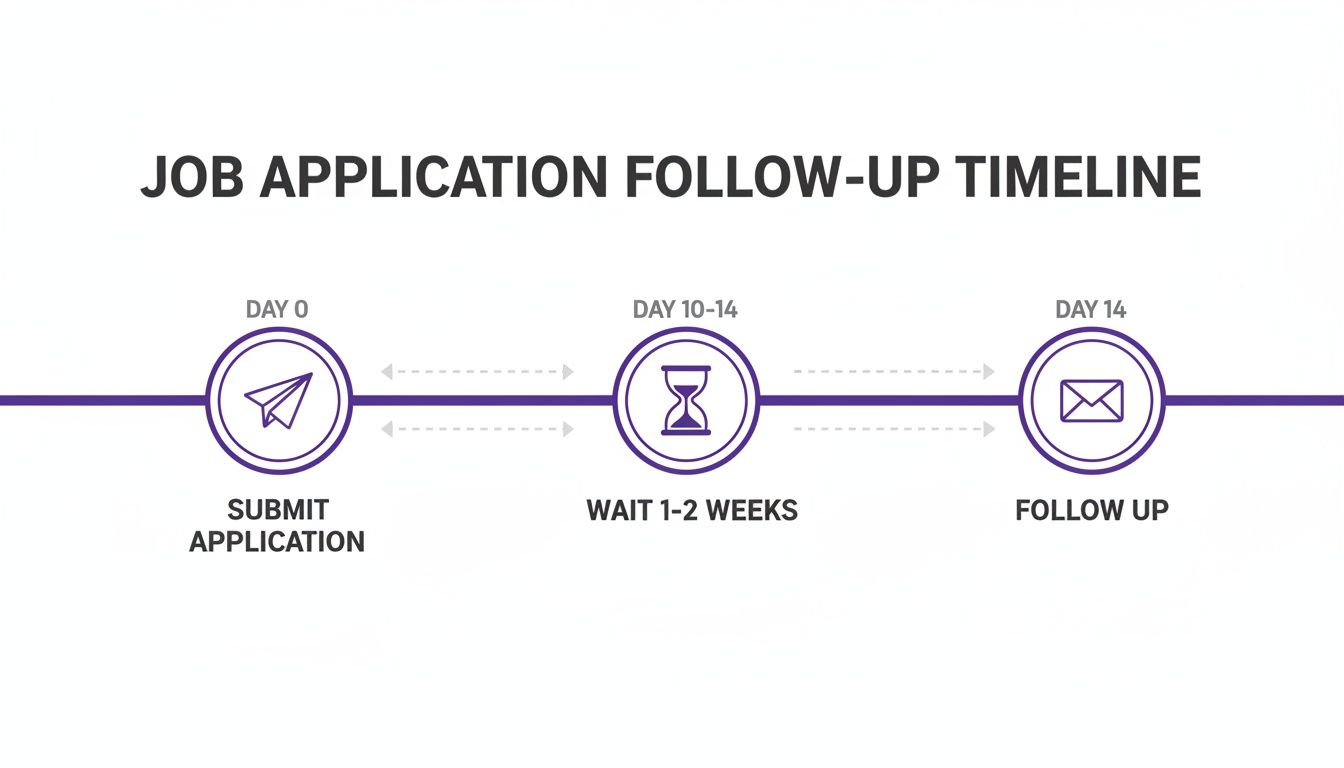
Reading the Room: Adjusting Your Timing
Of course, that 5-7 day rule isn't set in stone. You have to play detective and look for clues in the job posting itself.
- Is there a closing date? Don't even think about following up before then. Give them at least a few business days after the deadline passes before you reach out.
- Did they give you a timeline? Sometimes a posting will say something like, "We'll contact shortlisted candidates within two weeks." If they give you a timeline, stick to it. Only follow up once that window has closed.
It also helps to understand what’s happening on the other side. While a whopping 77% of us expect to hear something back within two weeks, the reality is that top-tier companies often blast through initial applications in just 3-5 days. In some industries, the time-to-hire can drag on for what feels like an eternity. In those cases, a polite check-in about 7-10 days after applying can be a huge advantage.
If you’re curious about what goes on behind the curtain, our guide on how to follow up with a recruiter has some great insider tips.
The whole point of a follow-up is to be a polite reminder, not a demand. Your tone and timing should always scream "professional and interested," not "impatient and entitled."
Juggling different timelines for every application is a recipe for a headache. This is exactly why a good tracking system isn't just a nice-to-have—it’s essential for a smart, effective follow-up game.
Anatomy of a Compelling Follow Up Email
Let's be real: writing a follow-up email after applying for a job feels like a delicate dance. You want to be professional but not robotic, persistent but not pushy. The whole thing is a mix of art and science, and every piece of it has a job to do.
Think of it like this: your application was the formal introduction. This follow-up? It's the confident, friendly handshake that makes them remember your name.
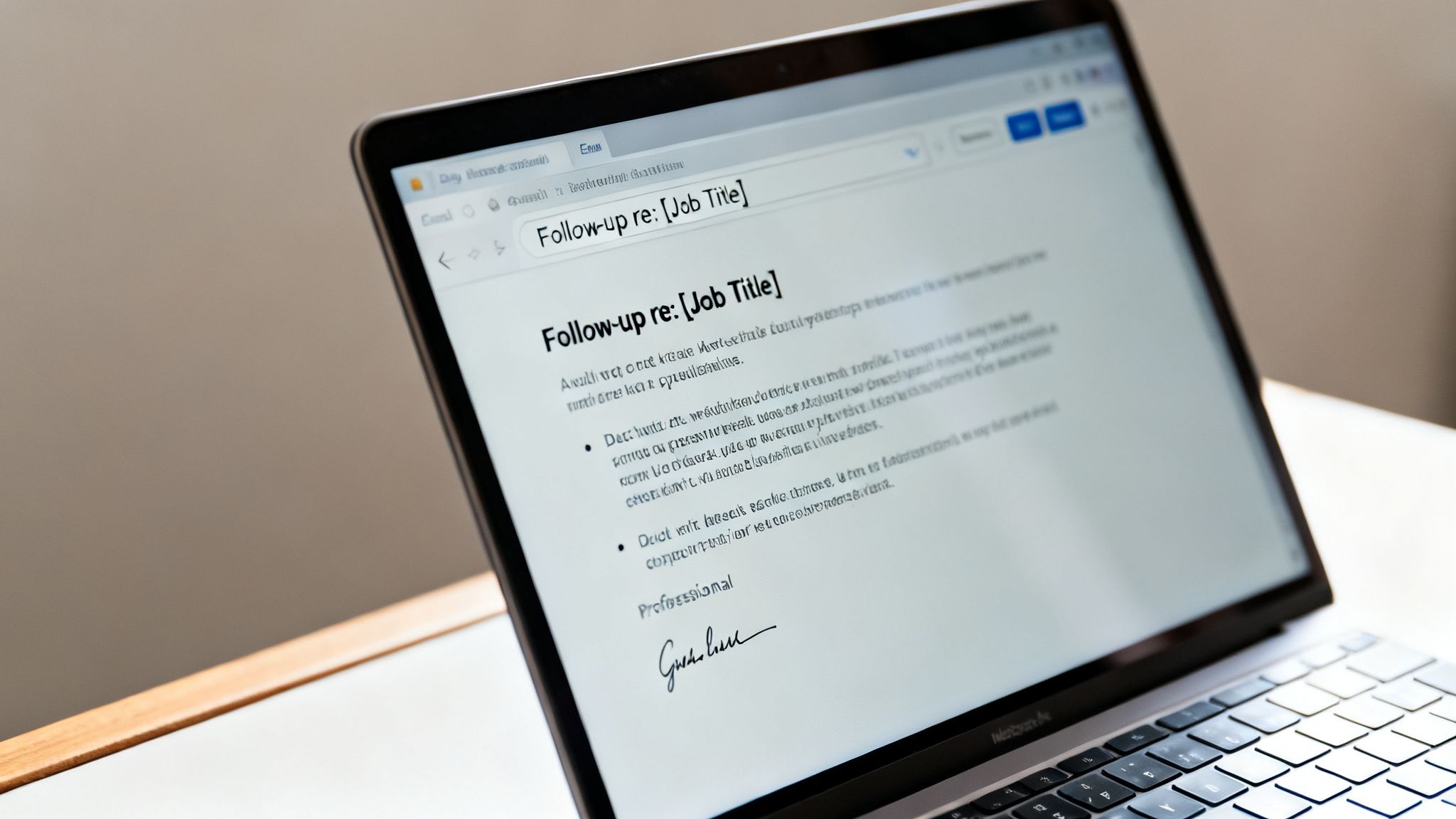
Crafting an Unmissable Subject Line
First things first, your subject line is everything. It’s the gatekeeper. When a recruiter has an inbox flooded with hundreds of emails, a vague subject line like "Checking in" is a one-way ticket to the trash folder. The goal here is simple: clarity and searchability.
A hiring manager should know exactly what your email is about in a single glance. Always, always include the job title you applied for. This small detail helps them instantly categorize your message and find your application without any extra digging.
A few no-nonsense examples that get the job done:
- Following Up on Application for Marketing Coordinator
- Checking In: Application for Project Manager Role
- Follow Up: [Your Name] for Software Engineer Position
These are direct and professional. No need to get overly clever—just be clear.
Structuring the Body for Impact
Okay, they opened it. Now what? The body of your email needs to be quick and to the point, while still showing you're genuinely interested. Forget the long-winded essays; brevity is your best friend. A simple three-part structure is all it takes.
Your opening line should politely remind them who you are and why you're in their inbox. Mention the specific role and the date you applied to give them some context and jog their memory.
Next, you want to briefly reconnect your skills to the job. This isn't the time to rehash your entire resume. Just pick one key qualification and tie it directly to a need mentioned in the job description. Something like, "My experience leading successful product launches seems to align perfectly with the growth goals you mentioned for this role." This adds real value and shows you’ve thought about it.
Finally, wrap it up with a clear statement about your continued interest and a polite call to action. Let them know you’re excited to talk more and ask about the next steps. It shows you're proactive and thinking ahead. If you want to dive deeper into crafting the perfect message, our guide on https://www.eztrackr.app/blog/professional-email-writing-tips has some great pointers.
Perfecting the Closing and Signature
Your closing needs to be just as polished as the rest of the email. A simple, professional sign-off is the only way to go.
Stick with one of these classics:
- Best regards,
- Sincerely,
- Thank you for your consideration,
This isn't the place for a casual "Cheers" or "Thanks!" unless you've already built that kind of informal rapport. Under your name, make sure to include your phone number and a link to your LinkedIn profile. This makes it incredibly easy for the hiring manager to get in touch without having to hunt down your original application.
When it all comes together, every part of your follow up email to a job application paints a picture of a thoughtful, organized, and enthusiastic candidate. Of course, understanding broader business communication best practices is a huge help in crafting any message that truly connects.
Real-World Email Templates for Any Job Search Scenario
Knowing the theory behind a good follow-up is one thing. Seeing it in action is another entirely.
The templates below are built to be a starting point, not a copy-paste solution. The real magic happens when you inject your own personality and pull specific details from the job description. That’s what gets a response.
Think about it: personalized outreach can lead to a 40% spike in candidate engagement. That’s a massive edge when you’re up against an average of 250 resumes for a single opening. For the 45,000+ job seekers using Eztrackr, a thoughtful, value-packed email is often the key that turns radio silence into a real conversation. You can dig into more of these application stats to see just how much standing out really matters.
For the Recent Graduate
As a new grad, your email needs to scream potential and enthusiasm. You’re not selling a long track record; you’re selling your hunger to learn and make an immediate impact.
Subject: Following Up – [Your Name] for the Junior Analyst Role
Body:
Dear [Hiring Manager Name],
I hope you’re having a great week. I’m writing to follow up on my application for the Junior Analyst position that I submitted on [Date]. I was so excited to see this opportunity at [Company Name]—I've been following your innovative work in the fintech space since my final year at [University Name].
My recent coursework in data modeling and my capstone project on market trend analysis felt like a perfect match for the responsibilities you outlined. I’m really eager to apply what I’ve learned in a real-world setting.
I’m very enthusiastic about the possibility of contributing to your team and would appreciate any update on the hiring timeline.
Best regards,
[Your Name]
[Phone Number] | [LinkedIn Profile URL]
For the Career Changer
Switching careers? Your job is to connect the dots for the hiring manager so they don't have to. Your follow-up is the perfect place to briefly highlight your transferable skills and prove you get their industry.
Subject: Follow Up: Application for Customer Success Manager
Body:
Dear [Hiring Manager Name],
I’m writing to express my continued interest in the Customer Success Manager role I applied for on [Date].
After a decade in the hospitality industry, I've developed a deep understanding of client relationship management and creative problem-solving. I'm confident those skills would translate directly to creating a fantastic experience for your SaaS clients. I’m passionate about making this transition and believe my background offers a unique and valuable perspective.
I would love to discuss how my dedication to customer satisfaction can benefit [Company Name]. Please let me know if there's any other information I can provide.
Sincerely,
[Your Name]
[Phone Number] | [LinkedIn Profile URL]
For When You've Heard Nothing Back
This is your classic, all-purpose nudge. It’s polite, professional, and gets straight to the point without wasting anyone's time.
Subject: Checking In: Application for Social Media Coordinator
Body:
Dear [Hiring Team],
I hope this email finds you well. I submitted my application for the Social Media Coordinator position last week and just wanted to briefly follow up.
I am still very interested in this opportunity and am confident my experience growing online communities and running paid social campaigns would allow me to contribute to your team from day one.
I’ve attached my resume again for your convenience. I look forward to hearing about the next steps.
Thank you for your time and consideration.
[Your Name]
[Phone Number] | [LinkedIn Profile URL]
Common Follow-Up Mistakes (And How to Dodge Them)
Knowing what not to do in a follow-up email is just as important as knowing what to do. One wrong move can completely derail an otherwise strong application, turning a polite nudge into a major red flag for a busy recruiter. You want them to remember your professionalism, not your impatience.
It's surprisingly easy to hurt your chances with a simple, avoidable error. These aren't just minor typos; they're strategic mistakes that suggest a lack of professional awareness. Getting a handle on these common slip-ups is the first step to making sure your follow-up email helps, not harms, your chances.
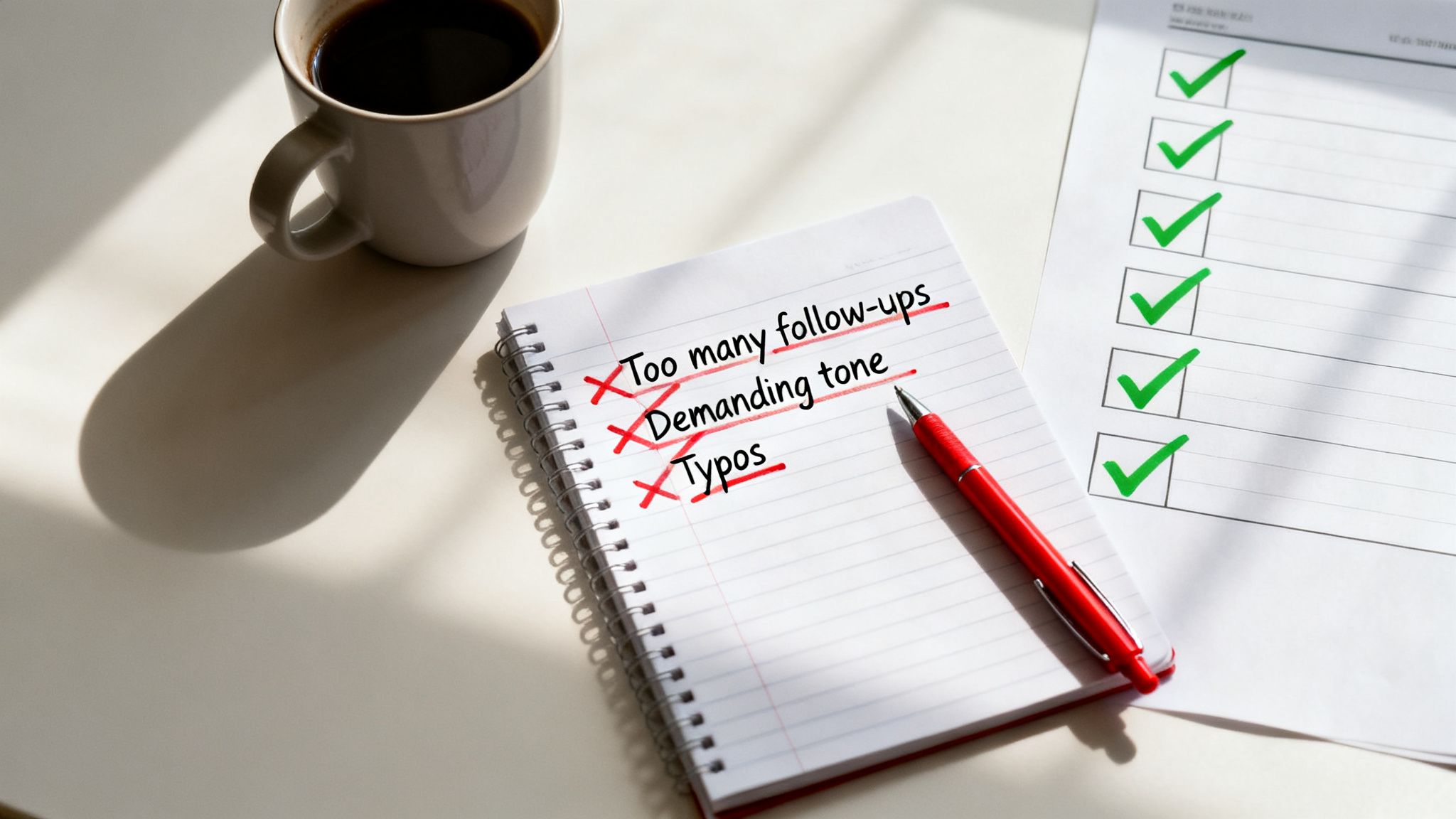
Being Too Persistent or Impatient
This one is the classic mistake. Firing off an email too soon or sending multiple follow-ups is the fastest way to get on a hiring manager's bad side. Just remember, recruiting takes time and involves a lot of moving parts and people. Bombarding their inbox comes off as impatient and shows a lack of respect for their process.
Stick to one follow-up. If you feel you absolutely must send another, make it a final, very brief check-in at least another week later. Anything more than that crosses a clear line from proactive to problematic.
Adopting the Wrong Tone
Your tone is everything. A follow-up should be a polite expression of your continued interest, not a demand for an update. You have to avoid any language that sounds entitled, like "I haven't heard from you yet" or "I need to know my application status."
Instead, keep your language courteous and respectful of their time. Small changes in how you phrase things can make a world of difference.
- Don't say: "When can I expect to hear back about the next steps?"
- Try this instead: "I'd really appreciate any update you can share on the hiring timeline when you have a moment."
A professional, respectful tone is non-negotiable. Your email is a preview of how you’d communicate as an employee, so make sure it paints the right picture.
Sending Generic, Low-Value Messages
The absolute worst kind of follow-up is one that adds no value. A generic, copy-and-pasted message that just says "I'm checking in" is a complete waste of an opportunity. It just shows you're ticking a box. And please, never just rehash what's already on your resume.
Your email should do something more. Briefly reinforce why you're so interested or connect one of your key skills directly to the role's biggest need. For a deeper dive into writing emails that actually get results, check out our guide on the best practices for email communication.
By steering clear of these common mistakes, you can ensure your follow-up email stands out for all the right reasons.
Answering Your Burning Questions About Follow-Up Emails
Even with the best game plan, a few questions always pop up. It’s totally normal. Trying to figure out the unwritten rules of following up can feel like walking a tightrope, but getting it right can make all the difference.
Let's clear the air and tackle some of the most common "what if" scenarios job seekers run into. My goal is to give you direct, no-nonsense answers so you can move forward with confidence.
How Many Times Should I Actually Follow Up?
You really only need to send one or two follow-ups, max. The first one should go out about a week after you hit "submit" on your application. That timing hits the sweet spot—it’s prompt enough to show you're on top of things but patient enough not to seem desperate.
If radio silence continues, you can send one more super-short check-in a week after the first. Anything beyond that starts to feel a little too persistent and can actually backfire.
Think of it this way: your first email is a polite reminder, and the second is a final, gentle nudge. After that, it’s best to focus your energy on other promising opportunities while you wait.
This is where a good tracking system becomes your best friend. Knowing exactly when you sent each email keeps you from accidentally overdoing it and helps you manage a dozen applications without breaking a sweat.
What if I Can't Find the Hiring Manager's Email?
Ah, the classic mystery. This happens all the time. If you can't find a specific person to contact, your next best move is to send your follow up email to a general company address. Keep an eye out for emails like careers@company.com or recruiting@company.com.
When you’re emailing a general inbox, a simple "Dear Hiring Team" or "To the [Department Name] Recruiting Department" works perfectly. It’s professional and helps your message land in the right hands.
If you want to do a little more digging (which I highly recommend), here’s what I’d do:
- Hop on LinkedIn: Search for recruiters or the Head of Talent Acquisition at the company. A quick, polite InMail message referencing your application is a great modern alternative to email.
- Check the Company Website: The "Our Team" or "About Us" page can sometimes be a goldmine for finding the right contact.
Should I Follow Up if the Posting Says "No Emails"?
This one is refreshingly simple: respect their request. If a job posting flat-out says "no calls or emails," then don't send one. Period.
Ignoring a direct instruction like that is a huge red flag for recruiters. It basically screams, "I don't follow directions," which is a deal-breaker for any job. Instead of trying to be clever and find a workaround, trust their process. If they’re interested, they know how to find you. Just make a note of it in your job tracker and move on to the next opportunity.
Stop juggling spreadsheets and start landing interviews. Eztrackr organizes your entire job search with an intuitive kanban board, AI-powered writing tools, and insightful analytics so you can focus on what matters. Take control of your job hunt today!