Do I Need a Cover Letter? Your Definitive Guide
So, should you bother writing a cover letter, or is it just an old-school formality that hiring managers toss aside? Here’s the real talk: a well-written cover letter can give you a serious competitive edge. A generic, copy-paste one? That can actually hurt your chances.
Think of it as your one real opportunity to tell the story your resume can't.
The Real Answer to the Cover Letter Question
Deciding whether to sink time into a cover letter feels like a bit of a gamble, doesn't it? Is it actually worth the effort? Will a real human even lay eyes on it?
My advice is to stop thinking of it as a requirement and start seeing it as a strategic move. If you're gunning for a highly competitive role, making a career pivot, or need to explain a gap on your resume, a cover letter isn't just nice to have—it's non-negotiable.
It’s your chance to connect the dots for the hiring manager. You can draw a direct line from your past wins to their future needs, showing you’ve done your homework and are genuinely all-in. On the flip side, skipping it when others are putting in the effort can make you look like you're just not that interested.
Your Quick Decision Guide
Don't just take my word for it; the data shows that cover letters are far from dead. One survey found that 83% of recruiters said they're an important factor in their hiring decisions. A killer letter can even persuade 49% of hiring managers to interview a candidate who might have a less-than-perfect resume.
But there’s a catch. A bad one can cause 18% of them to reject an otherwise strong applicant. And even when a job ad says it's "optional," a whopping 72% of hiring managers still want to see one. It’s a sign that you’re willing to go the extra mile. You can dig into more of these fascinating cover letter statistics if you're curious.
To make things even simpler, I put together a little decision tree. It helps you see when a cover letter gives you an edge versus when it’s a potential risk.
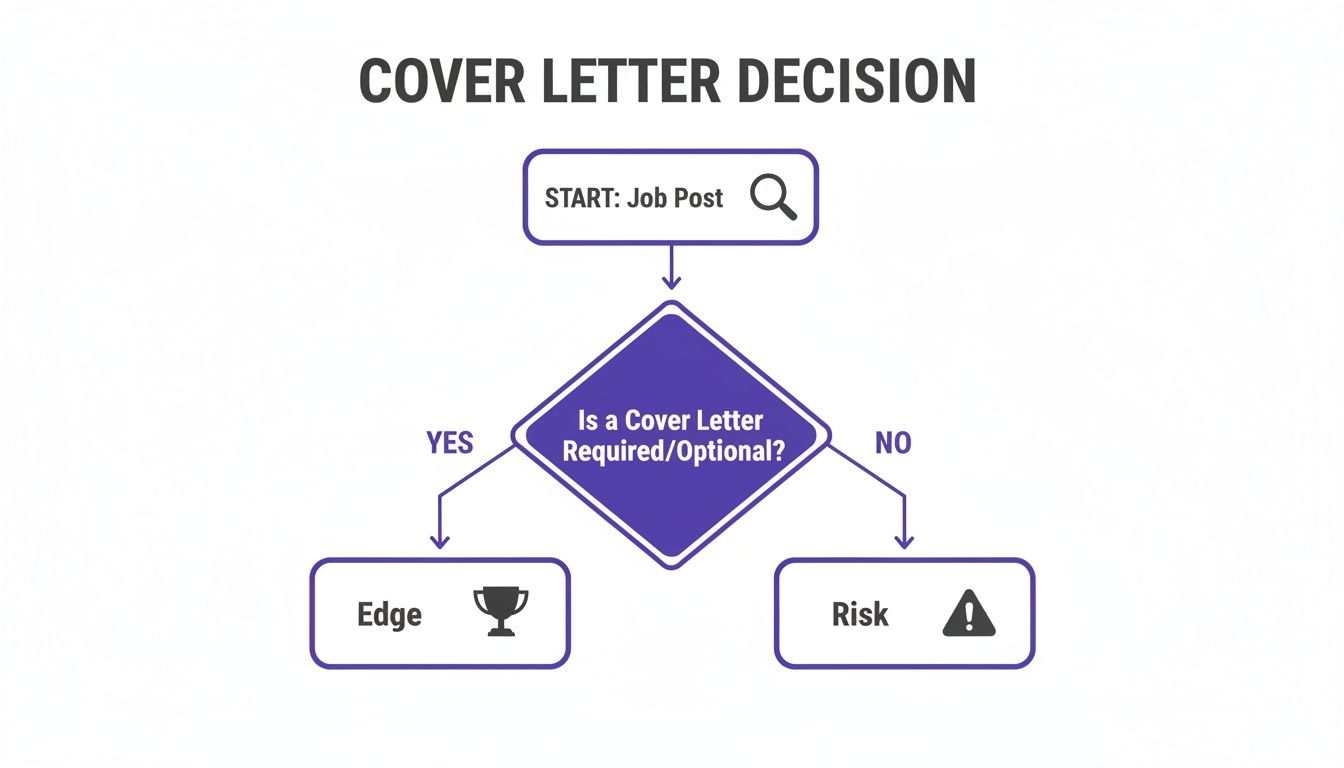
The main takeaway here is pretty clear. If the posting says it's required or optional, sending one is a golden opportunity to make your case. The only time you should really hesitate is if the instructions explicitly tell you not to.
When a Cover Letter Gives You a Winning Edge
There are times when a cover letter goes from being "just another document" to your single most powerful asset. Think of it like this: your resume is the list of ingredients, but the cover letter is the recipe that shows the hiring manager how you’ll create something amazing. It gives a voice to the bullet points.
This is especially true when your career path hasn't exactly been a straight line. The cover letter is your chance to connect the dots for the hiring manager and explain the why behind your journey. It’s what turns a standard application into a memorable story that makes them think, "This is the person we need."
When Your Resume Needs a Narrator
Some professional situations just scream for the kind of context only a cover letter can offer. Your resume is the blueprint of your career, sure, but your cover letter is the guided tour where you get to point out all the best features.
Here are a few of those high-stakes scenarios:
- You're a Career Changer: Your resume shows what you’ve done, but the cover letter shows what you want to do next. It’s your place to translate your skills—like how managing a construction crew makes you a rockstar project manager for a tech startup—and prove they’re a perfect match.
- You're a Recent Graduate: Let's be real, a resume with limited professional experience can look a little light. A cover letter is where you fill that space with your drive, standout academic projects, and transferable skills to show you’ve got massive potential.
- You Have an Employment Gap: Unexplained gaps on a resume can make recruiters pause. A cover letter lets you get ahead of the questions with a brief, professional note about why you took time off—whether it was for family, travel, or personal development. You control the story.
- You're Relocating: Applying for jobs in a different city or state? A cover letter is non-negotiable. It shows you're serious about the move and not just firing off applications into the void. A simple sentence like, "I am relocating to the Denver area this May and am eager to contribute my skills to your team," changes everything.
A cover letter is a powerful tool to articulate your unique value, much like the broader effort to build a strong personal brand that opens doors in your career. It’s your chance to shape the perception of your professional journey on your own terms.
Proving Your Passion and Fit
Beyond just explaining the tricky parts of your resume, a cover letter is your best shot at showing genuine excitement and proving you’ll be a great cultural fit. This is absolutely critical when you’re applying to smaller companies or mission-driven organizations where personality and values matter just as much as hard skills.
While some might debate their value, the data is clear: cover letters are make-or-break in certain situations. They’re your secret weapon for explaining a career pivot, addressing a resume gap, or getting your foot in the door at a smaller company that prizes a good personality fit.
Basically, if there’s anything about your story that isn't crystal clear from your resume alone, the answer to "do I need a cover letter?" is a loud and clear "yes." It’s your opportunity to make an impression that a list of bullet points never could.
The Hidden Risks of Skipping the Cover Letter
Deciding to skip the cover letter when a job posting lists it as "optional" feels like a tempting shortcut. Why do the extra work if you don't have to, right? The thing is, this little bit of corner-cutting comes with some pretty big, unspoken risks that can quietly shuffle your application from the "maybe" pile straight to the "no" pile.
Applying without one is like showing up to a huge networking event and never actually introducing yourself. Sure, you're in the room, but you haven't made a personal connection or given anyone a real reason to remember you. You’re just another face in a very large crowd.
You Lose the Chance to Tell Your Story
Let’s be honest, your resume is a factual, structured document. It’s a list of your skills, experiences, and wins, formatted for a quick scan—often by software first. It's absolutely crucial, but it completely lacks personality and context. By skipping the cover letter, you’re throwing away the single best chance you have to add a human element to your application.
This is your shot to explain why you're the perfect fit, going way beyond a simple list of qualifications. You can speak directly to what the company needs and prove you’ve actually done your homework. Without it, you’re just hoping the recruiter connects the dots all by themselves—a huge gamble when they've got hundreds of other resumes waiting.
You Might Seem Less Interested
In a tough job market, recruiters are always looking for clues that a candidate is genuinely invested in the role and the company. Taking the time to write a thoughtful, tailored cover letter sends a loud and clear message: you are serious about this opportunity.
When a hiring manager gets an application without one, they might just assume you're mass-applying to anything and everything. This can create a perception of low effort or a lack of real enthusiasm, immediately putting you at a disadvantage against candidates who took the time to introduce themselves properly.
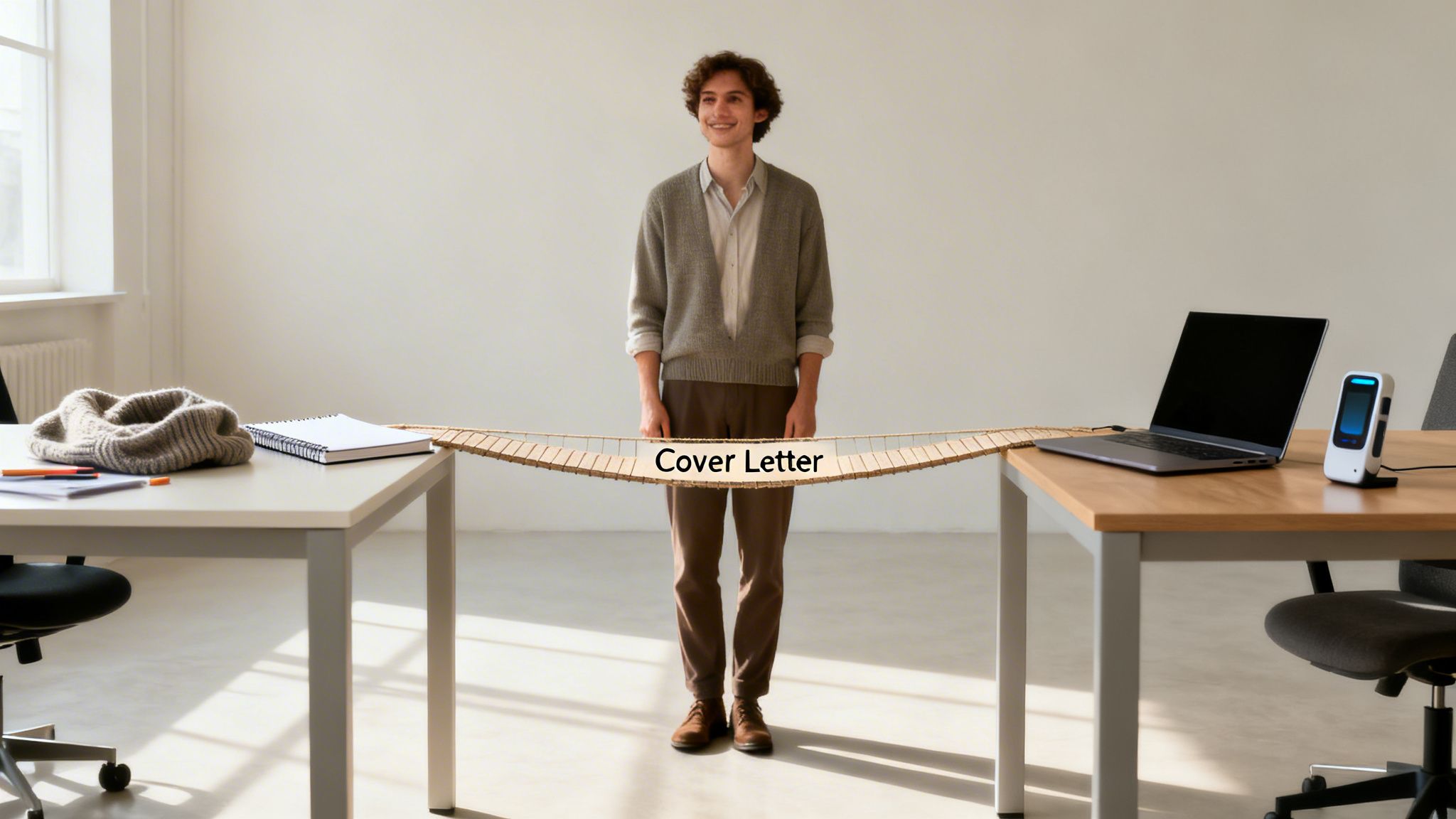
A cover letter isn’t just a summary of your resume; it's a bridge between your past achievements and the company’s future needs. Skipping it leaves a gap that your competitors will happily fill.
By not including a cover letter, you're giving up several key advantages:
- Showcasing Communication Skills: It’s a direct sample of your writing ability and professional tone.
- Expressing Genuine Passion: You can spell out exactly what excites you about the company’s mission or products.
- Explaining Resume Nuances: It lets you get ahead of any questions about career changes, employment gaps, or relocation plans.
Ultimately, the question "do I need a cover letter?" is less about following rules and more about seizing an opportunity. Even a fantastic resume can get lost in the digital shuffle. A great cover letter helps ensure your application isn't just seen, but remembered. You can learn more about making your resume stand out in our guide to beating applicant tracking systems.
Ditching the Formality: Modern Cover Letter Alternatives
In today's job market, especially in fast-moving fields like tech and creative industries, the old-school, formal cover letter isn't always your best play. Sometimes, a more direct and modern approach is what gets you noticed. Think of these as the cover letter's cooler, more efficient cousins—they still make that crucial personal connection, but in a way that respects a hiring manager’s slammed schedule.
Instead of attaching a separate document, why not make your case right in the body of your email? This move puts your best qualifications front and center, guaranteeing they get seen instantly. It's a sharp, powerful way to introduce yourself without making a recruiter click to open yet another file.
Your Application Email Is the Cover Note
Turning your submission email into a mini-cover letter is a seriously smart tactic. It's less about stiff formality and all about making an immediate impact. The whole point is to quickly spell out your value and genuine interest in just a few, hard-hitting sentences. It shows you're confident and, just as importantly, that you respect the reader's time.
Here’s a quick-and-dirty framework to make it work:
- A Subject Line That Sells: Ditch the generic "Application for [Job Title]." Try something with more punch, like, "Application: Senior UX Designer with 5 Years of SaaS Experience."
- A Direct Opener: Clearly state the role you're after and immediately drop one key achievement that lines up perfectly with what they’re looking for.
- The Value Prop: In one or two sentences, connect the dots. Tell them why you're the right person for this job at this company.
- A Clear Call to Action: Wrap it up by saying you’re excited to talk more and point them straight to your attached resume.
This isn't just an email; it's a real-time demonstration of your communication skills. A clean, concise message proves you can get straight to the point—a skill that’s golden in any workplace.
As companies get more creative with how they vet candidates, new methods like a virtual job tryout are popping up to let people show their skills directly. Your email can do something similar by proving you’re an effective communicator from the very first hello.
Using LinkedIn for Direct Outreach
Another killer alternative is sliding into the DMs—professionally, of course. A personalized LinkedIn connection request or InMail can be your secret weapon. If you can figure out who the recruiter or hiring manager is, a brief, well-crafted note puts you right on their radar. This works especially well if you have a mutual connection or a really specific reason to reach out.
For instance, you could send something like: "Hi [Name], I saw the opening for the [Job Title] role and was really impressed by [Company's recent project or value]. My background in [specific skill] seems like a great match for what you're looking for. I've just applied and would love the chance to connect."
Suddenly, your application isn't just another faceless entry in a database; it's the start of a real conversation. While you might still ask yourself, "do I need a cover letter?", these modern strategies often pack a bigger punch. And for those times when a formal document is non-negotiable, you can always use a tool like Eztrackr's AI-powered https://www.eztrackr.app/job-cover-letter-generator to knock it out fast.
How to Write a High-Impact Cover Letter in Minutes
Let's be honest. The biggest reason most of us groan when we hear "cover letter" isn't because we think they're useless. It's because writing a good one from scratch for every single application feels like an absolute marathon.
The good news? You can knock out a personalized, genuinely impressive letter in a fraction of the time you think. It just takes the right approach and the right tools.
This isn’t about grabbing some generic template online and just swapping out the company name—that’s a one-way ticket to the “no” pile. It’s about using smart automation to do the heavy lifting, giving you a strong, tailored first draft that you can then polish up in minutes.
Start with Smart Inputs for a Strong Output
Think of an AI cover letter generator like a really sharp assistant. The quality of its work comes down to the quality of your instructions. Give it vague, lazy inputs, and you'll get a bland, generic letter back.
But if you feed it the good stuff—the specifics from the job description and your own resume—you’re giving it the raw material it needs to build something that actually connects the dots for the hiring manager.
This is exactly where a tool like Eztrackr’s AI Cover Letter Generator becomes your secret weapon. The process is designed to be fast and intuitive.
By pulling details directly from both documents, the AI makes sure your cover letter is hitting all the right notes from the very first sentence.
We've broken down how simple it is to get a powerful first draft.
Crafting Your AI-Powered Cover Letter in 3 Steps
| Step | Action | Key Benefit |
|---|---|---|
| 1. Analyze the Job Post | Copy and paste the key responsibilities and qualifications from the job description into the tool. | This gives the AI a clear picture of exactly what the employer is looking for in their ideal candidate. |
| 2. Provide Your Resume | Next, paste your resume content. This provides the AI with your professional history and accomplishments. | The AI now has the "evidence" it needs to directly connect your experience to the company's needs. |
| 3. Generate & Refine | Click to generate the draft. The AI bridges the gap between their needs and your skills. | You get a structured, relevant first draft in seconds, saving you from the blank page dilemma. |
This process gives you a huge head start, handling the foundational work so you can focus on making it shine.
Refine and Personalize in Under Five Minutes
The draft the AI gives you is your 80% solution. It’s done the hard part—the structure, the keyword matching, the professional phrasing. Your job is to add the final 20%, that crucial human touch that makes it truly yours.
A great cover letter doesn't just list your skills; it tells a story. Your final edits should infuse the AI's logical structure with your genuine personality and enthusiasm.
Here's a quick checklist to nail the final polish:
- Inject Your Voice: Read the letter out loud. Does it sound like something you'd actually say? Change a few words or sentences to better match your natural professional tone.
- Add a Personal Connection: Drop in one specific thing you admire about the company. Maybe it’s a recent project, one of their core values, or an article you read about their CEO. This shows you’ve done your homework.
- Highlight a Key Achievement: Find one accomplishment the AI pulled from your resume and add a single, powerful sentence that shows its impact. Think numbers and results.
Using this method, you can turn a dreaded chore into a quick, strategic move. You’ll have a letter that feels both personal and professional in minutes, not hours.
For a deeper dive into structure, tone, and what to include, check out our complete guide on how to write a cover letter that gets noticed. This efficient approach means you never have to ask, "should I skip it?" ever again.
Got More Questions About Cover Letters?
Even with a solid game plan, a few nagging questions always seem to pop up right when you’re about to hit “send.” It's one thing to decide if you need a cover letter, but it’s another to nail the execution. Let's clear the air on some of the most common uncertainties so you can move forward with total confidence.
These quick-fire answers will help you handle the finer points of cover letter etiquette, making sure your application is polished, professional, and impossible to ignore.
Should I Write One If It Says "Optional"?
Yes. A thousand times, yes. You absolutely should.
Think of the word "optional" as a quiet test of your initiative. When a company gives you that choice, they're watching to see who’s willing to put in a little extra effort. Sending a well-crafted cover letter shows you’re truly invested in this role, not just blasting out applications to anything that moves.
It’s your single best chance to stand out from the crowd who took the path of least resistance. In a market where recruiters are buried under hundreds of applications, taking this extra step can be the very thing that pulls your resume from the digital slush pile and puts it on the top of the interview list.
When an application says a cover letter is optional, see it as an open invitation to make a stronger case for yourself. It’s an opportunity your competitors will likely skip.
How Long Should My Cover Letter Be?
Brevity is your best friend here. A hiring manager’s time is incredibly scarce, so your goal is to make a powerful impression, fast. The gold standard is simple: keep it to a single page.
This usually breaks down into three or four short paragraphs, somewhere in the ballpark of 250 to 400 words. You need to focus on impact, not length. Your intro should hook them, the body should connect your skills to their problems, and the closing should drive them to action.
- Paragraph 1 (The Hook): Name the position you want and show some genuine enthusiasm. Hit them with a key achievement that makes you a perfect fit right from the start.
- Paragraph 2 (The Connection): Explain why you're drawn to this specific company and how your unique skills can solve their biggest headaches.
- Paragraph 3 (The Proof): Give them a short, compelling story of a past win that proves your value. Use numbers and metrics wherever you can.
- Paragraph 4 (The Close): Reiterate your excitement and clearly state that you’re ready to discuss your qualifications in an interview.
Following this structure keeps your message tight, scannable, and incredibly persuasive. For more tips on what to write when you're sending everything off, check out our guide on what to say when emailing a resume.
Who Do I Address It To?
Please, whatever you do, avoid "To Whom It May Concern." Those days are long gone. That generic greeting just screams "I didn't do my homework" and makes your letter feel cold and impersonal.
Your first move should always be to find the name of the actual hiring manager. A quick search on LinkedIn or the company's "About Us" page often does the trick.
But if you’ve done a reasonable search and come up empty, don't stress. There are plenty of modern, professional alternatives that work just fine.
Try one of these instead:
- Dear Hiring Manager
- Dear [Department] Team
- Dear [Job Title] Search Committee
These options are respectful, direct, and show you’re at least aiming for the right audience without falling back on stuffy, outdated formalities.
Ready to stop stressing and start applying smarter? Eztrackr’s AI tools and intuitive tracking system give you everything you need to manage your job search and create powerful, personalized applications in minutes. Take control of your job hunt today.