Your Career Goals Template for a Path with Purpose
Let’s be real for a second. The whole idea of a straight-line career ladder? It feels like a fossil from a bygone era. A modern career goals template isn't about just climbing up, rung by rung. It's about building a living, breathing roadmap that actually connects with your values, your purpose, and the way we work today.
Why Your Old Career Plan Is Obsolete

That rigid, five-year plan just doesn't cut it anymore in a world that values agility and change. These days, a great career is built on a foundation of purpose, non-stop learning, and personal well-being—not just a string of promotions. One huge reason your old plan might be collecting dust is its focus on just trading hours for dollars. To build a more flexible and fulfilling future, you have to find ways to stop trading time for money.
This isn't about ditching ambition. It's about redefining it. People are consciously stepping away from the "climb at all costs" mindset. Instead, they're digging deep to figure out what truly drives them, and the data backs this up.
The Rise of Purpose-Driven Careers
The hunger for a career that means something is completely changing the definition of success. A paycheck just isn't the be-all and end-all anymore, especially for younger generations.
A recent Deloitte survey on Gen Z and Millennials paints a clear picture. Only a tiny 6% of Gen Zs said getting to a leadership spot was their top goal. What do they really want? A whopping 89% of Gen Zs and 92% of millennials say a sense of purpose is critical for their job satisfaction and well-being. This powerful mix of money, meaning, and balance is the new gold standard.
Your career goals template needs to be more than a simple to-do list. Think of it as your personal blueprint—one that reflects what you value, whether that's making an impact, mastering new skills, or finally nailing that work-life balance.
This is especially critical if you're thinking about a major career pivot. A modern template can be your North Star, and our guide with practical career change tips can help light the way.
Building the Foundation of Your Career Template

Before you can seriously map out where you’re headed, you need an honest look at where you're standing right now. A truly effective career goals template doesn’t start with wishful thinking; it starts with a real self-assessment.
This isn't just a warm-up exercise. It's about gaining clarity so the goals you set are genuinely yours, not just an echo of what you think you should want. Skipping this step is a fast track to setting goals that don’t resonate, leading to burnout or a total lack of motivation later on.
So, let's get real and figure out what actually drives you.
Uncovering Your Core Career Drivers
First things first: what are your core values and non-negotiables? These are the principles that steer your decisions and define what a fulfilling job actually looks like for you. Think back on past roles—what made you feel energized? What completely drained you?
Your values are your internal compass. They might be things like:
- Autonomy: The freedom to own your work and manage your own time.
- Impact: Knowing your work actually makes a difference.
- Collaboration: You do your best work as part of a great team.
- Stability: You value security and a predictable work environment.
A goal that clashes with your core values is a goal you're unlikely to stick with. For instance, if you value work-life balance above all, a goal to reach a C-suite role known for 80-hour workweeks is a recipe for conflict.
Conducting a Personal SWOT Analysis
Once you have a handle on what matters to you, a personal SWOT analysis is a fantastic way to organize your thoughts. It forces you to look at your career from four different angles, giving you a balanced perspective to build from.
This simple framework helps you take stock of your current professional standing:
- Strengths: What are you genuinely good at? This can be anything from technical skills like Python to soft skills like navigating difficult conversations.
- Weaknesses: Where do you need to improve? Maybe you struggle with a specific software or have a habit of procrastinating on big projects.
- Opportunities: What's happening out there that you can take advantage of? Think about industry trends, a growing professional network, or new tech.
- Threats: What obstacles might get in your way? This could be anything from AI automating parts of your role to a lack of company training resources.
This isn't just about making lists; it's about creating the blueprint for your goals. When you combine this self-awareness with a clear plan, you're setting yourself up for success. For a deeper dive into structuring this process, our guide on professional development planning lays out some really actionable steps.
Crafting Actionable SMART Goals
Once you've got a handle on your personal blueprint, it’s time to turn those big ideas into a real, actionable plan. This is where the SMART framework comes in—it’s the secret to transforming fuzzy daydreams into solid objectives. By making your goals Specific, Measurable, Achievable, Relevant, and Time-bound, you’re basically creating a GPS for your career.
And it works. Studies have shown that people who actually write down their goals with a clear plan are wildly more successful. We're talking about hitting your targets 76% of the time, compared to just a 43% success rate for those who keep their goals in their head.
Breaking Down the SMART Framework
Let’s cut through the corporate-speak and get real about what each part of the SMART framework actually means for you. This isn't just about ticking boxes; it's about adding layers of detail that make your career goals template a powerhouse tool.
- Specific: Your goal needs to be laser-focused. "Get better at marketing" is vague. "Learn to manage paid social media campaigns on LinkedIn" is specific.
- Measurable: How do you know you're winning? A measurable goal would be, "Independently manage a $500 monthly ad budget and generate 10 qualified leads per month."
- Achievable: Be honest—is this realistic right now? If you’ve never touched an ad platform, managing a $50,000 budget is a stretch. But $500? That’s a perfect place to start.
- Relevant: Does this actually move you closer to your ultimate career vision? If you want to become a digital marketing manager, mastering paid ads is definitely relevant.
- Time-bound: Give yourself a deadline. Something like, "Achieve this by the end of Q3" creates a sense of urgency and gives you a finish line to race toward.
A well-crafted goal is a GPS for your career. A vague goal is like saying you want to "go west," while a SMART goal is a precise address with turn-by-turn directions.
Thinking this way makes the whole process feel much less overwhelming. If you want to dig deeper into this, exploring different approaches to setting effective personal goals can give you even more tools for your toolkit.
From Vague to SMART: A Real-World Example
Okay, let's put this into practice. A super common (and super vague) goal is, "I want to get a promotion." It’s a great starting point, but you can’t build a plan around it.
This is where a career goals template built on SMART criteria really shines. Let’s see how we can transform that vague ambition into something concrete.
SMART Goal Breakdown
Use this framework to transform your vague aspirations into actionable career goals.
| Goal Aspect | Vague Goal Example | SMART Goal Example |
|---|---|---|
| Specific | Get a promotion. | Secure the Senior Marketing Associate position. |
| Measurable | Do better work. | Lead two major campaigns and increase my team's KPI contributions by 15%. |
| Achievable | Hope my boss notices. | Complete the company’s leadership training program and mentor a junior team member. |
| Relevant | I want more responsibility. | This promotion aligns with my long-term goal of becoming a Marketing Director. |
| Time-bound | Sometime next year. | Achieve these milestones and formally apply for the role in the next 9 months. |
See the difference? This level of detail is exactly what you need to build a plan that gets results. If you’re looking for more ways to add this kind of structure to your planning, our guide on creating a career development plan template has some great frameworks you can borrow.
Connecting Short-Term Wins to Your Long-Term Vision
A truly effective career goals template isn't just a wish list—it’s a roadmap. It’s all about connecting the small, manageable steps you can take today with the massive ambitions you have for the future. Thinking this way keeps you from feeling overwhelmed and helps build momentum, making your biggest dreams actually feel within reach.
The best way I've found to do this is to think of your goals in three distinct horizons. This layered strategy is what turns a big, vague vision into a practical plan you can start working on right now.
Three Horizons of Career Planning
When you organize your template this way, you start to see exactly how each small action contributes to the bigger picture. It forges a clear, tangible link between your daily grind and your ultimate professional destination.
- Short-Term Goals (3–12 Months): These are your immediate priorities, the foundational building blocks. Think about things like completing a specific certification, getting the hang of a new software, or successfully leading a small project at work.
- Mid-Term Goals (1–3 Years): These objectives build directly on your short-term wins. They usually involve a more significant step up, like moving into a new industry, landing your first management role, or getting a substantial side project off the ground.
- Long-Term Vision (5+ Years): This is your North Star. It’s that huge, guiding aspiration that gives all your other goals purpose, like starting your own consulting firm or reaching a C-suite position.
This whole process is about refining your ideas. You start with something fuzzy and gradually sharpen it into a clear, achievable target.
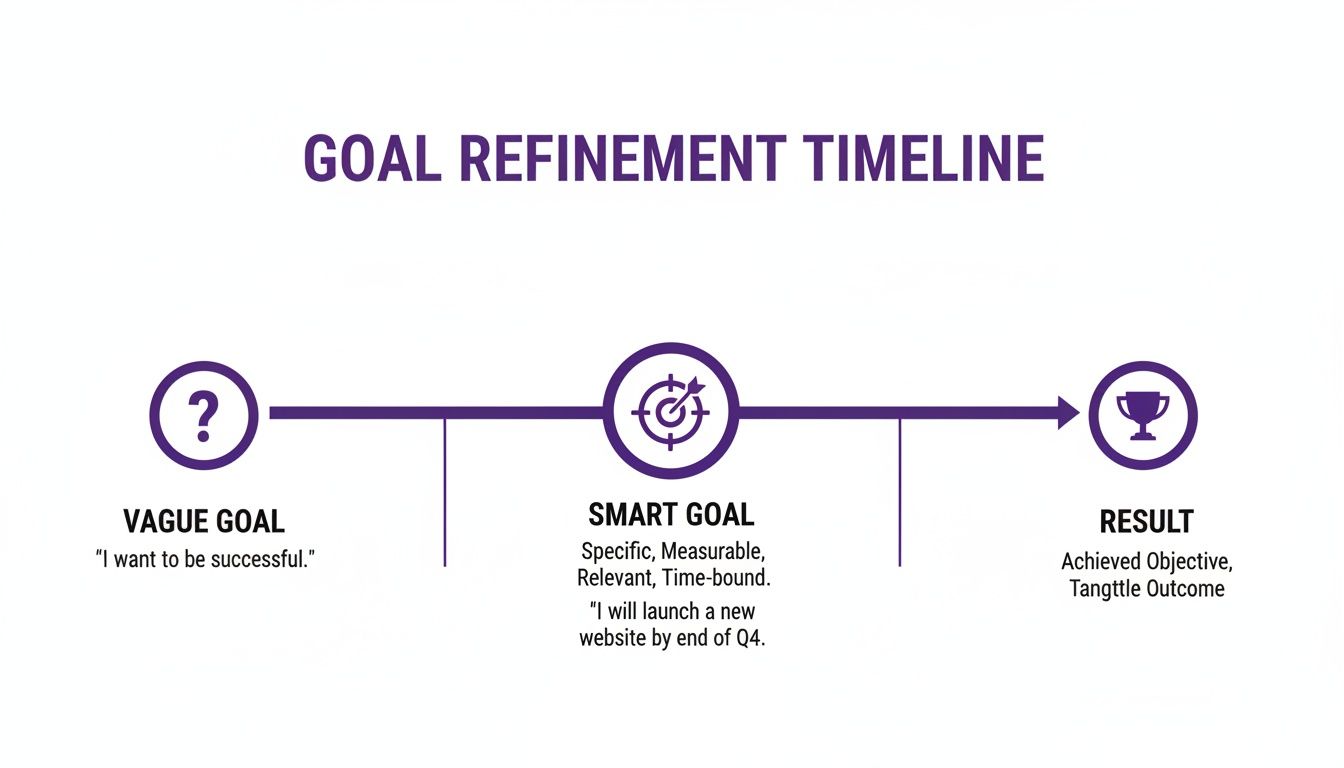
As you can see, vague goals tend to fizzle out. But once you apply specific criteria and break them down, you create a clear path straight to a successful outcome.
How the Layers Work Together
Let's walk through a real-world example. Imagine your long-term vision is to launch your own successful marketing agency in five years.
To make that happen, a solid mid-term goal (for the 1–3 year mark) might be to become a Marketing Director. Why? To gain critical leadership and budget management experience.
Suddenly, your short-term goals for the next 3–12 months become crystal clear: you need to complete that digital advertising certification, volunteer to lead the next major campaign, and start mentoring a junior team member.
See how that works? Each short-term win directly fuels your mid-term objective, which in turn paves the way for your long-term vision.
This structured approach transforms your career goals template into a dynamic, living document. You're not just listing dreams; you're building an interconnected system where small, consistent efforts compound into massive career achievements over time.
Future-Proofing Your Career with Continuous Learning

In a world that’s always changing, the one skill that never gets old is the ability to learn. A static, set-it-and-forget-it career plan just doesn't cut it anymore. Your goals template needs to be a living document, a tool for growth with learning baked right into its DNA.
This means you have to get proactive about upskilling and reskilling. You can't just sit back and wait for your company to offer a training session. Research from ADP is pretty telling: a measly 24% of workers globally feel confident they have the right skills for the future, and only 17% feel their employers invest enough in their development.
The takeaway? You have to own it. For a deeper dive, check out ADP's full "People at Work" report on global worker skill confidence.
Translating Learning into Actionable Goals
Making learning a priority means turning it into something you can actually track. A vague goal like "learn more about AI" isn't going to get you very far. Your template needs concrete, actionable steps.
Let’s look at a real-world example of a solid learning goal:
- Objective: Dedicate five hours per week to completing an online Python certification.
- Timeline: Finish the course and the final project by the end of Q4.
- Application: Use what I learn to automate at least one repetitive data-entry task in my current role.
This simple shift turns learning from a passive idea into an active part of your professional growth. It’s all about building tangible skills that directly push your bigger goals forward, whether that’s a promotion or a complete career change.
By treating skill-building as a core part of your career goals, you stay relevant and competitive. This mindset is a game-changer, especially if you're trying to figure out how to get hired with no experience in a new field. In those cases, provable skills are your best currency. At the end of the day, you're the one in the driver's seat of your own growth.
Your Career Goals Template Questions Answered
So, you've built your career goals template. Awesome. But now what? Practical questions always pop up once the rubber meets the road. Think of it as a living document—how you manage it is just as important as how you created it in the first place.
Let's tackle some of the most common things people ask.
How Often Should I Check In On My Goals?
Your template isn't something you create once and forget about. It's a dynamic guide, not a static file locked away in a folder somewhere.
I've found that a quick quarterly check-in works wonders for tracking short-term objectives. It's the perfect rhythm for making minor tweaks and keeping yourself accountable without feeling like you're chained to a rigid plan.
Then, once a year, block out some time for a deeper review. This is your chance to really look at your long-term vision and those bigger mid-term goals. Do they still feel right? Do they align with what you value and what's happening in your industry? Your career path is going to evolve, and your plan needs to evolve right along with it.
What Happens If I Miss a Deadline?
First off, don't panic. Missing a deadline isn't a failure—it's a data point. It’s actually a fantastic opportunity to learn something and recalibrate.
Don’t just push the date back and call it a day. Dig into the 'why'. Was the timeline a little too optimistic from the start? Did a more urgent project land on your desk and throw everything off? Were you missing a key skill or resource? Use that insight to make a smarter adjustment to the goal or your strategy. The template is there to guide you, not to judge you.
Can I Use This Template for a Career Change?
Absolutely. In fact, I'd say a career goals template is an essential tool if you're thinking about a major professional pivot.
That initial self-assessment phase is where the magic happens. It forces you to get crystal clear on your motivations and figure out what you really need from a new field. From there, your short-term goals become the bridge to get you there, focusing on things like targeted networking, picking up specific new skills, and finding ways to get some hands-on experience.
Ready to stop juggling spreadsheets and start landing interviews? Eztrackr centralizes your entire job search with a powerful application tracker, AI-powered resume tools, and insightful analytics. Take control of your career journey at https://eztrackr.app.