Purpose of a Resume: What It Does and How to Make It Work
The purpose of a resume is to earn the next step, usually an interview, by making your qualifications and evidence easy to find and trust. Clear writing helps a reader understand why you fit the role. The document has four jobs: get parsed, show you qualify, prove you can do the work, and give a human reason to continue the conversation.
Popular advice says to mirror the job posting until the page repeats its language. Keywords can help software identify a match, but they cannot prove you can do the job. A resume is an evidence layer: software needs clear, predictable signals, while a person needs credible claims backed by relevant examples. Serve both readers, or one may reject the application.
What a Resume Is Really For
A resume is a short case for your candidacy, not a record of everything you have done. The aim is to give a reader enough relevant evidence to judge whether you merit an interview. Like a film trailer, it selects a few telling details rather than showing the whole story.
Research in Applied Psychology examined how 244 experienced recruiters assessed 122 resumes from recent or imminent graduates. Academic qualifications, work experience, and extracurricular activities shaped judgments together, not as isolated checklist items. A course list beside thin work examples may leave questions; a project using tools required for the role can help answer them.
| Purpose | What the Reader Checks | Evidence That Answers It |
|---|---|---|
| Pass automated screening | Parsable text, standard headings, and role terms | Job title and relevant language from the posting |
| Establish qualification | Required education, licences, or certifications | The degree, certification, or licence stated clearly |
| Show applied capability | Whether past work reflects the role's demands | Outcomes and the scope of the work |
| Earn the interview | Whether the evidence supports a next step | Relevant proof placed near the top |
Pass automated screening means the file's text can be read and its sections recognized. Clear headings and familiar job-title wording help keep key information legible.
Establish qualification means naming a required degree, licence, or certification plainly. A reader should not have to infer it from a course list or a long paragraph.
Show applied capability means describing what changed or what you handled, rather than listing duties alone. “Supported sales” gives little sense of your contribution; a result or defined scope gives the reader more to assess.
Earn the interview means making the strongest relevant evidence easy to find. Each role has its own expectations, so compare your experience with the qualifications and responsibilities in the posting. For clinical roles, Medical School Programs residency guides can help candidates identify the kinds of experiences, exams, and letters relevant to residency applications.
After thirty seconds, a stranger should be able to say what you can do, at what level, and why you fit this role. If they cannot, the trailer is too vague.
How Screening Reads Your Resume in Order
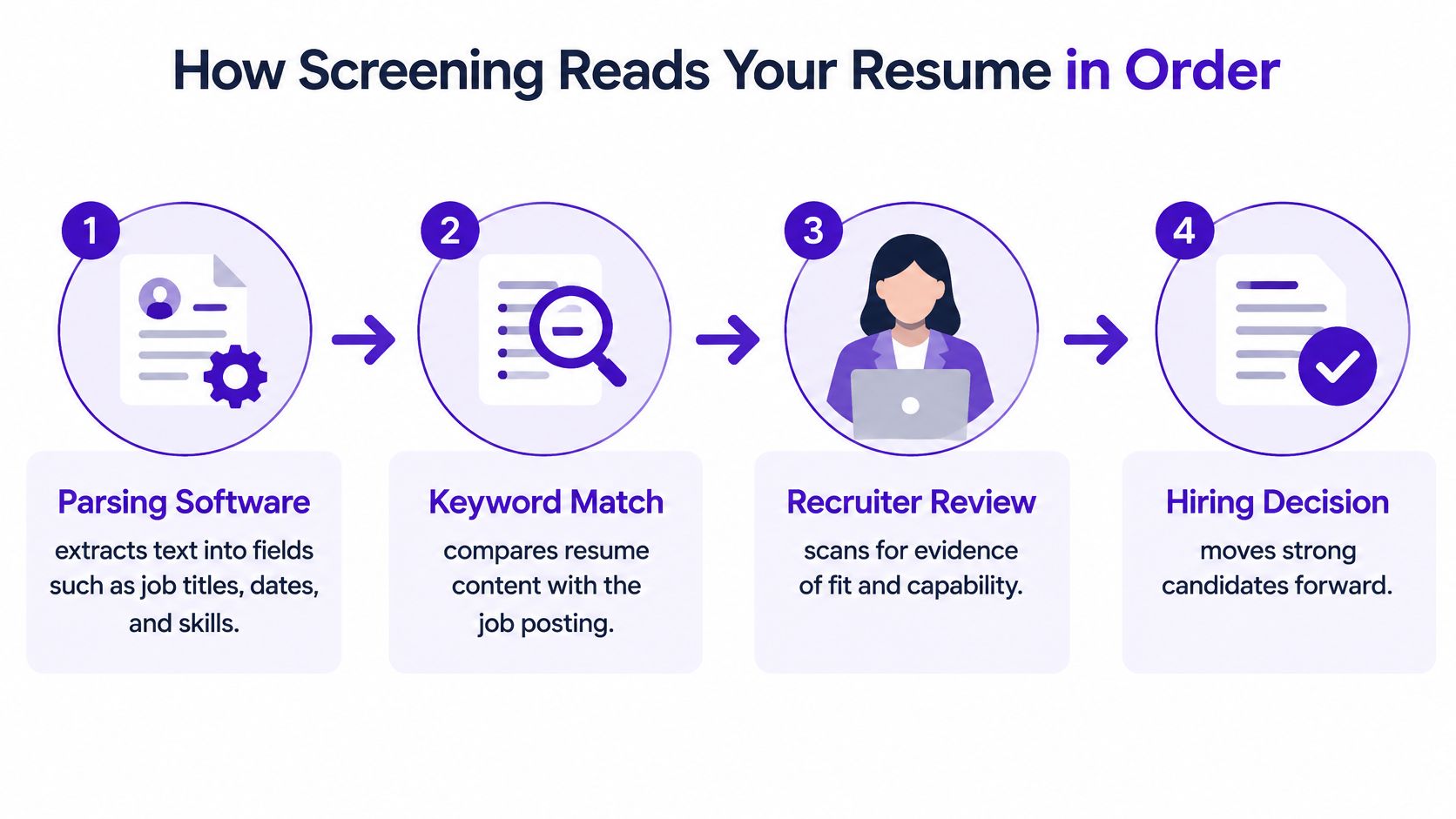
A resume passes through several checks, and each reader looks for a different answer. A clean layout helps the software extract details; clear evidence helps people judge whether those details fit the role.
- Parsing software pulls text into fields such as job titles, dates, and skills. Tables, text boxes, headers, and images can disrupt extraction. Paste your file into a plain-text editor and check whether the titles and dates remain in the right order.
- Keyword and title matching compares your wording with the posting. If the ad says “accounts payable” and your resume says only “finance support,” the match may be missed, even if the work is similar.
- A recruiter scans the upper part of the page for role relevance and familiar headings, often in well under a minute.
- A hiring manager looks more closely at scope, results, reasons for leaving, and whether the dates make sense.
- The shortlist determines who gets an interview. The earlier checks decide whether your resume reaches that point.
Clear writing can affect how quickly a reader understands your qualifications. A 2025 study tracking 183 students applying for full-time jobs in their field found that stronger resumes and cover letters produced substantially more interviews and faster employment. The authors estimated that a one-point improvement in the combined writing-quality measure produced 7% more interviews and shortened time to employment by nearly 10 days, according to the International Journal of Selection and Assessment study. Structure makes qualifications easier to locate; specific details give readers a basis for judging fit.
Order matters because resumes often come before skills tests. TestGorilla's employer research found that in 2025, 67% of employers screened resumes before using skills-based methods, while 33% screened resumes afterward. When a page is difficult to parse or skim, relevant qualifications may be overlooked before a later assessment can show what you can do. This explanation of how resume parsing technology extracts information shows why a readable structure matters. For regulated roles, the same sequence makes clear credentials and relevant experience easy to find; advice on how to optimize your loan originator resume can help focus that information.
Make each stage's answer easy to find, and your resume can serve both the software and the human reader.
Turning Duties into Evidence Recruiters Trust
A duty describes the job. A strong resume bullet shows what you did, the scope of your work, and what changed as a result.
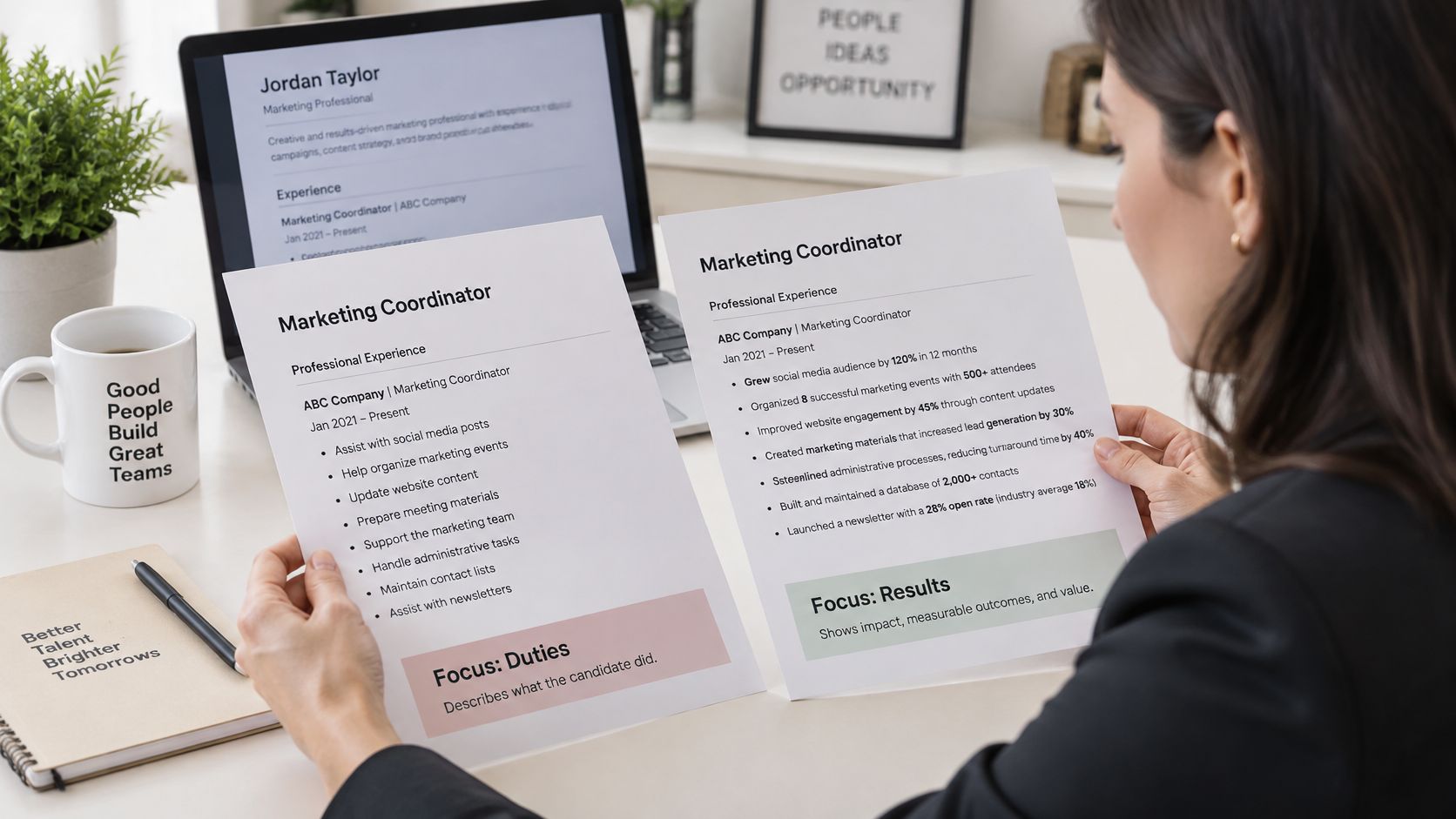
Keywords can help a resume match a role, but they cannot prove that you can do the work. Employers use skills-based hiring alongside resume screening, so give both software and people evidence they can assess. A title may establish relevant experience. A concrete example makes your capability easier to judge.
Action, scope, result
Build important bullets from three parts: the action, the method or scope, and the result.
| Draft bullet | What changed |
|---|---|
| Responsible for customer support | Replaced a vague duty with an action, scope, and result |
For example, revise “Responsible for customer support” to: “Resolved about 60 tickets a day across chat and email, cutting average first-response time from nine hours to four by building a shared reply library.”
“Resolved” names the action. “About 60 tickets a day across chat and email” shows the workload. The change from nine hours to four gives the reader an outcome. Together, these details turn a general responsibility into evidence.
If you do not have an exact result, show the scale or constraint of the work. Team size, customer volume, budget, or a deadline can make your contribution clearer. “Trained four new hires before a holiday rush” gives a reader something specific to evaluate.
A skill word can attract attention; a project, portfolio link, work sample, or assessment result can support the claim. That distinction helps career changers and new graduates, whose previous job titles may not match the posting. In hourly roles, too, a waitress resume job description with concrete examples can show section size, a busy shift, or repeat-guest results instead of saying “served guests.”
For every bullet, identify the problem or need behind the task. Then name what you did and what changed. A line that only repeats an assigned duty gives the reader little reason to trust that you can handle a similar challenge.
Before sending your resume, choose the bullets a hiring manager is most likely to ask about. Be ready to explain what needed attention, what you tried, and what happened. If you cannot support a claim with a clear example, soften it or leave it out.
Structuring Each Section to Answer One Question
Length is a description of typical files, not a target to hit. In 2024, the average resume contained 1.7 pages, 683 words, 15 skills, 13 years of experience, and 5 jobs, according to Enhancv's resume analysis. Early-career candidates usually fit on one page. A long career can justify two, if every line still serves this role.
| Section | Question It Answers | Proof to Include |
|---|---|---|
| Header | Who you are and how to reach you | Name, location, email, phone and links to work |
| Summary | Why you fit this role, in two or three lines | Role title, years of relevant experience and one or two strongest proofs |
| Experience | What you did and what changed because of it | Employer, title, dates and accomplishment bullets with results |
| Skills | Which tools and methods you use | Role-specific skills, grouped and matched to the posting |
| Education | What qualification you hold | Degree, institution, year and relevant coursework or honours |
| Projects or certifications | What you built or verified beyond a job | Project outcome, link or certificate name and date |
Keep the sections consistent
Education establishes that you qualify. Experience shows you applied that qualification. Projects, activities, or certifications add technical or behavioral proof the jobs don't cover. If the summary claims a skill that never appears in a bullet, a project, or a certificate, the page argues with itself.
Put the section with your strongest relevant proof nearest the top. A recent graduate with a thin job history can lead with projects. A licensed professional can lead with the credential and the outcomes tied to it. Don't give the skills list fifteen items because an average file does. List the ones this posting asks for, grouped so a skim can find them.
Each section should answer one question, and no section should repeat another. If the summary already states a result, the bullet underneath should add the method, not restate the boast.
Tailoring for Each Role Without Sounding Machine-Made
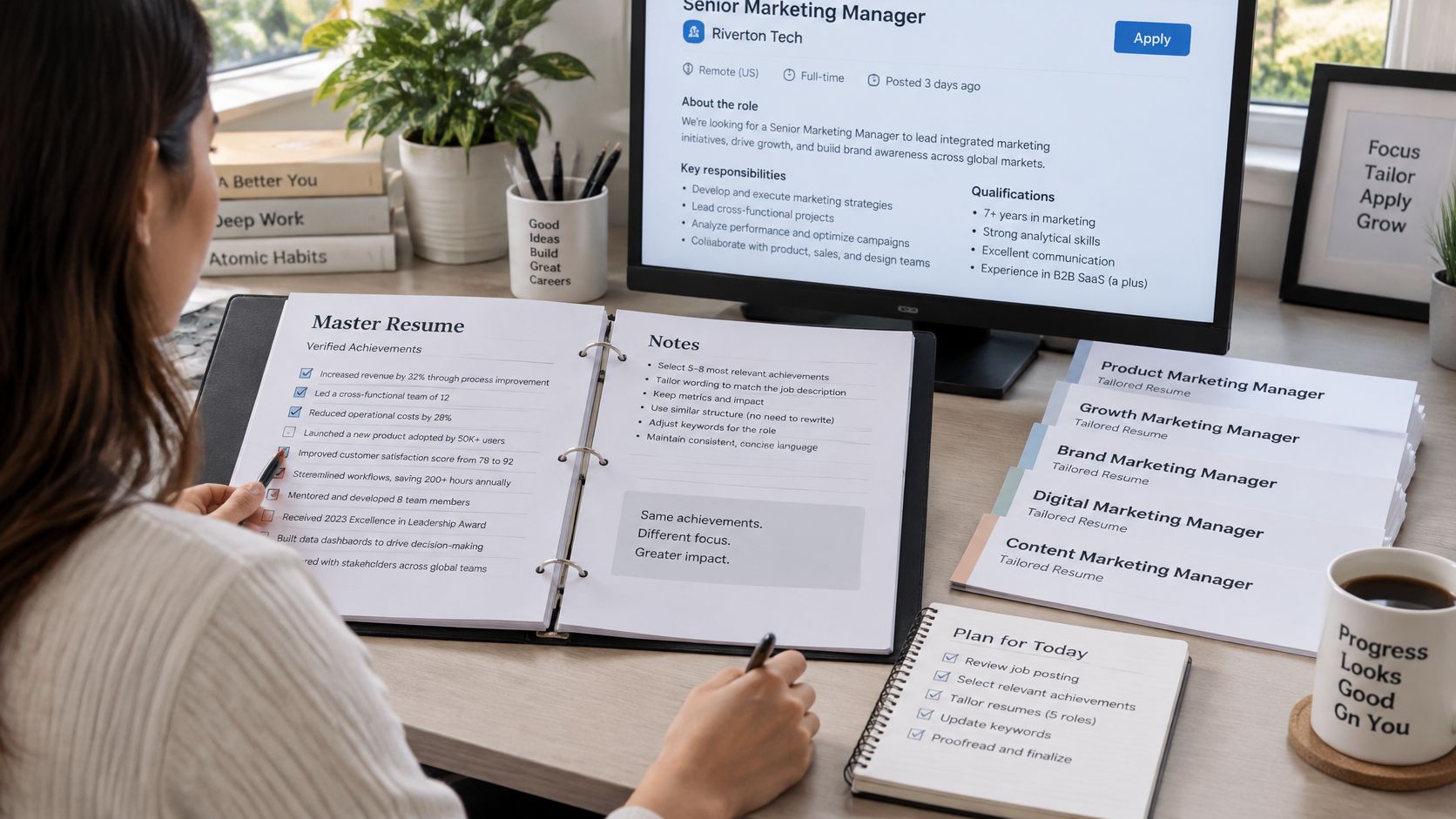
Tailoring isn't a rewrite from a blank page. It's a system you can repeat without sounding like a different person each time.
Keep a master resume with every verified achievement, dated and sourced in your own notes. For each role, read the posting and pick the five to eight requirements that would make or break a hire. Match each one to something you did. Reorder the bullets so those matches sit first. Rewrite the summary so the first line names this role, not a generic title like "hard-working professional."
Software is now one of the readers, and humans are wary of it. In 2025, 32.1% of employers using AI reported applying it to applicant or resume screening, up from 11.6% in 2024, according to iHire's State of Online Recruiting. At the same time, nearly 20% of surveyed U.S. hiring managers said they would reject a candidate for using an AI-generated resume or cover letter, while 33.5% said they could identify AI-created resumes quickly.
Rules that keep both readers
- Use AI for structure. Let it tighten a long bullet or flag a missing term from the posting. Don't let it invent a metric, a tool, or a job.
- Fact-check every figure. If you can't point to a spreadsheet, a ticket log, or a manager who saw the result, take the number out.
- Keep your own voice. Read the summary aloud. If you wouldn't say it in an interview, rewrite it.
- Prepare the story behind each claim. The page only has to open the door. You still have to walk through it.
Among technology professionals in that same survey, 63% worried that AI screening would favor keywords over qualifications. Pairing a real result with the posting's term is how you answer that worry. A practical pass on resume keywords for ATS helps you choose terms you can defend, not a pile you can't.
The page now serves two audiences at once: software that wants structured signals, and a person who wants a credible judgment. Maximizing one at the other's expense can reduce trust rather than raise your odds.
Common Misconceptions About What a Resume Does
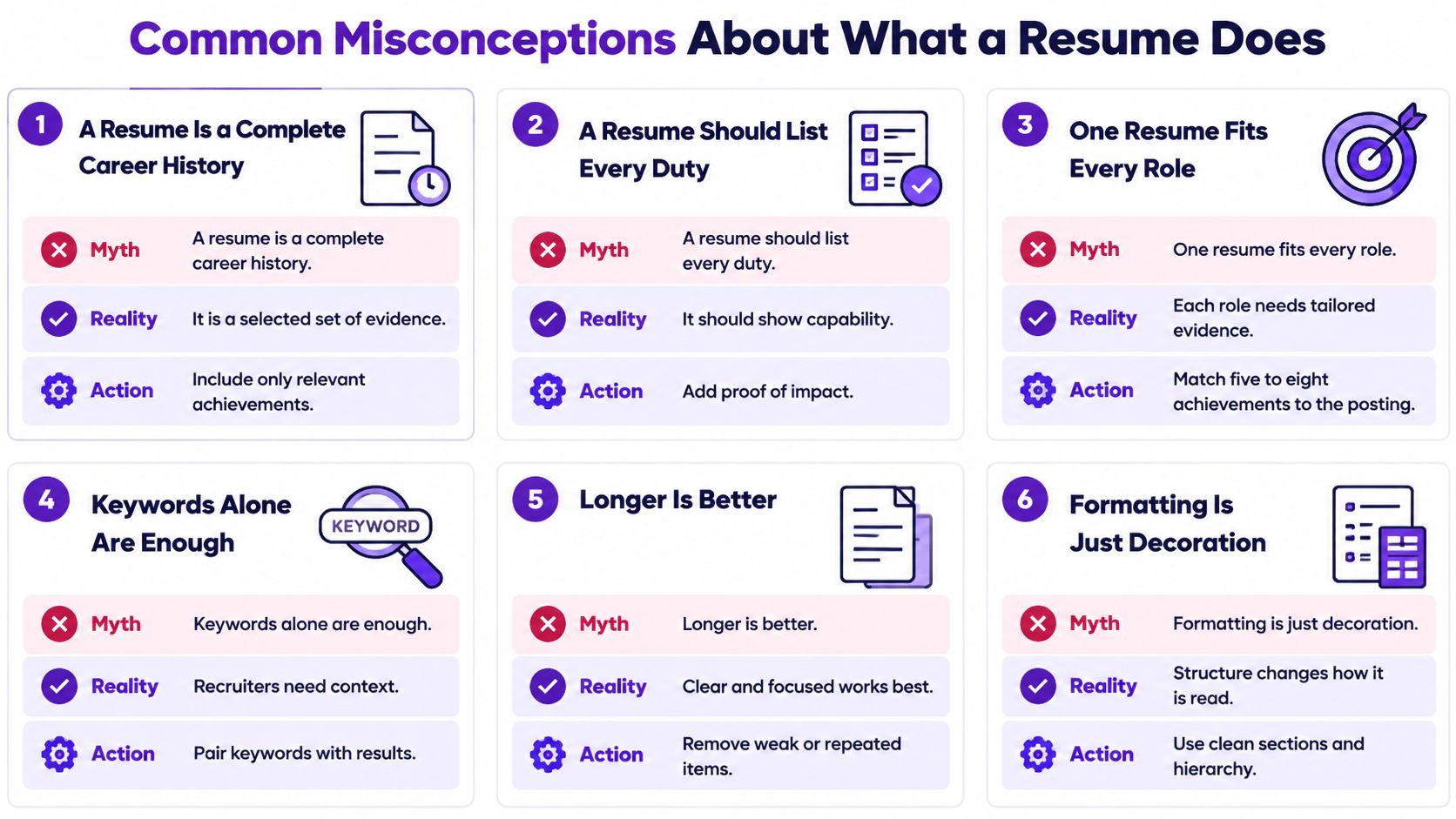
A resume is a complete career history. It isn't. It's a selected set of evidence for one role. Cut the job from eight years ago if it doesn't support this posting.
More pages mean more chances. They don't. A second page helps only when the extra lines are as relevant as the first. Delete repeated duties before you add length.
Keywords alone get you through. They get you read. Proof gets you believed. Put the posting's term in the bullet, then add the result next to it.
A resume gets you hired. It gets you interviewed. Save the full story, the context, and the tradeoffs for the conversation.
One version fits every role. It doesn't. A posting that leads with a certification makes a different first impression than one that leads with revenue. That's what tailoring is for: same master file, different order and emphasis.
AI polish is always safe. Generic or inaccurate wording can cost trust with the person who can tell. Use the tool to tighten. You own the facts.
A resume does not need to prove everything about you. It needs to prove enough for the next step.
Confirm Your Resume Serves Its Purpose Before You Apply
Run this pass before you hit submit. It takes less time than rewriting after a silent rejection.
- Circle the posting. Paste the ad next to your file and mark the five requirements that would decide a yes.
- Export plain text. Confirm headings, job titles, and dates still read in order. If a date jumps into the wrong job, fix the layout.
- Check the formula. Each important bullet needs an action, a scope or method, and a result.
- Look at the top third. Your strongest proof for this role should be visible without scrolling on a laptop.
- Mark interview claims. Put a dot next to every line you could explain with a specific example. Unmarked boasts come out.
You can do all five with a printout and a pen. If you want a second look at whether formatting, keywords, and structure will survive an applicant tracking system, our ATS compatibility check evaluates those three things. The resume process is three steps and takes about five minutes, and creating a resume with Eztrackr is free. The checklist still works if you never open a tool.
When you finish, read the page against those four purposes: parsed, qualified, capable, and worth a conversation. A short pass on common resume mistakes will catch the layout and wording errors that undo that work.
Eztrackr helps you build and tailor a resume for each posting, check how it matches the description, and keep every application in one place so you spend your time on proof instead of reformatting. If you're ready to turn this page into something a screener can trust, start with Eztrackr.