8 Resume Keywords for ATS That Get Noticed
The most popular ATS advice is also the least useful: copy as many words from the job posting as possible. Resume keywords for ATS aren't a numbers game. Repeating a term without proving you can use it can make a resume sound forced, while omitting the employer's exact language can hide a genuine qualification from automated screening.
A stronger approach follows the hiring decision step by step. First, identify the role language in the posting. Next, separate required skills, credentials, tools, and responsibilities from optional preferences. Then connect each accurate keyword to evidence, such as a project, responsibility, result, or credential. Finally, place those terms naturally across your resume and LinkedIn profile.
This guide organizes eight keyword categories around those decisions. You'll see how to use technical skills, soft skills, industry language, action verbs, job titles, performance evidence, credentials, and placement strategy. The examples are templates, not claims to copy. Keep only the language that truthfully describes your experience.
1. Hard Skills and Technical Keywords
Hard skills are the clearest starting point because employers often state them plainly in a job description. They include programming languages, platforms, software, methods, technical processes, and role-specific tools. For a software developer, the posting might name Python, Java, JavaScript, SQL, AWS, or Azure. A CRM professional might need Salesforce or HubSpot, while a data analyst could be expected to use SQL or Tableau.
Use the exact term from the posting when it accurately describes your background. “Customer relationship management software” may be true, but if the employer specifically asks for Salesforce, that product name gives the ATS and recruiter a clearer match. You can include both when appropriate, such as “Salesforce, customer relationship management,” but don't add a platform you've never used.
A dedicated skills section near the top makes relevant capabilities easy to find. Your experience bullets should then show where and how you used them.
Match the tool to the evidence
A skills list says you know a tool. A work-history bullet gives that claim context. Compare these two versions:
- Weak: “Python, SQL, Tableau.”
- Stronger: “Used Python and SQL to clean operational data and built Tableau dashboards for weekly reporting.”
The second version preserves the keywords while showing a real application. If a posting specifies a version, framework, cloud service, or product module that you used, include that detail. Don't turn a broad skill into a more precise claim unless your experience supports it.
Practical rule: Mirror the employer's wording, then prove the skill in a responsibility or achievement bullet.
Before applying, compare your resume with the posting and look for missing technical terms. Eztrackr's ATS resume keyword guide can support that comparison by helping you focus on relevant skills rather than stuffing every possible technology into the document.

2. Soft Skills and Professional Competencies
A soft-skill keyword has little value without a work situation attached to it. Terms such as leadership, communication, collaboration, stakeholder management, adaptability, problem-solving, and project management can help an ATS match your resume, while specific evidence helps a recruiter judge whether the claim fits the role.
Start by identifying the competency in the posting. Then decide where it belongs. Use a summary for a central strength, a skills section for quick scanning, and an experience bullet to show how you applied it. A generic “Strengths” list leaves too much unclear. “Excellent communicator” could mean writing documentation, presenting to executives, handling customer escalations, or coordinating a handoff.
A concrete example is stronger: “Led a cross-functional launch team, coordinated product and marketing deliverables, and resolved competing priorities before release.” A management title is not required. Mentoring, owning a deliverable, facilitating decisions, and influencing teammates can all demonstrate leadership.
Turn the keyword into evidence
Pair the competency with an action and a setting:
- Communication: “Presented quarterly results to senior stakeholders and translated technical findings into operating recommendations.”
- Collaboration: “Facilitated planning sessions across product, engineering, and customer success.”
- Adaptability: “Learned a new CRM workflow and documented the process for teammates.”
- Problem-solving: “Investigated recurring service issues and introduced a clearer escalation process.”
The same keyword may need different evidence for a senior role, industry, resume, or LinkedIn profile. For example, a manager can emphasize decisions and team direction, while an individual contributor can emphasize ownership and influence. Keep the employer's wording when it accurately describes your work. Eztrackr's soft skills examples can help turn broad qualities into evidence-based resume language.
Strong soft-skill keywords explain how you produced an outcome, managed a responsibility, or improved the way a team worked. They function as labels for evidence, not substitutes for it.
3. Industry-Specific Terminology and Jargon
Industry terms work like labels on a technical map. They help an ATS and a hiring manager identify your field quickly. Look for standards, regulations, methods, systems, acronyms, and business concepts in the posting, then use them only when they match your experience.
Examples vary by field. Finance roles may request GAAP, EBITDA, P&L management, SEC filings, or hedge accounting. Healthcare postings may mention ICD-10, HIPAA compliance, EHR systems, or clinical workflows. Technology employers may seek DevOps, CI/CD pipelines, microservices, and REST APIs. Marketing roles can include customer acquisition cost, lifetime value, attribution modeling, or marketing automation. Supply chain positions may emphasize SKU optimization, demand forecasting, ERP systems, or inventory management.
Accuracy determines whether jargon helps. A keyword should identify work you performed, knowledge you developed, or a qualification you hold. Copying unfamiliar terminology can create a mismatch when a recruiter checks the evidence.
Make terminology readable and searchable
Acronyms can have several meanings. Write the full term first, then add the abbreviation when both forms may appear in the posting:
- “Customer Acquisition Cost (CAC)”
- “Generally Accepted Accounting Principles (GAAP)”
- “Electronic Health Record (EHR) systems”
- “Continuous integration and continuous delivery (CI/CD)”
Using both versions gives the ATS recognizable language while helping recruiters outside your specialty follow the resume.
Use the job posting as a checklist. Compare several similar postings, record recurring domain terms, and separate transferable vocabulary from one employer's internal wording. Then place the terms where they fit: a skills section can identify systems, while an experience bullet should show how you used them. Adapt the emphasis to the specific role, seniority, industry, resume, or LinkedIn profile. A finance candidate targeting reporting work might highlight financial analysis, reconciliation, forecasting, and reporting. A healthcare candidate should prioritize the clinical or compliance terms the role requests.
Jargon becomes evidence when it appears in a complete statement, such as “Supported HIPAA compliance during EHR workflow updates.” A disconnected cluster of terms gives the ATS words, but it gives the recruiter little proof.
4. Action Verbs and Power Words
A keyword can identify a skill, but an action verb shows what you did with it. Strong verbs help ATS parsing and make the human review faster because each bullet begins with a clear responsibility or result. Useful options include managed, developed, implemented, analyzed, optimized, coordinated, launched, designed, and led.
Choose the verb based on your actual scope. “Coordinated” may accurately describe a small project with shared ownership. “Led” may fit an initiative you directed. “Architected” should describe genuine design authority, not routine website updates.
Compare the difference:
- Weak: “Was responsible for sales activities.”
- Stronger: “Managed account planning and customer follow-up across a defined sales territory.”
- Weak: “Worked on process improvements.”
- Stronger: “Implemented a revised intake workflow that clarified ownership and reduced handoff confusion.”
- Weak: “Helped with a product launch.”
- Stronger: “Coordinated launch materials across product, sales, and marketing teams.”
Make every verb earn its place
Avoid repeating “managed” in every bullet. A project manager might planned, facilitated, tracked, resolved, delivered, and reported. A designer might conceptualized, produced, tested, refined, and presented. A data analyst might extracted, cleaned, modeled, visualized, and interpreted.
Use past tense for completed roles and present tense for ongoing responsibilities. Don't inflate the language to satisfy an ATS. A precise verb connected to a real responsibility is stronger than a dramatic verb that a recruiter could challenge.
The best formula is simple: action verb + relevant keyword + context + result. For example, “Built SQL reports for customer operations and clarified recurring service trends for weekly planning.” If you have a verified metric, include it. If you don't, describe the scope or decision the work supported instead of inventing a number.
5. Job Titles and Role-Specific Keywords
Job titles are high-value signals because they tell the ATS and recruiter what kind of work you've performed. Employers don't always use the same title for similar responsibilities. One company may call the role Software Engineer, another Software Developer, and another Programmer. Comparable variation appears in sales, product, operations, analytics, and project management.
Your resume should preserve your official title for accuracy. If the internal title is unfamiliar, add a clarifying equivalent in parentheses only when it remains truthful. For example, “Customer Programs Specialist (Account Management)” may help a reader understand the role, but changing “Assistant Project Coordinator” to “Senior Project Manager” would misrepresent your experience.
Match seniority as well as function
A title isn't just a function. It also signals level. “Project Coordinator,” “Project Manager,” and “Program Director” suggest different degrees of ownership. Use language that reflects your real scope, such as supporting schedules, managing delivery, directing a portfolio, or setting strategy.
Place your current or target function in the headline or summary when it accurately represents your goal. Then reinforce it in experience bullets through responsibilities and outcomes. A candidate applying for a product manager role might write about roadmap planning, stakeholder alignment, customer research, prioritization, and launch coordination only if those activities are part of their background.
Review the language employers use across comparable postings, not just one advertisement. This explanation of how applicant tracking systems work can help you understand why title and responsibility alignment matters, but your resume still needs to remain honest.
When changing industries, translate responsibilities into the target field's language without erasing the original context. A teacher may describe curriculum ownership as program development, while an operations professional may frame scheduling and handoffs as workflow coordination. The translation should clarify transferable work, not create a new career history.
6. Quantifiable Metrics and Performance Data
A number helps a recruiter connect a keyword to evidence. “Improved reporting” names an outcome but leaves its scale unclear. A stronger bullet explains the work, the keyword, and the change it produced, such as standardizing data collection and clarifying ownership before reporting became more consistent.
Choose proof that you can support: revenue, cost, time, volume, quality, customer activity, project scope, team size, or delivery milestones. Every bullet does not need a dramatic figure. The reader needs enough context to understand what changed because of your work.
Build each bullet around three parts: an action, a relevant keyword, and verifiable evidence. For example:
- “Used SQL to reconcile operational records and improve the consistency of weekly reporting.”
- “Managed a portfolio of enterprise accounts and maintained structured renewal tracking.”
- “Implemented a new intake process that shortened handoffs between customer support and engineering.”
- “Built Tableau dashboards to help leaders review service trends.”
Know the difference between precise and approximate evidence. Use the exact result with its timeframe or baseline when you can verify it. If you know only the general scale, write “approximately,” “more than,” or “over.” Do not create a percentage to make a bullet appear stronger.
Choose metrics according to the employer's decision point. A sales role may call for pipeline, revenue, retention, or quota attainment. A finance role may emphasize reporting accuracy, close-cycle responsibilities, or portfolio scope. A technical role may focus on system users, reliability, delivery, or performance.
Place the evidence in the experience bullet where the keyword appears naturally. A keyword without proof can look copied, while a result without the keyword may be difficult for an ATS to associate with the role. Pair the term with the work and the outcome, then adjust the emphasis for the specific resume or LinkedIn profile.
7. Certification, Credential, and Qualification Keywords
Credentials are especially important when a job requires formal proof of knowledge, authorization, or professional preparation. Relevant keywords can include degrees, licenses, certifications, security clearances, and required training. Examples include Project Management Professional (PMP), Certified Public Accountant (CPA), Salesforce Certified Administrator, AWS Certified Solutions Architect, Google Cloud Professional Data Engineer, and SHRM Certified Professional (SHRM-CP).
Use the official name supplied by the issuing organization. “AWS Cloud Cert” is vague, while the credential's formal title is easier to recognize. Put relevant certifications in a dedicated section with the issuer, status, and dates when those details help establish validity.
Put required credentials where they're easy to verify
If a license or certification is a screening requirement, don't bury it in a paragraph. Give it a clear heading such as Certifications and Licenses. You can also place a relevant credential after your name or in the professional summary, provided the resume remains readable.
Check every date before submitting. If a credential expires, include the expiration date when it demonstrates that your qualification is current. If you're pursuing a certification rather than holding it, label it as “in progress” and include an expected completion date only when you can support that timing.
Credentials should reinforce the role, not decorate it. A cloud certification matters most when your experience also mentions cloud architecture, deployment, security, or platform administration. A PMP becomes more meaningful when your bullets show planning, risk management, delivery, and stakeholder coordination.
Don't claim a certification because the posting asks for it. If you lack a required credential, address the gap through relevant coursework, equivalent experience, or an active plan, when appropriate.
8. Keyword Density and Strategic Placement
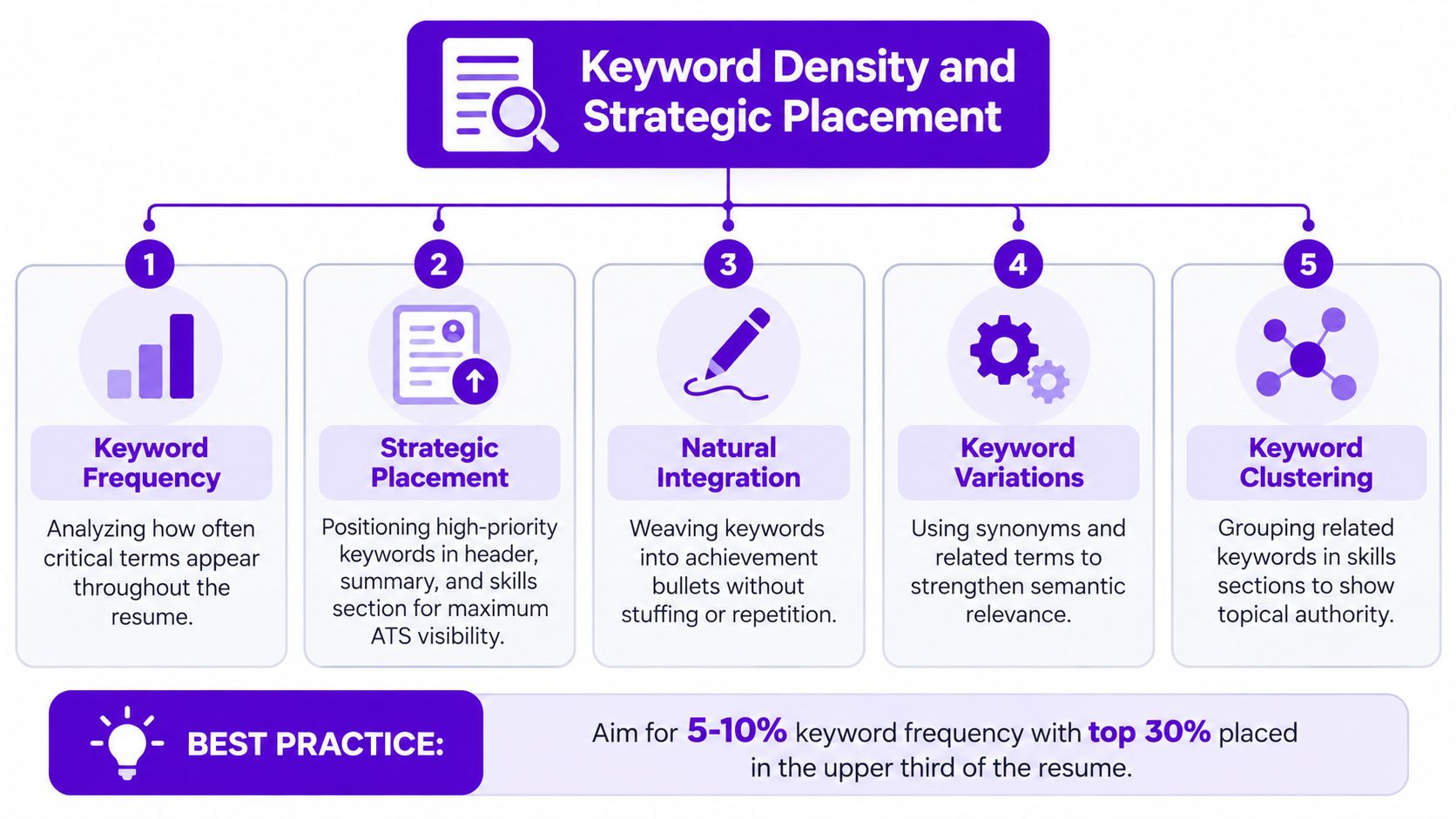
Placement affects whether the right terms are found quickly. Put the most important, accurate keywords in sections that both ATS parsers and recruiters can interpret easily: your headline, summary, skills section, experience bullets, education, and certifications. The first lines should clarify your target function and strongest relevant capabilities, not force a dense block of jargon.
A practical workflow begins with the posting. One job-description targeting guide can help you organize the requirements before you revise your resume. Separate terms into required qualifications, preferred skills, tools, credentials, responsibilities, and industry language. Then choose where each term belongs.
Give each keyword a job
Use the skills section for compact tool and competency coverage. Use the summary for your target role and strongest qualifications. Use experience bullets for proof. Use certifications and education for formal requirements. Your LinkedIn profile should use the same credible terminology, especially in the headline, About section, skills, and experience descriptions.
Don't hide keywords in white text, repeat them unnaturally, or create a paragraph designed only for machines. Keyword stuffing makes the resume harder for people to trust and can weaken the narrative. Exact matching matters, but context matters too.
A useful test is to read the document aloud. If a sentence sounds like a list of disconnected terms, rewrite it around a responsibility or result. Build a version for each application rather than forcing one general resume to cover unrelated roles.
Use the following video as an additional visual reference while reviewing placement and readability.
8-Point ATS Resume Keyword Comparison
| Topic | 🔄 Implementation Complexity | ⚡ Resource Requirements | ⭐📊 Expected Outcomes | 💡 Ideal Use Cases |
|---|---|---|---|---|
| Hard Skills and Technical Keywords | Medium, requires precise, up-to-date terms | Medium, training, tooling, frequent updates | ⭐⭐⭐⭐⭐, strong ATS pass rate; direct role fit | Technical roles, cloud/data, engineering positions |
| Soft Skills and Professional Competencies | Low–Medium, needs contextual evidence | Low, examples, storytelling; minimal cost | ⭐⭐⭐, improves human fit; supports ATS when evidenced | Leadership, customer-facing, cross-functional roles |
| Industry-Specific Terminology and Jargon | Medium–High, demands domain knowledge | Medium, research, possible certifications | ⭐⭐⭐⭐, boosts sector filtering and credibility | Regulated sectors (finance, healthcare), niche roles |
| Action Verbs and Power Words | Low, stylistic edits to phrasing | Low, editing time only | ⭐⭐⭐⭐, enhances perceived impact and ATS indicators | All resumes; especially achievement-focused bullets |
| Job Titles and Role-Specific Keywords | Low, research and alignment | Low, title research and small edits | ⭐⭐⭐⭐, critical first-filter match in ATS | Targeted applications; clarifying seniority and function |
| Quantifiable Metrics and Performance Data | Medium, requires data collection and verification | Medium, tracking systems or reporting access | ⭐⭐⭐⭐⭐, highest impact on recruiter assessment and ATS | Revenue, operations, sales, product, and measurable ROI roles |
| Certification, Credential, and Qualification Keywords | High, obtaining credentials can be time-consuming | High, cost/time for courses and renewals | ⭐⭐⭐⭐, mandatory in many roles; strong verifier | Regulated industries, specialized technical roles |
| Keyword Density and Strategic Placement | High, careful balancing to avoid stuffing | Medium, analysis tools and custom tailoring | ⭐⭐⭐⭐, improves ATS score when balanced and natural | High-volume applications; ATS-sensitive job markets |
Turn Keywords Into Evidence
The best resume keywords for ATS aren't the ones you can repeat most often. They're the terms that accurately connect your experience to the employer's stated needs. A recruiter should be able to see what you did, which tool or competency you used, and why that work matters.
Start with the job posting and mark every repeated phrase, required qualification, named tool, credential, job title, and responsibility. Then sort those terms into two groups: required language and optional language. Required terms deserve priority, but only when they describe your real background. Optional terms can strengthen the match when they add precision, but they shouldn't displace more relevant evidence.
Next, compare the posting with your current resume. An independent 2026 ATS analysis reported that an average unoptimized resume contains roughly 46% to 48% of the keywords in its target job description, leaving many terms absent even when the applicant may have the underlying skill. The same source reported that the median resume misses five keywords, while 72% lack at least one term identified as critical in the posting. Read the figures as a language-mismatch warning, not as an invitation to copy every phrase. The ATS statistics and keyword-gap analysis explains why qualified candidates can be overlooked when their wording doesn't match the role.
Preserve exact terms wherever they're accurate. If the posting says “stakeholder management,” don't rely only on “relationship building” when both describe your experience. Include the employer's phrase in a natural sentence, then add a specific example that shows how you managed stakeholders, handled trade-offs, or communicated a decision.
Build each bullet around proof
For every important keyword, ask three questions:
- Where did I use it? Name the project, function, system, or responsibility.
- What did I do? Begin with an accurate action verb.
- What changed? Add a verified result, scale, timeframe, or decision supported by the work.
A bullet might read, “Implemented Salesforce workflow updates, coordinated training for customer-facing teams, and improved consistency in opportunity tracking.” It includes a tool, an action, a soft skill, and a business context without pretending that the keyword alone proves competence.
For harder-to-quantify work, use scope and outcome language instead of invented metrics. “Presented analysis to senior stakeholders and guided a revised reporting process” still gives the recruiter useful evidence. If you have a reliable number, include it and explain what it measures.
Tailor the resume for each application. A software engineer may emphasize Python, SQL, cloud services, and APIs for one role, while a data-focused position may require more emphasis on modeling, dashboards, and analysis. A career changer should translate transferable responsibilities into the target industry's language while keeping the original job title and facts clear.
Apply the same standard to LinkedIn. Your profile shouldn't contain claims your resume can't support, but it can use the same role language in the headline, About section, skills, and experience descriptions. If you need help with the profile mechanics, this guide to uploading a resume on LinkedIn covers that separate task. Your profile and resume should tell the same credible story, not compete with each other.
Eztrackr is one optional way to make the process more repeatable. Its tools can parse job details, compare skills, help build materials, and track applications, so you can revise each document without losing the underlying keyword strategy. Treat any match score or suggestion as an editing aid. Your judgment still decides whether a keyword belongs.
Before you submit, remove unsupported jargon, confirm credential details, check title accuracy, and read every bullet for natural flow. The right resume keywords for ATS help a qualified application surface, but evidence is what gives that application a reason to advance.
Use Eztrackr to parse job postings, compare your skills with each role, build resume materials, and keep your applications organized in one place. Visit Eztrackr to connect your ATS keyword strategy with a practical application workflow.