8 Cover Letter Opening Lines That Get Noticed
The most popular advice about cover letter opening lines is to “grab attention.” That's incomplete. A clever sentence can still fail if it doesn't show why you fit this role at this company. Strong openings earn attention through relevance, not drama. They quickly connect your value, motivation, evidence, or context to an employer's need.
Career guidance consistently favors a concise, specific opening. MIT Broad recommends naming the exact position, adding a requisition number when available, and explaining why the role interests you. Purdue and UCF likewise advise identifying the job and how you found it. CareerBldr's 2026 guidance puts a practical benchmark around one or two sentences and about 25 to 50 words, as summarized in its cover letter opening guidance.
The eight approaches below are organized by purpose and evidence strength. Choose the one your background can support, then use the next sentence to connect that proof, relevance, connection, or curiosity to the employer's priorities. Clear writing helps because every word needs to carry meaning, as this guide to clear sentence structure also emphasizes.
1. The Specific Achievement Hook
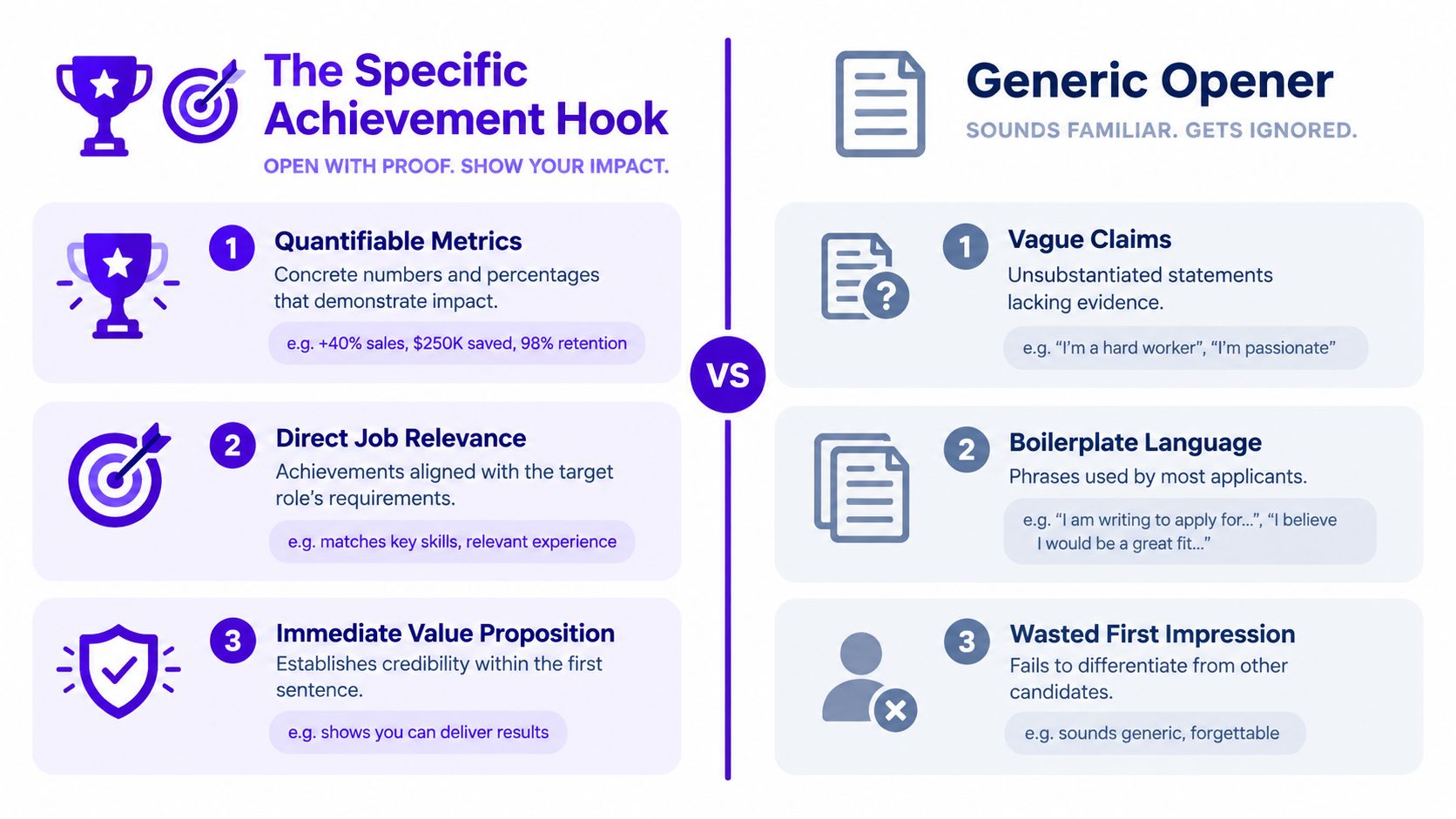
A specific achievement works best when your evidence closely matches the vacancy. Rather than describing yourself as results-oriented, open with a result you delivered. It might involve revenue, efficiency, customer experience, project delivery, process improvement, or another outcome named in the job description.
For example:
“In my current role, I redesigned the customer onboarding workflow and reduced delays across the implementation team. I'm excited to bring that process-focused approach to the Operations Coordinator position at Northstar.”
The line works like a signpost. It shows action, relevance, and value before the reader reaches the rest of the letter. The candidate improved a process, then connected that experience to an operations role without pretending every employer needs the same solution.
Match the evidence to the vacancy
Use a measurable result when you can verify it and when it matters to the hiring team. For an account-retention role, lead with a retention-related outcome. For a project-delivery role, mention a project completed successfully. A number without context can feel decorative, so explain what changed and why that change matters.
You can use Eztrackr's AI cover letter generator to organize the achievement around the job description, but verify each detail yourself. The tool can help phrase a result, but it cannot confirm whether the metric is accurate, current, or relevant.
Use case: You have a recent accomplishment closely related to the target role.
Personalization method: Take the employer's stated priority, then connect it to your strongest relevant outcome.
Caution: Do not inflate, generalize, or choose an impressive achievement with little connection to the position.
Adaptation formula:
“I [action] to achieve [verified result], and I'm ready to bring that experience to [exact role] at [company].”
Follow the hook with context. Explain the problem, your contribution, or the skill behind the result. That turns the opening from an isolated resume bullet into evidence the hiring team can assess.
2. The Company-Specific Research Reference
A company-specific reference works when your interest is tied to something the organization has done, built, announced, or prioritized. You might mention a product, mission, public initiative, expansion, or clearly stated business direction. The reference should lead naturally to your relevant experience.
For example:
“Your investment in accessible digital services caught my attention because my recent product work has focused on simplifying complex customer journeys. I'd welcome the opportunity to bring that user-centered approach to the Product Designer role.”
The opening feels specific because it could not be copied unchanged into an unrelated application. It also avoids a common mistake, expressing admiration without showing what you can contribute. Research only becomes useful when you connect it to evidence from your own background.
Research without sounding like a press release
Use the company website, the job posting, public product pages, and reliable company announcements. Look for a detail that affects the team you'd join. A broad mission statement may work for an early-career application, but a product launch or operational priority will usually create a sharper connection for an experienced candidate.
This AI cover letter writer guide can help you identify details to consider, but you still need to judge whether the reference is accurate and meaningful. Don't repeat company language just to insert keywords.
Use case: You've researched the employer and can connect a genuine company detail to your experience or motivation.
Personalization method: Name the initiative, product, or priority, then identify the skill or experience you'd apply to it.
Caution: Don't mention unverified news, outdated information, or a detail unrelated to the advertised role.
Adaptation formula:
“Your [specific initiative or product] aligns with my experience in [relevant area], and I'd bring [specific capability] to the [exact role].”
Keep the reference concise. The employer already knows its own history. Your purpose is to show that you understand the context and have a credible reason to participate in the work.
3. The Problem-Solution Framework
The problem-solution opening suits candidates who understand the employer's challenge and have relevant experience addressing it. It starts with a business problem, then positions your background as useful evidence. This approach can sound strategic, but only if you remain precise and respectful.
Consider this example:
“Growing a customer support operation while maintaining consistent service creates a difficult balance. In my previous role, I built documentation and escalation processes that helped teams handle complex requests more consistently, and I'd bring that operational discipline to your Customer Success Manager position.”
The first sentence demonstrates awareness of a constraint. The second gives the employer a reason to believe you can help. Notice the tone. The candidate doesn't imply that the company is failing or present a solution as if they already understand every internal detail.
Make the problem specific enough
Study the responsibilities, not just the preferred qualifications. If the posting emphasizes reporting, the challenge might involve turning scattered information into useful decisions. If it emphasizes coordination, the issue might involve keeping multiple stakeholders aligned. Don't claim to know the employer's internal problem unless the posting or public information supports that conclusion.

Use case: The role centers on a recognizable operational, customer, technical, or commercial challenge.
Personalization method: Translate one responsibility into a challenge, then pair it with a related example from your work, studies, volunteering, or projects.
Caution: Avoid sounding prescriptive. You're applying to contribute, not diagnosing the company from outside.
Adaptation formula:
“As [relevant challenge] becomes more important, my experience in [related capability] would help support [employer priority].”
The body of the letter should prove the connection. Give one example of how you assessed a problem, chose an approach, and contributed to an outcome. Without that evidence, the opening becomes a business cliché.
4. The Personal Connection Story
A personal story earns space in an opening line only when it explains why the work matters to you and points toward evidence you can offer. It can come from a problem you experienced, an event that shaped your interest, or a project that changed how you understood the field. Treat the story like a doorway, not the whole room. Open with the moment, then lead the reader to your relevant capability.
For example:
“While volunteering at a community legal clinic, I saw how difficult it was for people to understand complex information under pressure. That experience led me to focus on accessible content design, which is why the Content Specialist role at your public-interest organization appeals to me.”
The example works because it connects motivation to direction. The candidate does not ask the employer to value a personal memory on its own. They explain what the experience taught them and connect that lesson to the organization's work.
Keep the story working for the application
Two or three sentences can be enough. Choose a moment that relates directly to the role, then support it with evidence elsewhere in the letter. A story about discovering an interest in logistics should lead to logistics coursework, a relevant project, process experience, or another concrete sign of commitment. Dramatic background details add little if the application cannot show what you learned or did next.
A writing tool can help arrange the opening, but personal stories need careful editing. Replace polished generalities with details only you could truthfully provide. The final line should sound like a candidate explaining a clear professional direction, not a template claiming a lifelong calling.
Use case: Your motivation comes from a credible experience connected naturally to the industry, organization, or function.
Personalization method: Name the moment, explain what changed in your thinking, and connect that change to one responsibility in the role.
Caution: Don't make the employer responsible for fulfilling a personal dream. Show what you can contribute, especially when your evidence is still developing.
Adaptation formula:
“When I [specific experience], I developed [relevant insight or motivation]. That led me to [relevant action], and it's why I'm applying for [role].”
Your next sentence should shift from story to proof. Mention the skill, project, or experience that shows this connection is more than a passing interest.
5. The Mutual Connection Reference
A referral or genuine professional connection gives the opening useful context. If an employee, recruiter, former colleague, professor, or networking contact encouraged you to apply, mention that person accurately and explain the connection briefly.
For example:
“Priya Shah, a member of your analytics team, encouraged me to apply after we discussed your focus on improving customer reporting. My experience building dashboards for account teams would allow me to contribute to that work as a Business Analyst.”
This opening works because it establishes a real point of contact and then adds independent evidence. The referral shouldn't carry the entire application. The hiring team still needs to understand what you can do.
Protect the credibility of the reference
Ask permission before naming someone. Confirm the person is comfortable being mentioned and that your description of the conversation is accurate. A casual encounter shouldn't be presented as a formal endorsement, and a former colleague shouldn't be described as a current employee if they've moved on.
Use case: Someone with a legitimate connection to the organization has encouraged you to apply or discussed the role with you.
Personalization method: Name the person, explain where you connected, and link the conversation to one relevant capability.
Caution: Never imply an endorsement that wasn't given. Don't use a name merely because you once shared an event or online group.
Adaptation formula:
“After speaking with [connection] about [specific topic], I became interested in [role]. My experience in [relevant area] would help me contribute to [team priority].”
If you don't have a genuine connection, choose another strategy. A specific achievement or company reference is stronger than a forced name-drop.
6. The Trend or Industry Insight Opening
An industry insight can work for experienced candidates whose knowledge is central to the position. It signals that you understand the environment in which the employer operates. The insight should be relevant, defensible, and connected to something you've done.
For example:
“Responsible use of automation is becoming a central concern for teams adopting new digital tools. My experience creating review processes for technology projects would help me support innovation while keeping governance and user impact in view.”
This version avoids unsupported statistics and broad predictions. It makes a qualitative observation, then connects the observation to a practical capability. That's safer than inserting an impressive-sounding market claim that you can't verify.
Use insight as a bridge, not a lecture
The employer isn't hiring you to write an industry essay. Keep the trend brief and move to your evidence. Explain how you've responded to a similar change, worked with a relevant technology, advised stakeholders, or delivered a project under comparable constraints.
Be careful with sources. The verified career guidance for this topic supports concise, role-specific, evidence-driven openings, but it doesn't validate unrelated market statistics. If you include a current external fact, check the original source and link it directly. Otherwise, write qualitatively.

Use case: The role requires sector knowledge, technical awareness, regulatory understanding, or the ability to respond to change.
Personalization method: Name the relevant shift, then explain how your experience helps the employer manage it.
Caution: Don't use jargon, predictions, or statistics to sound senior. An unsupported claim can weaken trust.
Adaptation formula:
“As [relevant industry shift] changes how teams approach [business activity], my experience in [specific capability] would help [company] respond effectively.”
The strongest trend openings stay grounded in the job description. If you can remove the company name and the paragraph still fits almost any employer, it needs more personalization.
7. The Skill-Challenge Alignment Opening
This direct approach works well when the job description clearly names the capabilities the employer needs and your background matches them. It is especially useful for technical, regulated, specialist, and mid-career roles where clarity matters more than storytelling.
For example:
“Your Operations Manager position calls for process improvement, cross-functional coordination, and careful performance reporting. I've used those skills in service operations roles, where I mapped workflows, supported team handoffs, and turned recurring issues into practical process changes.”
The opening tells the reader that you've read the posting and can respond to its requirements. It also uses natural role language, which can help keep the application clear for both human reviewers and screening systems. Don't copy the entire job description. Select the few requirements that best match your evidence.
Choose evidence you can defend
Review the role and identify the main responsibilities. Then choose one or two examples that demonstrate those capabilities. A skill claim becomes more credible when you name the setting in which you used it and the type of work you completed.
For more guidance on tailoring the document around the role, see these cover letter best practices. You can also compare the language in the posting with your resume, but don't add a keyword unless it accurately describes your experience.
Use case: Your experience aligns closely with the stated requirements, particularly in a specialist or experienced role.
Personalization method: Name the exact position, select the employer's main requirements, and pair them with evidence from your background.
Caution: Don't list skills without showing where or how you used them. Avoid claiming proficiency you can't demonstrate.
Adaptation formula:
“The [exact role] requires [two or three relevant capabilities]. My experience in [context] has prepared me to use them to support [specific priority].”
A distinctive value-add can follow the core match. Perhaps you've worked across departments, explained technical issues to nontechnical audiences, or improved documentation. Keep it relevant and supportable.
8. The Curiosity and Eagerness Opening
Curiosity and enthusiasm can be effective when you're early in your career, changing fields, or applying for a role where your potential matters alongside your existing experience. The key is to balance what you want to learn with what you can already contribute.
For example:
“I'm excited by the opportunity to bring my research and spreadsheet skills to your Junior Data Analyst role while learning how your team turns customer information into product decisions. My final-year project required careful data cleaning, clear documentation, and presenting findings to people without technical backgrounds.”
This opening makes the learning goal specific. It also gives the employer immediate evidence that the candidate has practiced relevant skills. The result feels confident rather than desperate because the applicant isn't asking the company to provide all the value.
Show interest through preparation
Mention a part of the role, team, or development culture that interests you. Then pair it with coursework, a project, volunteer experience, freelance work, or transferable experience. Recent graduates and career changers don't need to pretend they have years of professional experience. They do need to show deliberate preparation.
A resource on cover letter closing statements can help you carry the same balance of confidence and interest through the rest of the letter.
Use case: You're a recent graduate, intern candidate, career changer, or applicant entering a new specialty.
Personalization method: Identify one specific thing you want to learn, then name a relevant skill or experience you can contribute now.
Caution: Avoid vague enthusiasm, excessive praise, or language that makes the role sound like a training opportunity with no employer benefit.
Adaptation formula:
“I'm eager to contribute [relevant skill] while developing [specific capability] in [role or team]. My experience with [project or context] gives me a foundation for [employer need].”
Curiosity should lead to contribution. If the opening only describes what you hope to gain, revise it until the employer can see why your learning would also support the team.
8 Cover Letter Opening Lines Compared
| Opening Strategy | 🔄 Complexity | ⚡ Resources | ⭐ Key advantages | 📊 Expected outcomes | 💡 Ideal use cases |
|---|---|---|---|---|---|
| The Specific Achievement Hook | Low–Medium, select & verify metrics | Low, needs accurate stats & alignment | Establishes credibility quickly; ATS-friendly | Higher callbacks when metrics match role; clear differentiation | Data-driven roles, sales, PM, operations |
| Company-Specific Research Reference | Medium–High, per-application research | High, time to research & tailor | Demonstrates cultural fit; memorable personalization | Increased interview invites; stronger employer resonance | Senior/strategic roles, mission-driven orgs, niche roles |
| The Problem-Solution Framework | Medium, requires correct problem diagnosis | Medium, research + concrete examples | Positions you as a solver; shows business acumen | Appeals to hiring managers; creates narrative momentum | Consulting, operations, BD, process improvement |
| The Personal Connection Story | Low–Medium, craft concise, relevant anecdote | Low, personal story + relevance check | Emotional resonance; memorable humanization | Better engagement from readers who value authenticity | Mission-focused, creative, startups, customer-centric roles |
| The Mutual Connection Reference | Low (if contact exists), verify permission | Low–Medium, confirm & mention specifics | Immediate credibility; often bypasses early screening | Significantly higher callback rates when credible | Any role with internal contacts; competitive/closed networks |
| The Trend or Industry Insight Opening | Medium–High, current, accurate knowledge required | Medium, ongoing research & citations | Positions you as forward-thinking/subject-matter expert | Attracts innovation-focused employers; demonstrates market fit | Tech, strategy, consulting, industry leadership |
| The Skill-Challenge Alignment Opening | Low, formulaic alignment with JD | Low, extract & match key requirements | Highly ATS-compatible; clear and scannable relevance | Improves recruiter keyword matches; quick relevance signal | Technical/specialized roles, high-volume applications |
| The Curiosity and Eagerness Opening | Low, express genuine learning orientation | Low, mention specific learning goals | Shows coachability, positive attitude, growth mindset | Effective for entry-level/career-change candidates; signals culture fit | Entry-level, internships, career transitions, startups |
Turn the Best Line Into a Tailored Letter
The best cover letter opening line isn't the most creative option on the list. It's the option your evidence can support and the employer's priorities can justify. MIT Career Advising and Professional Development recommends that the opening state the letter's purpose, introduce you briefly, and explain why you're interested in the specific position and organization. That structure keeps the first paragraph useful instead of making the reader wait for the point.
Start by identifying the employer's priority. Read the responsibilities and ask what the team needs this person to accomplish. Then choose one strategy. Use an achievement hook when you have a closely matched result, a company reference when your research reveals a meaningful connection, or a skill-alignment opening when the requirements map directly to your background. Choose the story or curiosity approach when your motivation and potential are stronger evidence than your professional track record.
Edit for proof and relevance
Replace every placeholder with a detail you've verified. Check the exact job title, company name, team name, product, and contact information. If you mention a referral, confirm that the person is comfortable being named. If you mention an achievement, confirm that the result is accurate and that the metric measures something relevant to this role.
The opening should also follow the principle described in this guide to productive writing. Remove words that don't help the employer understand your fit. Phrases such as “I'm highly motivated,” “I'm the perfect candidate,” and “I'm writing to express my interest” make claims without proving them. Replace them with an action, result, connection, or specific reason for applying.
Use the next sentence to explain the hook. If you lead with a result, identify the skill behind it. If you lead with company research, connect the initiative to your experience. If you start with curiosity, show what you can contribute immediately. The opening doesn't need to summarize your entire career. It needs to create a clear path into the evidence that follows.
Keep every application organized
Tailoring becomes harder when you lose track of which version belongs to which role. Save the job posting, resume version, cover letter, referral details, and submission status together. Eztrackr can help job seekers track applications, link documents, and manage progress through a centralized workflow. That organization reduces the risk of sending a letter with the wrong company name or an outdated opening.
Before submitting, read the first paragraph aloud. Ask whether it sounds like you, whether it names the role, and whether it gives the employer a concrete reason to continue. If another applicant could use the same paragraph without changing anything except the company name, make it more specific.
Use Eztrackr to save job postings, organize applications, and link the resume and cover letter version created for each role. Its AI tools can help you draft and tailor opening lines, while its tracking workflow keeps your evidence, documents, and application progress together.