How to Write a Job Description for Waitress on Resume
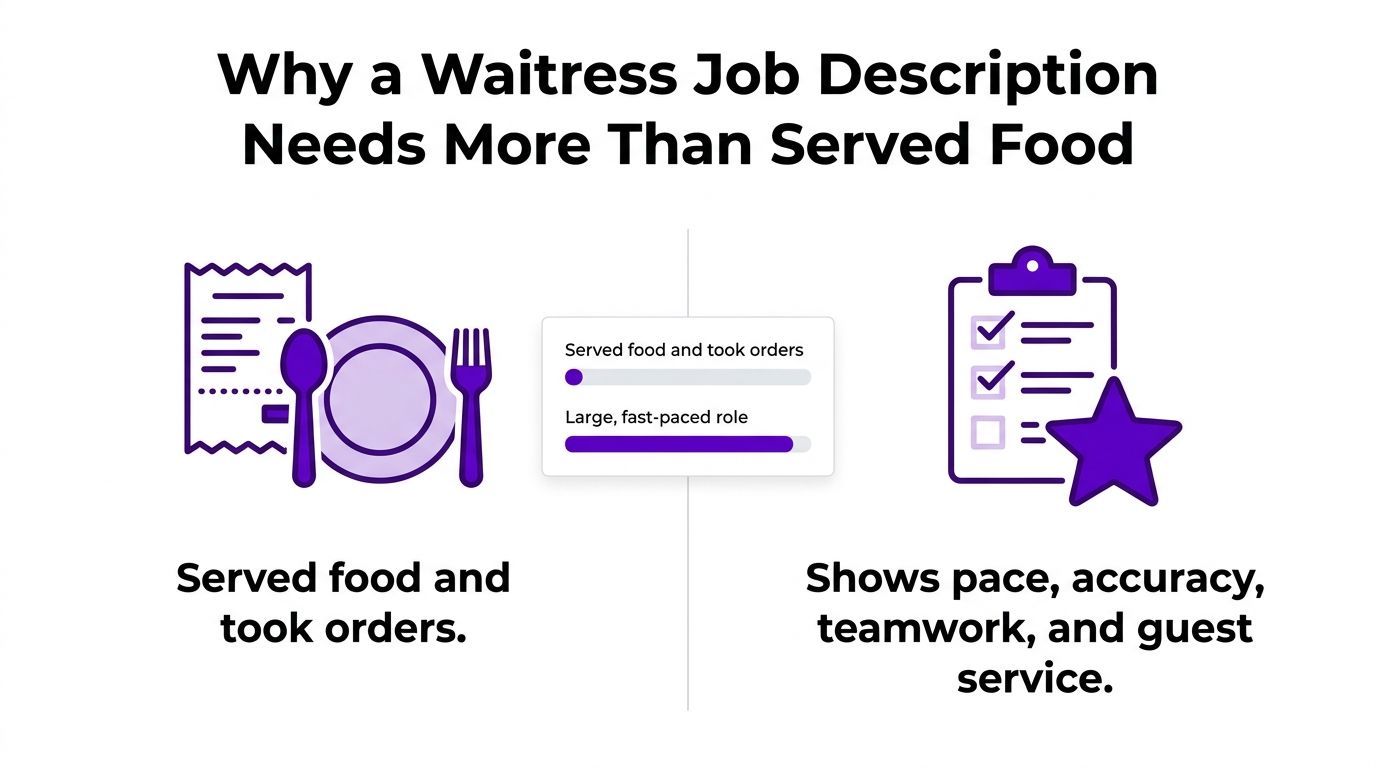
A hiring manager opens your resume and finds one line under your last restaurant job: “Served food and took orders.” It's accurate, but it could describe almost anyone who has waited tables. It doesn't show whether you handled a busy section, entered orders carefully, solved guest problems, or kept your composure when the kitchen fell behind.
A strong job description for waitress on resume makes those parts of the work visible. It connects what you did to evidence a hiring manager can picture, whether you're applying to another restaurant or moving into retail, sales, office support, or hospitality supervision.
Why a Waitress Job Description Needs More Than Served Food
“Served food and took orders” lists tasks, but tells an employer little about how you handled them. Did you check that orders were accurate? Keep track of several tables? Notice when a guest needed help before they asked? Those details distinguish routine duties from proof that you can manage responsibility.
The occupation represents a substantial labor market. The U.S. Bureau of Labor Statistics reported 2,284,400 waiter and waitress jobs in 2025, with median pay of $16.94 per hour, or $35,230 annually. The occupation typically requires no formal educational credential, no prior related work experience, and short-term on-the-job training. The BLS projects 2% employment growth from 2025 to 2035, while still expecting approximately 423,100 openings per year, largely because workers leave the occupation or move into other roles (Bureau of Labor Statistics occupational profile).
That context changes what your resume needs to do. Employers already know restaurants hire servers. They need to see whether you were reliable, accurate, quick to learn, and composed with guests and coworkers. When formal credentials aren't the main barrier to entry, the way you describe your work becomes evidence of your ability.
Turn routine service into evidence
A useful description makes ordinary responsibilities concrete. Instead of saying you “helped customers,” show that you listened to a concern, clarified an order, and worked with the kitchen to resolve an issue. Instead of writing “handled payments,” explain that you processed guest checks through the point-of-sale system and balanced cash accurately, if that reflects what you did.
That approach also helps when you're applying outside restaurants. A retail manager may recognize customer service and sales judgment. An office employer may value accuracy, prioritization, and calm communication. A hospitality supervisor may look for signs that you can coordinate work and support newer staff.
If you're tailoring descriptions for different fields, comparing how employers frame responsibilities can help you focus on the duties that matter in each setting. For example, medical role hiring descriptions offer a different view of how job responsibilities can be written clearly for a specific audience.
The progression is simple: identify the actual duties, choose the ones relevant to the job you want, and describe them with evidence. Your resume shouldn't just confirm that you waited tables. It should help a hiring manager see what you can do next.
Duties and Skills That Belong on the Resume
A waitress's work involves much more than carrying plates. O*NET lists taking food and beverage orders, entering orders into computer systems, serving meals, checking customer satisfaction, correcting problems, and verifying identification for alcohol service among the occupation's duties. It also identifies active listening and monitoring as essential skills, alongside knowledge of customer needs, service-quality standards, and customer-satisfaction evaluation (O*NET waiter and waitress profile).
Those duties are your raw material. The trick is to name them in language that a hiring manager can understand and evaluate, not to dress them up with empty claims.
Separate the task from the judgment
Taking an order is the task. Listening closely, checking special requests, and confirming details are the judgment behind it. Serving a meal is the task. Monitoring the table and responding when something is wrong show how you handled the guest experience.
Use direct descriptions that name the work:
- Order entry: Entered food and beverage orders into the POS system and communicated requests to the kitchen.
- Guest concerns: Listened to customer concerns and coordinated with team members to resolve service issues.
- Table monitoring: Checked guest satisfaction throughout service and responded to changing needs.
- Alcohol service: Verified identification when required before serving alcohol.
- Team coordination: Shared order updates with kitchen and front-of-house staff to keep service moving.
These are clear statements of responsibility, not finished achievement bullets. The next step is to choose the most relevant ones and add evidence where you have it.
“Helped customers” is too broad to tell a manager anything useful. “Monitored tables” is clearer, but still doesn't say what you noticed or how you responded. Favor precise actions that show what you did and why it mattered.
Treat the work as skilled service
Waitressing has also been a significant source of employment for women in the United States. A University of Washington labor-history resource reports that women represented fewer than one-third of roughly 100,000 U.S. waiters in the early 1900s, compared with 92% of more than one million waiters by 1970; waitressing ranked as the nation's 14th most popular occupation for women in 1920. Those historical figures put the work in context, but your resume should focus on your own responsibilities and capabilities.
For a short resume, keep duties that show the strongest mix of service, accuracy, and sound judgment. Cut repetitive lines that describe the same basic interaction. If you want to show how different service settings shape staff coordination, synchronized fine dining service is a useful reference point for thinking about how timing and teamwork affect the guest experience.
You can also draw on soft skills examples to find plain-language ways to describe communication, listening, and teamwork. Then make sure the experience bullets show those qualities through actions, not a string of self-descriptions.
Writing Achievement Bullets Hiring Managers Can Verify
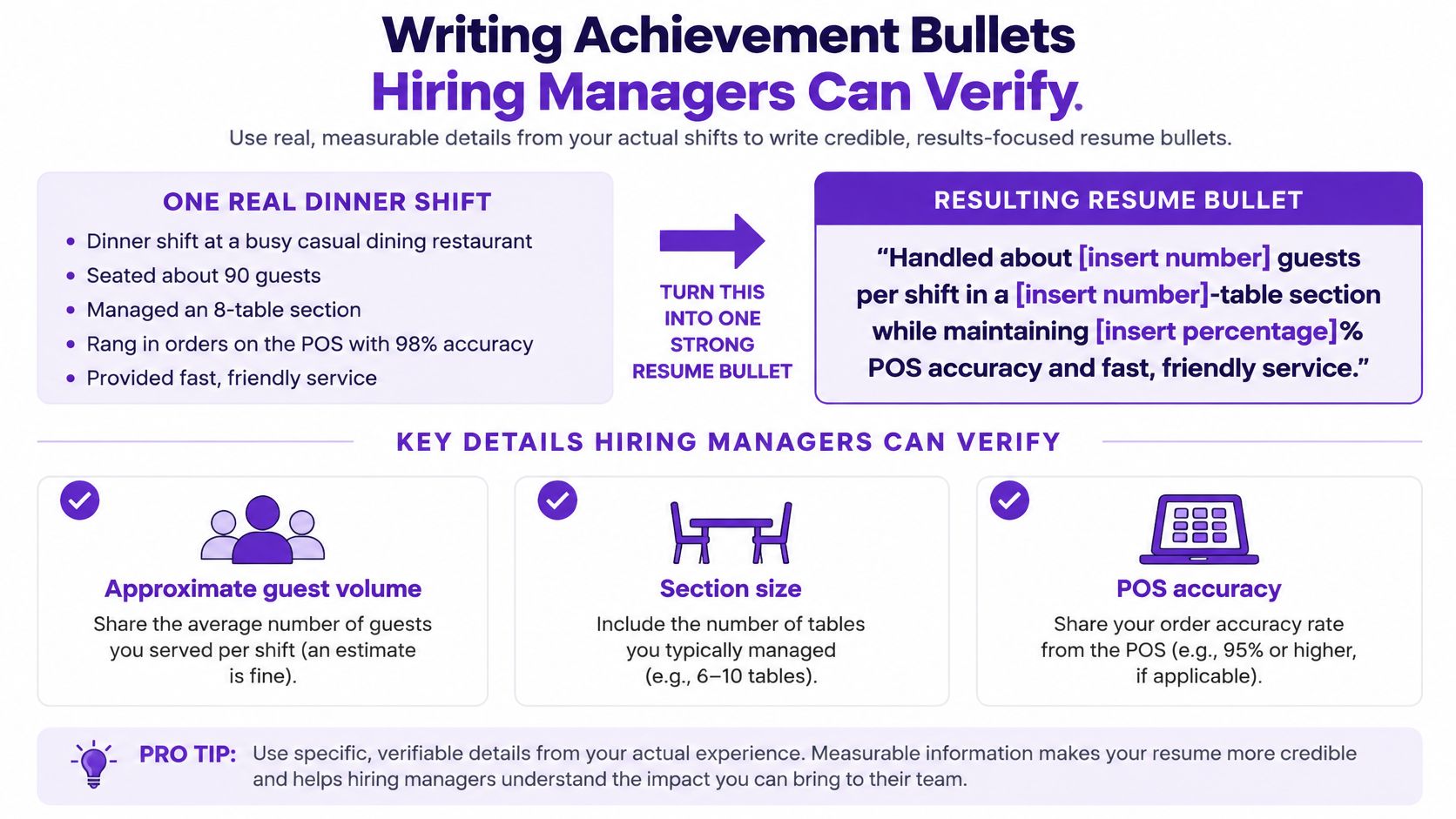
A useful resume bullet gives a hiring manager something specific to picture and something you can explain in an interview. Start with a real shift you remember. Think about the section you handled, how busy service was, how you used the POS system, and what you did to help guests.
A defensible example is: “Served approximately 60 guests per shift across a 10-table section, maintained accurate POS entries, recommended beverage pairings, and supported consistent guest satisfaction during peak dinner service.” That example draws on a real occupational profile, not a universal claim that every server should copy. Only use its details if they're true for your experience.
The point isn't to cram every detail into every bullet. It's to choose evidence that makes your contribution concrete. The BLS reported approximately 2.24 million waiter and waitress jobs in May 2023, with mean annual pay of $36,530, and notes that the occupation generally requires no formal educational credential (BLS occupational employment data). For applicants, that makes demonstrated reliability, throughput, and customer-facing judgment especially useful evidence. A degree alone won't show how you handled a busy shift.
Choose measures you can stand behind
Think about what you can quantify from memory, schedules, POS records, reviews, or manager feedback. Possible measures include:
- Service volume: Guests or tables handled per shift, or the size of your regular section.
- Accuracy: Order-entry accuracy, or how you followed up on special requests.
- Sales contribution: Beverage or menu recommendations, check average, or upselling, if you have a reliable basis for describing the result.
- Guest feedback: Customer comments or review feedback that you can substantiate.
- Team contribution: Training new servers or helping coworkers learn service routines.
- Service pace: Faster table turns or a shorter close, only if you can explain how you know.
If exact records are gone, use bounded estimates you can defend, such as “10–12 tables,” “50+ guests,” or “high-volume weekend shifts.” Say what period or shift the estimate describes. Don't imply that an estimate came from a formal report if it didn't.
Claim outcomes only when you can explain your role in them. “Reduced order corrections” is credible when you can describe what you changed or how the improvement was tracked. “Increased sales 40%” isn't credible just because it sounds impressive. Neither is “hardworking.” Both ask the reader to trust a claim without showing evidence.
Practical rule: If a number or result would be awkward to explain in an interview, leave it off the resume.
Use a simple bullet pattern
Build each line from three parts: action, context, evidence. Start with what you did, add the setting or responsibility, then include the outcome or scale if you can support it.
For instance, a real example might become: “Coordinated guest requests with kitchen staff during peak dinner service, keeping special instructions visible through order entry and follow-up.” It's specific without pretending you measured a result you didn't track.
For more ideas on framing actions and outcomes, see this guide to resume advice for blockchain engineers. The job itself is different, but the useful principle is the same: explain the action and the situation clearly, then include a result only when it's real.
A delivery driver resume sample can also show how another customer-facing role translates routine responsibilities into readable experience. Borrow the clarity, not somebody else's achievements. Write several bullets from your own work, then keep the strongest ones for the job you're targeting.
Here's a short video to help you think through how service experience can be presented on a resume:
Matching the Description to the Role You Held
A café server moving into fine dining should foreground attentive service and menu knowledge. A fine-dining waitress applying to a café should put pace, flexibility, and reliable service first. Your experience stays the same; the details you lead with should match both the role you held and the job you want next.
| Role context | Lead with | Leave out |
|---|---|---|
| Short-term café role | Reliability, quick learning, and adapting to a changing pace. | A long explanation of why the job was brief. |
| Fine dining | Menu knowledge, attentive guest judgment, and polished service. | Claims about wine expertise or formal training you don't have. |
| Banquet service | Team coordination, event setup, and organized service across a large function. | Restaurant details that don't explain event work. |
| Lead server | Training, shift coordination, and consistent closing standards. | Leadership claims that imply authority you didn't hold. |
Answer the questions templates skip
Keep your official title accurate. If your employer called you “Waitress,” use that title. If the posting says “Server,” you can write “Server (Waitress)” when it accurately describes your work. Don't give yourself a more senior title to match a keyword.
Describe cash handling as a responsibility. “Processed guest payments and reconciled cash accurately” shows what you did without relying on a tip total. Include tips only when the figure is accurate, relevant, and easy to explain, such as when it demonstrates a genuine sales contribution or reliable service.
Make irregular work legible. Seasonal shifts, changing schedules, or several employers don't need a defensive explanation. Describe the work plainly. If relevant, show how you followed through, handled varied schedules, or adapted to different teams.
Match your experience to the posting. A lead-server job may call for training and shift support. A café opening may put more weight on reliability and learning the routine quickly. Compare the employer's wording with your actual duties, then describe the overlap in your own terms. Use this guide to match your resume to a target job description without claiming skills or responsibilities you don't have.
The strongest description is accurate and selective. Make the parts that fit the target job easy to find.
Choosing Tools That Keep Each Application Specific
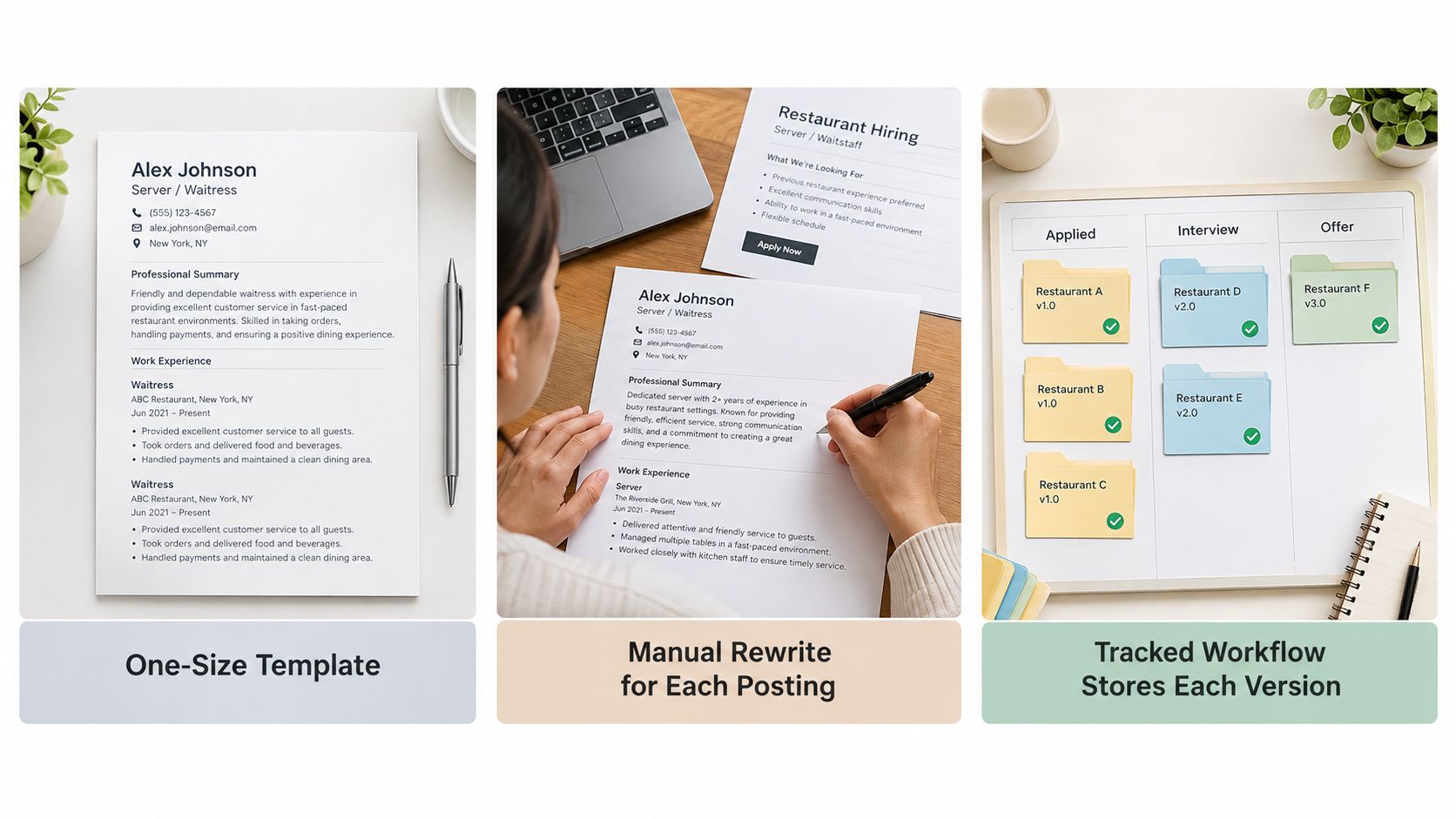
A static template, a manual rewrite, and a tracked application workflow each solve a different problem. Pick based on how many roles you're pursuing and how much of your work history you've already organized.
Choose the right approach for your search
A one-size template is a practical starting point if you're writing your first resume. It gives you a place to list your experience, but it can flatten different jobs into the same generic descriptions. A café shift and a lead-server role shouldn't sound interchangeable.
A manual rewrite for each posting gives you control over emphasis. You can foreground service pace for a café, guest judgment for fine dining, or training experience for a lead position. The drawback is administrative: when you're applying to several jobs, it's easy to lose track of which version you sent, what the employer asked for, and which wording you changed.
A tracked workflow connects each job posting to the resume and application materials you prepared for it. That makes it easier to reuse accurate details while adjusting which ones you feature. It also keeps your search organized when multiple applications are active.
Eztrackr is one option for that workflow. Its Chrome extension saves postings from major job boards, while its kanban board and timeline help organize applications. The platform also offers an AI resume builder, skill-match analyzer, cover letter generator, and answer generator, along with spreadsheet import and statistics on application volume and progress. It's used by more than 45,000 job seekers. Those features can support organization and tailoring, but they're not a reason to add unverified achievements to your resume.
For a first resume, a clean template and careful manual edits may be all you need. If you're actively applying to different kinds of roles, tracking can reduce the chance that you reuse the wrong version or forget which posting a bullet was written for.
Whatever you use, treat automated suggestions as prompts, not facts. Keep only skills you have and accomplishments you can explain. A tool can help you spot relevant language in a job posting; it can't verify what happened during your shift.
Putting the Finished Description to Work
Before you send the resume, read the experience section as a hiring manager would. Can they tell what kind of service setting you worked in, what responsibilities you owned, and why your experience fits this particular opening? If the answer is no, cut general wording and bring the most relevant evidence forward.
Make a final editing pass
- Match the title accurately: Keep the employer's official title, and clarify it with a familiar equivalent only when that helps the reader.
- Check every number: Keep only figures you can explain in an interview.
- Replace empty verbs: Cut “helped customers” and other phrases that don't name a specific action.
- Keep the strongest lines: Choose four to six bullets that show the most relevant parts of the job, rather than documenting every routine task.
- Mirror the posting selectively: Use its terms only for skills you have, not as a reason to claim experience you lack.
A job description for waitress on resume should prove volume, accuracy, and judgment, not just list duties.
Don't keep polishing the same generic draft. Pick a live job posting, rewrite your experience for that specific setting, and save the posting with the customized resume. That way, your next application starts from accurate details rather than a blank page.
A resume builder for tailoring job applications can help you shape the wording around a target role. Keep interview preparation separate from application tracking, and use each customized resume as a record of what you submitted.
Use Eztrackr to save the job posting, check how your skills match its requirements, and keep customized resume versions organized. Visit Eztrackr to connect your waitress experience to the next role you're pursuing.