Resumes for Law Enforcement: 8 Templates & Key Tips
A polished one-page resume isn't automatically the right resume for a law enforcement job. Agencies don't all evaluate applicants the same way: a municipal hiring panel, a federal reviewer, and a public safety communications supervisor need different evidence. The right document makes it easy for the intended employer to verify your qualifications, understand your experience, and compare your application with the role's requirements.
That matters because law enforcement hiring extends beyond a first resume review. Applicants may face written and physical tests, interviews, medical or psychological evaluations, and background investigations, with details checked against formal application materials. Your resume must be clear, accurate, and consistent, not just persuasive.
Choose your format based on the badge or public safety role you want. Patrol applicants should foreground relevant experience and credentials. Federal candidates need to follow the vacancy's required submission method. Veterans, new graduates, investigators, command staff, and dispatchers each need to translate their experience for a different reader without implying authority or qualifications they don't have.
Even outside law enforcement, a well-targeted resume helps employers see how your experience fits their needs. For ideas on presenting your background to a distinct audience, explore jobs for F1 commercial teams.
1. Reverse-Chronological Police Officer Resume
For patrol and municipal police jobs, reverse chronology is the strongest default. Listing your current or most recent work first lets hiring panels and background investigators check your employment history against your application, personal history statement, and background questionnaire. Keep the document focused on what this employer needs to verify.
For each role, show what you did, the scope of the work, and what you can document. Describe patrol duties, calls handled, community programs supported, or training completed when relevant to the posting. Include counts or outcomes only if they are accurate and department policy permits disclosure. Sensitive case details do not belong on a resume.
Keep the chronology verifiable
Use job titles, dates, and supervisor details that match your official records and personal history statement. Label part-time work, reserve service, and overlapping roles clearly. Don't leave investigators to guess how those positions fit together. Hiring may include background investigations and other selection stages, so factual consistency matters as much as polished writing. Research on law enforcement hiring processes describes background investigations among those stages.
Practical rule: A modest, accurate bullet beats a dramatic claim you can't substantiate.
Place POST or equivalent certification details where the posting asks for them. Include a certification number or expiration date when applicable. Reverse chronology works best when your recent, relevant experience is easy to verify; if your work history needs a different presentation, compare resume formats and review this guide to chronological versus functional resumes. Save a separate version for each department and connect it to the matching application in Eztrackr, so you can confirm exactly which resume you submitted.
2. Federal Law Enforcement Resume
A federal resume is a documentation tool, not a municipal resume with extra pages. Federal agencies evaluate applicants against vacancy requirements, and the application instructions determine the format and submission method. Read the full announcement before drafting. Don't assume that one federal resume works for every role or agency.
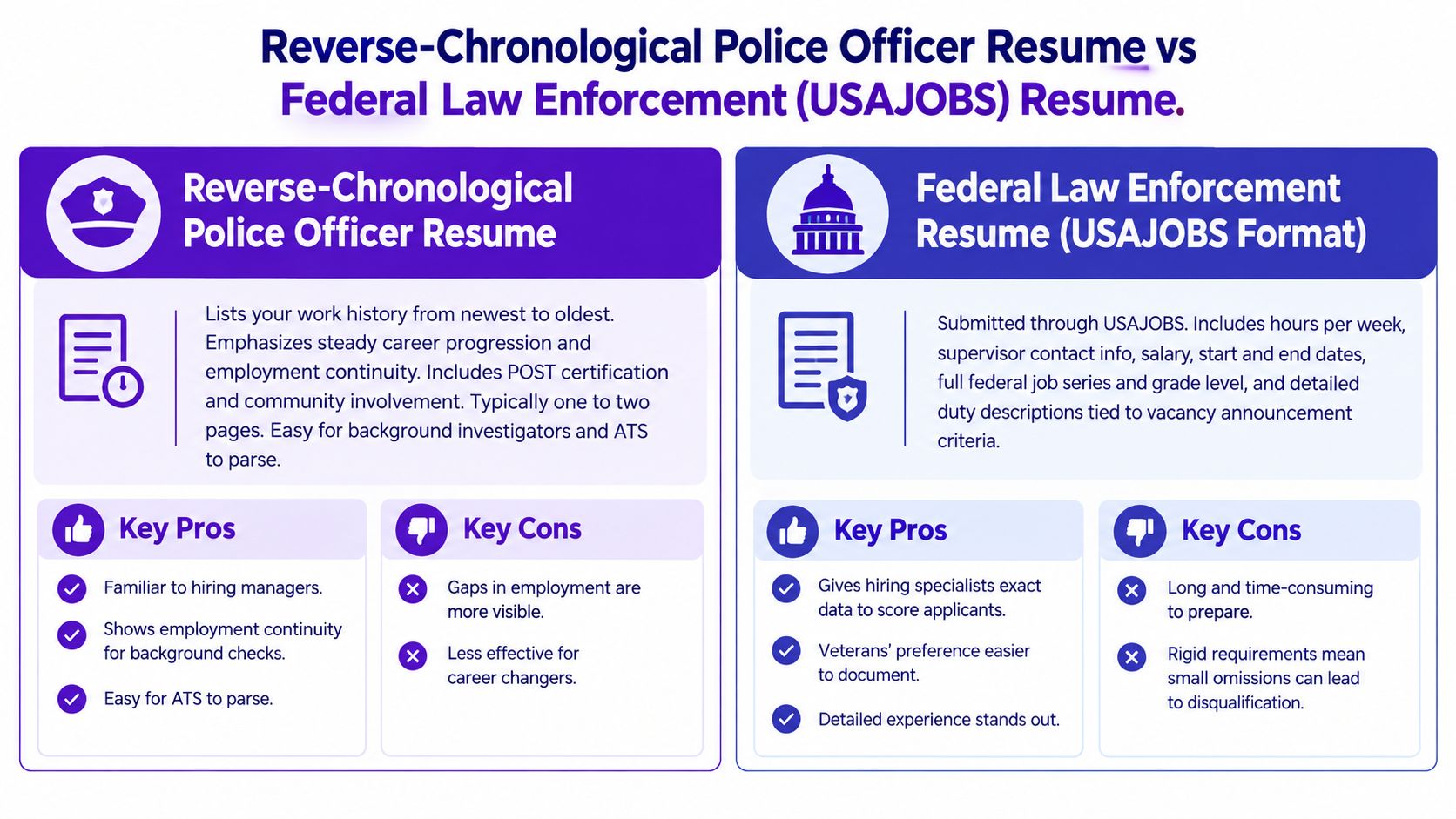
For FBI special-agent applications, the required process includes a federal resume and supporting documents such as transcripts and, where applicable, military or federal employment records. The FBI application and evaluation guidance makes clear that missing required materials can prevent an application from being processed. Use the format requested in the announcement, and record employer or agency, job title, exact start and end dates, hours worked, relevant duties, and accomplishments.
Match documented experience to the announcement
Use the vacancy's terminology when it accurately describes your experience. If a posting asks for investigative work, explain the investigations you supported and your responsibilities. Don't insert keywords for duties you never performed. A strong entry gives the reviewer enough detail to assess your experience, such as the relevant function, scope, systems or procedures used, and documented outcome.
FBI special-agent applicants using the specified USAJOBS announcement must complete the required Resume Builder fields. The FBI special-agent announcement on USAJOBS states that uploaded resumes won't be used for qualification purposes; the information entered is also used to evaluate qualifications and validate questionnaire answers. Check every field against your records before submitting.
Federal resume conventions can differ by position, so don't add details just because you've seen them on another applicant's resume. Use the announcement's instructions, confirm supervisor contact information before listing it, and compare your qualifications with each vacancy using Eztrackr's skill-match analyzer.
3. Military-to-Law Enforcement Transition Resume
Military experience can demonstrate leadership, sound judgment, security awareness, and performance under pressure. It doesn't automatically establish civilian police authority or investigative experience. Your resume should translate military work into language a civilian hiring panel can assess, while clearly separating military qualifications from law enforcement credentials.

Replace unexplained acronyms, unit shorthand, and military job codes with plain descriptions. Instead of relying on a rank or specialty title to speak for itself, say whether you supervised personnel, maintained accountability for equipment, coordinated operations, or documented incidents. For example, a platoon sergeant can describe the team's size and responsibilities if those details are accurate and appropriate to share.
Translate your work. Don't translate it into authority you didn't hold.
Put transferable skills in context
Include training that relates to the target role, such as firearms qualification, first aid, detention operations, or investigations coursework. Identify the issuing organization and completion status, and don't present military instruction as a civilian POST certification unless it qualifies. If you're eligible for a relevant veterans' preference, state it as the vacancy directs.
The military-to-police transition resource discusses translating military experience for civilian policing. A career changer can use that same principle: explain what the work required, then connect it to the agency's published qualifications. Identify transferable skills by starting with concrete duties, not broad claims like “mission-focused leader.”
Track applications by agency and posting type in Eztrackr. That makes it easier to preserve the right version of your resume for each employer and learn which descriptions lead to conversations with recruiters.
For a general overview of moving from military service into civilian work, watch this video:
4. Entry-Level Police Academy Candidate Resume
A new applicant doesn't need to disguise limited experience. The resume should show readiness through education, dependable work habits, community involvement, and training relevant to the agency's requirements. Put education and certifications near the top when they're central to eligibility. The Bureau of Labor Statistics overview of police and detective entry requirements notes that standards vary by employer, so check the specific posting rather than assuming one education requirement applies everywhere.
Use a short summary to identify the role you're pursuing and the strengths you can support with examples. A criminal justice student, for instance, might list relevant coursework, a campus safety role, volunteer work, and customer-facing employment. A degree alone won't show how you handle responsibility; describe what you did in each setting.
Turn early experience into evidence
Give dates and specific responsibilities for internships, ride-alongs, volunteer work, and police explorer programs. Explain your role and what you learned, but don't imply that observing officers gave you operational authority. For part-time jobs, show transferable duties such as accurate recordkeeping, conflict de-escalation, following procedures, or serving the public.
Use numbers only when you can verify them. If you know the hours you volunteered or the events you helped organize, include those details. If you don't, explain the work clearly without estimating. Distinguish credentials you've completed from courses or academy preparation still in progress.
If you're applying while finishing school, keep a separate version that puts relevant coursework and service near the top. Eztrackr's resume builder can help organize those details alongside each posting. For preparation beyond the resume, review these correctional officer interview questions, then tailor your answers to the position you're pursuing.
5. Detective and Investigator Resume
An investigator's resume should make the work reviewable. A detective, financial crimes applicant, or cybercrime candidate needs more than a list of cases or a claim to be a strong investigator. Show your role in the process: how you handled evidence, conducted interviews, prepared reports, coordinated with partners, or presented information in court.
Start with the unit's requirements and select examples that demonstrate relevant skills. A major-crimes applicant might describe investigative responsibilities and courtroom testimony. Someone targeting a digital investigations role should name relevant systems, digital-evidence training, and certifications, provided those details are accurate and cleared for disclosure.
Protect sensitive information
Don't expose protected details about victims, suspects, operations, or active cases to make a bullet more vivid. Follow your agency's confidentiality and disclosure rules. If case outcomes or workload figures aren't authorized for your resume, describe the scope of your work and the procedures you followed instead.
A useful bullet structure is: function, scope, method, documented result. For example, explain that you coordinated evidence review with a partner agency and prepared reports for prosecutors, if that accurately reflects your contribution. Avoid taking credit for a team outcome you didn't control, and identify task-force work by your role rather than implying you led it.
Make your contribution unmistakable. Don't claim the whole case when you handled one part.
Keep specialized skills visible, including interviewing, evidence handling, case management, and digital forensics where relevant. An investigator moving into a different specialty shouldn't assume a reviewer understands the connection between units; spell out the transferable responsibilities. Use Eztrackr's skill-match analyzer to compare your real experience with the unit's stated qualifications, then revise only where the language can be made more precise.
6. Police Supervisor and Command Staff Resume
Promotional resumes need to show how you lead, not merely that you hold a supervisory title. A sergeant seeking a lieutenant role should document personnel development, policy implementation, operational planning, community engagement, and other duties that match the promotion criteria. Read the internal posting and promotional process materials before choosing what to emphasize.
Give each leadership claim a concrete example. If you managed a training cycle, explain your responsibility and its documented result. If you served on an accreditation team or community-policing initiative, identify the work you contributed and the outcome you can verify. Don't claim credit for department-wide results unless your role supports that claim.

Show readiness for the next rank
A promotional panel needs evidence that you can handle the responsibilities of the position, not just perform your current job well. Include relevant committee work, coaching, project leadership, policy review, and collaboration with community or agency partners. Where the posting sets requirements such as time in grade or assessment participation, make your eligibility easy to verify.
Keep this resume current between promotional cycles. Record projects, training, and leadership responsibilities as they happen, and store supporting documents in Eztrackr so you're not reconstructing your accomplishments under deadline. A running record also helps you distinguish sustained leadership from a one-time assignment.
Keep the tone professional and specific. Replace phrases like “excellent communicator” with an example of a briefing, community meeting, or interagency project you led. Promotional reviewers can judge the claim only if they can see what you did and how it connects to the job.
7. Public Safety Dispatcher and Telecommunicator Resume
Dispatcher and telecommunicator applications call for their own resume, even though the work supports law enforcement and emergency response. The employer needs to see that you can communicate clearly, manage competing demands, document information accurately, and follow established procedures. Customer service experience can be relevant, but explain the connection instead of expecting a reviewer to make it.
Name systems and responsibilities
List the communications and dispatch systems you've used, including CAD or radio platforms where applicable. Add certifications such as APCO, NENA, or emergency medical dispatch training only if you hold them, and include dates when requested. If you're trained on a specific tool but haven't used it on the job, label that distinction accurately.
Describe multitasking in concrete terms. A call-center applicant might explain how they gathered information while updating records and communicating with colleagues, if that reflects their work. A current dispatcher can describe call handling, radio communications, and coordination duties without sharing confidential incidents or restricted operational detail.
Don't use “good under pressure” as the main proof of readiness. Show the reader what you did during urgent or emotionally difficult interactions, how you followed scripts or protocols, and how you kept records complete. Transferable experience from social work, healthcare, retail, or a customer support center can help, but don't equate it with emergency dispatch experience.
Use an Eztrackr resume version focused on communications roles. Its AI resume builder can help recast call-center or customer-service duties in public safety language, while you remain responsible for confirming each statement is accurate. The target is a resume that connects your experience to the dispatch role without overstating your training or access to emergency systems.
8. ATS-Optimized Law Enforcement Resume
An ATS-friendly resume is usually a clean, single-column document with standard headings and text that can be parsed reliably. It can help an online application system identify qualifications, but it can't make an applicant eligible or replace the format an agency requires. For a federal role, follow the announcement and submission instructions first.
Use familiar headings such as Experience, Education, Certifications, and Skills. Keep important information out of text boxes, decorative graphics, headers, and footers, where some systems may fail to read it. Use consistent date formats and spell out an acronym the first time if a hiring reviewer may not recognize it.
Match terms honestly
Compare your resume with the posting's qualifications. If the announcement asks for a driver's license, report your status accurately. If it names a certification, use the correct title only if you hold it. Don't add a keyword just because it appears in the vacancy; a reviewer may ask you to explain the experience behind it.
A master resume can hold your full work history, training, certifications, and accomplishments. Create a customized copy for each agency, then review it against your application answers and records before submitting. Review ATS resume keywords, but treat keyword matching as a final language check, not a substitute for documented qualifications.
Eztrackr's resume builder and skill-match analyzer can help compare a resume customized for a specific posting. Save the final document and link it to the application so you can identify the exact version later. If you also maintain a command or board-style resume, assess your board resume separately; don't assume that format suits an online law enforcement application.
8 Law Enforcement Resume Examples Compared
| Resume Type | 🔄 Implementation Complexity | ⚡ Resource Requirements | 📊 Expected Outcomes | Ideal Use Case | ⭐ Key Advantage |
|---|---|---|---|---|---|
| Reverse-Chronological Police Officer Resume | Low; organize roles newest to oldest with consistent dates | Employment history, certifications, education, and measurable duties | Clear employment timeline that is easy to verify and scan | Patrol and municipal police applicants with relevant work history | Familiar to reviewers and generally easy for ATS to parse |
| Federal Law Enforcement Resume (USAJOBS Format) | High; follow detailed vacancy and federal resume requirements | Detailed work history, hours per week, salary, supervisor details, and vacancy-specific qualifications | Gives hiring specialists information to assess applicants against posting criteria | Applicants to federal agencies using USAJOBS | Documents qualifications and veterans' preference in detail |
| Military-to-Law Enforcement Transition Resume | Medium; translate military roles and terminology into civilian language | Military experience, training, clearances, qualifications, and preference eligibility | Makes transferable skills and leadership experience clearer to civilian reviewers | Veterans and service members transitioning to law enforcement | Connects military training and experience to law enforcement duties |
| Entry-Level Police Academy Candidate Resume | Medium; build evidence from education and limited experience | Education, coursework, volunteer work, internships, certifications, and activities | Demonstrates readiness and public-service commitment despite limited work history | Recent graduates and applicants with limited professional experience | Highlights relevant preparation and community involvement |
| Detective and Investigator Resume | High; select relevant metrics while protecting confidential information | Case experience, specialized training, systems, testimony, and permitted outcomes | Shows investigative skills and results relevant to specialized-unit selection | Officers applying to investigative, major-crime, financial-crime, or cybercrime roles | Uses relevant casework and measurable outcomes to demonstrate competence |
| Police Supervisor and Command Staff Resume | High; substantiate leadership claims with specific results | Leadership scope, team and budget figures, policy work, and performance metrics | Demonstrates readiness for promotion and operational or administrative leadership | Sergeants, lieutenants, captains, and command staff seeking advancement | Connects leadership experience to department impact |
| Public Safety Dispatcher and Telecommunicator Resume | Medium; describe systems, certifications, and call-handling experience precisely | Call-volume data, CAD and radio systems, and relevant certifications | Shows communication, accuracy, and composure under pressure | Applicants pursuing 911 dispatch or emergency communications roles | Presents transferable public-safety skills and verifiable credentials |
| ATS-Optimized Law Enforcement Resume | Low to medium; use standard headings and tailor genuine keywords | Plain single-column document, consistent dates, and job-posting language | Improves parsing and supports quick review; results vary by ATS | Applicants submitting through online hiring portals | Clean structure helps software and reviewers identify relevant qualifications |
Build Once, Tailor for Every Agency
Start with a complete master resume that records your real work history, education, certifications, training, and accomplishments. Then make a copy for each opening. A patrol application, federal vacancy, investigative unit, and dispatcher posting don't ask reviewers to verify the same evidence, so they shouldn't all receive the same emphasis.
Read the vacancy carefully and follow its instructions before polishing the language. Federal applicants should use the required submission method and include requested documents. Municipal candidates should make eligibility, relevant experience, and credentials easy to locate. An entry-level applicant can foreground education and service; a command candidate should show leadership evidence; a veteran should translate military duties without implying sworn civilian authority.
Accuracy is a hiring requirement, not a final proofreading preference. Keep dates, titles, hours, supervisors, certifications, and employment details consistent across your resume and application. If a role overlaps another job, explain the arrangement. If you left a position, describe it truthfully wherever the application asks. A background investigator may compare your resume with formal records and disclosures, so don't create a mismatch just to make a story sound cleaner.
Use accomplishment bullets that connect a duty to a verifiable result. Include numbers only when you can support them and are permitted to share them. When confidentiality rules prevent details, describe the process and your role instead. Avoid broad claims such as “expert investigator” or “proven leader” unless the resume immediately provides evidence the employer can assess.
Before you submit, compare the final document with the vacancy and the information you entered in the online portal. Check that every credential is complete or clearly marked in progress, every term accurately reflects your experience, and every required attachment is included. Keep a copy of what you sent.
Eztrackr can store separate resume versions, link documents to individual applications, compare skills with a vacancy, and track application progress. Use it to keep a clear record of which resume went to which agency, then update your master version as you complete training or gain relevant experience. That gives you a reliable starting point for the next application without turning every submission into a fresh draft.
Build a verified master resume, then use Eztrackr to tailor and save a version for each law enforcement application. Compare your skills with the posting, link the submitted document to the application, and track your progress in one place. Get started with Eztrackr.