Address on Resume in 2026: What to Include and What to Skip
The old advice says to put your full mailing address at the top of every resume. Skip it. A hiring manager needs to know whether you're eligible and available for the role, not your apartment number. A precise home address can expose personal information without making you a stronger candidate.
The better question isn't whether an address belongs on a resume. It's how much location information to share, where to put it, and whether the application context calls for it. The right choice depends on ATS readability, recruiter expectations, privacy risk, and the possibility of geographic bias.
The Address Rule Nobody Talks About Anymore
Career sites love a clean rule: always include the address, never include it, city only. Reality refuses to cooperate. Two candidates can apply to the same company in the same week, and the right disclosure level for each will differ, because the address question is really four questions stacked into one line. This is a context call.
American University's resume guidance says city and state are generally enough, and that a full street address is no longer commonly expected. That holds as a default. The default then shifts once you weigh what a specific application demands.
Four variables decide how much to share. ATS parsing: whatever you write has to survive a machine read. Location bias: your city can help you or cost you a callback. Exposure: a resume posted publicly travels much further than one sent to a single recruiter. Role type: remote applications signal something different than on-site ones.
Resume.io's analysis of resume statistics reports that 18% of resumes included a full home address, 85% included a city, and 15% included no address information. Applicants have largely settled on city-level disclosure already.
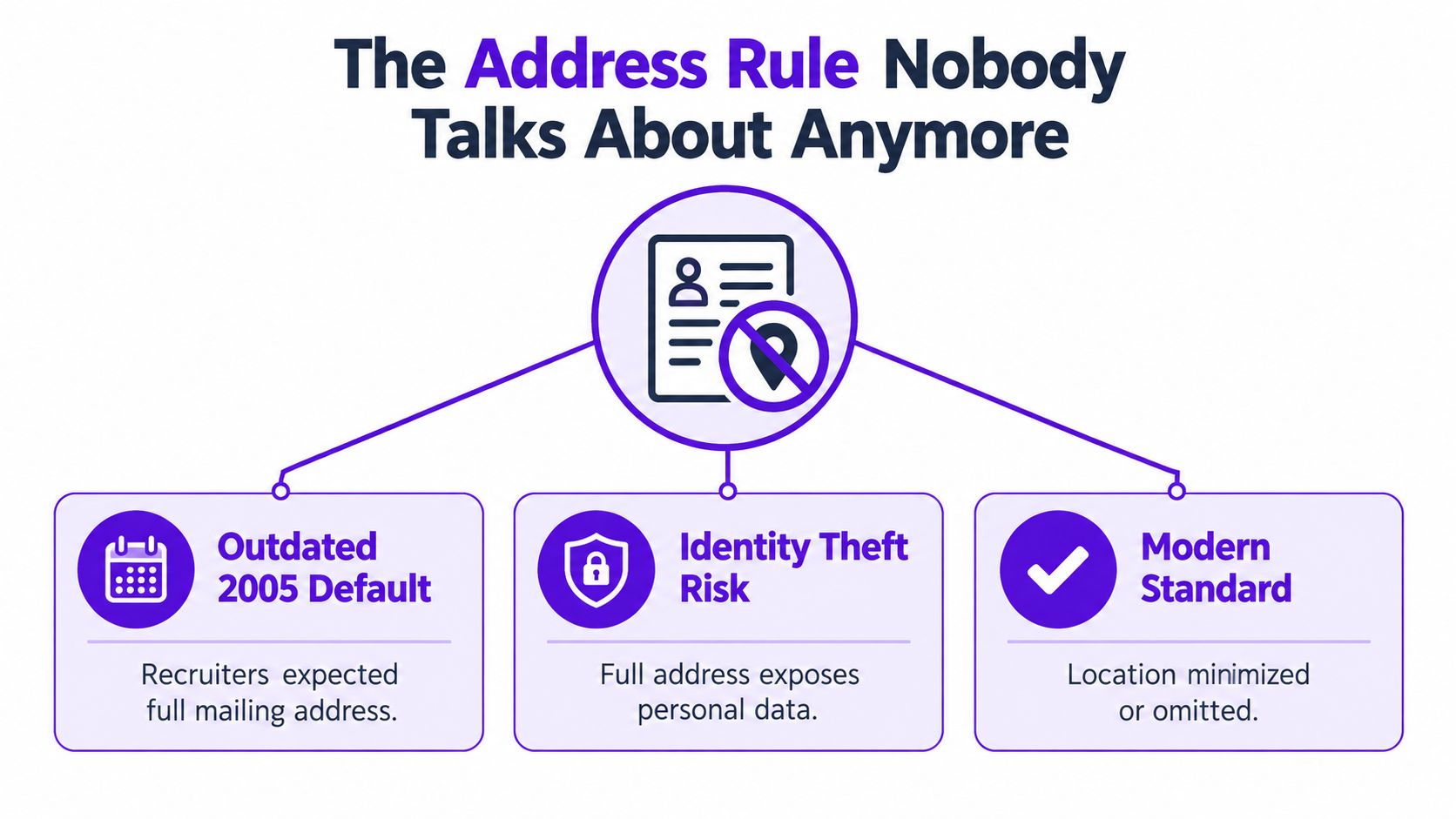
The address line runs on a scale, and each application deserves its own setting. A posting on a public job board calls for the leanest version. A direct application where local availability strengthens your case can justify more.
The Four-Step Location-Minimization Workflow
Treat location as a small, deliberate piece of resume information, not a mailing label. This workflow keeps it useful to employers and easier for applicant tracking systems to read.
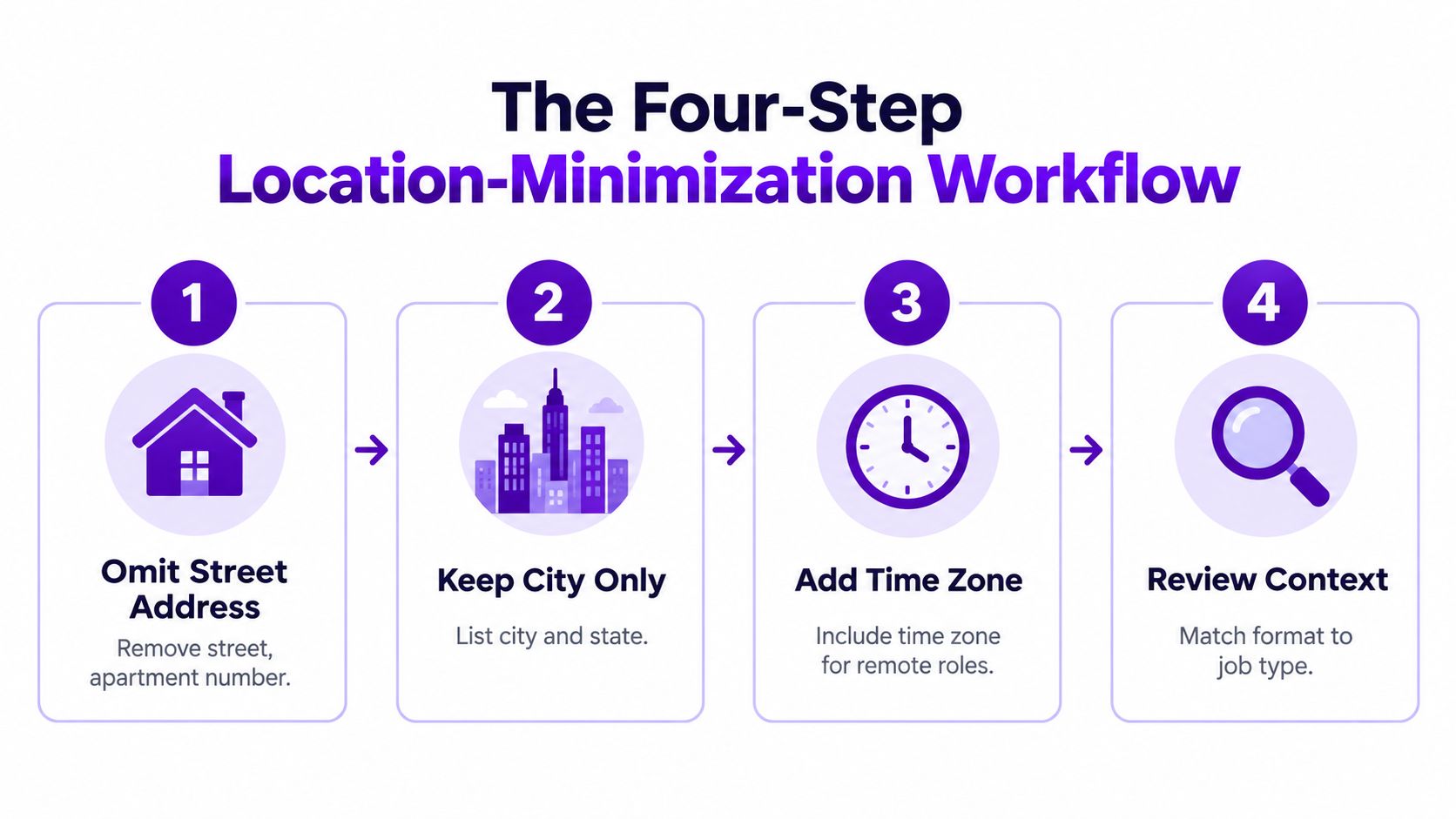
Omit the street address
Remove your street name, house or apartment number, and ZIP or postal code from the resume. The University of Maryland advises applicants not to upload sensitive personal information such as a home address, and the University at Buffalo recommends listing only city and state. Both are useful defaults: your exact residence rarely helps a recruiter assess your qualifications.
Do this: keep the home address for a verified process that requires it. Not that: include it automatically because an old template has a blank address line.
Put the location in the body
If location matters, add your city and state or province in the resume body, usually with your contact details. Don't bury it in a header or footer. The University of Virginia notes that many ATS platforms can't reliably parse content placed in those areas; the University at Buffalo's electronic resume guidance also advises city-and-state disclosure rather than a full street address.
A clean line might read “Portland, OR” or “Greater Toronto Area.” Keep it readable as ordinary text. If you want to understand how applicant tracking systems process resumes, this guide to how ATS software works offers relevant context.
Add a note when your current location could confuse
If you're moving or applying from somewhere that might appear impractical, say what the recruiter needs to know. For example: “Relocating to Chicago, IL” or “Open to relocation.” For remote roles, use a clear location or availability label rather than implying you live near the employer.
Verify the same story everywhere
Check that your resume, LinkedIn profile, and application form don't contradict one another. A difference may be completely explainable, but it can prompt a recruiter to wonder whether the details are current. Do this: use consistent city, region, and relocation wording. Not that: let an outdated profile create confusion you could have prevented with a quick review.
Why Location Quietly Changes Your Callback Rate
Location can affect the first screen even when your skills are the same. In a field experiment involving more than 2,000 fictional resumes sent to low-wage employers in Washington, D.C., researchers varied applicants' residential addresses while controlling for other factors. Applicants who lived approximately 5–6 miles farther from a job received about one-third fewer callbacks than applicants living closer, according to the Esri summary of the location-bias research.
The same source reports that callback rates fell by roughly 0.9 percentage points for each additional mile. A related analysis found more callbacks for otherwise comparable applicants listing nearby neighborhoods, even though the farther addresses were only 2.6 miles farther from the workplace. The study suggests employers may interpret distance as a sign of commute feasibility or reliability. It found little meaningful difference based solely on neighborhood affluence when commute distance was comparable.
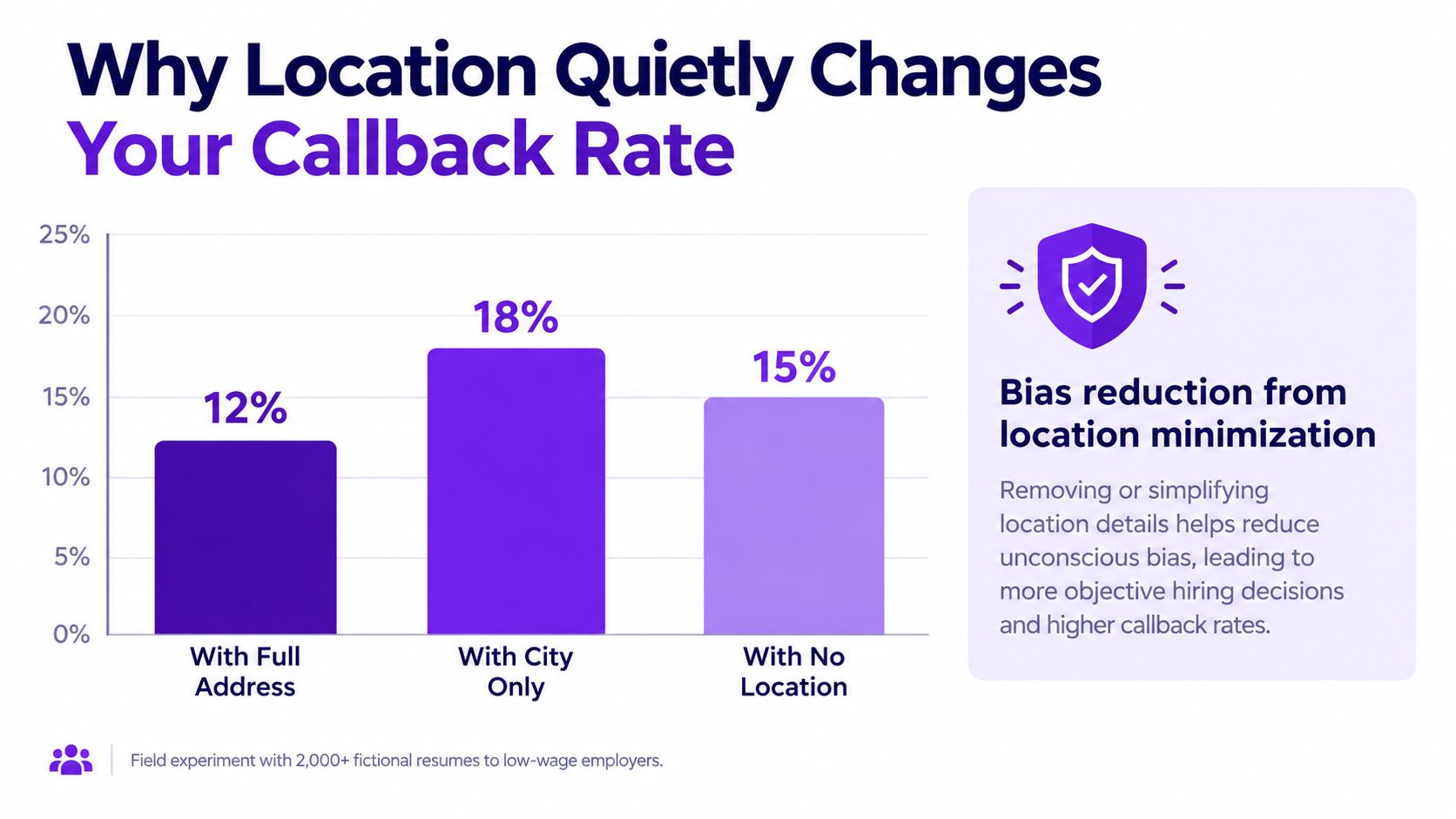
The practical takeaway isn't to publish your street address. It's to avoid hiding all useful location context when a job depends on being nearby. City and region can signal availability; your full residential address usually adds exposure, not a stronger case for hiring you.
Practical rule: If proximity matters, show your city or region. Don't hand over your exact home address just to prove you can commute.
Public Resumes by Application Context
The same resume can need different location details depending on where it's going. A public resume database is not the same as a private application portal, and neither is the same as verified payroll paperwork. Decide which one you're dealing with before filling in the address line.
| Application Context | Recommended Disclosure | Why |
|---|---|---|
| Public resume database or portfolio | City and state or region, if useful. No street address or postal code. | Anyone who can view the resume may see personal details. Use available privacy settings and a contact method you're comfortable sharing. |
| Private application through an employer's portal | City and state, region, or time zone as relevant. Add a relocation note if needed. | The employer can assess eligibility and availability without receiving your precise home address on the resume. |
| Verified onboarding or payroll process | Provide the full address only if the secure process requires it. | Employers may need residential details for formal administration, but that doesn't make the resume the right place for them. |
Georgia's consumer-protection guidance warns job seekers against publishing a full street address in public resume databases. It also recommends privacy settings, disposable contact details, or a post-office box until an employer is verified, as explained in its job-seeker identity theft guidance. Your name and address can be combined with other personal information, so there's no benefit in making a precise residence broadly searchable.
If you're posting a resume on a job board, check what the platform makes public before you upload. This guide to posting a resume on Indeed can help you think through the channel as well as the document. Public visibility calls for less disclosure; verified, secure forms can collect more when there's a real need.
Remote, Hybrid, and Relocation Formats That Work
Remote applications carry their own trap: candidates use a local address to suggest proximity to an office that does not exist. What the employer needs is your base and your working hours, nothing more. University of Virginia career guidance, referenced earlier, treats the full street address as optional, and on a semi-public platform that address exposes your precise residence to viewers you will never vet. Skip it.
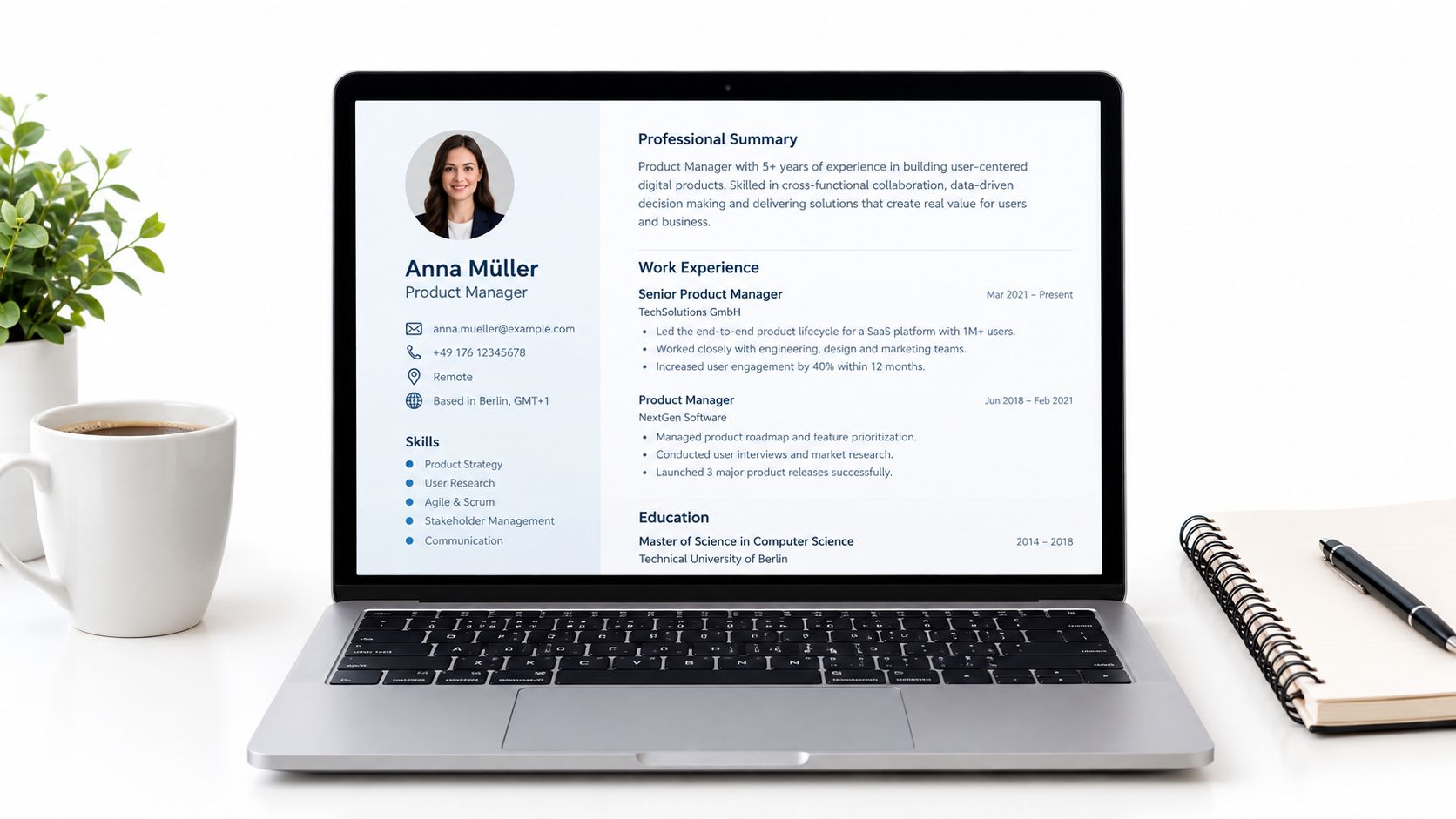
Use wording that answers the employer's real question. For example:
- Remote: "Based in Berlin, GMT+1" or "Available for remote work."
- Hybrid: "Denver, CO" or "Greater Denver area," so the recruiter can assess whether regular office attendance is realistic.
- Relocating: "Relocating to Austin, TX" or "Open to relocation."
Don't add a commute radius unless you can explain what it means for the job. A vague claim like "willing to commute anywhere" tells the recruiter nothing about your availability. Keep the location line in the resume body rather than a header or footer, so both people and parsing software find it where they expect it.
The location line is a signal, not a credential.
If you are still deciding which remote roles fit your location and schedule, How to Find Remote Work offers useful guidance for approaching the search. You can also browse the best job boards for remote work while keeping your resume's location line honest and specific. The right wording makes your situation clear without pretending a mailing address is a qualification.
A Pre-Submit Address Audit
Before sending your resume, check the address line against the role and the channel. The goal is minimum effective disclosure: enough information for an employer to understand your availability, no more than that. The resume-analysis figures cited earlier show that city-level disclosure is common, while full home addresses are less common.
Run through this checklist:
- Is the street address gone? Remove your street, apartment number, and postal code from the resume. Add them only when a verified process requires them.
- Does the location line say what the employer needs? Keep the city, state or province, region, or time zone when it clarifies eligibility or availability. Fix: replace a full address with the smallest useful location label.
- Does the disclosure match the channel? A public resume should reveal less than a secure employer form. Fix: check the platform's visibility settings before uploading.
- Do your documents agree? Compare your resume, application form, and LinkedIn profile. Fix: update outdated location or relocation wording so it tells one consistent story.
- Does the resume explain a move or remote availability? Add a concise note when your current location could raise a practical question. Fix: write “Open to relocation” or state your remote availability clearly.
Moving can create its own paperwork, separate from the question of what belongs on a resume. If you're changing homes, TLC Moving & Storage's moving checklist for address changes can help you keep those logistics organized. For your professional profiles, this guide to managing your online presence is a useful reminder to review what you share publicly.
A resume address isn't a yes-or-no checkbox. It's a disclosure decision. Keep the location information that helps an employer assess fit, and skip the precise details that don't.
Eztrackr helps you organize job applications, track your progress, and tailor resumes with tools such as a resume builder and ATS feedback. If you're applying to different roles with different location requirements, visit Eztrackr to keep your applications and resume updates in one place.