What Do Business Administrators Do: The Real Day-to-Day
You're looking at a business administrator job posting and wondering whether the role means answering phones, managing calendars, or keeping an entire operation from falling apart. The honest answer is that it can include all three, but the important work happens underneath: turning organizational goals into dependable processes, maintaining control over resources, and helping people make decisions with accurate information.
The title also changes meaning from one employer to another. A startup administrator may coordinate suppliers and build basic systems from scratch. A hospital administrator may protect records, schedules, and compliance processes. A corporate administrator may manage budgets, vendors, facilities, and reporting across several teams. So, what do business administrators do? They create the operational structure that lets other people perform their jobs reliably.
The Reality Behind the Title
It's Monday morning, a supplier delivery is late, two team members are out, a budget approval is still pending, and a facilities issue is about to affect the day's work. In many organizations, the business administrator is the person lining those pieces up so the department can keep operating.
That is why the title can mislead people. “Administrator” suggests forms, calendars, and inboxes. In practice, the role connects people, information, money, facilities, vendors, and policies. The work has shifted well beyond clerical support in many workplaces. A startup may need someone to build repeatable processes from scratch. A hospital may need tighter control over records and coordination. A corporate office may expect reporting, budget control, and vendor management across teams.
A busy quarter makes the difference easy to see. A business administrator might confirm equipment is available, check that supplier agreements are current, organize schedules, track spending, maintain records, and raise a facilities problem before it slows the team down. Each task looks small on its own. Together, they keep the operation steady, much like a control panel that prevents one minor fault from turning into a larger disruption.
The U.S. Bureau of Labor Statistics groups this kind of work under administrative services management, covering oversight of records, office support, facilities, maintenance, and related operations, as described in the BLS occupational classification for administrative services managers. In plain terms, the formal definition includes both visible office tasks and the behind-the-scenes control that keeps staff, space, and resources working together. That mix of people management with process control is what defines the role.
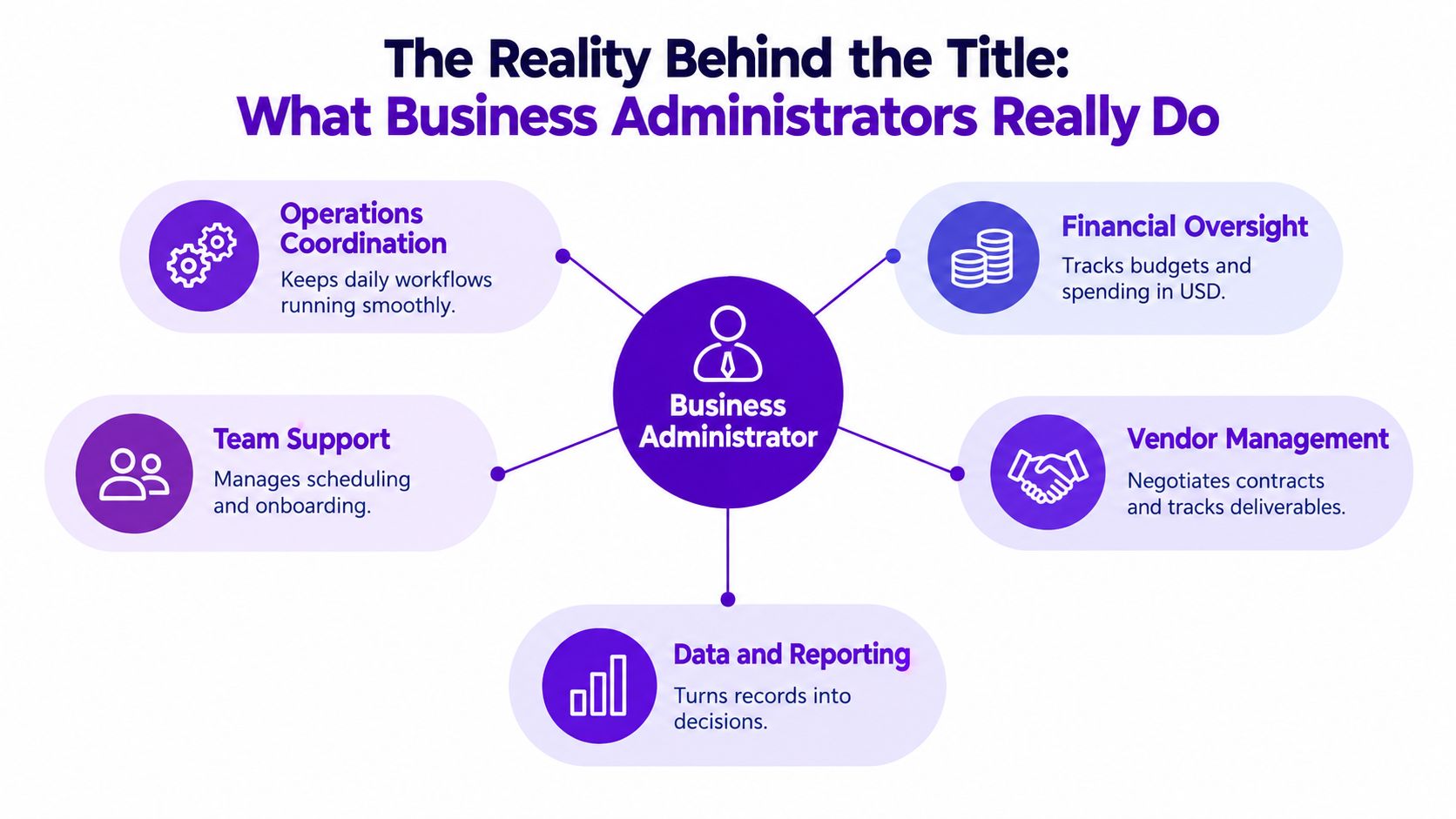
Practical rule: If a responsibility affects how people, resources, or information flow through an organization, it may belong to business administration.
That's also the right way to read a job post. A role that mentions calendars and records may really be asking for workflow judgment, budget follow-up, vendor coordination, and policy support. Using a target job description guide can help you spot the operating problems the employer expects this person to handle.
Core Duties and Responsibilities
Business administrators operate as a control layer between strategy and execution. Leaders may set a goal such as improving service delivery or reducing waste. The administrator turns that goal into owners, deadlines, approval rules, records, and follow-up.
The formal duties are broad. O*NET describes administrative-services managers as people who coordinate support functions, set departmental goals and deadlines, administer budgets for contracts and supplies, establish staff schedules, maintain electronic or paper filing systems, and work with external service providers. The BLS overview of administrative services managers provides the occupational context for these responsibilities.
In practical terms, the work often includes:
- Workflow control: Define who owns each step, what must happen next, and when an exception needs escalation.
- Budget administration: Track planned spending against actual invoices for supplies, equipment, contracts, and services.
- Records management: Maintain accurate files, retention practices, approvals, and access controls.
- Resource coordination: Arrange staff coverage, equipment, rooms, repairs, and office services.
- Vendor oversight: Confirm deliverables, resolve service issues, and keep contract obligations visible.
- Policy support: Help teams follow internal procedures and workplace requirements.
A good administrator doesn't rely on memory or informal reminders. They use approval thresholds, service-level targets, document-retention rules, budget-versus-actual reviews, and escalation procedures. These controls make missing records, delayed work, overspending, and vendor problems visible early.
The role may overlap with executive assistance, particularly in scheduling, communication, and coordination. For a useful comparison of adjacent responsibilities, review this guide to assistant duties by Approved Lux. The difference is often the scale of operational ownership: an executive assistant may optimize support for one leader, while a business administrator may coordinate systems used by a department or organization.
Strong judgment matters as much as technical organization. These soft skills examples are especially relevant when the administrator must resolve competing priorities, explain a policy, or obtain cooperation from people who don't report directly to them.
A Day in the Life of an Administrator
A business administrator's day rarely follows a single uninterrupted task list. The work alternates between immediate coordination and deliberate improvement. A supplier may need an answer at nine in the morning, while a process review scheduled for the afternoon requires quiet analysis.

Morning coordination
The day might begin by checking open requests, staffing coverage, deliveries, maintenance tickets, and invoices awaiting approval. The administrator sorts urgent issues from routine follow-up. If a vendor missed a delivery, the administrator checks the agreed requirement, contacts the supplier, informs the affected team, and records the resolution.
That sequence is more than email management. It protects continuity. The administrator is making sure one external delay doesn't become an internal bottleneck.
A corporate administrator may then prepare a department meeting by updating spending information, collecting status notes, and confirming decisions that need approval. In a hospital, the same period might involve coordinating administrative coverage, reviewing documentation processes, or escalating a facilities issue. In a startup, it could mean arranging a new supplier while creating the purchasing process at the same time.
Afternoon process work
The analytical side appears when recurring problems demand attention. Suppose employees repeatedly submit incomplete requests. The administrator maps the current process, interviews the people involved, reviews the records, and identifies where instructions or ownership break down.
The next step is to define a better workflow. That might involve a standardized request form, clearer approval rules, a shared tracker, or a procedure manual. The administrator establishes a baseline, chooses a relevant measure such as cycle time, error frequency, backlog, cost per transaction, or labor utilization, and reviews performance after the change.
The BLS describes management analysts as professionals who recommend changes to improve efficiency, reduce costs, and increase revenue. They analyze revenue, expenditure, employment, and other data before presenting recommendations, with attention to organizational studies, work simplification, and procedure manuals. That same evidence-based mindset increasingly appears in business administration roles.
The question isn't “Did we complete the task?” It's “Does the process produce a reliable result without avoidable rework?”
End-of-day reporting
Later, the administrator may update a dashboard or report for a manager. The report could show pending approvals, supplier issues, spending activity, staffing gaps, or progress against departmental deadlines. The purpose isn't to create paperwork. It's to give decision-makers an accurate view of operational health.
A useful report separates facts from interpretation. It identifies what happened, why it matters, who owns the next action, and when the issue needs review. That discipline turns routine records into decision support.
Context Matters
A hiring manager says they need someone to “run office operations.” In a startup, that can mean building the first workable system for purchasing, onboarding, and vendor follow-up. In a hospital, the same phrase can point to controlled records, service coordination, and strict procedures that protect patients and staff. The title matches. The work often does not.
| Workplace context | Typical emphasis | What success looks like |
|---|---|---|
| Startup | Build lightweight systems, coordinate suppliers, support hiring logistics, and keep priorities moving | The organization gains structure without unnecessary bureaucracy |
| Hospital | Protect records, coordinate services, support compliance, and maintain dependable administrative coverage | Staff can work within controlled, traceable processes |
| Corporate department | Manage budgets, vendors, facilities, reporting, and cross-team requests | Leaders receive reliable information and teams meet operating commitments |
| University or public organization | Coordinate policies, records, purchasing, facilities, and multiple stakeholders | Processes remain consistent across departments and requirements |
The same job title spans universities, local government, and hospital systems, which is why two postings with identical titles can describe materially different work, as shown in BLS employment data for administrative services and facilities managers.
Context also changes what “good performance” means. A startup may reward speed and workable structure. A hospital may value traceability, coverage, and rule-following. A corporate team may care most about budget control, reporting accuracy, and dependable follow-through across departments.
Seniority shifts the role too. An entry-level administrator often keeps requests moving and records clean. A more experienced administrator usually shapes procedures, manages vendors, reads operating data, and warns leaders when a weak process is creating risk.
Technology is changing the job boundary. Routine entry, scheduling, document routing, and reminder chasing are easier to automate, so the role is moving away from clerical upkeep and toward interpretation and control. The stronger administrator handles exceptions, coordinates stakeholders, explains what the numbers mean, and helps the organization change the process instead of just updating the file.
Skills and Qualifications for Success
The strongest business administrators combine operational discipline, digital fluency, analysis, and communication. Formal education can help establish a broad foundation, but employers also need evidence that you can control work in a real environment.
Spreadsheet ability is a practical baseline. You should be comfortable cleaning data, using formulas, organizing records, reconciling entries, and presenting a clear summary. Tools such as Excel, shared databases, project-management platforms, enterprise systems, and dashboard software can extend that capability. The specific platform matters less than your ability to maintain accurate information and use it to support a decision.
Analytical thinking separates a reliable administrator from a purely reactive one. When a process slows down, don't jump straight to a software purchase. Map the steps, identify duplicated work, check where approvals wait, and compare the intended procedure with actual behavior.
Communication keeps the system usable. You may need to explain a purchasing rule to a colleague, ask a vendor for corrective action, summarize a budget issue for a manager, or coordinate people across departments. Calm follow-up and precise writing often prevent small problems from becoming operational disruptions.
Build evidence through practical projects:
- Create a dashboard: Summarize requests, spending, deadlines, or service issues in a format a manager can use.
- Document a workflow: Turn an informal process into a clear procedure with owners and escalation points.
- Improve a handoff: Show how you reduced confusion by clarifying required information and responsibility.
- Practice reconciliation: Compare records, identify discrepancies, and explain how you resolved them.
Use this transferable skills guide to translate experience from retail, education, hospitality, volunteering, or customer service into administrative language. “Handled busy customers” becomes stakeholder coordination under pressure. “Organized events” becomes scheduling, vendor management, and resource allocation.
Career Paths and Specializations
Business administration is less a single destination than a foundation for several paths. Your next move depends on which part of the work you enjoy and which evidence you build.
Office and facilities management suits people who like visible, tangible operations. The work may center on space, equipment, maintenance, supplies, safety, and service providers. Human resources administration places more emphasis on employee records, onboarding, policy processes, and confidential communication.
Project coordination and management are natural extensions for administrators who enjoy timelines, dependencies, and cross-functional delivery. These roles require stronger planning and risk tracking, with less emphasis on recurring office services. Operations leadership is a broader route. It combines process improvement, performance reporting, resource planning, and team management.
A finance-oriented administrator may move toward budget analysis or procurement. Someone working in healthcare may specialize in healthcare administration. A person who enjoys systems may progress toward business analysis, workflow design, or implementation support.

The progression isn't automatic. Keep a record of improvements, reports, reconciliations, procedures, and stakeholder problems you've handled. Resources such as Fluidwave's goals for assistants can help turn broad support work into specific development objectives.
The distinction between paths is useful:
- Specialist route: Build deep expertise in HR, procurement, facilities, finance, or compliance.
- Generalist route: Coordinate several functions and grow toward office or operations management.
- Analytical route: Focus on data, process mapping, reporting, and management recommendations.
- Leadership route: Add hiring, coaching, budgeting, and strategic planning responsibilities.
A business administrator who deliberately chooses a direction can avoid being defined by a vague title.
Salary Expectations and Market Trends
Salary expectations make more sense once you picture the actual job. A business administrator in a small startup may handle purchasing, scheduling, vendor setup, and reporting in the same week. In a hospital or large corporate department, the role is often narrower, but the systems are heavier, the controls are tighter, and mistakes carry more operational weight. Pay tends to follow that difference in scope.
For market context, the widely cited federal figures discussed earlier are dated. Treat those older numbers as a floor for occupational scale, not as a current quote for what an employer in your city will offer today.
That matters because this field has shifted. The title still sounds clerical to some employers, but many organizations now expect business administrators to work more like operations support analysts. The person who keeps records current and meetings on track is useful. The person who also cleans up a process, spots a reporting gap, reconciles spending, or helps a manager make a better decision usually commands stronger compensation over time.
Context shapes the ceiling. A school, a public agency, a medical group, and a private company can all use the same title while assigning very different levels of budget exposure, compliance responsibility, software use, and cross-functional coordination. A startup may pay for range and adaptability. A regulated setting may pay for accuracy, documentation discipline, and control of sensitive workflows. A larger company may reward administrators who can support executives, own reporting cycles, and coordinate across departments.
So read salary ranges carefully. They often bundle together entry-level support roles and broader administrative management jobs.
The practical approach is simple. Use posted salaries in your region, compare them with the complexity of the role, and ask what decisions your work supports. In this market, analytical ability and technology fluency often move an administrator from task coverage toward higher-value operational responsibility.
Tips for Landing the Job
Start by tailoring your application to the employer's operating environment. A hospital will care about controlled records, coordination, and compliance. A startup may prioritize adaptability, supplier setup, and process creation. A corporate department may look for budget support, reporting, and cross-functional follow-through.
Use evidence instead of duty lists. Replace “managed administrative tasks” with a specific description of the system you maintained, the people you coordinated, the records you controlled, or the decision your work supported. If you improved a workflow, explain the problem, your intervention, and the observable result without inventing a number.
Build a convincing application
- Target the language: Match legitimate terms from the posting, such as vendor coordination, scheduling, procurement, records management, reporting, or compliance.
- Show your tools: Name the software you used, including Excel, Tableau, project-management platforms, HR systems, or finance tools.
- Demonstrate judgment: Describe a time you handled an exception, clarified ownership, or escalated a risk.
- Prepare examples: Keep concise stories about a process improvement, a difficult stakeholder, a discrepancy, and a deadline you coordinated.
- Make documents readable: A resume builder such as ParakeetAI's resume maker can help you organize experience into a targeted format.
Before applying, compare your resume with the posting using this guide to ATS resume keywords. Don't add tools or achievements you can't defend in an interview. Hiring managers usually learn more from a clear explanation of how you worked than from a long list of software names.
Your final preparation task is to define the operational value you bring. Can you keep records accurate, make ownership clear, spot a process problem, coordinate people who have competing priorities, and give a manager information they can act on? Those are the signals that move your profile beyond clerical support.
Eztrackr helps you save job postings, organize applications by stage, link resumes and other documents, and monitor your search through a structured tracking system. Visit Eztrackr to turn your business administrator job search into a clear workflow, from customized application through interview follow-up.