Examples of Resumes for Bank Tellers: 7 Expert Tips for 2026
What makes a bank teller resume convincing if the applicant hasn't held a teller title before? The strongest document isn't one universal template. An entry-level applicant needs to make skills, education, and training visible, while an experienced teller should lead with measurable performance. A career changer must make transferable value obvious before a recruiter assumes the experience isn't relevant.
The seven examples below match resume models to candidate situations and hiring objectives. Each one breaks down the format, evidence, ATS alignment, risks, and practical edits that make the example work. The approach also reflects the role's current context. The U.S. Bureau of Labor Statistics teller profile identifies a high school diploma or equivalent as the typical entry-level education, reports median pay of $43,030 per year, or $20.69 per hour, in 2025, and projects teller employment to decline by 13% from 2025 to 2035.
That outlook makes adaptable evidence more valuable. Eztrackr can help you compare job requirements, create custom resume versions, and organize applications, but the substance still has to come from your real experience.
1. Entry-Level Bank Teller Resume With Limited Experience
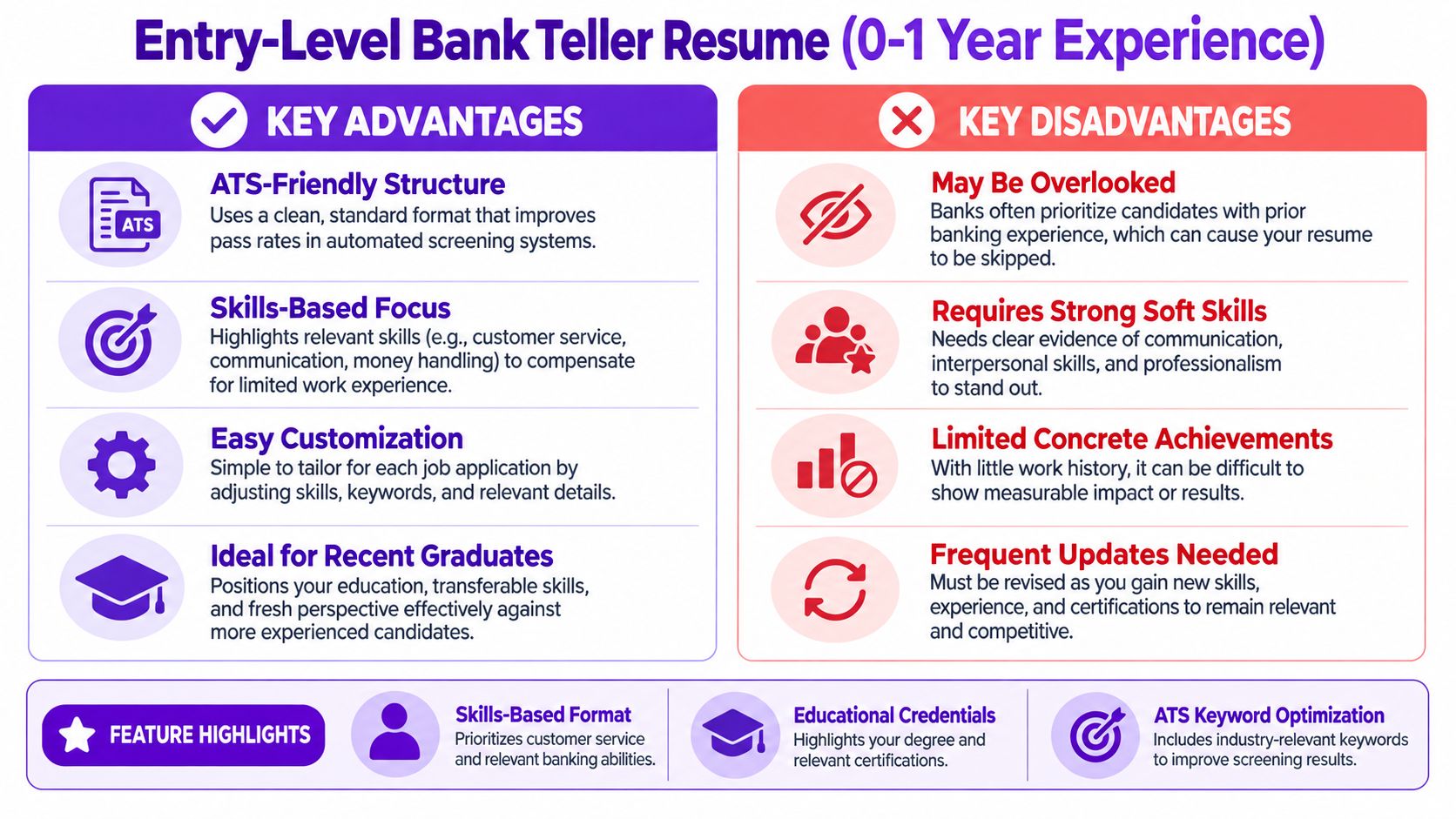
A recent graduate, high school graduate, or first-time banking applicant shouldn't imitate a senior teller's resume. A better structure places a concise objective or profile near the top, followed by relevant skills, education, training, and transferable experience. This order helps the reader see readiness before scanning for a missing bank title.
The profile should connect customer-facing work to teller responsibilities without overstating experience. For example:
Entry-level profile: Customer service professional with experience processing payments, balancing a cash register, resolving customer concerns, and protecting private account information. Seeking to apply accurate transaction handling and professional communication in a bank teller role.
That statement works because it names behaviors a branch can evaluate. It doesn't claim experience with deposits, withdrawals, or banking software unless the applicant has it.
Build evidence from adjacent work
A retail cashier can describe end-of-shift reconciliation, payment processing, recordkeeping, and customer identification procedures. A hospitality worker can emphasize payment accuracy, complaint resolution, confidentiality, and service under pressure. A student can add relevant coursework, banking fundamentals training, volunteer financial-literacy work, or a completed teller certificate.
Use a skills section with terms such as cash handling, transaction processing, customer service, active listening, recordkeeping, customer identification, and discrepancy resolution. Place the exact terms naturally in experience bullets as well. ATS alignment improves when the document describes what the applicant did, not when it repeats a keyword without evidence.
The recent graduate job-search guide can support the broader process of turning education and early experience into application material. Eztrackr's resume builder and skill-match analyzer can also help compare a draft with a specific posting.
Avoid the beginner's biggest risk
Don't fill the page with generic traits such as “hardworking” or “detail-oriented.” Replace them with proof:
- Cash accountability: Reconciled register funds and documented discrepancies according to store procedures.
- Customer support: Resolved payment and account-related questions while maintaining a calm, professional tone.
- Technology: Entered transactions accurately in the point-of-sale system and learned new checkout procedures quickly.
If you have no banking experience, say so through positioning, not apology. The resume should show that you already handle money, documentation, customers, and procedures responsibly.
2. Mid-Level Bank Teller Resume With Proven Performance
A teller with established branch experience should use a reverse-chronological format, with the most relevant role and strongest accomplishments near the top. The document needs to show more than routine transaction processing. It should demonstrate consistency, system fluency, customer support, and growing responsibility.
O*NET gives especially high importance scores to several teller duties, including balancing currency, coins, and checks at shift close, receiving and verifying deposits, and cashing checks after confirming signatures, amounts, and account sufficiency. The O*NET teller occupation profile rates each of those activities 95 out of 100, while counting currency for deposit receives 93, and entering transactions into computers and examining checks for endorsements each receive 92.
Those priorities should shape the bullets. Compare a weak statement, “Handled cash and helped customers,” with a stronger version:
Stronger bullet: Served 60+ customers per day, processed deposits, withdrawals, and official checks in teller-platform software, verified identity and transaction documentation, escalated unusual activity under branch procedures, and completed daily drawer reconciliation.
That example is useful because the workload figure comes from the verified guidance, but applicants should replace it with their own truthful volume if it differs. It also links customer service to control steps and operational accuracy.
Show progression without exaggeration
A mid-level resume can include cross-training in operations, support for account opening, coaching newer colleagues, product referrals, and resolution of account discrepancies. Name the banking platform only if you used it, then describe the task performed. Examples may include Fiserv, Jack Henry, FIS, Temenos, or Oracle FLEXCUBE, but a software list without context adds little value.
Include a dedicated skills section with the role's vocabulary, then repeat the most relevant terms in experience bullets. Don't keyword-stuff every line. The reader should be able to see how the skill affected the customer, the transaction, or the control process.
A practical mid-level resume usually gives each recent role several accomplishment-led bullets, followed by earlier experience with less detail. Keep the focus on evidence that helps a branch trust your judgment, not on listing every transaction type you've ever encountered.
3. Senior Bank Teller or Lead Teller Resume
A senior teller resume answers a specific hiring question: can this person protect accuracy while helping the branch and team perform better? A chronological format often works well, but the summary should immediately show leadership, operational judgment, mentoring, and process improvement.
Open with a targeted summary instead of a broad objective:
Lead teller with progressive branch experience in cash controls, customer identification, discrepancy resolution, staff coaching, and escalation of unusual activity. Trusted to support daily operations, explain procedures, and maintain customer confidentiality during complex service interactions.
This summary places the candidate in a working leadership role without claiming unsupported savings, efficiency gains, or team size. It works like a label on a file. The hiring manager can see the candidate's level and priorities before reading the employment history.
Convert leadership into outcomes
Senior applicants often write “trained staff” or “assisted the supervisor.” Those phrases name activities, while stronger bullets show what the work involved and why it mattered:
- Training: Coached new tellers on drawer balancing, deposit verification, transaction documentation, and privacy procedures.
- Operations: Reviewed exception items, investigated discrepancies, and escalated unresolved issues through branch procedures.
- Customer experience: Supported complex account-service questions and coordinated resolutions with supervisors and operations colleagues.
- Process improvement: Standardized a transaction checklist to improve consistency in documentation and handoffs.
Practical rule: Describe the decision, control, or improvement behind the responsibility. A duty tells the reader what you touched. An accomplishment shows how you applied judgment.
Use figures only when records support them. Truthful examples may include the actual number of colleagues trained, transactions handled, audit results, or discrepancies resolved. The bank teller skills guidance from Jobscan also identifies results such as wait-time reductions, qualified referrals, cash-loss records, or customer-satisfaction results, but include them only when you can verify the evidence.
Choose the right leadership emphasis
Customize the same career history for the target role. A lead teller seeking supervision should give more space to coaching, scheduling support, quality reviews, and escalation judgment. An operations applicant should foreground reconciliation, documentation, audit preparation, and exception handling. A relationship-banking applicant can include needs-based referrals, while keeping risk controls visible.

The trade-off is length and focus. Senior candidates have more material, yet a long list of routine duties can hide the evidence that supports advancement. Remove older bullets unrelated to the target role, then use the available space for decisions, improvements, coaching, and leadership evidence.
4. Career-Change Bank Teller Resume From Another Field
A career changer needs a hybrid resume that makes transferable value easy to recognize. The best structure starts with a summary of relevant competencies, followed by selected accomplishments, banking education or training, and employment history. It shouldn't conceal the previous industry, but it shouldn't force the reader to translate every detail alone.
A retail manager, for example, may have balanced tills, approved refunds, protected customer information, documented incidents, trained employees, and handled escalations. A healthcare service professional may have verified identity, protected confidential records, explained complex information, and resolved sensitive concerns. A military veteran may bring procedural discipline, accountability, incident documentation, and leadership.
Practical rule: Translate the behavior, not the job title. “Managed a retail floor” is broad. “Reconciled cash activity, documented exceptions, protected customer information, and coached staff on operating procedures” is relevant.
Separate awareness from real compliance work
Career changers should be precise about banking knowledge. Basic awareness of BSA/AML, KYC, fraud detection, or customer identification isn't the same as performing regulated investigations. Use phrases such as BSA/AML awareness, training in identity verification, or familiarity with confidentiality procedures when those descriptions are accurate. Don't claim suspicious-activity escalation or formal compliance duties without direct experience.
A transferable-skills section can group evidence under cash accountability, customer communication, privacy, documentation, and problem-solving. Each group should lead to an accomplishment from the previous field. The career-change explanation guide can help shape the narrative, while applicants seeking more personalized support can choose a career change coach.
Make the transition feel intentional
Add relevant coursework, banking fundamentals training, or a certification when completed or in progress. Then connect it to the target role in the summary. A candidate might write, “Completed banking fundamentals training while managing cash controls and customer escalations in retail,” rather than listing a course with no explanation.
The main trade-off is that a hybrid resume can hide chronology if it's overdesigned. Keep the employment section clear and dated. The goal isn't to disguise a career change. It's to show why the previous experience creates a credible foundation for teller work.
5. Specialized Bank Teller Resume With Bilingual or International Experience
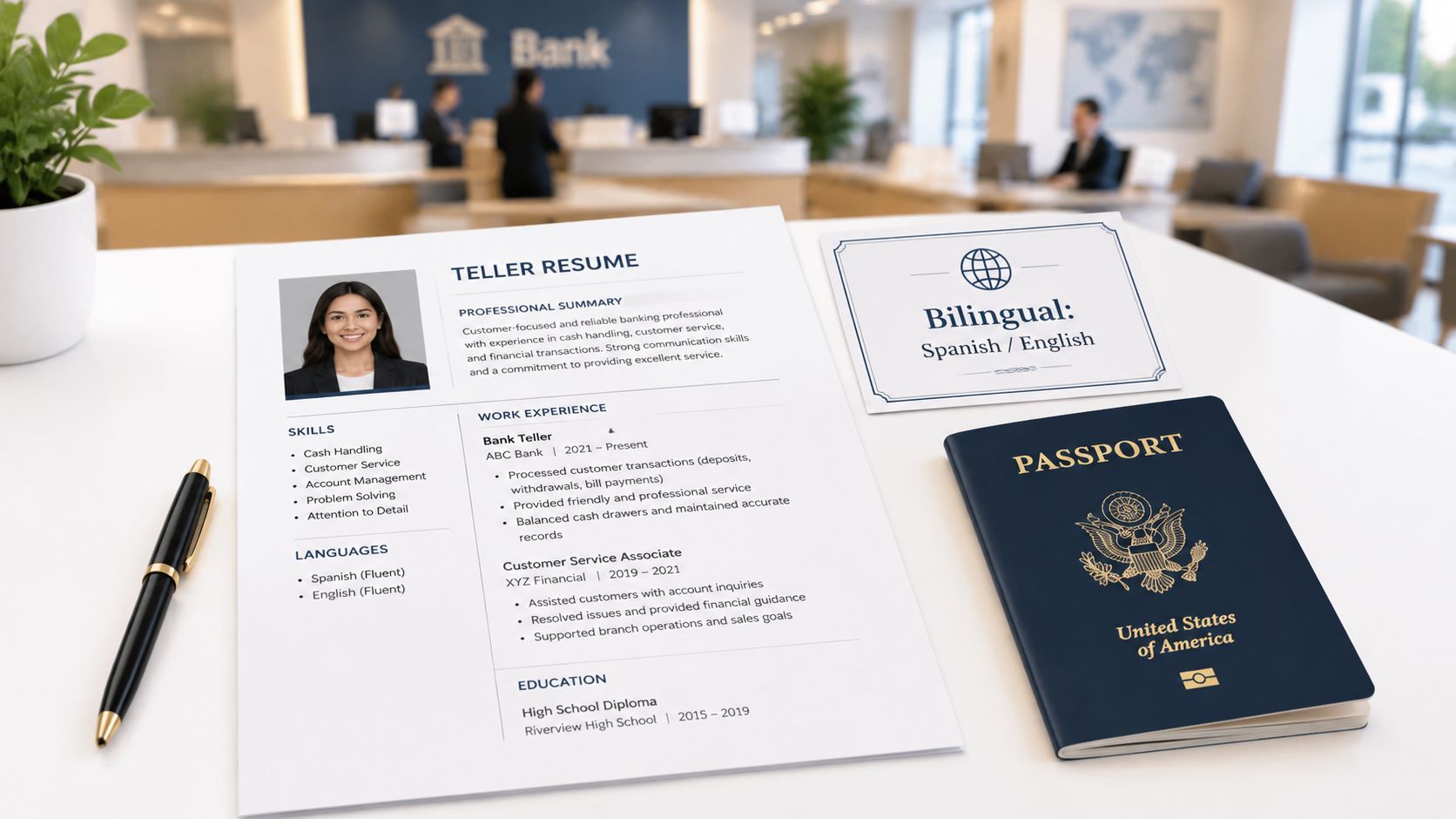
Language ability can be a strong differentiator in a customer-facing branch, but only when the resume explains how the candidate used it. Put language skills in the summary or a clearly labeled skills section, then reinforce them in experience bullets describing customer communication, service access, problem-solving, or documentation.
A useful summary might say:
Bilingual customer-service professional with experience assisting customers in English and Spanish, processing payments, resolving account-related questions, and protecting confidential information. Prepared to support a diverse branch clientele through accurate transactions and clear communication.
Don't write “fluent” if your ability is conversational. Use a precise label such as native, professional working proficiency, conversational, or basic, and add a recognized language credential when you have one.
Connect language to branch value
A language line alone may be missed by both an ATS and a hiring manager. Place the language in relevant bullets:
- Customer access: Assisted customers in English and Spanish with payment questions and service explanations.
- Accuracy: Recorded customer information and transaction details carefully while switching between languages.
- Trust: Used clear, respectful communication when explaining procedures involving private information.
- International context: Described actual experience with international banking practices or systems, without implying familiarity with a domestic platform you haven't used.
The guide to identifying transferable skills can help applicants connect international service, financial administration, or customer support to teller competencies. A candidate with overseas banking experience should name the task, system, and regulatory setting only when those details are accurate and understandable to the target employer.
Avoid making language the whole resume
The trade-off is focus. A bilingual resume still needs evidence of cash handling, transaction processing, customer identification, recordkeeping, and discretion. Language expands the candidate's service value, but it doesn't replace operational proof.
Create a targeted version for each branch population only when the job posting calls for it. Otherwise, use one broadly accurate resume that presents language ability as an additional strength rather than a substitute for teller readiness.
6. Bank Teller Resume With a Sales Focus
A sales-focused teller resume works like a bridge between accurate transactions and helpful product guidance. It should show that you can recognize a customer's needs, explain suitable options, and complete each interaction within bank procedures. A sales-heavy resume without evidence of accuracy may concern hiring managers, while a purely operational resume can hide your relationship-building value.
Open with a summary that gives both priorities equal weight:
Customer-focused teller experienced in transaction processing, account-service support, product education, and needs-based referrals. Combines accurate cash controls with clear explanations that help customers choose appropriate banking services.
Build bullets around customer needs
Each bullet should follow a simple pattern: customer situation, action, and useful outcome. Avoid unsupported claims about approval rates, revenue, product penetration, or branch comparisons. If you have documented figures, provide context. Otherwise, describe the contribution clearly:
- Needs assessment: Asked targeted questions about everyday banking needs before discussing relevant products.
- Product education: Explained account features, fees, and required documentation accurately, then referred complex questions to the appropriate colleague.
- Relationship support: Identified service issues during transactions and coordinated follow-up with relationship or operations staff.
- Risk control: Completed required checks and transaction documentation before processing or referring an account request.
The bank teller skills resource from Jobscan supports pairing cross-selling with accurate account handling and needs-based recommendations. Reflect that pairing in both the summary and the experience bullets.
Place sales keywords carefully
Use cross-selling, product education, customer acquisition, account opening, relationship building, and referrals only when they describe your actual work. Add them to a skills section, then prove them through experience bullets. Repeating “sales” throughout the resume adds noise, much like labeling every tool in a toolbox without showing what it can do.
This model fits retail banking and relationship-oriented branch roles. It can also support a future move toward corporate sales career resources when your experience includes consultative conversations and customer follow-up. For a strictly operations-focused vacancy, move reconciliation, discrepancy resolution, and documentation higher, while keeping sales as a supporting capability.
Customize the version to the job posting. Match its terminology where accurate, place the strongest sales evidence near the top, and keep operational proof visible rather than treating it as background detail.
7. Bank Teller Resume With a Compliance and Operations Focus
A compliance and operations resume suits candidates targeting teller, branch operations, compliance support, or internal-control roles. Its purpose is to show that the candidate can protect customer information, document transactions, identify exceptions, and follow procedures while maintaining accurate service. Separate hands-on experience from general knowledge.
Use a summary that names the control environment:
Detail-oriented banking professional experienced in cash-drawer balancing, deposit verification, identity checks, transaction documentation, discrepancy resolution, and escalation under branch procedures. Known for protecting confidential information and following operational controls during customer service.
O*NET's documented teller duties include checking endorsements and identifying information on checks, entering transactions into computers, resolving account discrepancies, preparing official checks, and answering customer questions. Use these terms when they describe the applicant's actual work. The ResumeOptimizerPro guidance on teller resume examples also stresses combining transaction accuracy with digital-service support and sound judgment as teller responsibilities change.
Turn procedures into evidence
“Followed compliance procedures” gives the reader no way to assess the work. Build each bullet like a small control checklist: state what you checked, what action you took, and how you handled an exception.
- Identity verification: Checked customer identification and transaction documents before processing services.
- Fraud awareness: Recognized unusual details, recorded concerns, and escalated them through branch procedures.
- Reconciliation: Balanced cash drawers at shift close and investigated discrepancies instead of only recording them.
- Audit readiness: Maintained complete transaction records and organized supporting documents for review.
- Privacy: Discussed account information discreetly and restricted access to confidential customer data.
Describe the control you performed and the escalation path you used. Do not claim authority or results you cannot support.
Avoid invented fraud-prevention outcomes, audit scores, or avoided losses. Confidentiality may restrict the details you can share, so explain the process without revealing customer information.
Choose keywords by hiring objective
A compliance-focused application may emphasize AML awareness, BSA awareness, KYC procedures, fraud detection, audit preparation, regulatory documentation, and exception handling. An operations-focused application may prioritize cash reconciliation, transaction processing, banking software, official checks, deposit verification, and workflow accuracy.
Place these terms in a skills section only when they match your background, then prove them in experience bullets. This format works like a labeled control file: keywords help the reader find the capability, while specific actions establish credibility.
The trade-off is tone. A resume filled only with controls can sound distant from customers. Keep communication, active listening, and service resolution visible, showing a careful professional who protects the bank while helping people. For each posting, place the most relevant evidence near the top and keep operational proof prominent.
Comparison of 7 Bank Teller Resume Examples
| Resume Type | Implementation Complexity 🔄 | Resource Requirements ⚡ | Expected Outcomes ⭐ / 📊 | Ideal Use Cases 💡 | Key Advantages ⭐ |
|---|---|---|---|---|---|
| Entry-Level Bank Teller (0–1 yr) | 🔄 Low, simple skills-based + ATS formatting | ⚡ Low, basic education/certificates, builder/AI assist | ⭐ Moderate; 📊 Improves ATS pass rate and interview volume, few hard metrics | 💡 Recent grads, high-school diplomas, career changers entering banking | ⭐ ATS-friendly; highlights transferable customer-service skills |
| Mid-Level Bank Teller (2–5 yrs) | 🔄 Medium, chronological with quantified achievements | ⚡ Moderate, performance metrics, banking systems proficiency | ⭐ High; 📊 Shows measurable results (accuracy, volumes, CSAT) | 💡 Mid-career tellers targeting larger branches or supervisory track | ⭐ Demonstrates growth with quantifiable performance |
| Senior / Lead Teller (5+ yrs) | 🔄 High, condense long history, emphasize leadership & ROI | ⚡ High, leadership metrics, process-improvement evidence, certifications | ⭐ Very High; 📊 Positions for management, shows business impact and efficiency gains | 💡 Senior tellers, lead/head roles, management-track candidates | ⭐ Leadership, process improvements, strong ROI focus |
| Career-Change (From Unrelated Field) | 🔄 Medium, hybrid format to bridge gaps and narrative | ⚡ Moderate, transferable-skill mapping, certifications, cover letter | ⭐ Moderate; 📊 Mitigates lack of banking history when narrative is strong | 💡 Professionals pivoting from retail, healthcare, military, etc. | ⭐ Highlights transferable skills and commitment to transition |
| Specialized (Bilingual / International) | 🔄 Medium, emphasize language proficiency and international exposure | ⚡ Moderate, language certifications, proof of multicultural work | ⭐ High in diverse markets; 📊 Improves discoverability for multilingual roles | 💡 Bilingual/multilingual candidates and branches serving diverse communities | ⭐ Differentiates candidate; aligns with D&I and underserved markets |
| Sales-Focused (Cross-Sell / Upsell) | 🔄 Medium, performance-oriented with verifiable sales metrics | ⚡ Moderate–High, CRM data, revenue figures, approval rates | ⭐ High; 📊 Direct revenue impact and advancement to sales roles | 💡 Sales-oriented tellers, retail banking at performance-driven institutions | ⭐ Demonstrates revenue generation and product penetration |
| Compliance / Operations (Regulatory Track) | 🔄 High, detail-oriented, sensitive documentation, audit focus | ⚡ High, AML/KYC certifications, compliance training, confidential metrics | ⭐ High; 📊 Positions for operations/compliance roles and audit readiness | 💡 Tellers pursuing compliance, internal audit, or risk roles | ⭐ Shows risk management, fraud prevention, and regulatory expertise |
Turn the Best Example Into Your Targeted Resume
Choose the model that matches both your actual experience and the role you want. An entry-level applicant should lead with transferable skills, education, and training. A mid-level teller should emphasize reliable performance and system knowledge. A lead teller should foreground coaching and operational judgment, while a career changer should translate previous responsibilities into evidence of cash accountability, documentation, privacy, and customer service.
Next, replace every generic claim with verified evidence. “Handled cash” becomes “balanced the cash drawer at shift close,” if that is what you did. “Provided customer service” becomes a description of the questions you answered, the documentation you checked, or the issue you resolved. Use figures only when you can support them with truthful records, and do not borrow a result from an example just because it sounds impressive.
Mirror relevant language from the job description, but keep the wording natural. If the posting names deposit processing, check verification, banking software, customer identification, BSA/AML awareness, fraud detection, or cash-drawer balancing, use those terms where they describe your experience. Include the keywords in a dedicated skills section and reinforce the most important ones in experience bullets.
Formatting should remain simple and ATS-readable. Use clear section headings, standard text, consistent dates, readable spacing, and a file type the employer requests. Avoid graphics, text boxes, unexplained abbreviations, and software names you haven't used.
A targeted resume is a controlled edit, not a completely new identity. Keep your history truthful, then change the order, emphasis, and wording to match the hiring objective.
Create a small set of role-specific versions rather than sending one resume everywhere. You might maintain an entry-level or transition version, an operations-focused version, and a customer-service or relationship-banking version. Each should share the same factual history while presenting different evidence first.
Eztrackr's resume builder and skill-match analyzer can help tailor those versions to individual postings. Its application-management tools can also connect documents to saved jobs and track outcomes in its dashboard, so future edits are based on your own application results rather than guesswork. For broader career planning, a professional development plan for banking careers can help connect short-term resume edits with longer-term skills development.
Eztrackr helps bank teller applicants build ATS-friendly resumes, compare their skills with job requirements, create role-specific application materials, and organize each application in one place. Visit Eztrackr to create role-specific resume versions and keep your job search organized.