CV for Nurses Examples: 8 Formats for 2026
You're applying after a shift, comparing your CV with a vacancy that seems written for your experience. You've worked with the right patients, used the employer's electronic health record, and kept your certifications current. Yet your application doesn't make those matches obvious until halfway down the page.
Consider a hiring scenario where two RNs with identical experience apply to the same hospital. One leads with a general personal statement and an undifferentiated skills list. The other puts active licensure, relevant unit experience, and patient population near the top. If only the second nurse receives an interview, the difference may be how clearly the CV presents the match, not clinical ability.
That distinction matters in a profession whose workforce includes approximately 3,282,010 registered nurses, according to the Health Resources and Services Administration's workforce report. Your CV needs to identify your professional level and specialty, not just establish that you're a nurse.
Useful CV for nurses examples match the layout to the hiring decision. A new graduate needs to show supervised preparation; a travel nurse needs an assignment history; an APRN needs a precise credential record. Choose the format that makes your next employer's essential questions easiest to answer.
1. Reverse-Chronological Nursing CV
Choose this format when your recent work is your strongest evidence. It suits experienced bedside nurses whose employment history shows relevant specialty experience, increasing responsibility, or progression into precepting and charge duties.
Start with contact details, a short specialty summary, and prominent licensure and certifications. Then list employment from most recent to oldest, followed by education and relevant skills. Keep each employer, unit, job title, and employment period together so recruiters don't have to reconstruct your timeline.
A straightforward layout keeps the document focused on your clinical record.

Show scope before adding outcomes
For a medical-surgical RN applying to telemetry, use bullets that distinguish monitored care from general bedside duties. These are adaptable examples, not achievements to copy without verification:
- Instead of a duty list: Replace “Provided patient care” with “Managed medical-surgical assignments requiring telemetry monitoring, postoperative assessment, and discharge coordination.”
- Show progression: “Assumed charge responsibilities, coordinating assignments, admissions, and escalation of deteriorating patients.”
- Make teaching specific: “Precepted newly qualified RNs using the unit's orientation pathway and documented competency assessments.”
Add your verified patient load, unit capacity, and outcome measures where available. Healthcare-focused nurse resume guidance identifies credentials, unit type, patient ratios, and EHR names such as Epic or Cerner as useful matching information, while warning against placing essential details inside images, complex tables, or headers.
ATS check: Use a single-column layout with standard headings such as Professional Experience, Licensure, and Education. Put license jurisdiction, current status, and relevant expiry information in ordinary text; supply identifiers through the employer's requested channel.
The trade-off is visibility: this format makes gaps and short tenures easy to notice. Explain them accurately rather than choosing a decorative layout to obscure them.
2. Functional (Skills-Based) Nursing CV
A nurse returning to practice may have strong experience that isn't recent. A bedside nurse applying for utilization review may have relevant coordination skills hidden beneath clinical job titles. A functional CV can bring those transferable competencies forward, but it shouldn't conceal where or when you used them.
Organize the main content under competency headings such as Medication Safety, Patient Education, Care Coordination, or Documentation. Keep a complete employment timeline underneath, with employers, titles, and dates.
The weakness is verification. A recruiter reading “experienced in medication management” still needs to know whether that experience came from recent acute care, an older community role, or supervised training.
Recruiter's test: Every major skill claim should connect to an identifiable role, placement, or current learning activity.
Attach evidence to each competency
Say you're returning after a career break and applying to a chronic disease service. Your draft might contain the vague statement “Excellent patient education skills.” Rewrite it around an actual intervention:
- Patient education: “Used teach-back to explain medication changes and symptom escalation during community nursing visits.”
- Care coordination: “Communicated changes in patient needs to primary care and community teams, documenting follow-up responsibilities.”
- Return-to-practice preparation: “Completed supervised updating in assessment and documentation,” followed by the actual provider and completion details.
Don't present refresher learning as equivalent to recent independent practice. Keep past competence, current training, and authorization to practise clearly separated.
ATS check: Copy the finished document into a plain-text editor. Confirm that competency headings, employer names, and dates remain readable and correctly ordered, then inspect any application fields populated from the upload.
I'd choose this format only when the skills-led opening clarifies your suitability. If you spend most of the interview explaining your timeline, a hybrid CV is probably the stronger choice.
3. Hybrid (Combination) Nursing CV
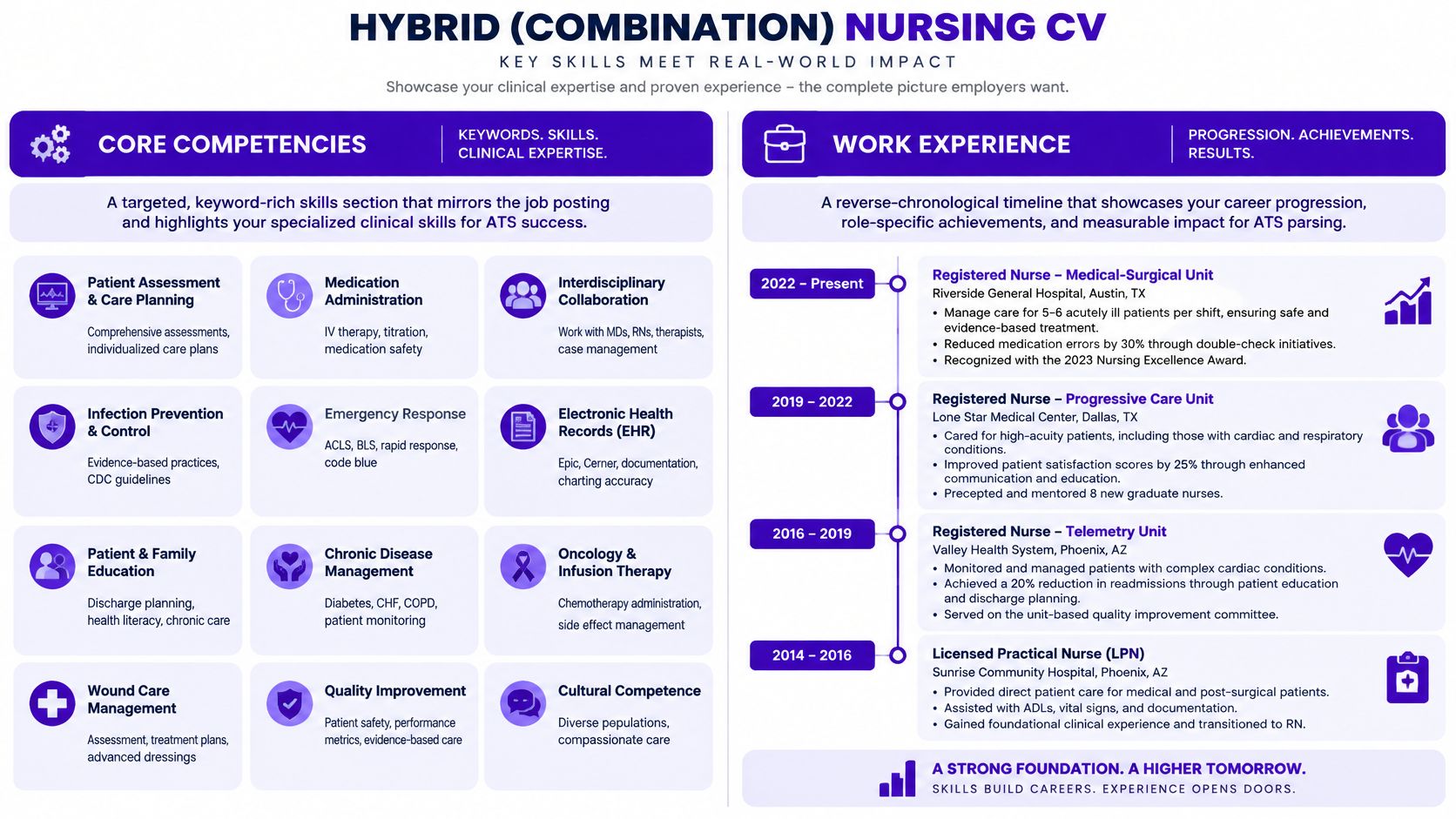
A hybrid CV gives specialist skills early visibility without sacrificing the employment timeline. It's a useful choice for an oncology nurse, clinical educator, or experienced RN changing specialties while retaining substantial relevant experience.
Open with a concise professional summary and a focused competency section. Follow immediately with reverse-chronological employment. The summary establishes your clinical identity; the work history supplies the evidence.
For an oncology applicant, that might mean placing chemotherapy administration, vascular access, symptom assessment, and patient education above the employment section, provided those terms accurately describe current competence.
This layout illustrates how competencies and a dated work history can coexist.
Don't repeat the skills list in every role
Use the competency section for searchable terminology, then show application in your bullets. The Nursing Directory's resume guidance supports pairing vacancy terminology with evidence of clinical scope rather than relying on keyword repetition.
- Weak claim: “Skilled in oncology nursing.”
- Stronger rewrite: “Assessed treatment-related symptoms, reinforced escalation advice, and coordinated follow-up with the oncology team.”
- Educator alternative: “Designed simulation scenarios around deterioration recognition and used competency assessments to identify learning needs.”
Add verified activity volumes or evaluation results when you have them. If you don't, describe the intervention and your responsibility precisely instead of manufacturing a performance percentage.
A summary should explain the match, not announce that you want a rewarding opportunity. These nurse resume objective examples can help distinguish a targeted career statement from a generic introduction.
ATS check: Match the employer's terminology only where it's truthful. Include both a clear clinical phrase and its familiar abbreviation where useful, and remove skill ratings, icons, and progress bars.
The trade-off is duplication. If your opening consumes space without adding information beyond the first employment entry, shorten it.
4. New Graduate Nursing CV (RN or BSN)
Your clinical preparation belongs near the top when you don't yet have RN employment. A new graduate CV should make education, registration status, supervised placements, and relevant healthcare work easy to distinguish.
Keep the presentation simple enough that the clinical content receives attention first.

The University of Maryland School of Nursing's resume guide recommends reverse-chronological organization and identifying clinical placements by unit and hours. Use your own placement records for those details, rather than copying the workload from an example.
Separate supervised learning from independent practice
A pediatric residency applicant should describe pediatric preparation before unrelated employment. A former CNA should retain that experience, but label the role accurately rather than implying it was RN practice.
- Placement rewrite: Replace “Completed pediatric rotation” with “Supported pediatric assessments, family education, and medication administration under RN supervision.”
- Capstone rewrite: Replace “Participated in quality improvement” with “Reviewed discharge education materials, identified inconsistent escalation advice, and presented proposed revisions to the placement team.”
- Registration status: State whether NCLEX is scheduled, passed, or awaiting results, and distinguish that from an issued RN license.
Use a new graduate nurse resume sample to check section order. Aim for a concise page without cutting the placement details that establish your readiness.
List completed certifications with the issuing organization and actual validity details. If you're arranging CPR and basic life support training, confirm that the specific course satisfies your prospective employer's requirements before enrolling.
Use the accompanying video as another presentation reference, while keeping your own clinical record authoritative.
ATS check: Ensure the uploaded document distinguishes Education, Clinical Placements, Licensure, and Employment. Never label a pending credential as active to obtain a keyword match.
5. Travel Nurse CV
For travel work, the assignment record is the main selling document. An agency needs to understand where you've worked, which populations you can support, and whether your credentials match the proposed placement.
Lead with specialty, relevant certifications, availability if requested, and accurately described licensing status. Then present assignments in reverse chronology, identifying the staffing employer and host facility clearly enough to avoid apparent duplicate employment.
A recruiter should be able to separate contract completion from resignation, and a repeat assignment from continuous permanent employment.
Make assignments comparable
Use a consistent entry pattern: facility, location, unit, assignment dates, patient population, EHR, and relevant clinical scope. Add verified ratios and unit capacity when your records support them.
- Weak description: “Worked travel contracts in different hospitals.”
- Stronger rewrite: “Completed telemetry assignments across community and academic hospital settings, managing monitored patients and coordinating escalation with local teams.”
- Adaptability evidence: “Completed facility orientation and competency validation before accepting independent assignments.”
- Float experience: “Supported medical-surgical and step-down areas within validated competencies,” naming only units where you practised.
An assignment ending as agreed isn't a job-hopping problem. Label it as a completed contract rather than asking the recruiter to infer that.
Maintain a detailed master record, then tailor the submitted version to the assignment. Don't remove dates or omit requested history to make the document shorter.
ATS check: Use plain-text license jurisdiction and status. Describe multistate privileges only as your regulator confirms them; holding several licenses isn't automatically the same as holding a compact multistate license.
Keep manager references in a separate, permission-based record unless the agency requests them with the CV. Before accepting a move, use a relocation cost calculator to compare the practical costs of the destination, not just the advertised compensation.
6. Nurse Leadership or Nurse Manager CV
Management applicants need evidence of operational responsibility, not a longer bedside task list. Hiring managers need to understand your authority over staffing, development, quality, resources, and escalation.
Start each leadership role with its scope. Identify the service, reporting relationships, workforce responsibilities, and budget accountability where applicable. Distinguish managing a budget from contributing information to someone else's budget.
A chart can support a leadership discussion, but your CV still needs to explain the intervention behind the result.

Attribute results honestly
A charge nurse applying for management might replace “Responsible for staffing” with “Coordinated shift allocation against patient acuity, escalated staffing risks, and supported redeployment decisions.”
For improvement work, distinguish between leading the intervention and contributing to a wider team:
- Owned the work: “Led a review of roster patterns and introduced an escalation process for uncovered shifts.”
- Contributed to delivery: “Supported the unit's pressure-injury prevention initiative through bedside coaching and audit feedback.”
- Developed staff: “Used competency reviews and individual development plans to address identified learning needs.”
The registered-nurse CV guidance from Wensa emphasizes pairing clinical context with substantiated outcomes. For management applications, retrieve the baseline, reporting period, and result from approved quality or workforce records, then make your contribution explicit.
These examples of leadership on a resume can help you choose evidence that demonstrates responsibility rather than merely seniority.
ATS check: Match genuine experience to terms such as workforce planning, quality improvement, competency assessment, or budget management. Don't add regulatory expertise solely because the vacancy mentions it.
If you browse nursing membership plans for professional development, list completed, relevant learning on the CV rather than treating membership itself as evidence of leadership competence.
7. Advanced Practice Nurse CV (Nurse Practitioner or CNS)
An APRN CV must work as both a hiring document and an accurate professional record. Lead with your advanced practice role, population focus, national certification, and relevant registration rather than allowing older RN employment to dominate.
Build a clearly labeled credentials section. Record the issuing body, credential title, jurisdiction, current status, and expiry details exactly as documented. Provide credential identifiers through the application or secure credentialing channel when requested.
For an RN moving into advanced practice, separate graduate clinical preparation from paid APRN employment. Strong bedside experience supports the application, but it doesn't become advanced practice experience through a change of wording.
Describe authority without overstating it
A psychiatric NP applying to a telehealth service should explain the patient population, assessment work, medication management, follow-up, and jurisdictions involved. An acute care NP should foreground relevant inpatient practice and validated procedural competence.
- Weak statement: “Managed complex patients independently.”
- Stronger rewrite: “Assessed adults with acute clinical needs, developed management plans within authorized scope, and coordinated escalation with the treating team.”
- Telehealth rewrite: “Provided psychiatric follow-up and medication management by telehealth within the jurisdictions covered by active authorization.”
- CNS alternative: “Supported evidence-based practice through clinical consultation, staff education, and evaluation of service improvement activity.”
Add verified patient-panel size, encounter volume, or procedure counts where appropriate. Define the measure so readers can distinguish an assigned panel from patients seen during a reporting period.
Credentialing safeguard: Keep titles, dates, certification names, and employment history consistent across the CV and credentialing application.
ATS check: Include the exact specialty and certification terminology relevant to the vacancy. Never add independent prescribing, procedures, or cross-border practice claims unless they accurately describe your authorization and work.
Keep publications, presentations, teaching, and research when they support the appointment. An academic or credentialing CV shouldn't lose necessary detail merely to resemble a short employment resume.
8. UK NHS Nursing CV (Supporting Information Format)
An NHS application needs evidence against the person specification, not a polished employment document. Where the employer requires a structured online application, the CV should support that process rather than replace the supporting information.
Keep employment, qualifications, NMC registration information, and relevant development clear. Follow the vacancy's requested format, and avoid importing personal details from a template designed for another country.
International healthcare resume guidance illustrates why destination-specific disclosure matters: registration expectations and personal-information conventions differ between markets. Label overseas registration, NMC registration, and any pending assessment separately.
Match Band progression to demonstrated responsibility
For a Band 5 application, select evidence of assessment, safe escalation, communication, and patient-centred care. For a Band 6 application, make supervision, coordination, audit involvement, and service development visible without overstating your authority.
Use the person specification as evidence labels where the application permits it:
- Safeguarding: “Recognised a safeguarding concern, documented the assessment, and escalated through the local pathway for multidisciplinary review.”
- Supervision: “Supported newly appointed colleagues through planned supervision and competency feedback.”
- Audit leadership: “Coordinated documentation review, discussed findings with ward staff, and followed up agreed actions.”
- Deterioration recognition: “Used NEWS2 within local policy, assessed clinical changes, and escalated concerns to the appropriate clinician,” if that reflects your practice.
Structure supporting examples around situation, task, action, and result. Describe the relevant context briefly, give most space to your own actions, and include the outcome only when you know it.
ATS and application check: Use the person specification's terminology where accurate, but answer the criterion rather than repeating its wording. Confirm registration status and any requested revalidation details against your current record.
Keep the CV concise and reserve fuller examples for supporting information. Repeating the same narrative in both documents adds length without giving the panel additional evidence.
How the Eight Nursing CV Formats Compare
| Item | Best For | ATS Readability | Main Drawback |
|---|---|---|---|
| Reverse-Chronological Nursing CV | Experienced nurses showing career progression | High; easy to parse | Employment gaps are more visible |
| Functional (Skills-Based) Nursing CV | Nurses returning to practice or changing specialties | Low; harder for ATS and recruiters to parse | Can appear to obscure work history |
| Hybrid (Combination) Nursing CV | Experienced specialty nurses highlighting skills and progression | High when using a text-based layout | Can be lengthy or repetitive |
| New Graduate Nursing CV (RN or BSN) | Recent graduates applying for first RN roles or residencies | Good with a simple layout | Limited clinical experience may make it look thin |
| Travel Nurse CV | Nurses seeking short-term contracts across facilities or states | Good for agency screening | Frequent assignments may raise questions |
| Nurse Leadership or Nurse Manager CV | Nurses pursuing charge, management, or director roles | Good when achievements use clear headings and text | Requires credible operational metrics |
| Advanced Practice Nurse CV (Nurse Practitioner or CNS) | NPs and CNSs applying for specialty roles or credentialing | Good; specialty keywords support matching | State-specific scope details require careful accuracy |
| UK NHS Nursing CV (Supporting Information Format) | Nurses applying for UK NHS roles | Moderate; applications use structured forms | Supporting statements often carry more weight than the CV |
Match Your Format to Your Next Role, Then Tailor Every Time
Choose your format by asking what the employer needs to verify first. If recent specialty employment answers that question, use reverse chronology. If relevant skills are scattered across different roles, use a hybrid format; reserve a functional opening for situations where it clarifies a transition or return to practice.
New graduates should foreground supervised clinical preparation and registration status. Travel nurses should make assignments comparable, leadership applicants should establish operational scope, and APRNs should prioritize credential accuracy. For NHS applications, let the person specification guide the supporting evidence.
Keep a master CV that contains the detail you might need later. It should hold your complete employment timeline, clinical placements, education, licenses, certification history, EHR experience, teaching, improvement work, and substantiated outcomes.
- Record the evidence: Note where each outcome came from, what period it covers, and whether it reflects individual or team performance.
- Protect confidentiality: Keep patient-identifiable information and restricted internal records out of application documents.
- Maintain credential status: Separate active, pending, expired, and in-progress items instead of relying on a vague certifications list.
- Save application versions: Retain the document submitted for each vacancy so you can prepare for the interview from the same record.
Tailor a shorter copy for each application. Move relevant content upward, remove unrelated detail, and use the employer's clinical terminology where it accurately describes your work. Mirroring keywords isn't permission to claim unfamiliar systems, procedures, or authority.
When you don't have outcome metrics, use defensible scope instead. Explain the patient population, intervention, clinical setting, and your responsibility. A precise account of discharge coordination is more credible than an unsupported claim that you transformed readmission performance.
Before submitting, check both readability and application-field accuracy. Confirm that dates, credentials, and headings survive the upload, then review whether the opening makes your suitability obvious.
Our ATS keyword matching in Eztrackr shows what the job description asks for, surfaces gaps in your resume, and explains suggested changes. Use that comparison to find missing evidence or terminology, then review every edit yourself, because only you can confirm that the finished CV represents your practice accurately.
Eztrackr lets you upload an existing resume or build one from scratch, tailor it to a vacancy, and keep the application with its linked documents and notes. Visit Eztrackr to compare your nursing CV with your next job description, review the suggested changes, and save a customized version for that application.