How Long Should a Cover Letter Be? Length Guide for 2026
Most cover letters should run about 200–400 words, fit on one page, and follow any employer-stated limit exactly. Aim to prove your fit, not fill the available space.
In a survey of 205 human-resources professionals reported by The Muse, 82% preferred a cover letter no longer than one page, according to Jobs AI Copilot's length guide. That's a preference, not proof that a particular word count earns interviews. But it reframes the question: how much relevant evidence can you give an employer without making them work to find it?
Ideal Cover Letter Length at a Glance
Start with a concise, personalized letter, then adjust it to the application instructions. Length should leave room to explain why your experience matters without turning your résumé into prose.
The UNLV career-services guide supports a one-page maximum, with roughly 250-400 words generally fitting that boundary in a readable layout. The table separates a routine application from situations where the employer or profession sets a different expectation.
Target cover letter length by situation
| Situation | Target length | Word range |
|---|---|---|
| Standard corporate role, tailored letter | Half to one page | 250-400 words |
| Entry-level or limited experience | About half a page | 200-300 words |
| Employer or form sets a limit | Follow the stated limit exactly | Set by employer |
| Academic faculty position | 1.5-2 pages | Follow the institution's requirements |
| Standard PDF upload | One page maximum | Never exceed one page without a compelling reason |
The shorter default is supported by the University of Virginia's cover-letter guidance, which recommends 200-300 words. Academic exceptions belong with application formats, where an institution's instructions take precedence.
Read the range as a budget for evidence, not a target to fill. A 250-word letter with two relevant results can do more than a 400-word letter that repeats the résumé.
Treat the page as a boundary
A 2024 ResumeLab survey reported that 70% of hiring professionals preferred cover letters shorter than one page, with most of those respondents favoring half a page, according to Scoutify's cover-letter guide. That finding supports brevity, but it doesn't establish a universal hiring rule.
A longer draft can be justified when it contains distinct, relevant proof. A desire to make the page look complete does not justify it.
Practical rule: Leave unused space before you add a sentence that tells the employer nothing new.
For students, the harder task is choosing relevant evidence rather than shortening an employment history. Coursework, volunteering, and projects can supply that evidence, and subject choice tips for teens can help younger applicants identify which subjects and projects are worth citing.
Before submitting, check the word count, inspect the actual upload file, and compare both with the employer's instructions. A draft that looks compact in an editor may spill onto another page after export.
How to Budget Words Across Paragraphs
Give each paragraph a job before you start polishing sentences. A working budget keeps the introduction and closing from crowding out evidence.
Word budget for each cover letter paragraph
| Paragraph | Word budget | Job |
|---|---|---|
| Opening: role, source and fit | 40 to 60 words | Name the role and give one reason you fit |
| Evidence: two quantified achievements | 100 to 150 words | Map each result to a requirement in the posting |
| Closing: motivation and next step | 40 to 60 words | Ask directly for an interview |
| Whole letter | 200 to 300 words | Three or four short paragraphs |
These component ranges are planning allowances, not minimums to add mechanically. For a wider benchmark, HerMoney's guidance cites Zety's recommendation of 200-400 words across three to six paragraphs.
Put most of the space into proof
A 270-word draft might allocate 60 words to the opening, 150 to the evidence, and 60 to the closing. Those allocations are illustrative, not an additional rule.
For an analyst application, the opening identifies the position and your relevant reporting experience. The middle explains a reporting improvement and a separate data-quality achievement, connecting each to a requirement in the posting. The closing names the work you want to contribute to and invites an interview.
Include documented measurements when you have them. If you do not, describe a verifiable outcome, such as a report adopted by the operations team, rather than inventing a percentage.
The evidence deserves the most space because it answers the employer's practical question: What suggests you can do this work? The introduction only needs to establish direction. If it is taking too long, these cover letter opening lines can help you replace a ceremonial introduction with a relevant starting point.
Cut in this order:
- Generic background: Remove broad claims about ambition or professionalism.
- Résumé repetition: Keep the result, but explain its relevance instead of copying the bullet.
- Company history: Replace a summary of the employer's business with a specific reason your work fits its needs.
Every remaining sentence should add evidence, role-specific context, or a clear hiring implication.
How Short Is Too Short
A short letter doesn't automatically signal low effort. An interchangeable letter does.
The statistics compiled by CareerLaunchKit report that 49% of hiring managers preferred approximately half a page, while 25% said a few sentences were sufficient. Those preferences challenge the assumption that filling a page demonstrates commitment. They don't mean every employer wants the same amount of detail.
Too short means underdeveloped, not merely brief. A letter is underdeveloped when it names the vacancy but gives no evidence, claims skills without showing their use, or could be sent unchanged to another company.
Compare claims with evidence
Consider these hypothetical analyst openings, shown as excerpts rather than complete letters.
| Weak opening | Stronger opening |
|---|---|
| I'm applying for the analyst role. I have strong data skills and work hard. | I'm applying for your analyst role with experience rebuilding recurring reports in SQL. That work helped the operations team receive usable information earlier, directly matching your requirement for reliable reporting. |
The stronger version uses more space, but it gives the reader something to assess. The writer can develop it with a genuine measurement from their records, explain their own contribution, and connect the outcome to the employer's work.
The weak version needs more proof, not more enthusiasm.
Stop writing when you've established fit, not when you've reached the bottom of the page.
Apply a simple deletion test: if removing a sentence loses no evidence of fit, remove it. If the whole letter contains no specific result, add one before worrying about whether it looks short.
The same test applies outside office roles. Our sample cover letters for retail can help you identify relevant material from customer service, stock handling, and store responsibilities.
When you're managing many applications, a compact letter with a specific example is a more useful working approach than a long template with only the company name changed. Preserve the detail that proves you read the posting.
Length Rules for Email, PDF and Portal Applications
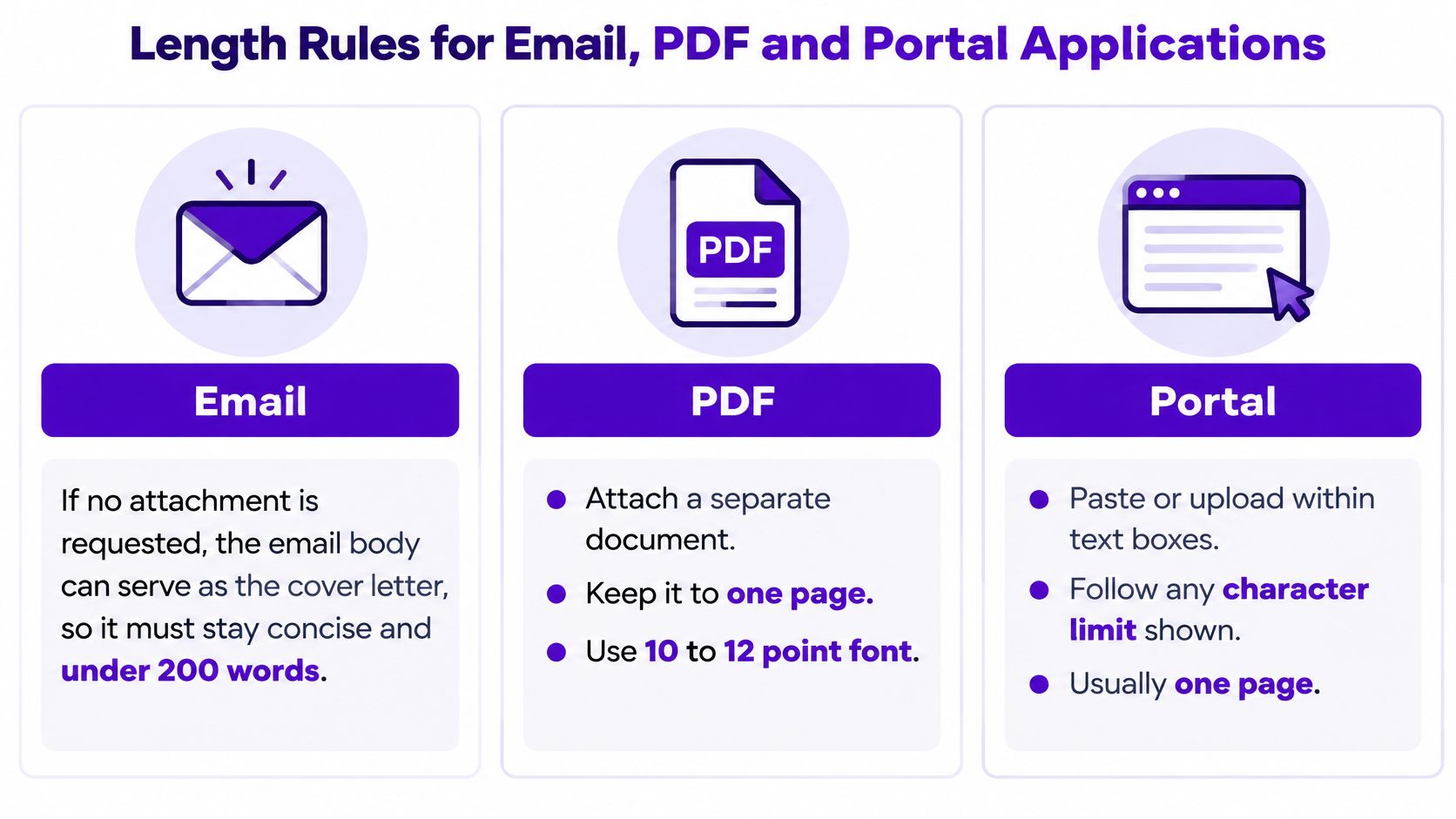
The submission format changes how you present the evidence. Use the employer's instructions to decide whether you're writing a message, uploading a formal document, or answering a constrained prompt.
Length rules by application format
| Format | Length rule | What to adjust |
|---|---|---|
| Email body, no attachment requested | Half a page or less | Put the role and strongest result in the first lines |
| Uploaded PDF | One page maximum, about 250–400 words | Use readable margins and an 11- or 12-point font |
| Application portal text box | Exact character limit | Keep only the most relevant evidence |
| Academic faculty position | 1.5–2 pages | Add teaching, research and service evidence |
| Employer prompt or form | Stated limit overrides all norms | Follow the instruction exactly |
Evernote's cover-letter length guide explains that employer instructions take precedence, an email can serve as the letter when no attachment is requested, and academic faculty letters commonly extend to 1.5–2 pages. Treat the table's standard-document settings as working defaults, not permission to disregard a posting.
This visual compares the main submission environments.
Write for the place it will be read
Email: Start with the position and your strongest connection to it. Keep paragraphs short enough to scan on a phone. If you're attaching a requested letter, use the email as a brief introduction rather than pasting the entire attachment into the message too.
PDF: Check the exported document, not just the editable version. Your contact block, greeting, closing, and signature all occupy space. Don't shrink the type to rescue an overlong draft, edit the content instead.
Portal: Distinguish a word limit from a character limit. Use the portal's counter when available, because spaces and line breaks may affect what it accepts. After pasting, inspect paragraph breaks and confirm that the ending hasn't been truncated.
For another explanation of cover-letter length, watch the video below.
Academic applications require a different editorial judgment. A committee may need evidence of research direction, teaching practice, and service, so compressing the letter into a corporate-style note can remove information it requested. Still, distinguish the letter's overview from material that belongs in separate research or teaching statements.
Use this order of precedence: employer instructions, professional format conventions, then the standard concise-letter default. The file type alone never determines what the employer needs.
Adjusting Length by Career Stage and Role
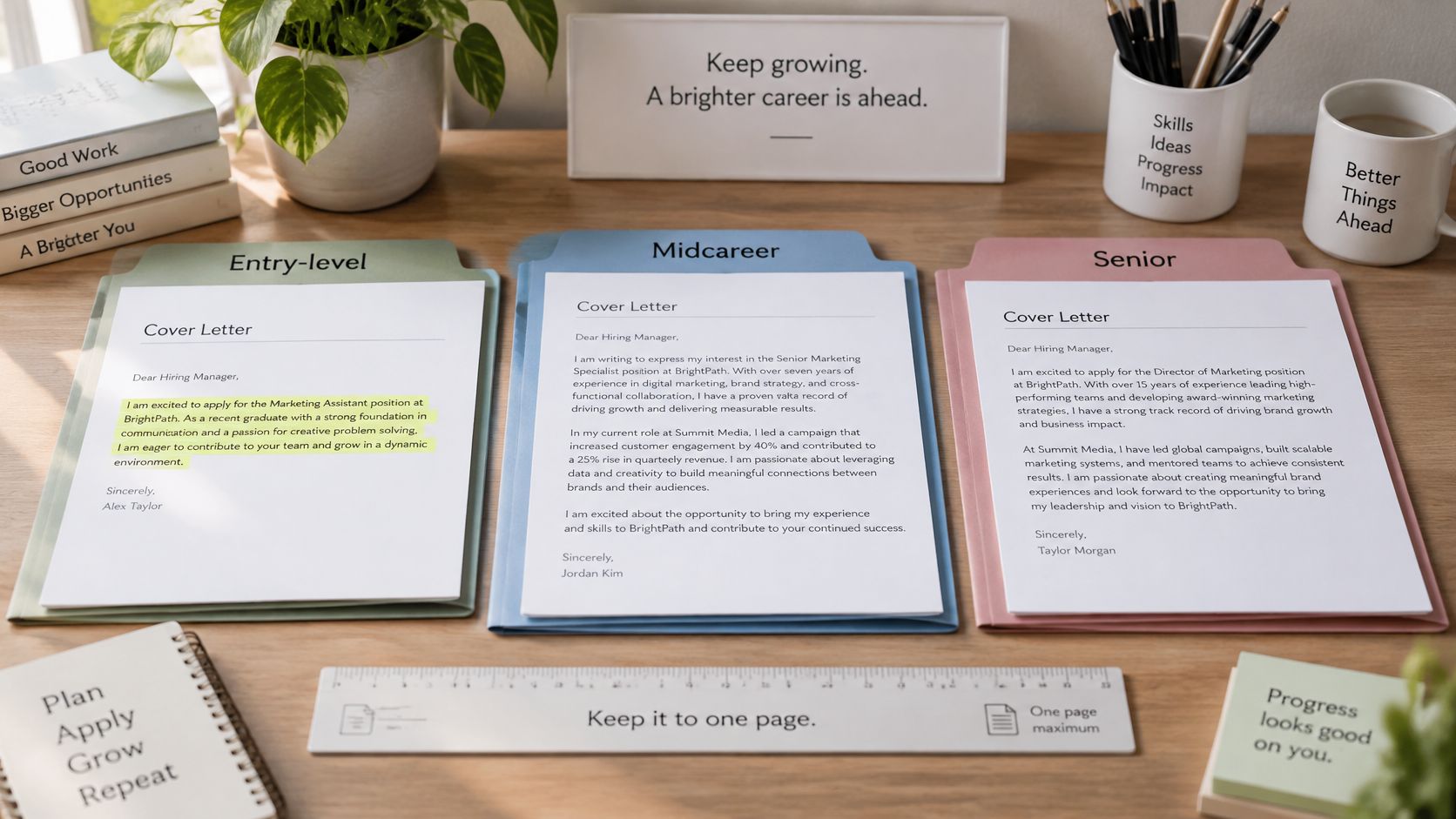
Your career stage changes which evidence deserves space, not how much of your biography an employer needs.
These examples represent different stages, but each should remain focused on the vacancy.
Choose evidence for your next move
- Entry-level candidates and interns: Use the shorter end of the standard range when you have limited experience. Explain a project, internship, class assignment, or volunteer responsibility that resembles the advertised work. Don't spend space apologizing for being new.
- Career changers: Allow room to explain the connection between your previous work and the new role. A hospitality supervisor moving into operations might connect scheduling, supplier coordination, and problem resolution to the employer's operational needs.
- Senior and executive candidates: Emphasize scope and decisions. Budget responsibility, teams led, business outcomes, and organizational complexity matter more than a chronological account of promotions.
- Recruiting and HR applicants: Select evidence related to the actual remit, such as pipeline management, stakeholder communication, hiring delivery, or process improvement. Use measurements only when you can verify them.
Check the role, not just the title
A request for a brief note is a signal to compress. A request to address detailed selection criteria calls for explicit answers, even if your usual template doesn't accommodate them.
Review recent postings in your target sector and note what employers request: a letter, a statement, short answers, or supporting documents. Then use this guide to tailoring a cover letter to a job description to choose what belongs in the available space.
Cut, Check and Decide Before You Apply
Editing works best when you remove duplication before cutting useful detail. Don't begin by deleting the explanation of your strongest achievement just because it's the longest sentence.
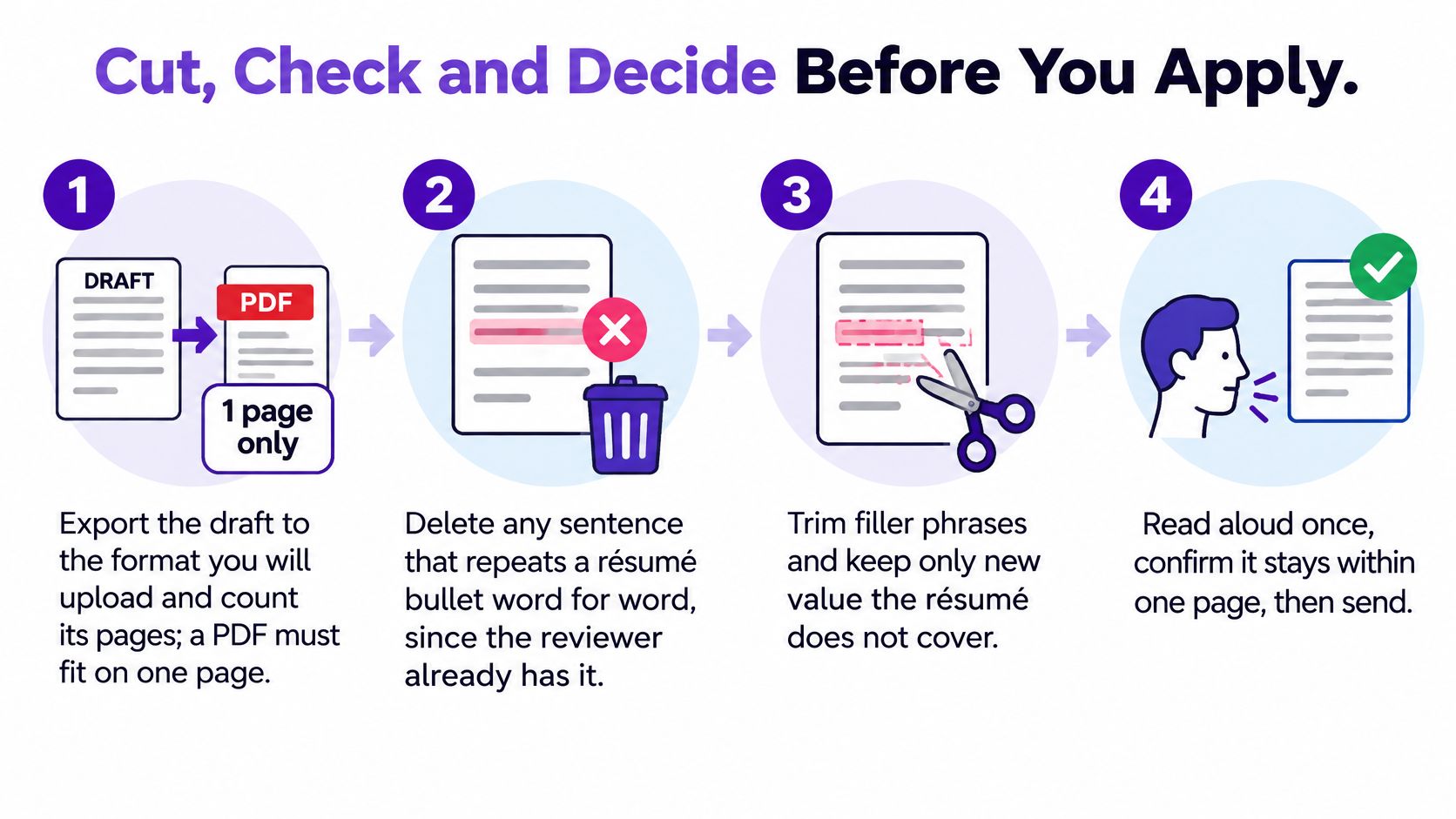
Save a copy of the draft, keep the posting open, and work through the following routine.
Cut without weakening the argument
Export the document first. Open the file you'll submit and inspect its page count, spacing, and closing. For a standard application, an extra page is a reason to edit, not immediately reduce the font.
Delete sentences that copy résumé bullets word for word. Where the achievement matters, explain the problem you solved or why the result is relevant to this employer.
Replace a generic introduction. Start with the role and a fact about your fit. You don't need a ceremonial sentence announcing that you're applying.
Remove company history the employer already knows. Retain a company detail only when it explains your motivation or connects directly to work you can contribute.
Merge overlapping examples. If separate sentences both demonstrate the same reporting skill, choose the clearer result and preserve the detail that makes your contribution credible.
Check the evidence paragraphs for outcomes. Add a real measurement from your records when it strengthens the explanation. If you can't verify a number, use a concrete qualitative result rather than manufacturing precision.
Read the letter aloud. Replace phrases you wouldn't use in an interview, such as an exaggerated claim of passion, with plain descriptions of your interest and ability.
Recount the words and compare the draft with the submission requirements. Check the filename, company name, role title, and final sentence before uploading.
This visual summarizes the editing sequence.
Make the final decision
Submission check: The reader should be able to identify the role, your strongest evidence, and your requested next step without searching.
Confirm that you haven't exceeded an employer limit, that the opening names the position, and that the closing invites an interview. Read every achievement as if an interviewer had just asked you to explain it. You should be able to support both the result and your contribution.
If the draft is too long, remove repetition before removing proof. If it's short and unsupported, add a genuine example rather than more adjectives.
For help producing a starting draft, our cover letter maker guide explains the options. Our AI Cover Letter Generator personalizes letters to your résumé and lets you set the length, focus, and tone in a few clicks. Review the draft against the posting and verify every claim before sending.
Visit Eztrackr to create a résumé-personalized cover letter with a length, focus, and tone you choose. Use it as your starting draft, then apply the editing checks above to submit a concise letter built around evidence you can defend.