7 Sample Cover Letters for Retail: Templates by Role
Two people apply for the same sales associate role at the same chain on the same morning. One sends a polite, generic letter about enjoying people and working hard. She hears nothing. The other opens with a short example of helping a confused shopper find the right size, names the store's current promotion, and states she's available for weekend and holiday shifts. She gets a callback.
That gap isn't luck. Retail hiring managers scan for different signals depending on the job. A seasonal manager needs availability and speed. A store manager panel needs numbers and staff development. A luxury boutique needs discretion and polish in every line. Good sample cover letters for retail aren't interchangeable templates. They're matched to the posting, your experience level, and the store's customer promise. Use the seven formats below by career stage and role type, then change one lever in each letter so it couldn't have been sent anywhere else.
1. Entry-Level Retail Sales Associate Cover Letter

Hiring signal to satisfy: reliability before credentials. For an entry-level sales associate role, show that you can arrive reliably, welcome customers, learn store routines, and stay composed during busy periods. Your strongest evidence may come from volunteering, school activities, or another customer-facing job. Give one specific example of how you helped someone, then connect that behavior to the store.
Entry-Level Retail Sales Associate Cover Letter Template
Dear [Hiring Manager's Name],
I'm applying for the [Sales Associate] position at [Store Name]. I'm interested in helping customers find products that suit their needs, and I'm available for [your accurate days and shifts].
As a [volunteer/student/café team member] at [organization or workplace], I [describe a specific customer-service action]. For example, I [briefly explain what the customer needed and what you did], which helped [state the result without exaggerating]. That experience taught me to listen carefully, communicate clearly, and stay organized when people need help.
I'm drawn to [Store Name] because [specific detail about its products, service, mission, or current campaign]. I'd bring a dependable approach, a willingness to learn [relevant store task or product range], and a focus on making each customer's visit helpful.
Thank you for considering my application. I'd welcome the opportunity to discuss how I can contribute to your team.
Sincerely,
[Your Name]
The One Customization Lever
Make the employer-specific sentence do real work: connect a detail about the store to your example, rather than adding a string of keywords. Keep the example concrete. Applicants to general merchandise or apparel stores can draw on a volunteer or café interaction; electronics applicants can mention helping someone choose a product, if that reflects their experience.
Before sending, replace every bracket with accurate information. Name the role in the opening, state only the shifts you can work, and use a customer-service example that shows what you did. Keep the letter concise and use these cover letter best practices for tailoring each draft to make the employer-specific detail fit the posting.
2. Customer Service-Focused Retail Cover Letter
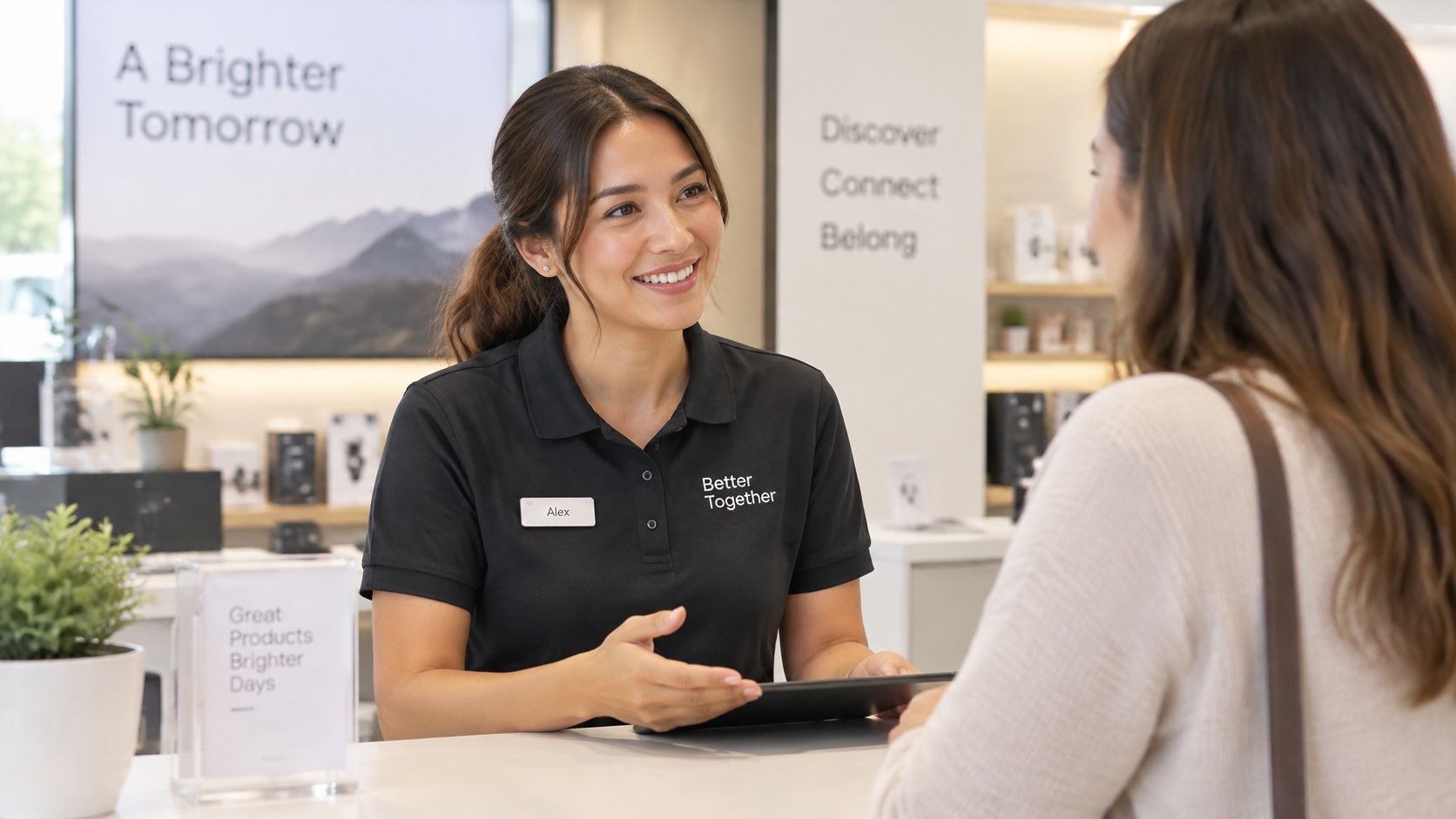
A customer leaves upset about a return. Your cover letter should show how you handled the concern, followed store policy, and kept the interaction productive. A claim like “I have excellent customer-service skills” gives the hiring manager little to assess. A specific example shows your judgment in action.
Hiring signal to satisfy: you can resolve a problem while protecting the customer relationship. Build the letter around one resolution story. Explain what happened, what you did, which policy guided your response, and how the interaction ended. For department store or home goods roles, emphasize clear communication and finding a workable solution. For returns positions at large chains, show that you can be calm and helpful while applying policy consistently.
Use numbers only when you can support them, such as inquiries handled per shift. Otherwise, describe the scale of the situation, for example, a busy Saturday return period or a queue during a store event. Show how product knowledge helped you recommend a relevant solution, rather than pushing a sale. These soft skills examples for customer-facing applications can help you choose behaviors to demonstrate. You can also explore service representative positions to see how employers describe customer-facing responsibilities.
The One Customization Lever
Use one service phrase from the job posting, such as “delight” or “every guest,” then connect it to your resolution story. That single detail makes the example feel relevant without turning the letter into a list of borrowed keywords. A field experiment involving 7,287 fictitious applications found that applications with a cover letter received a 53% higher interview-callback rate than applications without one. Tailor the story to the role so the hiring manager can see how your approach fits the store's service expectations.
3. Retail Store Manager Cover Letter (Results-Driven)
Management panels don't hire enthusiasm. They hire evidence that you've moved sales, labor, inventory, and retention without burning out a team. Your letter should read like a brief business case, not a longer version of a sales associate application.

Choose three or four metrics that match the posting, such as sales growth, labor efficiency, inventory accuracy, shrinkage, or employee retention. State your scope in the same paragraph, including staff managed, store revenue range, and number of locations if you've covered more than one. Store manager applicants at national apparel and home improvement chains often structure letters around sales per hour and labor-cost targets. Candidates moving between grocery and general merchandise use operations metrics to show their experience transfers.
Hiring signal to satisfy: commercial judgement plus people development. Include one example of developing someone, such as coaching an associate into a supervisor role or training a new lead to run closing counts. Numbers without a team story can make a panel worry you'll hit target for a quarter and lose the staff who delivered it.
The One Customization Lever
Tie your metrics to that employer's format, whether it's a department store, grocery chain, specialty shop, or warehouse operation. Context matters because Bureau of Labor Statistics analysis found U.S. retail-trade employment increased 9% from December 2009 to December 2019, while total private employment grew 21%.
Practical rule: Attach a one-page performance summary to your resume in Eztrackr, then reference only its strongest results in the letter.
4. Career Changer Cover Letter Moving Into Retail
Your biggest obstacle isn't a skills gap. It's the manager's quiet doubt that you'll leave when a job in your old field appears, or that you won't accept entry-level tasks like replenishment and closing routines. Remove that doubt in your first sentence.
Open with one clear reason for moving into retail, without apologizing for your background. A former teacher might say she wants customer-facing work with measurable daily results after years of managing classrooms, parents, and schedules. A hospitality worker might point to peak service, cash handling, and complaint resolution. Veterans applying for retail operations roles translate logistics, security checks, and team leadership into stock accuracy and delivery coordination.
Build a translation table before you write. On the left, list what you did. On the right, write the retail term from the posting. Scheduling a staff rota becomes labor planning support. Handling a difficult parent meeting becomes resolving a customer concern while staying within policy. Pull only your three or four strongest matches into the letter, using guidance on transferable skills for a career change to keep the language credible.
The One Customization Lever
Name the kind of retail you're moving toward, not retail in general. Store work, fulfillment, omnichannel service, and operations need different proof. Hiring data in an ANCOR labor market overview showed warehouse and stocking roles rising from 3.5% of seasonal retail postings in 2019 to 9% in 2026.
Mention retail-adjacent training if you have it, such as an inventory software course, product certification, or merchandising workshop. Don't list courses you only plan to take as if they're complete.
5. Seasonal and Holiday Retail Cover Letter
Seasonal hiring moves fast, and managers often read on a phone between floor walks. Your letter has one job in its first two sentences. It must tell them when you can work and when you can start.

Write your exact availability, including evenings, weekends, and any blackout dates you can't cover. Then add one short proof point about pace. Say you worked a school holiday event, a busy market stall, or a previous peak season and handled queues, gift wrapping, restocking, or order pickup. Students applying for winter break and summer roles use this availability-first format because it answers the scheduler's question immediately.
Hiring signal to satisfy: flexible cover with minimal training risk. State whether you're willing to move between register, stockroom, fulfillment, and fitting rooms if the posting asks for that flexibility. Be specific about systems you've already learned, but don't claim speed on a till you've never touched. Managers will test that claim in your first shift.
The One Customization Lever
Send early and make the letter easy to scan on mobile. Short paragraphs matter because iCIMS's 2023 Workforce Report found that in June 2023, 70% of retail applicants used a mobile device to apply, compared with 53% of applicants overall.
- Put peak dates first: Name the holiday weekends you can cover.
- Name the tasks: Register, stockroom, pickup, and replenishment are clearer than "helping out."
- Close with start date: "Available to start Monday" beats a vague closing if it's accurate.
6. Luxury Retail Client-Relationship Cover Letter
In luxury retail, the letter itself is a work sample. A typo, a sloppy layout, or slang that would pass in a warehouse application can end your chances before anyone reads your sales record. Boutique managers are scanning for presentation, discretion, and client memory as much as conversion.
Research the brand's current collection and client experience philosophy. Reference one specific element, such as appointment-based styling, private viewings, aftercare for watches, or a beauty consultation ritual. Applicants for client advisor roles at international fashion houses and jewelry boutiques emphasize clienteling, which means remembering preferences, following up appropriately, and inviting clients back for relevant launches. Candidates for luxury beauty and watch counters add product expertise and retention.
Describe your relationship approach without exposing confidential client details. You can say you maintained a personal client book, scheduled follow-up appointments after alterations, or contacted clients when a requested size arrived. Don't name private clients or share their spending. Discretion is part of the proof.
If you're building toward this end of the market early in your career, research on internships at Chanel can help you understand how heritage brands present experience and training.
The One Customization Lever
Match the brand's tone in your opening sentence, then support it with one retention result or repeat-appointment example. Precision pays. Research on application-writing quality estimated that a one-point improvement in the combined writing-quality measure yielded 7% more interviews and shortened time to employment by nearly 10 days.
Proofread the final PDF, not just the draft. Font changes and broken spacing often appear only after export.
7. Visual Merchandising and Retail Buyer Cover Letter
Merchandising and buying managers want to know whether your taste changes what customers pick up, try on, and pay for. "I have a good eye" won't answer that. A display you rebuilt, a category you reordered, or an assortment decision you supported can.
Include one or two quantified results, such as sell-through improvement, category sales growth after a window change, or reduced markdowns because sizes were replenished earlier. Name the product categories you understand best and why. Visual merchandising applicants for apparel and home decor retailers often link to portfolio work. Assistant buyer applicants at department and specialty chains cite category performance and margin awareness, while staying honest about whether they led the decision or supported it.
Watch how a strong merchandising application connects presentation choices to customer behavior before you draft your own evidence paragraph.
Hiring signal to satisfy: creative judgement backed by commercial results. Explain the customer you were designing or buying for, the constraint you faced, and the result you observed. Limited fixture space, a late delivery, or a narrow size curve makes the example believable.
The One Customization Lever
Match your strongest category example to the department in the posting, and include a portfolio link only if it's current and professionally presented. Retail's scale makes that specificity valuable. The International Labour Organization estimated the global retail and commerce sector supported more than 420.5 million jobs in 2020.
Store your portfolio and custom letters side by side in Eztrackr so each opening gets the right work samples. Delete outdated seasonal displays that no longer reflect your standard.
How the Seven Retail Cover Letter Templates Compare
| Item | Best For | Core Focus | Main Drawback |
|---|---|---|---|
| Entry-Level Retail Sales Associate Cover Letter | Students, recent graduates, and first-time retail applicants | Reliability, availability, enthusiasm, and transferable skills | Can feel generic without employer-specific details |
| Customer Service-Focused Retail Cover Letter | Candidates with customer-facing experience | Resolving issues, building loyalty, and delivering strong service | Requires credible, specific customer-service examples |
| Retail Store Manager Cover Letter (Results-Driven) | Experienced retail supervisors and managers | Leadership, team development, operations, and measurable results | Depends on having relevant metrics to share |
| Career Changer Cover Letter Moving Into Retail | Professionals transitioning into retail | Explaining motivation and translating transferable skills | Must address concerns about commitment and long-term fit |
| Seasonal and Holiday Retail Cover Letter | Students and candidates seeking temporary retail work | Availability, flexibility, fast learning, and peak-season readiness | May blend in without a distinctive detail |
| Luxury Retail Client-Relationship Cover Letter | Applicants for boutique and high-end client advisor roles | Polished communication, clienteling, discretion, and brand alignment | Requires convincing brand or category familiarity |
| Visual Merchandising and Retail Buyer Cover Letter | Candidates pursuing merchandising, buying, or planning roles | Product presentation, assortment decisions, and business impact | Works best with a portfolio or performance data |
Match the Template to the Posting Before You Hit Send
Start with the posting, not with a blank document. Read the title, duties, schedule, and first three requirements, then decide which hiring signal dominates. If the posting stresses friendliness, reliability, and learning the register, use the entry-level format. If it centers on complaints, returns, and loyalty, lead with customer service. If it names sales targets, labor, shrinkage, and staff development, you're writing a management letter and numbers need to appear early.
Career changers should choose based on the destination role, then translate evidence into that role's language. Seasonal applicants should put dates and task flexibility before career history. Luxury applicants need polish and clienteling proof in every paragraph. Merchandising and buying applicants need a category result, not a general claim about creativity. When a posting blends two signals, pick the template for the higher-risk concern. For example, a luxury seasonal role still needs availability first, but the writing and layout must meet luxury standards.
Then make one customization you can defend in an interview. Add a store-specific campaign reference, a quantified result, an exact availability statement, or a category example that matches the department. Don't change only the company name and call the letter customized. That version usually reads generic because the evidence could belong to any applicant, at any store, in any town.
Keep the structure tight across all seven formats. Open with the exact role and your strongest fit. Use two evidence-based body paragraphs that answer what you did, under what conditions, and what changed. Close with availability or the next step when the posting makes scheduling important. Read the letter aloud once. If a sentence sounds like a template rather than something you'd say across the table, rewrite it in plainer words.
Log each version in Eztrackr alongside the posting and the date you applied. After several applications, compare which formats earn replies, which openings stall, and whether your customized versions outperform your generic ones. Replace weak proof points instead of endlessly polishing adjectives. The best sample cover letters for retail give you a starting structure. Your specific evidence, matched to the right hiring signal, is what makes a manager call.
Ready to stop guessing which retail letter you sent to which store? Use Eztrackr to save job postings, generate and tailor cover letters from each job description, link the right resume or portfolio to every application, and track replies on a visual board. Visit today and turn your next retail application into a version you can measure, improve, and reuse with confidence.