Resume of Finance Analyst: 7 Annotated Examples for 2026
You've rewritten your resume three times this week. One version lists every Excel function you know, another echoes a job posting, and a third tries to cover FP&A, banking, and reporting at once. None makes clear which analyst role you fit or which bullets would hold up in a brief recruiter scan.
A finance analyst resume is judged on fit, not effort. Recruiters look for the finance problem you solved, the scale of the work, and the decision your analysis supported. Without those details, strong work can read like routine reporting. With them, even limited experience can show credible decision support.
The eight role-specific examples below show how resumes present evidence across finance subfields. Each example identifies the bullet or resume detail that matters, explains what makes it effective, lists the ATS terms it carries, and names the recruiter question it answers. Some examples start with a weak bullet and rewrite it; others focus on how to frame experience, education, tools, or certifications for a particular role. Use the formulas, not the example figures. Be ready to defend every metric in an interview. If you cannot support an impact claim, state the work's scope, frequency, or volume instead. That gives recruiters useful context without overstating your contribution.
1. Entry-Level / Recent Graduate Finance Analyst Resume
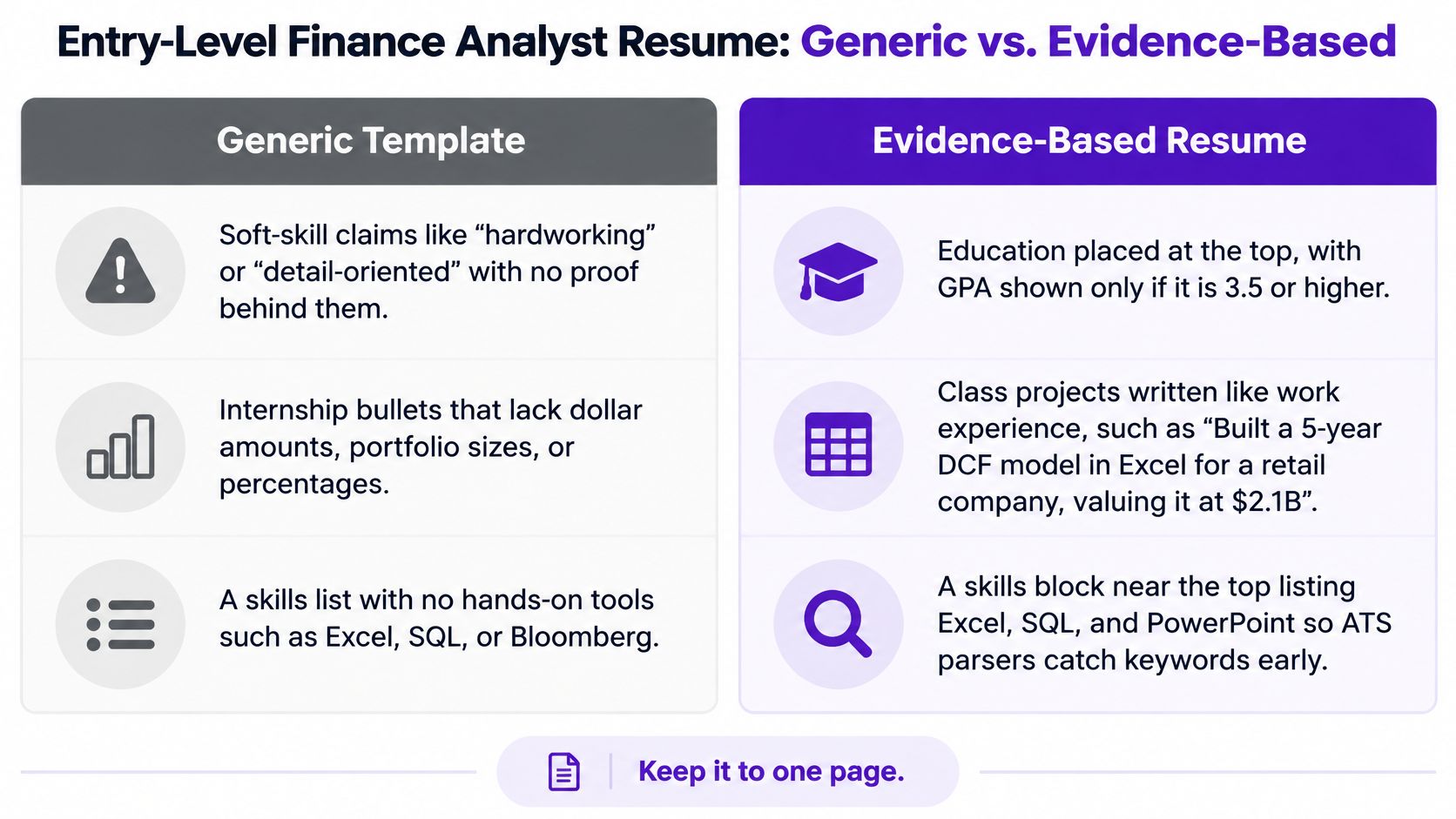
An entry-level resume has to show what you can do with financial information, even if your experience comes from coursework or a project. Lead with education, relevant coursework, internships, and specific analysis. Recruiters need evidence that you can build a model and explain its assumptions.
Annotated Bullet
- Weak: Built financial models in class.
- Rewritten: Built a 5-year DCF model in Excel for a retail company, valuing it at $2.1B.
- ATS terms: DCF model, Excel, financial modeling, valuation.
- Recruiter question answered: Can you build and explain a valuation?
For a corporate FP&A rotational program, show a capstone forecast and state how its quarterly projections compared with actual results. For banking applications, put relevant internships and a Bloomberg Market Concepts certification ahead of general campus activities. A bachelor's degree is the typical entry-level education for financial analysts, according to the Bureau of Labor Statistics occupational outlook for financial analysts. Pay varies by employer, location, and experience.
Keep the resume to one page. Place Excel, SQL, and PowerPoint in a skills block near the top, and remove GPA after two years of experience. Still building experience? Use this guidance on writing a resume for internships to present projects with a clear method and outcome. Before applying, run each version through Eztrackr's skill-match analyzer.
2. Financial Planning & Analysis (FP&A) Analyst Resume
FP&A managers don't hire you to close a spreadsheet. They hire you to improve a forecast, explain a variance, and help an operator decide what to do next. Your bullets should name the planning cycle you owned and the decision it changed.
Annotated Bullet
- Weak: Performed variance analysis.
- Rewritten: Reduced monthly close forecast variance from 8% to 2.5% by automating driver-based models in Anaplan.
- ATS terms: FP&A, variance analysis, forecast, Anaplan.
- Recruiter question answered: Did your forecast get more accurate?
Another credible line is leading the annual budget for a $120M cost center across five departments and finishing early. That gives dollar scale, organizational scope, and cycle time in one sentence. That's stronger than listing budgeting as a skill and hoping a recruiter infers ownership.
Practical rule: If a bullet names a tool but no planning decision, rewrite it until the decision is visible.
List ERP and planning tools in both skills and experience so parsers and humans see them in context. Name the business partner and outcome, such as a hiring freeze avoided or spend reallocated. When you prepare for screening calls, review common financial analyst interview questions and make sure every metric can be explained. Track which FP&A versions earn interviews in Eztrackr's statistics dashboard instead of guessing.
The image below captures the review work behind this version of the role.

3. Investment Banking Analyst Resume
Banking resumes are dense for a reason. Recruiters scan for transaction type, sector, deal size, and model type, in that order. A polished summary won't compensate for missing deal context.
Consider this rewrite. Weak: Worked on M&A transactions and built models. Rewritten: Supported sell-side advisory on a $1.2B industrial divestiture, building the buyer universe and merger model. The ATS terms are sell-side advisory, merger model, and divestiture. The recruiter question is simple. Have you touched a live process at meaningful scale?
What to Include and What to Cut
- Include: Built an LBO model for a $400M take-private scenario, showing 22% IRR under three exit-multiple cases.
- Include: Strong GPA and relevant licenses in a separate section when they help you clear a filter.
- Cut: Long coursework lists once live deal or internship modeling can take that space.
Respect confidentiality with phrasing like undisclosed sell-side mandate when a client name can't be shared. Don't invent a closed deal, and don't imply you led a workstream you only supported. Banking interviewers test model mechanics quickly, so every LBO, DCF, and merger model claim needs a walkthrough behind it.
Keep formatting clean, conservative, and single-column. Use Eztrackr's kanban board to track networking outreach beside each application, since referrals matter heavily. Fancy design won't help here, and it can hurt parsing.

4. Equity Research / Investment Analyst Resume
A research resume has to prove judgment, not just modeling speed. Hiring managers want a thesis, a recommendation, and evidence that you can defend both in writing and in a room.
Annotated Bullet
- Weak: Analyzed bank stocks and made recommendations.
- Rewritten: Initiated coverage on a regional bank, recommending overweight with a $48 price target reached within 11 months.
- ATS terms: equity research, coverage initiation, price target, investment thesis.
- Recruiter question answered: Did your call have a clear view and a testable outcome?
A second example works without a portfolio return. Presenting a three-stock long/short pitch to a 12-person investment committee shows communication, conviction, and audience. That matters because O*NET's profile for financial and investment analysts includes analyzing company performance and forecasting business, industry, or economic conditions, work that only matters when someone can use the conclusion.
Frame each idea as a concise thesis followed by outcome, catalyst, or risk. Don't disclose confidential holdings, and use relative metrics when that's what's allowed. Add a public writing sample only if it's appropriate and genuinely strong.
Place CFA status near the top if you've passed Level II or III. Below that level, keep it accurate and don't let candidacy crowd out research evidence. Sector coverage, model ownership, and published or internal notes should carry more weight than a long list of market tools.
5. Corporate Finance / M&A Analyst Resume
Corporate development sits between banking and operations. You need the valuation discipline, but you also need proof you can work with legal, tax, operations, and executives after signing.
Weak: Helped with acquisition due diligence. Rewritten: Led financial due diligence on a $75M add-on acquisition, identifying $3M in working capital adjustments before signing. The terms are due diligence, working capital, and acquisition. The recruiter question is whether your analysis changed price, terms, or risk before money moved.
Show Post-Deal Accountability
- Synergies: Tracked realized synergies achieving 91% of the $12M target over 18 months.
- Cross-functional scope: Coordinated with legal and tax on purchase price allocation.
- Capital allocation: State the project, hurdle, or scenario your model helped leadership compare.
That post-deal line separates corporate finance from a pure deal list. It tells a manager you'll stay accountable when integration gets messy and the original model meets actual results.
Tailor the summary to the target sector when the company operates in one industry. Don't send a healthcare acquirer a generic summary built around unrelated transactions if you have closer experience to foreground. Use Eztrackr's timeline view to plan follow-ups with corporate development teams, which often move through referrals and direct conversations.

6. Accounting & Financial Reporting Analyst Resume
Accuracy is the product in reporting roles. That doesn't mean your bullets should read like a control checklist. Show close speed, reconciliation volume, standards knowledge, and whether audits passed without material surprises.
Annotated Bullet
- Weak: Responsible for month-end close and reconciliations.
- Rewritten: Reduced month-end close from 10 to 6 business days by standardizing journal entry templates in NetSuite.
- ATS terms: month-end close, journal entries, NetSuite, financial reporting.
- Recruiter question answered: Can you close faster without weakening control?
Reconciling 120+ balance sheet accounts monthly with zero material audit adjustments over two cycles is another complete claim. It gives volume, frequency, and quality. A hiring manager doesn't have to guess whether accurate means ten accounts or a full close calendar.
Name GAAP, IFRS, and SOX only where you've applied them in practice, and pair ERP names like SAP or Oracle with the process you improved. Listing systems alone tells a recruiter very little.
A defensible reporting bullet pairs speed with evidence that control stayed intact.
If you're pursuing the credential, write CPA in progress with exam status and expected date clearly stated. Don't use wording that implies licensure you haven't earned. Use Eztrackr's document linking to attach the version of your resume written for that role and your certification proof to each application so the right version doesn't get mixed up.
7. Data-Driven / Quantitative Finance Analyst Resume
A finance leader reviewing weekly revenue reports wants to know what changed and what action to take. Show how your analysis improved that work, then name the tool behind it.
- Weak: Used Python for reporting.
- Rewritten: Automated weekly revenue reporting with a Python script, saving 12 hours per week across a five-person team.
- ATS terms: Python, automation, revenue reporting.
- Recruiter question answered: Did your code remove recurring finance work, or was it only a side project?
The bullet works because it connects a technical skill to a recurring finance task and its result. Keep the claim only if you can explain how the time saved was measured and what your role was.
Calibrate the Tool Stack
For example, a hypothetical bullet could say: “Built a Tableau dashboard tracking 40 KPIs for executive leadership, reviewed in monthly operating meetings.” The figure is illustrative, not a benchmark. Name the audience and decision cadence, and show how the dashboard informed work. A chart count alone says little about its value.
Franklin University's financial data analyst career guide offers guidance on the financial data analyst career path. Use SQL, Power BI, Python, or Tableau only when you can connect each tool to work you performed.
- Pair tool with use case: Used SQL to pull transaction data for churn analysis.
- List defensible skills: Remove languages you cannot discuss in an interview.
- Link selectively: Include one or two documented projects, not an unfiltered repository.
For practical advice on describing those projects and skills, see how to present data analysis skills on a resume. Run the final version through Eztrackr's skill-match analyzer for each posting.
The walkthrough below shows how to connect a tool with its finance output.
8. Career-Changer Finance Analyst Resume (Skills-Based / Hybrid Format)
You can't hide a career change, so don't try. Use a hybrid format that leads with a targeted summary and finance skills, then gives a clean reverse-chronological history underneath.
Weak: Managed warehouse operations and budgets. Rewritten: Owned a $5M annual operating budget, reducing cost per unit by 9% through variance analysis. The ATS terms are operating budget, variance analysis, and cost reduction. The recruiter question is whether your prior work already involved financial trade-offs, even if your title didn't say analyst.
Translate, Don't Relabel
- Operations to FP&A: Convert throughput, waste, and staffing decisions into margin, budget, and variance language.
- Engineering to finance: Foreground scenario models, controls, and stakeholder recommendations you've built yourself.
- Credential signal: Place CFA Level I candidacy or a recent course near the top to show commitment.
An engineer can also list a self-built forecasting model, but label it clearly as a personal project. Supported outcomes count when you state your role accurately. Built a model used to compare scenarios is credible even when someone else made the final call.
Map your experience against transferable skills for a career change before rewriting titles. Then use Eztrackr's AI resume builder to draft role-specific bullets and compare ATS scores. The summary should name the target finance role and your two strongest transferable qualifications, not apologize for the path that produced them.
Finance Analyst Resume Types Compared
| Item | Best For | Format | Strongest Proof Point |
|---|---|---|---|
| Entry-Level / Recent Graduate Finance Analyst Resume | Recent graduates and candidates with 0–2 years of experience | One page; education and projects near the top | Forecasting project with a 6% variance from actuals |
| Financial Planning & Analysis (FP&A) Analyst Resume | Corporate FP&A roles focused on budgeting and forecasting | Experience-led, with planning tools and quantified results | Reduced forecast variance from 8% to 2.5% |
| Investment Banking Analyst Resume | Candidates targeting investment banking analyst roles | Concise, formal, and typically one page | Supported a $1.2B industrial divestiture |
| Equity Research / Investment Analyst Resume | Buy-side or sell-side research and portfolio analysis roles | Investment thesis and sector coverage focused | Price target reached within 11 months |
| Corporate Finance / M&A Analyst Resume | Corporate development, M&A, and capital allocation roles | Balanced modeling, diligence, and cross-functional work | Identified $3M in working capital adjustments |
| Accounting & Financial Reporting Analyst Resume | Controllership, reporting, and audit-adjacent roles | Close, controls, and reporting focused | Reduced month-end close from 10 to 6 business days |
| Data-Driven / Quantitative Finance Analyst Resume | Finance roles requiring analytics, coding, or automation | Skills and project focused, with portfolio links | Saved 12 hours per week through Python automation |
| Career-Changer Finance Analyst Resume (Skills-Based / Hybrid Format) | Professionals transitioning into finance from another field | Hybrid format with summary and skills before work history | Reduced cost per unit by 9% through budget analysis |
Turn These Examples Into Your Own Finance Analyst Resume
Start with fit, not formatting. Pick the one or two types closest to the roles you want, then stop trying to make one document win unrelated searches. An FP&A hiring manager, a banking staffer, and a controller are answering different risk questions, and your top third should tell each one a different story.
Rewrite your three weakest bullets first using action verb, analytical method, scale, and measurable result. A practical benchmark from Wensa's financial analyst resume guidance is to quantify dollar scale, performance change, and cycle-time or error reduction where possible. When employer data is confidential, use department size, transaction volume, reporting frequency, or portfolio scope instead. Don't borrow percentages from examples, including the ones in this article.
Then tailor deliberately. A 200-application resume tailoring comparison reported screening moving from 9% to 14% after extracting 15 to 20 distinctive job-description terms and placing relevant terms verbatim in a customized version. Treat that individual case as directional, not as a guarantee. The useful lesson is the workflow. Keep a master resume, create role-specific versions, and place terms like three-statement modeling, budgeting, SQL, or Power BI only where you've used them.
Entry-level and changing candidates need the same discipline. The CFA Institute skills pulse survey reported managers ranking financial-statement analysis, Excel, and data analysis as day-one expectations, while also identifying soft skills as a major employability factor and gap. So don't list communication as a trait. Show the memo, presentation, committee, or stakeholder decision that proves it.
Finally, track outcomes by version. If one FP&A resume earns screens and a broader corporate finance version doesn't, that's evidence, even with a small sample. Refine the winner, keep the claims honest, and retire bullets nobody asks about.
Use Eztrackr to keep each finance analyst resume version tied to the right posting, check skill matches before you submit, and track which customized versions move to interviews. Start organizing your applications at Eztrackr so your next rewrite is based on results, not guesswork.