Sales Engineer Internship: Skills and How to Land One
You're a semester or two from finishing a degree in computer science, industrial engineering or something adjacent, and a listing for a sales engineer internship has been sitting open in a browser tab for two days. The responsibilities mention demos, discovery calls and proof-of-concept work. The qualifications ask for technical acumen plus strong presentation skills. You can handle the coursework. You haven't sold anything to anyone, and you're not sure which half of that description the hiring manager cares about.
The confusion makes sense, because the title hides two jobs inside one word. A sales engineer is a translator. The buyer describes a problem in business language, the engineer turns it into a technical solution, and someone has to stand in the middle and make both sides understand each other. An internship is where you learn that translation, one call at a time, with someone checking your work before it reaches a customer.
What a Sales Engineer Intern Does Day to Day
Start with the interpreter role, because everything else follows from it. A buyer says the finance team needs four days to close the books each month. The engineer hears reconciliation, data latency, access control and audit trail, then points to the parts of a platform that address each one. You spend the internship learning to hear the second version while the first is still being spoken.
The U.S. Bureau of Labor Statistics defines sales engineers as the professionals who sell business products or services, such as software or technical support, that require technical expertise. That definition explains why the pipeline runs through engineering, computer science and related programs. The work is translating technical specifications into customer benefits, supporting demonstrations and answering technical questions alongside sales and engineering teams, not reciting a script on a call floor.
The pay reflects the specialization. The BLS sales occupation roundup reports a mean annual wage of $130,410 for sales engineers in May 2024, the highest of the sales occupations it highlights, against $67,920 across all occupations, and projects 3% growth from 2025 to 2035 with about 3,800 openings a year. You're aiming at a technical career with a commercial wage attached, not a general sales placement.
Interns at technology companies tend to follow a similar weekly rhythm. Early in the week you shadow live discovery and demo calls, writing structured notes and comparing them with the account executive's afterward. Midweek goes to practice, where you run a short walkthrough for a colleague playing a specific buyer and get corrected on the exact sentence where you lost them. Later in the week you research target accounts, draft quotes with the account executive, and answer or route technical questions that arrive by email.
What gets remembered: the intern who asked a buyer what "too slow" meant in seconds and then showed a benchmark that closed the gap, not the intern who recited twenty features.
The duty list maps cleanly onto the competencies a hiring manager is scoring, which is useful when you're deciding what belongs on a resume.
| Duty | What the intern does | Competency tested |
|---|---|---|
| Shadowing live customer calls | Listens to discovery and demo calls and takes structured notes | Listening and note taking |
| Discovery conversations | Asks questions to find the buyer's problem, constraints and decision owner | Diagnosing customer needs |
| Role-play demonstrations | Practises a short product walkthrough tailored to one use case | Presenting clearly |
| Technical question support | Answers or routes questions on integration, security and performance | Technical fluency |
| Account research | Reviews a target company's stack, size and recent news before a call | Commercial curiosity |
| Quotes and proposals | Drafts pricing or scope with the account executive | Attention to detail |
| Prospecting support | Builds lead lists and drafts outreach for technical buyers | Written communication |
Notice what that list rewards. You're judged on the strength of the connection between a stated need and a measurable criterion, not on product recall. An intern who can say "you told me reports take two hours, this brings it under ten minutes, and this is the test that proves it" is already doing the job.
Skills Employers Test and Which Ones You Can Learn
Most sales engineer internships assume you can speak credibly about technology, then teach you the product itself. Splitting skills into those two buckets changes how you prepare. You stop trying to memorize a platform you've never touched and start proving the handful of things that no onboarding program can install in two weeks.
The IBM technical sales engineer intern posting hosted by MIT Career Advising and Professional Development describes the work as technical solution design rather than conventional sales. Interns translate customer requirements into demonstrable architectures, check whether a proposed solution satisfies technical and business constraints, and present trade-offs to technical and nontechnical stakeholders. The domains it names are cloud computing, software development, artificial intelligence, automation, data and cybersecurity, and it notes that postings commonly request at least one language such as Python, Java, JavaScript or C++.
What you need before day one
- Communication in both directions. You'll explain a trade-off to a database administrator and to a finance lead in the same meeting without patronizing either one.
- Structured problem solving. A buyer's complaint arrives messy. The job is converting it into constraints you can test.
- One technical domain, at depth. Cloud, data, automation or security. Breadth helps later; depth is what makes you credible now.
- One programming language. Python, JavaScript, Java or C++ is enough to build or debug a small proof of concept.
What the company teaches you
The specific platform, its pricing rules, the approval chain, competitors and the demo script all come from onboarding and shadowing. Nobody expects a junior to arrive knowing how a particular vendor bundles its enterprise tier. They expect you to ask good questions about it.
The link between technical breadth and performance is direct. An intern who can prototype or troubleshoot a small proof of concept, as that posting frames it, moves from explaining features to validating a solution with evidence, which removes guesswork from both discovery and the demo.
The split looks like this in practice.
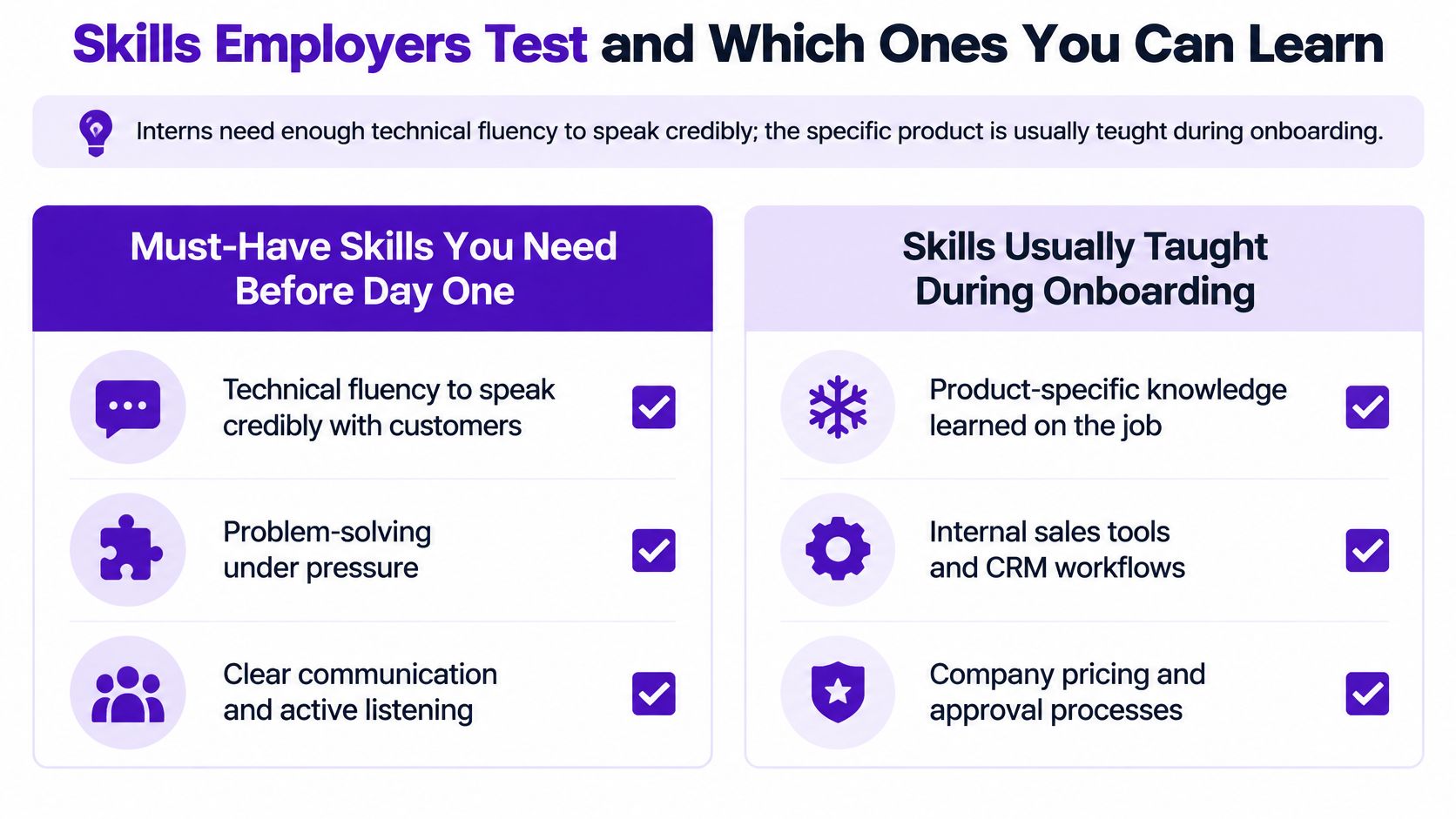
Then check each skill against the way employers test it.
| Skill | Why it matters | Must-have or trainable | How to show it |
|---|---|---|---|
| Written and spoken communication | Explains trade-offs to technical and nontechnical buyers | Must-have | Short demo recording or clear project write-up |
| Programming language | Lets you prototype or troubleshoot a proof of concept | Must-have (one language) | Project in Python, Java, JavaScript or C++ on a code host |
| Technical domain fluency | Connects cloud, data, automation or security to customer needs | Must-have (one domain) | Course project or lab with an architecture diagram |
| Requirements analysis | Turns a stated need into measurable criteria | Must-have | Requirements matrix built from a case study |
| Product knowledge | Lets you demo the specific platform accurately | Trainable | State willingness to learn; the company teaches it |
| Pricing and competitor landscape | Helps frame value against alternatives | Trainable | Research one competitor and summarise it in a paragraph |
Reading a posting is its own skill, and breaking a job description into required and learnable skills before you apply tells you which gaps to address in a cover letter and which to admit.
Before the interview, have physical proof ready for the four must-haves: a project write-up, a two-minute demo recording, one architecture diagram and a sentence naming the language you used. In the conversation, name what you'd learn on the job, meaning the platform, the pricing rules and the approval chain. That signals you understand what the role involves, which is half of what the interview measures.
Qualifying With a Non-Technical Background
Sometimes yes, and the answer depends on which gap you have. The BLS Occupational Outlook Handbook notes that sales engineers typically enter the occupation with a bachelor's degree in engineering or a related field. That's the expectation you're working against, and it's a real one.
It isn't the only thing a hiring manager weighs. Given two juniors with comparable coursework, the one who has held a genuine conversation with a stranger about a problem tends to win, because that's the skill the internship trains and the hardest one to teach.
Three translations worth making
The tutoring case is the strongest of the three, and the one students undersell most. A good tutor doesn't start explaining. They diagnose: what did you try, where does the confusion begin, what do you already understand. Then they pick an explanation that fits the learner. That is needs discovery, executed under pressure, with an unhappy stakeholder.
A hackathon is a technical demo on a deadline. You scoped something small, built it, and presented it to people who didn't write the code. That's the shape of every proof of concept you'll build as an intern.
A retail or support shift is objection handling, and it's harder than it sounds. A frustrated customer doesn't want a policy recitation. They want a fix and a reason to believe it will hold. If you can describe a specific complaint you resolved and the method you used, you have evidence for the part of this job that engineers find hardest.
| Past experience | What it proves | Sales-engineering competency |
|---|---|---|
| Tutoring | Diagnoses what a learner misunderstands before explaining it | Needs discovery |
| Hackathon | Builds and presents a working demo under time pressure | Technical demonstration |
| Retail or support shift | Calms a frustrated customer and finds a workable fix | Objection handling |
| Team project lead | Gathers requirements from non-specialists and assigns tasks | Requirements analysis |
| Club or volunteer event | Explains a plan to a mixed audience | Communication with nontechnical stakeholders |
Separate true blockers from closable gaps
Be honest about the difference. A posting that requires current enrollment in a STEM degree is a blocker if you're in a different program, and no amount of framing fixes it. A requirement for one programming language is not a blocker. It's a weekend project, then a second weekend project with a friend reviewing your code.
Pair a non-technical background with one concrete technical artifact: a script that pulls data from an API and writes a summary file, or a dashboard on a public dataset. The artifact doesn't need to be impressive. It needs to be explainable, because the interviewer will ask why you chose that approach and what you'd change.
Then build an evidence table before you apply. One example per competency, the result you got, and one sentence on what you'd learn next. If your background is thin on sales exposure altogether, what an entry level sales role actually asks of you clarifies which behaviors carry over and which don't.
Sample Projects to Prove Readiness
The benchmark worth aiming at is one project that mirrors the job: requirements in, working prototype out, business-value summary on top. Not five certificates. One project you can walk from problem to limitation without notes.
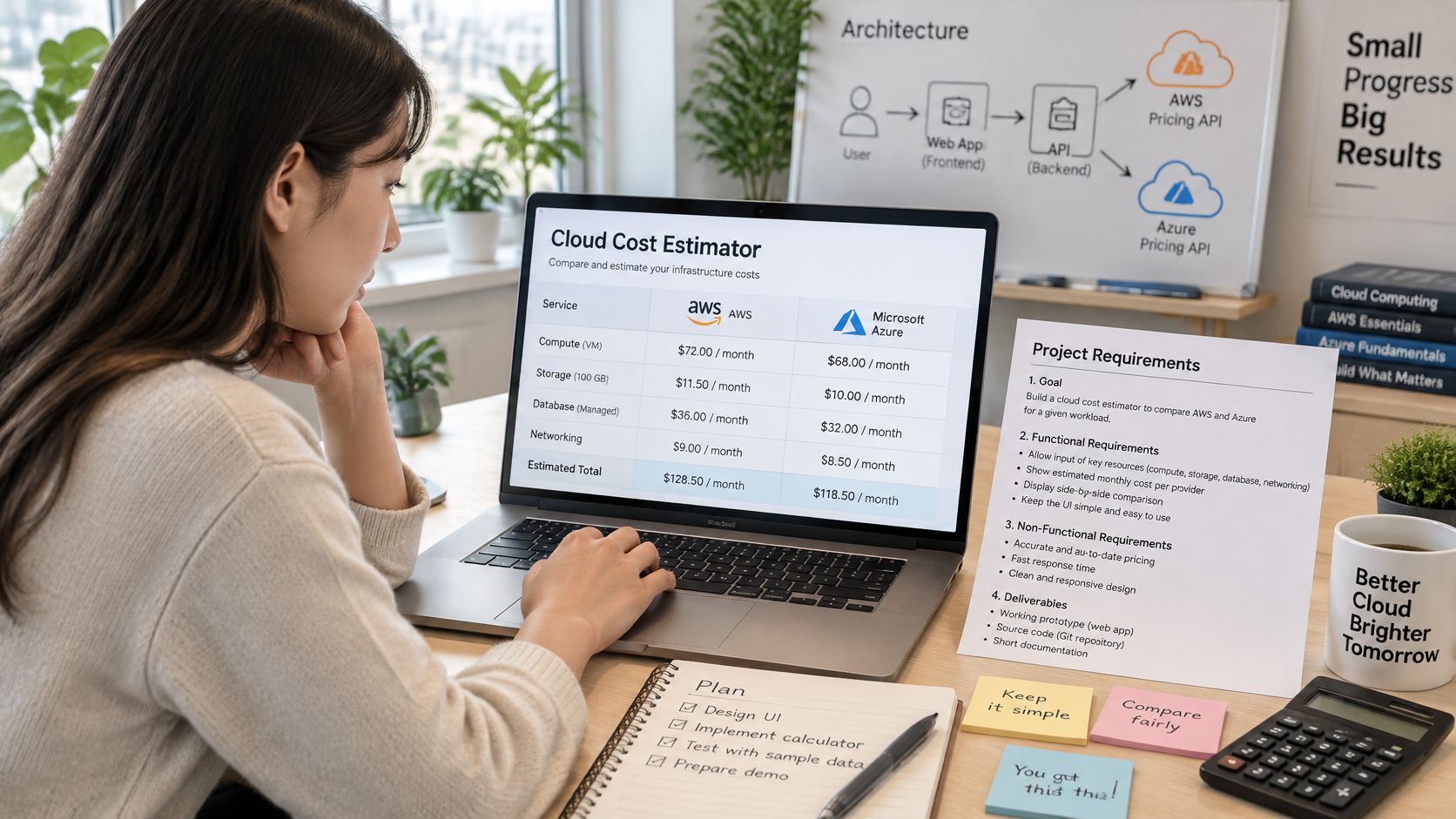
Three projects that map neatly to the role
- A cloud cost estimator for a small business. Take a concrete scenario, say a bakery with two locations and a nightly backup, and build a sheet or script that estimates monthly spend across two providers. Add a requirements sheet naming the constraints (budget, uptime, region) and a one-page comparison showing where each provider wins.
- An automation prototype that kills a manual reporting task. Find something repetitive, such as compiling a weekly sales export into a summary, and automate it with a short script. Deliver a five-box architecture diagram and testing notes that include the edge case that broke it.
- A data dashboard answering one buyer question. Pick something a manager would ask, such as which product line is losing margin, and build a dashboard that answers it on a single screen. Write the business-value summary as if handing it to someone non-technical.
The three artifacts that do the convincing
- A five-minute demo scripted for a non-engineer buyer, with the first thirty seconds spent on the problem rather than the architecture.
- Six to eight discovery questions for a fictional customer, ordered from context to constraint to decision owner.
- A one-page comparison of two alternatives with assumptions and limitations written out, including the assumption most likely to be wrong.
Build in this order: pick the problem, write the requirements, prototype the smallest working version, test the edge cases, then write the business-value summary last. Writing the summary last matters because you'll have discovered which claims you can defend.
Here's how the same project looks when a practitioner walks it through.
In the interview, open with the customer problem, show the demo, then name one limitation you found and how you'd fix it. That last part is what candidates skip. Saying "my cost estimate assumes steady-state usage, so it breaks for a seasonal business, and I'd add a usage profile to handle that" proves you understand the model behind the screenshot. A long feature list proves you can read a spec sheet.
Resume and Cover Letter Tips That Get Read
A recruiter screening internship applications looks for two signals in the first pass: can this person talk about technology without hand-waving, and will this person be useful in front of a customer. That pass takes under a minute, so the top third of your resume has to carry both before anyone scrolls.
Structure that survives the scan
Lead with a two-line summary naming the target role and one technical domain. Follow with a skills block listing one programming language and two domains, spelled the way the posting spells them. Then experience bullets in a fixed pattern: action, method or tool, result. Keep the order consistent so a reader can skim the left edge and get the story.
If you're unsure how that opening should read, objective lines for engineering resumes show how to name a role and a domain in two lines without restating your degree.
One bullet, before and after
"Helped with demos" tells a recruiter nothing they can score. Compare it with: "Built a ten-minute demo in Python dashboards for a three-person team, which the lead used in two client calls." The second version names the tool, the audience, the artifact and the outcome. It also invites exactly the follow-up question you want, which is how you built it.
Keywords without the lie
Mirror the posting's exact terms only where they describe work you really did. If you built the dashboard in a Python library, write that library's name. If you've only read about a platform, leave it off the skills block and mention the interest in the cover letter. Keyword stuffing collapses at the first "tell me about that project."
If a blank page is the obstacle, create an interview-ready resume from a structured starting point and edit it down, rather than fighting a template while you're still deciding what to say.
The cover letter in three paragraphs
First paragraph: name one customer problem you understood from the company's product pages or documentation, in your own words. Second: your strongest proof point with a result attached. Third: ask for a conversation and name the role. Skip the childhood passion for technology and any paragraph about your work ethic.
Keep the whole thing to one page for a first internship, and delete every phrase that could appear on any other candidate's resume. "Passionate about sales" and "detail-oriented team player" are placeholders wearing a suit.
The final check: every bullet carries a number or a concrete outcome, and you can explain any line on the page for two minutes without repeating the resume text back.
How to Apply Step by Step
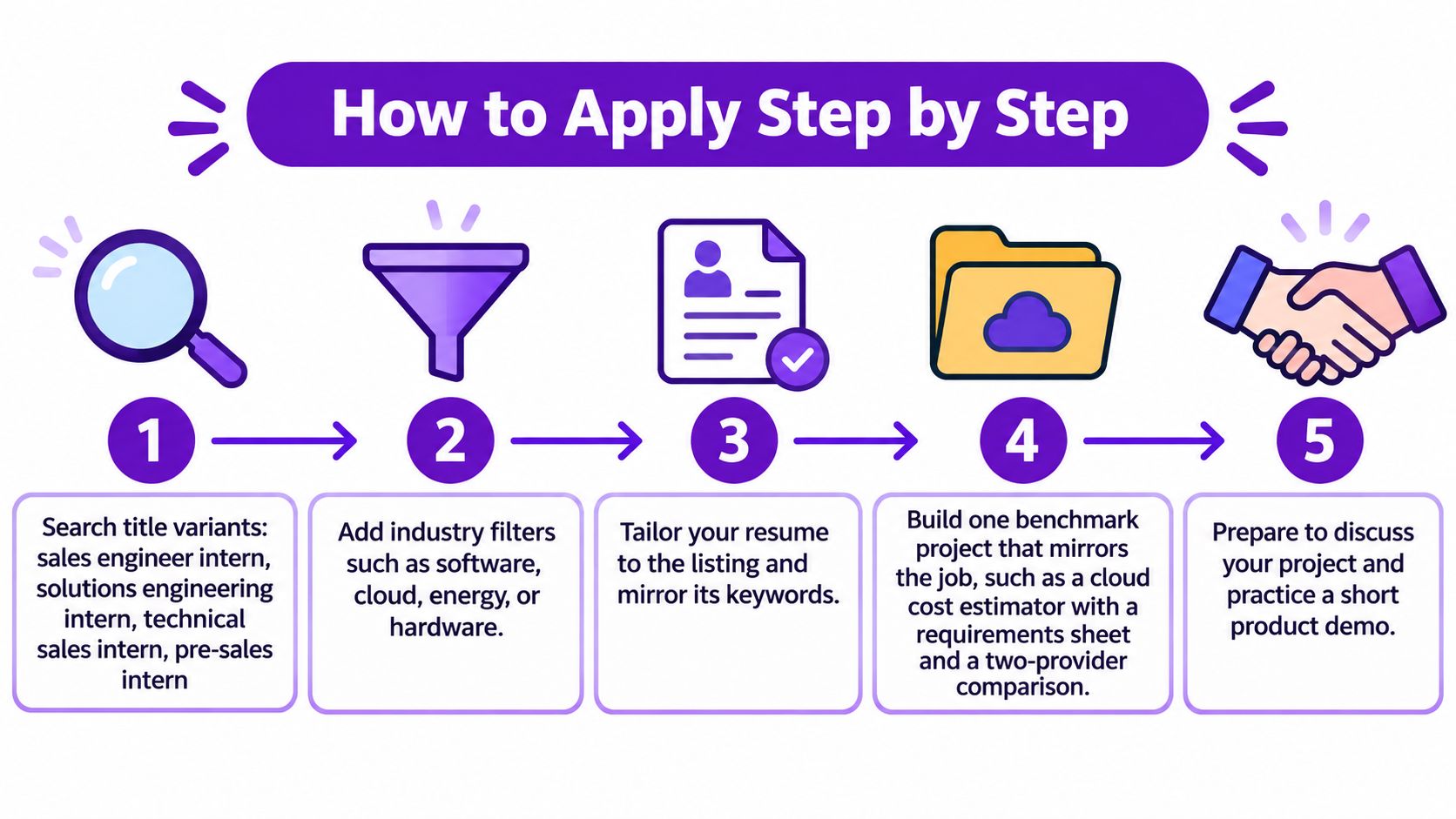
The search itself is where most applicants leak opportunities. Postings for this role appear under at least four titles, and a search for one of them misses the rest.
- Search every title variant. Use sales engineer intern, solutions engineering intern, technical sales intern and pre-sales intern. Add industry filters for software, cloud, energy and industrial equipment, because the role exists well beyond tech.
- Filter to requirements you already meet. Note which listings name a programming language or a specific domain, since those tell you what to prove and what to admit.
- Log each listing with its link, deadline and a contact name. Progress you can't see is progress you don't manage.
- Tailor one resume and one cover letter per role. Reuse the posting's exact technical terms where they describe work you did.
- Attach a project link or a one-page project summary. It's the fastest way to move from "plausible" to "already doing this."
- Apply early and follow up after a week. Reference one specific product or customer problem in the note, which demonstrates the commercial curiosity the role requires.
- Record every response and book preparation time for each stage. A discovery role-play needs different practice from a technical explanation round.
The order isn't arbitrary. Tailoring before applying cuts the early screening rejections that come from a generic resume, and a follow-up tied to a real product detail shows interest that most applicants can't fake for a week.
Timing catches people out. Many programs close months before the term starts, and the strongest listings fill on a rolling basis, so the calendar matters as much as the resume. If you're planning around a summer start, summer internship application timelines show how far ahead the deadlines fall so you can work backward.
One more habit worth building now: keep a single document of your project's story, meaning the problem, the constraint, the demo, the limitation and the fix. You'll retell it in a screening call, a technical round and a final presentation, and each time it should get shorter and sharper.
Prepare Your Interview Plan and Apply This Week
Interviews for this role come in three shapes, and each one tests something different. Knowing which shape you're walking into changes what you rehearse.
- Discovery role-play. The interviewer plays a buyer with a vague problem. Your job is questions, not answers. Ask what the problem costs, who owns the decision, what they've already tried and what "solved" looks like in numbers.
- Technical explanation round. You'll explain a concept such as APIs, cloud architecture or data pipelines to someone who isn't an engineer. Use one analogy, one concrete example and then stop talking.
- Timed demo or case presentation. You get a fixed window, usually short. Open with the customer problem, show the smallest thing that solves it, and close with the limitation.
For each format, run one practice cycle with a recording. Time the demo to five minutes, write three questions you'd ask a buyer, and watch the recording once with the sound off to see whether your slides or your face were doing the work.
Answering "why this company" is where preparation shows. Name one product, the customer problem it solves, and one specific reason that problem matters to you. A generic answer about innovation reads as though you applied to five companies that afternoon.
Ask this in the room: "What does a successful intern look like at week six?" The answer tells you what you'll be measured on, and it's rarely the thing you spent the most time preparing.
Then put a date on it. This week: pick one project from your list, write one focused resume, apply to three listings and set a reminder for a follow-up seven days out. Keep every listing's stage, deadline and contact in one log so nothing stalls. Eztrackr's job tracker, for instance, groups applications by hiring stage on a Kanban board and saves a listing with one click from a LinkedIn or Indeed page, and a plain spreadsheet does the same work if that's your preference.
Eztrackr keeps a search like this in one place: save a sales engineer internship from a job board in a single click, move it across hiring stages as you progress, and check how closely your resume matches each posting before you send it. The job tracker is free, so you can start with the three applications you're planning this week. Visit Eztrackr and turn the tab you've had open for two days into an application that's out the door.