8 Engineer Resume Objective Examples for 2026
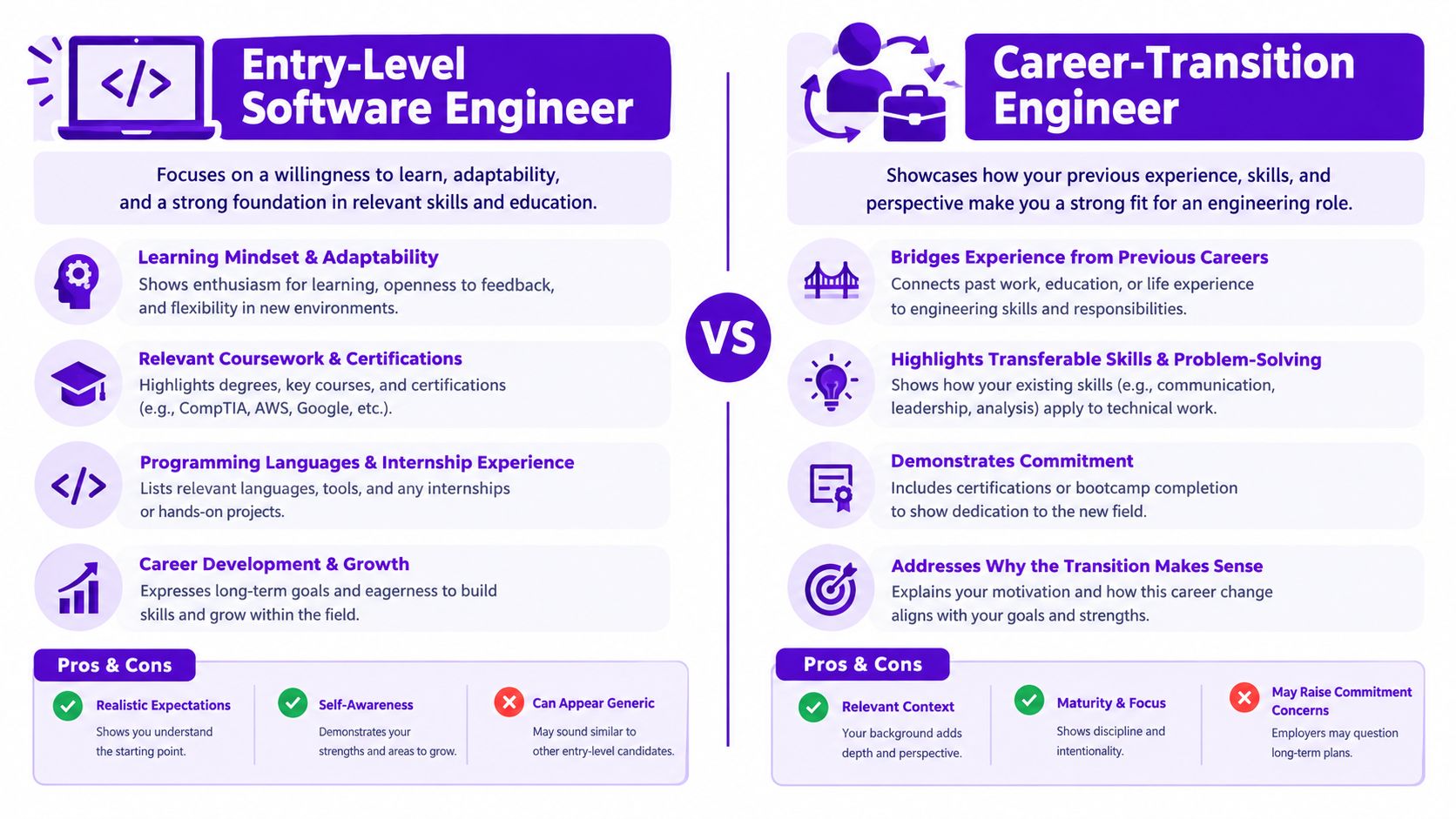
The best resume objective isn't the most polished universal statement. It's the one that makes your positioning obvious before the reader reaches your experience section. A recent graduate needs a different opening from a senior architect, and a career changer needs a different bridge from a cloud specialist.
Use an objective only when it quickly connects your career level, engineering focus, relevant evidence, and target role. A vague line about seeking growth wastes that space. A specific line can explain why your background fits the vacancy, especially when your job titles, specialization, or direction don't tell the full story.
These engineer resume objective examples are organized around eight real positioning challenges, including entry-level experience, career transitions, specialization, measurable impact, innovation, remote work, and mission. Each example includes editing tactics for the job description and ATS. For additional context, compare the role-specific approach with these resume objective examples for IT.
1. Entry-Level Software Engineer Resume Objective
Recent graduates often overcompensate for limited experience with enthusiasm-heavy language. “Passionate,” “hardworking,” and “eager to grow” can describe almost anyone. Your objective should instead show what you can already contribute through technical foundations, projects, internships, coursework, or disciplined practice.
Try a statement such as:
Recent computer science graduate with internship experience in full-stack development seeking an entry-level Software Engineer role to build web applications with JavaScript, React, and Node.js while contributing to a collaborative development team.
This version works because it identifies the candidate, names the target role, and connects specific skills to a practical contribution. If your strongest evidence is academic, replace the internship with a capstone project, relevant coursework, or a published technical project. Don't list every technology you've touched. Select the tools that appear in the posting and that you can discuss confidently.
For a mobile role, you might write:
Recent software engineering graduate seeking a Software Engineer position to apply Java and Python foundations to mobile application development while collaborating with experienced developers and improving code quality through testing and review.
Make the entry-level version credible
Use the job description as your keyword source, but don't copy a skills list into sentence form. Select the exact job title, then choose a small group of relevant technologies, methods, or domain terms. Connect those terms to evidence elsewhere on the resume.
- Lead with proof: Mention an internship, capstone, personal application, open-source contribution, or relevant lab work.
- Name useful skills: Prioritize the technologies the target team typically requests.
- Show contribution: Say what you'll help build, test, automate, or maintain.
- Keep the claim honest: Don't describe yourself as an expert when your experience is academic or project-based.
A resume objective should stay concise, usually two or three sentences at most. Before finalizing it, use the guidance on placing an objective on a resume to check whether an objective adds context that your education and projects don't already provide.

2. Career-Transition Engineer Resume Objective
A career change creates an interpretation problem. Recruiters can see what you did before, but may not know how it applies to engineering. Your objective should make that connection quickly, without turning into an explanation of why you changed fields.
Start with the value you already bring, then connect it to recent engineering evidence:
Project manager transitioning into software engineering, bringing process optimization, stakeholder coordination, and newly developed full-stack skills through structured technical training and independent application projects. Seeking a Software Engineer role focused on reliable, user-centered products.
This format names both sides of the move. The first side might include process design, technical communication, quality control, or industry knowledge. The second should point to evidence such as a certification, bootcamp, deployed project, or focused engineering work. Choose details that appear elsewhere on the resume, so the objective gives context rather than making unsupported claims.
Career changes can also involve a shift in specialization:
Electrical Engineer with hardware design experience transitioning into embedded systems and IoT development, combining circuit knowledge with C programming, microcontroller projects, and software debugging to build integrated technical solutions.
Build the bridge with evidence
Keep the objective focused. Your cover letter can explain the full transition, while the resume objective shows why the move makes sense for the target role.
- Translate transferable skills: Process optimization can support DevOps, requirements analysis can support product engineering, and technical documentation can support platform teams. Use this guide to transferable skills to identify credible connections.
- Name new preparation: Include relevant training, certifications, coursework, or projects that you can support in later resume sections.
- Use evidence from the previous role: A process redesign, technical implementation, or cross-functional delivery can show engineering-adjacent thinking.
- Match the vacancy: If the posting emphasizes embedded testing, cloud migration, or automation, use those terms only when your experience supports them.
Quantified accomplishments can strengthen the bridge. Use a figure only when it genuinely belongs to your own work and you can explain it in an interview, such as a percentage of cost savings from a process redesign you led. Otherwise, describe the outcome clearly without forcing precision. Aim for a concise objective that connects prior value, new preparation, and the target engineering role.
3. Experienced Senior Engineer Resume Objective
Your senior-level objective should establish scope quickly. Lead with the work you own, the decisions you influence, and the role you want next. Architecture, delivery, leadership, reliability, and organizational influence give the reader stronger signals than a long list of tools.
Senior Software Engineer with extensive experience developing cloud infrastructure and leading cross-functional delivery, seeking a Principal Engineer role to shape architecture, improve platform reliability, and mentor engineers building systems for a specific industry.
The example signals senior responsibility without inventing metrics or claiming a specific scale. Replace “cloud infrastructure” with the area most relevant to the vacancy, such as distributed systems, developer platforms, data engineering, or security architecture. Name the target industry only when the posting or your background supports it.
A systems-focused version might read:
Experienced Systems Architect with expertise in microservices, DevOps practices, and technical leadership seeking a senior architecture role focused on system performance, sound engineering decisions, and sustainable team practices.
Use the objective when your next move needs explanation. That may mean shifting into a new domain, pursuing a different title, or moving toward technical leadership. If your experience already matches the role closely, a professional summary may present your evidence more effectively. Recruiter-oriented resume guidance recommends keeping an engineering objective short, specific to the role, and focused on the employer.
Edit the opening against the job description:
- Show ownership: Prioritize architecture decisions, platform direction, technical standards, and delivery leadership over an exhaustive tool inventory.
- Make leadership verifiable: Include mentoring, technical direction, hiring involvement, or cross-functional influence only when the resume supports it.
- Select senior keywords: Use terms such as principal, staff, platform, architecture, reliability, or engineering effectiveness when they describe the target role and your experience.
- Keep proof in the resume: Put detailed percentages, timelines, budgets, and productivity gains in the experience section. Mention one relevant outcome in the objective only if it clarifies your scope.
The final test is simple: the opening should make the reader look for evidence of your seniority in the experience section. It should not make them decode a broad career ambition.
4. Specialization-Focused Engineer Resume Objective
A narrow technical opening can outperform a broad engineering statement when the role solves a defined problem. Machine learning, cloud infrastructure, and cybersecurity teams look for different evidence. Put the relevant specialization in the first clause, then connect it to the work described in the posting.
Use one of these models:
Machine Learning Engineer with experience developing production ML systems and deep learning models, seeking to apply computer vision and natural language processing expertise to reliable, high-value products.
DevOps and Cloud Infrastructure Engineer with experience using Kubernetes, AWS, and infrastructure as code, seeking to support platform modernization, stronger deployment practices, and resilient systems for a growing organization.
The second objective pairs tools, specialization, and outcomes without claiming broad mastery. Keep only technologies supported by your projects or employment history. If Kubernetes appears in the objective, the experience section should show how you used it.
Adapt the objective to the target specialty
Read the job description for the nouns that define the team's work and the verbs that describe success. A cloud role may emphasize platform modernization, observability, security, or cost control. A data role may prioritize pipelines, experimentation, modeling, or governance. Mirror the language that matches your evidence, rather than copying every keyword.
Use this editing sequence:
- Name the specialty first: Identify the target domain before listing tools.
- Choose supported technologies: Include AWS, Kubernetes, Terraform, Python, or similar terms only when your resume demonstrates them.
- Add relevant credentials: Certifications can show preparation, but they do not replace project or work evidence.
- Specify the setting: Production systems, regulated environments, platform teams, and customer-facing products make the objective more precise.
- Check ATS alignment: Use the posting's terminology where it accurately describes your background, then make the same capability easy to find in your experience section.
Use this engineering resume skills guidance to compare the posting with the technologies and competencies your resume can support.
A focused objective should make the target role obvious without turning into a keyword list. Select the specialization that best explains your fit, then let the rest of the resume prove depth.
5. Impact-Driven Engineer Resume Objective
Impact belongs in an engineer's objective only when the resume can support it. Product, platform, and business-facing teams need engineers who connect technical choices with user value, cost control, delivery speed, reliability, or revenue.
Start with the outcome that matches the target role:
Full-stack engineer with experience delivering customer-facing features and improving product performance, seeking a product engineering role where technical decisions support user value, reliable releases, and measurable business priorities.
A documented result can make the objective more specific:
Backend Engineer with experience reducing infrastructure costs and improving service reliability, seeking a platform role where scalable systems and operational discipline support product growth.
Use figures only when you can verify both the result and your contribution. The guidance on engineer resume objectives and summaries points to evidence such as project costs, time savings, efficiency gains, budget ownership, and performance improvements. An objective should reflect outcomes your experience section can substantiate.
Adapt the objective to the employer's priority
Choose technical evidence that explains the business result rather than listing every tool you have used.
- Lead with the result: State what improved, then name the engineering work behind it.
- Match the posting's priority: For a reliability-focused role, connect your background to observability, incident reduction, or resilient design.
- Keep metrics attributable: Include a percentage, timeline, or cost figure only when the measurement is accurate and tied to your work.
- Remove vague business language: “Improving deployment reliability through automated testing” communicates more than “driving transformational value.”
The emphasis should change with the role. A developer targeting a product team might foreground experimentation, accessibility, API performance, or release quality. An infrastructure engineer may focus on operational efficiency, capacity, security, or service continuity. Select the impact dimension that the job description values, then use matching wording in the objective and supporting resume bullets.
6. Innovation-Oriented Engineer Resume Objective
Innovation-focused objectives work best when they connect new technology to a specific engineering problem. Replace broad claims such as “forward-thinking” or “passionate about emerging technology” with the tools you have used and the outcome you can support.
Software Engineer with hands-on experience in machine learning and distributed systems seeking a role focused on solving complex technical problems, developing production-ready solutions, and contributing to responsible technology decisions.
For a research and development position, emphasize investigation and practical application:
Full-stack engineer with experience exploring emerging computing technologies through technical projects and collaborative development seeking to contribute to a research and development team that turns experimental ideas into usable systems.
Show how exploration becomes usable engineering
A hiring team may value experimentation, yet still need evidence that you can test assumptions, record decisions, and deliver dependable software. Shape the objective around the employer's innovation challenge, whether that means research, prototyping, applied engineering, or maintaining a production platform.
Use the evidence that matches the target role:
- Technical projects: Name what you built, tested, evaluated, or deployed.
- Open-source work: Include a contribution that shows collaboration or sound engineering judgment.
- Research participation: Mention relevant publications, experiments, or technical investigations.
- Communication: Refer to conference talks or technical writing when the role requires influence beyond implementation.
- Production discipline: Pair emerging tools with testing, monitoring, security, maintainability, or user requirements.
The wording should change with the job description. An AI research role may call for experimentation and evaluation. An applied engineering role may prioritize integration, reliability, and maintainable delivery. Mirror the posting's terminology where it accurately describes your experience, and place matching skills where an ATS can identify them.
A strong innovation objective makes two points clear: you can explore new approaches, and you can turn sound ideas into systems other people can use.
7. Remote-First and Flexible-Role Engineer Resume Objective
Remote work belongs in the objective only when it clarifies how you deliver results. Start with the engineering role and target contribution, then show the collaboration practices that make distributed work effective.
Self-directed Full-stack Engineer experienced in distributed collaboration and complex project delivery seeking a remote-first role where clear documentation, asynchronous communication, and reliable execution support product development across time zones.
For a backend position, make the technical focus more visible:
Backend Engineer experienced in asynchronous development environments seeking a remote-first position focused on scalable services, strong documentation, and dependable collaboration across distributed teams.
Adapt the wording to the work model in the posting. “Remote-first” suggests independent, written collaboration. “Hybrid” may require coordination between office and remote work. “Flexible” can describe autonomy without defining a fully distributed team. Use the employer's terminology only when it matches the stated role and your experience.
Make distributed execution visible
The strongest objective names behaviors that reduce coordination problems:
- Document decisions: Mention written design proposals, technical notes, or clear handoffs when those practices reflect your work.
- Describe coordination: Refer to asynchronous planning, remote code review, or collaboration with colleagues, stakeholders, or customers in different locations.
- Keep tools secondary: GitHub, Jira, Slack, and similar platforms matter less than the delivery or communication they supported.
- State your target without conditions: Identify the work model you want, while keeping the objective focused on the value you bring.
- Match the role: A remote-first team may emphasize written communication and autonomy. A flexible hybrid team may place more weight on office coordination and predictable availability.
Use remote job board guidance to find relevant opportunities, then tailor the objective to each team's actual expectations. The result should connect your engineering specialty, preferred work model, and evidence of dependable delivery, rather than present remote work as the main qualification.
8. Values-Aligned and Mission-Driven Engineer Resume Objective
Mission language belongs in an engineer resume objective only when it connects to work you can perform. A broad promise to “change the world” rarely helps. Name the organization's focus, the technical contribution you offer, and the experience that supports your interest.
For a sustainability-focused role:
Full-stack Engineer with experience building reliable digital products seeking to contribute to renewable energy technology, combining software engineering skills with a demonstrated interest in sustainable systems and measurable environmental progress.
For healthcare access:
Backend Engineer focused on secure, accessible services seeking to support healthcare technology that expands access for underserved communities, bringing experience in API development, data integrity, and collaborative product delivery.
Adapt the objective to the mission and the job
Start with the employer's products, programs, and stated priorities. Select one connection you can defend in an interview, then align its wording with the job description and ATS terms. A focused objective carries more weight than a catalogue of ideals.
- Define the mission area: Use terms such as sustainability, healthcare access, education, or public service when they describe the employer's work.
- Show the technical link: Pair the mission with a relevant capability, such as platform reliability, secure data handling, accessible interfaces, or analytics.
- Add evidence: Point to a volunteer project, domain role, product contribution, or research effort that makes the interest credible.
- Keep the claim accurate: Motivation is different from documented impact. Do not imply results you have not achieved.
- Mirror selectively: Reuse mission-related wording from the posting only when it matches your background and the role's responsibilities.
The technical target still leads. Hiring teams should identify the role, engineering strengths, and relevant domain experience before assessing the personal connection. For ATS alignment, place the target title and supported skills in the opening phrase, then use the remaining space to show why this mission fits your work.
8-Point Comparison of Engineer Resume Objectives
| Objective Type | Implementation Complexity 🔄 | Resource Requirements ⚡ | Expected Outcomes 📊 | Ideal Use Cases 💡 | Key Advantages ⭐ |
|---|---|---|---|---|---|
| Entry-Level Software Engineer Resume Objective | Low, concise, learning-focused statement 🔄 | Low, coursework, internships, basic projects ⚡ | Modest interview lift for junior roles; needs tailoring for ATS 📊 | Recent grads, first-job applications, internship-to-hire paths 💡 | Conveys growth mindset and realistic expectations ⭐⭐ |
| Career-Transition Engineer Resume Objective | Medium, craft narrative linking past experience to engineering 🔄 | Medium, certifications, bootcamp projects, transferable examples ⚡ | Provides context; increases chances at career-changer–friendly employers 📊 | Professionals switching fields or specializations 💡 | Legitimizes transition and highlights transferable skills ⭐⭐⭐ |
| Experienced Senior Engineer Resume Objective | Medium–High, requires metrics, leadership framing 🔄 | High, documented achievements, team outcomes, technical depth ⚡ | Strong credibility for senior/principal roles; higher compensation potential 📊 | Senior hires, technical leadership, advisory roles 💡 | Positions candidate as subject-matter expert and leader ⭐⭐⭐⭐ |
| Specialization-Focused Engineer Resume Objective | Medium, targeted terminology and domain proof 🔄 | Medium–High, specialization projects, certifications, research ⚡ | High match rate for specialist openings; narrows but deepens opportunities 📊 | Roles in ML, DevOps, cybersecurity, cloud architecture 💡 | Demonstrates deep domain expertise and ATS keyword fit ⭐⭐⭐⭐ |
| Impact-Driven Engineer Resume Objective | Medium, translate technical work into business outcomes 🔄 | Medium, quantifiable metrics and business context ⚡ | Strong resonance with product/startup roles; demonstrates ROI 📊 | Product engineering, startup teams, roles valuing business impact 💡 | Differentiates by emphasizing measurable business value ⭐⭐⭐⭐ |
| Innovation-Oriented Engineer Resume Objective | Medium, showcase emerging tech and thought leadership 🔄 | Medium, open-source contributions, talks, experimental projects ⚡ | Attracts R&D and growth-stage companies; signals forward thinking 📊 | Cutting-edge teams, research labs, disruptive startups 💡 | Positions candidate as creative problem-solver and early adopter ⭐⭐⭐ |
| Remote-First and Flexible-Role Engineer Resume Objective | Low–Medium, emphasize remote work practices and autonomy 🔄 | Low, examples of distributed projects, tools, async processes ⚡ | Improves fit for remote-first companies; highlights self-management 📊 | Fully remote teams, distributed organizations, flexible schedules 💡 | Signals reliability in asynchronous and distributed environments ⭐⭐⭐ |
| Values-Aligned and Mission-Driven Engineer Resume Objective | Medium, requires authentic mission alignment and research 🔄 | Medium, documented impact, mission-relevant examples ⚡ | Strong cultural fit with purpose-driven orgs; may limit broad applicability 📊 | Nonprofit, sustainability, healthcare, education, social-impact firms 💡 | Builds deeper cultural alignment and long-term retention ⭐⭐⭐ |
Turn One Objective Into a Targeted Set
Don't choose an example because it sounds impressive. Choose it because it solves your positioning problem. A recent graduate needs to establish readiness. A career changer needs to explain the bridge. A senior engineer needs to communicate scope. A specialist needs to surface the right domain. An impact-focused candidate needs to connect technical work to outcomes.
Start with the target job description and copy the exact job title used by the employer. Then identify the technical skills, domain terms, and responsibilities that genuinely match your background. Select only supported keywords. If the posting asks for Kubernetes and your experience includes Kubernetes-based deployment, use the term. If you've only read about it, don't present it as production expertise.
Next, connect those keywords to evidence. A skill without context is easy to dismiss, while a skill tied to an internship, project, certification, system, or measurable result gives the reader a reason to believe it. For an entry-level objective, that evidence might be a capstone application. For a transition objective, it might be a completed technical project alongside process or domain experience. For a senior objective, it might be architecture ownership, mentoring, or platform direction.
Use this editing sequence:
- Choose one positioning angle: Career stage, specialization, impact, innovation, work model, or mission.
- Copy the target title: Use the employer's wording when it accurately describes the role.
- Select supported skills: Keep only terms you can substantiate in the resume and interview.
- Add relevant evidence: Connect skills to projects, responsibilities, credentials, or outcomes.
- Remove broad claims: Delete phrases such as “challenging position,” “passionate professional,” and “excellent team player” unless you replace them with proof.
- Read it aloud: The final version should sound like a precise professional introduction, not a keyword list.
A professional summary may be stronger than an objective when your experience already aligns closely with the role. The resume statistics discussion from Kickresume notes that objectives or summaries don't appear on every resume, which reinforces the practical point: the opening section must earn its space. In engineering, quantified results such as cost reductions, efficiency gains, timelines, or budget responsibility belong in the document when they are accurate and relevant.
Save each version with the application it supports. Eztrackr can help organize job postings, link documents to applications, and use tools such as a resume builder or skill-match analyzer while you compare versions over time. That record makes it easier to see which positioning choices deserve further testing without relying on memory.
Before submitting, check five things:
- Specificity: Does the objective identify the role and engineering focus?
- Truthful keyword alignment: Do the terms match both the posting and your actual experience?
- Readable phrasing: Can a recruiter understand the value without decoding jargon?
- Evidence: Does the rest of the resume support every important claim?
- Role fit: Does the statement explain why this position, not just any engineering job?
Write the objective last if the rest of the resume is still changing. Once your experience bullets, projects, and skills are accurate, you'll know which positioning angle the opening should reinforce.
Eztrackr helps you save job postings, organize applications, and tailor resumes with tools such as a builder and skill-match analyzer. Use Eztrackr to connect each engineer resume objective to its target role and keep your application versions organized.