Entry Level Sales: Your 2026 Career Roadmap
Entry level sales is often sold as quick money for loud personalities. That advice misses the actual test. The people who last are usually the ones who can research fast, follow up consistently, and turn messy information into a clean next step.
The labor market backs up the point. Retail sales workers, the broadest entry-level sales category, numbered approximately 4,271,400 jobs in 2025, with a median wage of $35,560 or $17.10 per hour in May 2025, and the Bureau of Labor Statistics projects about 550,600 openings per year on average from 2025 to 2035 because of replacement demand, even though total employment is projected to show little overall change BLS retail sales workers. That's not a fantasy job market, it's a large one with constant churn.

If you're trying to stand out, polish matters more than most beginners think. A practical reference on how hiring teams evaluate presentation can help, and professional headshot insights is one place to think about the visual side of that first impression.
Why Entry Level Sales Is Not What You Think
The biggest myth is that entry level sales is easy money. It isn't. It's one of the few jobs where you can be rejected all day, then asked to show up with the same energy tomorrow, and the people who survive that rhythm are usually the ones who treat the role like an apprenticeship instead of a shortcut.
The work is repetitive before it's rewarding
The first stretch is rarely glamorous. You learn how to prospect, how to ask a better question, how to log activity without losing track of it, and how to keep your tone steady when a prospect is distracted or dismissive. That repetition is the job, and it's also how you build the judgment that later makes the work feel easier.
Practical rule: If you can't follow a process when the work is boring, you won't like sales for very long.
The upside is real, though. In U.S. sales and related occupations, nearly 13.4 million people worked in the category in May 2024, representing about 8.7% of total U.S. employment BLS sales occupations. That scale matters because it shows sales is not a niche hustle, it's a broad business function with many entry points and many ladders.
Sales teaches business by forcing contact with reality
Most first jobs teach one narrow slice of work. Sales teaches several at once. You learn how offers are framed, how buyers react, how product value is explained, and how small process mistakes show up in results. That's why strong entry level sales reps often grow fast, not because they're magically persuasive, but because they get direct feedback faster than most newcomers do.
You'll also do better if you think of the first two years as skill compounding, not identity proof. You're not trying to “be a sales person” in some theatrical sense. You're learning how to communicate clearly, how to stay organized, and how to keep moving after a no.
Understanding the Main Entry Level Sales Roles
Not every sales job starts in the same place, and the title on the posting can hide a lot of practical differences. A retail role, an inside sales job, and an SDR seat can all sit under the sales umbrella, but the pace, the customer type, and the performance expectations can feel completely different.
The titles mean different days
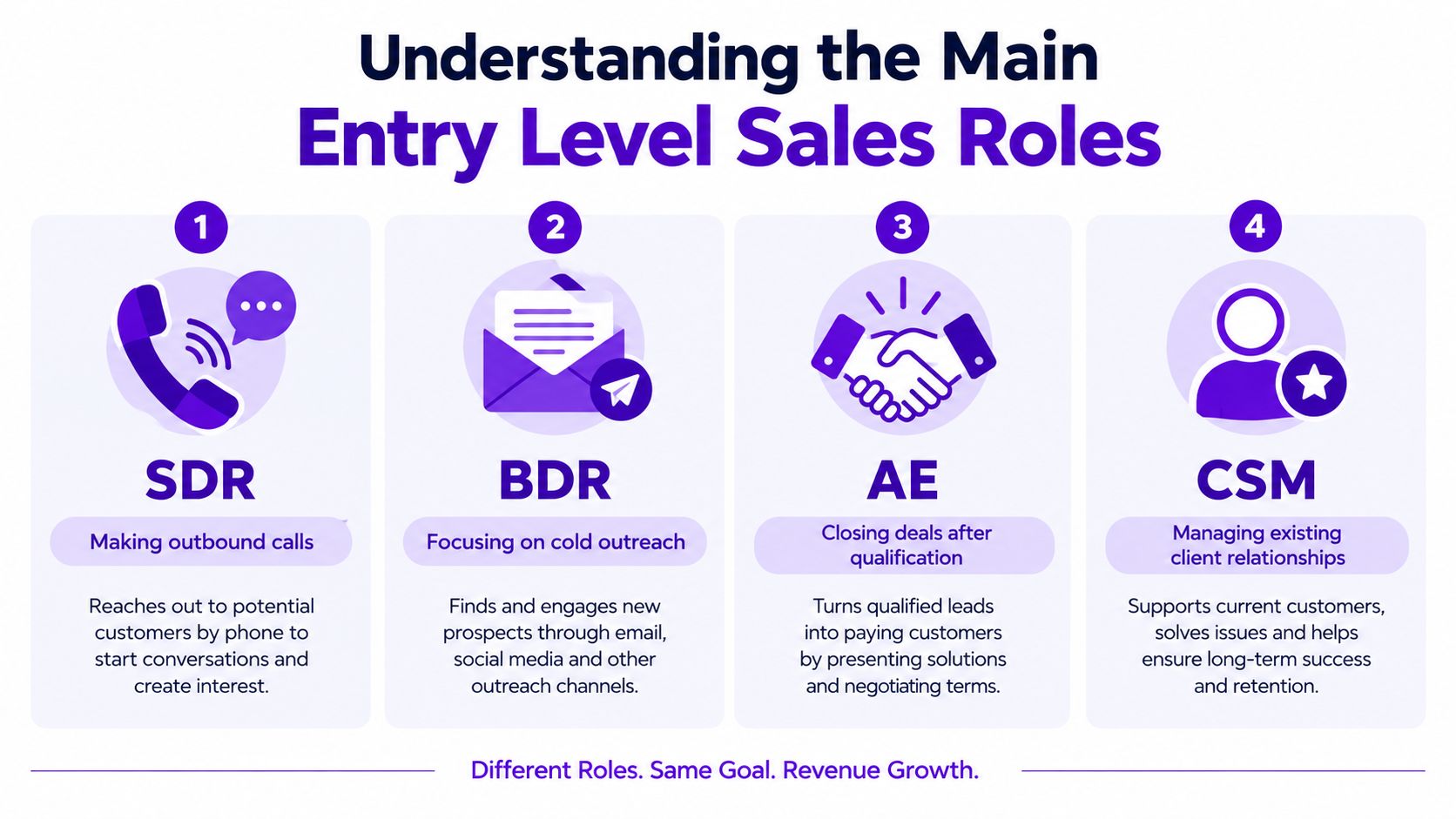
An SDR, or Sales Development Representative, usually focuses on outbound prospecting and setting meetings. A BDR often does similar front-end work, with the emphasis shifting toward cold outreach and lead qualification depending on the company. An AE closes deals after qualification, while a CSM manages existing client relationships after the sale. The corporate sales jobs guide is useful if you want a broader map of how those paths tend to differ in practice.
The compensation profile shifts as the work becomes more specialized. The 2025 Bridge Group benchmark reports median SDR on-target earnings of $80,000, split roughly $55,000 base salary and $25,000 variable compensation, with a median ramp time of 3.0 months and only 60% of SDRs at quota Bridge Group SDR report. That combination tells you two things, the pay can be solid, and the job still demands disciplined execution.
Match the role to your life, not your fantasy
Retail sales usually means direct customer contact and a steady public-facing rhythm. Inside sales is more phone- and computer-driven. Outside field sales can include travel and territory work, so the day is less predictable. If you hate being on the move, don't trick yourself into thinking field sales will feel exciting forever.
The best role fit is usually the one whose daily rhythm you can repeat without burning out.
The BLS notes that sales occupations vary widely in both pay and complexity, and that distinction matters because the work can move from transactional to highly consultative as you progress BLS wholesale and manufacturing sales reps. A title is only useful if you know what kind of repetition it asks for.
Essential Skills for Landing Your First Sales Job
Hiring managers do care about communication, but they care just as much about whether you can research, prioritize, and think clearly under pressure. A beginner who can show solid judgment often looks stronger than someone who sounds polished but can't explain how they reached a conclusion.
Prove you can do the work before you're hired
The modern interview test is often simple. Can you find the right account, understand the pain point, and turn that into a useful outreach idea? That's why a basic portfolio beats vague claims about being “a great communicator.” If you can show a sample prospecting list, a short account brief, or an outreach sequence, you've made the skill visible.
Recruiting coverage increasingly points to demonstrated research, personalization, tool fluency, and critical thinking as the things employers notice when candidates lack experience, while AI fluency is becoming a baseline rather than a bonus Meritt sales recruitment trends. That doesn't mean you should sound like a robot. It means you should know how to verify what a tool gives you before you use it.
Use AI as an assistant, not an answer key
The best beginner habit is to treat AI output like a draft that still needs judgment. Use it to speed up account research, then check company pages, role requirements, and recent activity yourself. If the tool gives you something generic, your job is to correct it, not to trust it.
For communication practice, a good resource on tone and message clarity can help you shape the human side of your outreach, and client communication advice from Documind is worth a look if you want a more thoughtful framework. The point isn't to sound “salesy.” The point is to sound informed, relevant, and respectful of the buyer's time.
Building a Portfolio That Replaces Experience
The experience trap is real. Companies want proof, but beginners often have no prior sales job to point to. The way out is to build a proof-of-work portfolio that shows how you think, not just what you say on a resume.
Show artifacts, not just ambition
A strong starter portfolio can include a mock prospect list for one target company, a short account-research brief, a draft outbound sequence, or a simple discovery-call script. Those pieces don't need to be flashy. They need to be specific, personalized, and easy for a recruiter to review in under a minute.
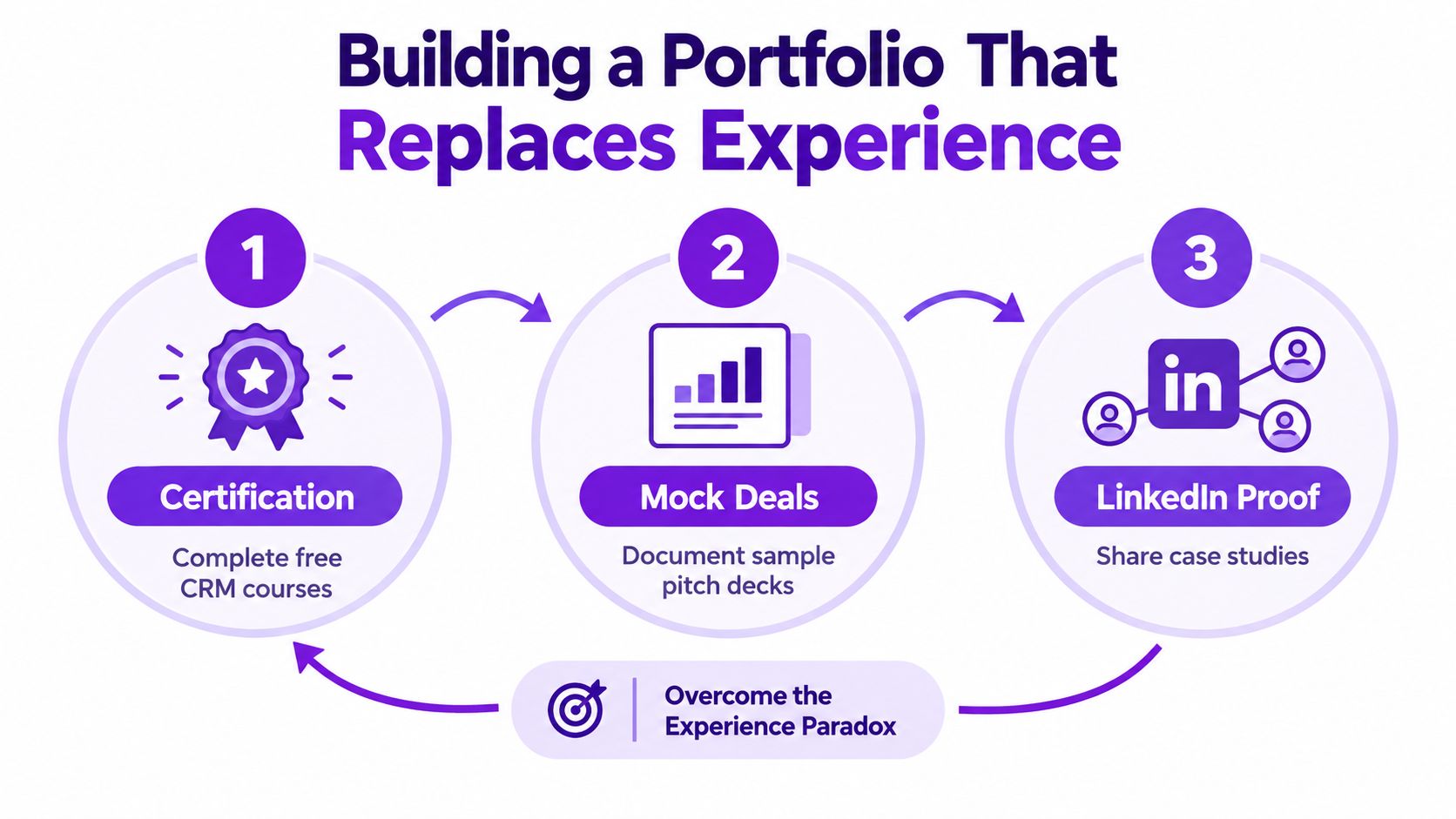
A resume still matters, but a resume alone is weak proof for entry level sales. An application customized for the role with a project sample says far more than a generic summary of “strong interpersonal skills.” If you want a structure for assembling those samples, this portfolio guide can help you think in terms of evidence instead of claims.
Tailor the proof to the role
For an SDR application, show outreach thinking and account research. For a customer-facing retail role, show responsiveness, organization, and product familiarity. For an inside sales job, show how you'd track follow-up and prioritize leads. The format can change, but the principle stays the same, make it easy for the hiring manager to see that you already think like someone in the seat.
If you want a lightweight way to create public-facing proof, this LinkedIn post idea tool can help you turn small projects into visible posts. That's useful because many candidates disappear after applying, while a visible track record gives employers something concrete to inspect.
Crafting an ATS-Friendly Sales Resume
A recruiter may never see your first resume if the system filters it out, so the document has to work twice, once for software and once for a human. The solution isn't stuffing in random keywords, it's translating your experience into the language the job description already uses.
Build around relevance, not chronology
If your background is thin, lead with skills, projects, and short achievement bullets instead of trying to hide gaps in work history. A summer job, campus role, volunteer assignment, or club leadership position can still show initiative, follow-up, and comfort with people. What matters is whether you frame the work as evidence of behavior that maps to sales.
The best resume changes are usually small but deliberate. Mirror the role's phrasing where it's truthful, use action verbs, and place the most relevant items near the top. A practical ATS keyword guide can help you spot the terms that matter without turning the resume into spam.
Use one master resume, then make targeted versions
Keep a master document with every project and role you've had. Then create separate versions for retail, inside sales, SDR, or BDR roles so the top third of the page speaks directly to that job. The point is not to lie, it's to select the most relevant proof for the seat you want.
Useful habit: If a bullet doesn't help you get this specific interview, cut it or move it lower.
That approach also keeps your language tighter. Instead of vague claims about being “driven” or “passionate,” show what you did, who you helped, and what process you followed. Hiring teams remember evidence.
Navigating the Sales Interview Process
A sales interview is a sales pitch with a mirror in it. You're selling your ability to learn, follow through, and stay composed while someone tests how you think in real time.

The process often starts with a screening call, then moves into role-play or case-style questions, and sometimes ends with a panel. A common first-year mistake is treating the role-play like a trick instead of a test of composure. The interviewer usually wants to see whether you can listen, adapt, and recover when the conversation goes sideways.
Treat the role-play like a conversation
Don't over-script your answers. If you're asked to cold call, focus on opening cleanly, asking a relevant question, and not panicking if the first response is dismissive. If you're asked to pitch a pen or a simple object, your real task is to organize your thinking under pressure, not to act like a television host.
The best questions you ask are specific. Ask how success is measured, what a strong first 90 days look like, or what separates top performers from average ones in that team. Those questions show curiosity and give you information you'll use later.
Tools to Manage Your Job Search Pipeline
Applying for sales roles without a tracking system turns into noise fast. You send a few strong applications, then a week later you can't remember which company asked for a follow-up, which role had a next-step deadline, or which version of your resume you used.
Treat the job hunt like a pipeline
A good system should let you see every application at a glance, store your documents, and track follow-up dates without digging through email. That's especially important in entry level sales, where volume matters and timing can separate a weak search from a disciplined one. If you want a simple structure to compare against, this task dashboard guide is a useful reference.
The logic is straightforward. If you manage prospects in a pipeline at work, you should manage your applications the same way during the search. A kanban-style workflow makes it easier to see where things stall, and that visibility keeps you from losing momentum.
Don't let admin work bury your outreach
The job hunt already asks you to tailor resumes, send follow-ups, and keep notes on each company. A scattered spreadsheet and a messy inbox make that work heavier than it needs to be. A structured workflow won't get you hired by itself, but it will stop good opportunities from slipping away because you forgot to act on them.
Common Misconceptions About Starting in Sales
A lot of people talk themselves out of sales before they ever apply. They think they need to be extroverted, aggressively competitive, or naturally charismatic. That belief filters out plenty of strong candidates who would do well.
Quiet doesn't mean weak
Introverts can thrive in sales because they often listen carefully, prepare thoroughly, and ask better follow-up questions. The job doesn't reward constant talking, it rewards relevant talking. A candidate who thinks before speaking can outclass someone who fills every silence with noise.
Sales is also less transactional than the stereotype suggests. Good reps solve problems, clarify confusion, and help buyers make better decisions. The best conversations feel consultative because the rep understands the business outcome, not just the product feature.
Rejection is data, not identity
A no is part of the job, and it usually says more about timing, fit, budget, or need than about your worth. New reps often take every rejection personally, then lose confidence and start sounding hesitant. That spiral is avoidable if you treat each response as information and keep your process steady.
Stay coachable, stay organized, and keep your follow-up clean.
If you're considering entry level sales, the key question isn't whether you're loud enough. It's whether you can build proof, learn fast, and keep showing up with better judgment than you had the week before.
Eztrackr helps job seekers track applications, tailor resumes, and keep follow-up from falling through the cracks, which is exactly the kind of discipline entry level sales rewards. If you want a cleaner way to manage your search and turn scattered applications into a real pipeline, visit Eztrackr and set up a system you can stick with.