What Is an Objective Statement and How to Write One That Works
Let’s get straight to it. So, what exactly is a resume objective?
Think of it as the opening line of your professional story. It's a short, punchy statement—usually just 1-2 sentences—that sits right at the top of your resume. Its job is to tell a hiring manager two things, fast: what you want to do next and what you bring to the table for that specific role.
It’s not your life story. It’s a focused preview designed to make them stop and say, "Okay, this person gets it. I'm listening."
Understanding the Purpose of an Objective Statement
A modern objective statement has one clear mission: to draw a straight line between your career goals and the company's problems. It shows them, in a nutshell, why you’re the solution they’ve been looking for.
This is a game-changer when your resume doesn't shout your qualifications from the rooftops. Maybe you're switching careers, or maybe you're just starting out. In those cases, an objective gives crucial context.
The whole philosophy has changed over the years. Old-school objectives were all about the job seeker ("I want a job with good growth potential"). Today, the best ones flip that around. They're all about what you can do for the company.
The Two Core Parts of a Modern Objective Statement
To get this right, you have to nail the basic anatomy. A really solid objective is built from two key pieces that work together to create a powerful introduction. Getting this structure down ensures you're clear about your goals and immediately interesting to the reader.
Here's a simple breakdown of how it comes together.
The Two Core Parts of a Modern Objective Statement
| Component | What It Means | Example Snippet |
|---|---|---|
| Your Career Goal | This is where you state the exact role you're after. No fluff. It tells them you're focused and you've done your homework. | "Seeking a Junior Graphic Designer position…" |
| Your Value Proposition | Here's where you connect the dots. Mention 1-2 key skills or experiences that make you perfect for the job. | "…to apply my skills in Adobe Creative Suite and brand identity development." |
See how that works? When you bolt those two parts together, you get a complete thought. You're not just saying what you want; you're proving you've got the goods to back it up. It turns a simple wish into a compelling argument for hiring you.
An objective statement acts as a signpost for the hiring manager. It quickly answers their most important questions: "Who is this person?" and "What can they do for us?"
So, what is an objective statement today? It’s your forward-looking pitch. It’s not just a box to check—it’s a critical tool that frames your entire resume, especially when your work history needs a little extra explanation.
Objective Statement vs. Professional Summary: Which Should You Use?
Deciding how to open your resume can feel like a big deal. Should you go with an objective statement or a professional summary? The answer really boils down to where you are in your career and where you're trying to go.
Think of it this way: an objective is like a map showing a recruiter where you want to go next. A summary, on the other hand, is like a highlight reel showcasing the incredible things you’ve already done.
An objective statement is all about the future. It's the perfect choice when your past experience doesn't neatly line up with the job you're targeting. This makes it a go-to for recent grads, people looking for internships, or anyone making a significant career change. It quickly tells a hiring manager, "Here's what I want to do, and here's how my skills fit."
A professional summary looks back at your accomplishments. It's the power move for seasoned professionals with a solid track record. This intro immediately proves your value by highlighting your biggest wins and most relevant qualifications. If you want to dive deeper, our guide on what to include in a resume summary has you covered.
Making the Right Choice for Your Career
Those first few lines of your resume are prime real estate, so you have to make them count. An objective statement answers the question, "What do you want to do for us?" A summary answers, "What have you already done that we care about?"
For instance, a senior accountant with 10 years of experience doesn’t need to announce their goal is to land an accounting job—their work history screams it. A punchy summary showcasing their knack for financial reporting and cost-saving would be way more effective. But a fresh-faced marketing grad needs to signal their direction and passion right out of the gate.
This simple flowchart can help you decide if an objective statement is your best bet.
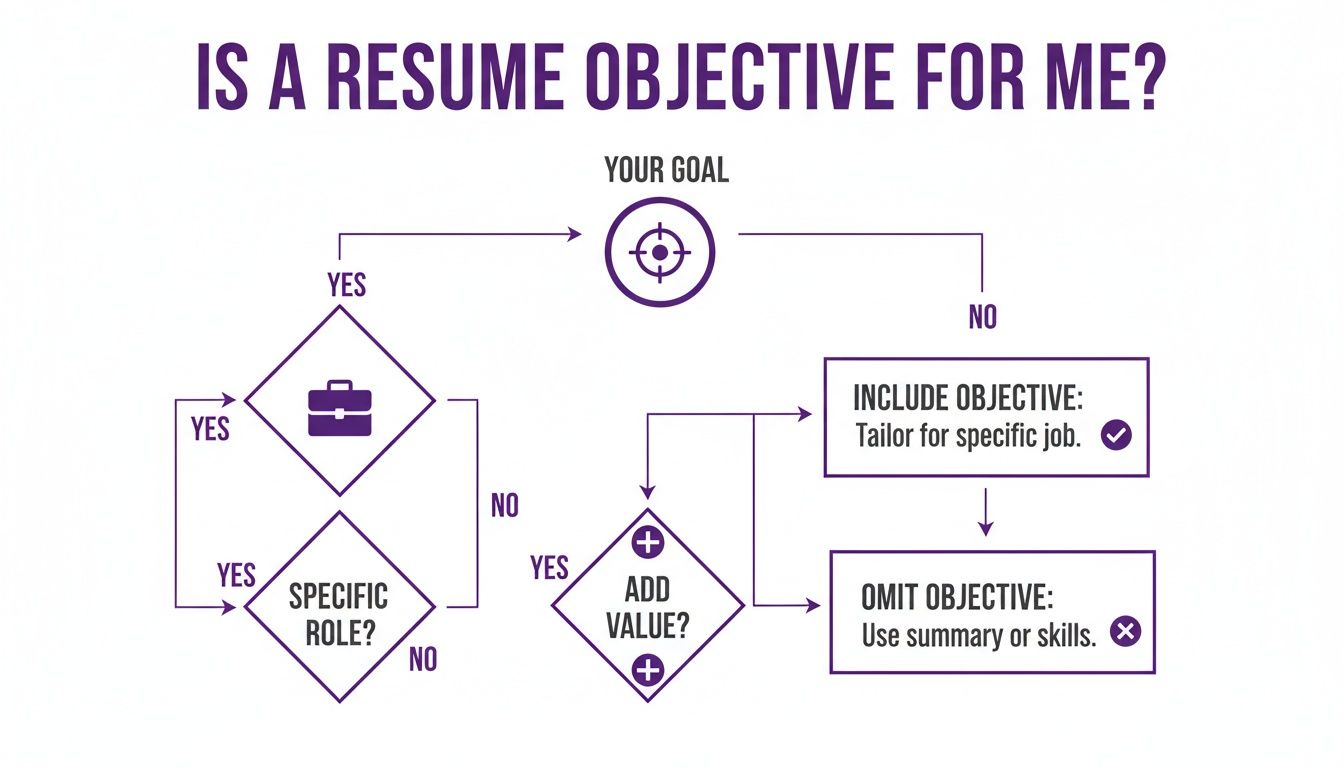
As you can see, an objective shines when you're targeting a specific role, especially if your value isn't immediately obvious from your previous job titles.
Choosing Your Introduction: Objective vs. Summary
To make the choice crystal clear, let's put them side-by-side. This table breaks down the core differences to help you frame your resume's opening in the most powerful way for your specific situation.
| Feature | Objective Statement | Professional Summary |
|---|---|---|
| Primary Focus | Your future career goals and what you hope to achieve. | Your past accomplishments and proven skills. |
| Best For | Recent graduates, career changers, or those with employment gaps. | Experienced professionals with a relevant work history. |
| Core Message | "Here is the value I plan to bring to this specific role." | "Here is the value I have already delivered in similar roles." |
Ultimately, both introductions are designed to grab a recruiter’s attention and make them want to read more. The key is picking the one that tells your story best.
If you’re building a bridge to a new career path, an objective statement is your tool. If you’re building on an already strong foundation, a summary is the way to go.
How to Write a Powerful Objective Statement
Writing a killer objective statement isn't about stringing together fancy buzzwords. It’s all about being strategic and direct. A great objective connects what you can do with what the employer desperately needs, all in one or two punchy sentences.
Let's walk through a simple, three-step process to get this done right—one that will help you get noticed every single time. Think of it like this: your skills and goals are on one side of a river, and the company's needs are on the other. Your objective statement is the bridge that connects them, showing a recruiter the clearest path from you to the role.
Step 1: Start with the Job Description
Before you even think about writing, you need to put on your detective hat. The job description is your treasure map, full of clues pointing to what the hiring manager really wants.
Read through it and highlight the key skills, qualifications, and responsibilities they mention over and over. Are they looking for someone who knows a specific piece of software? Do they keep mentioning teamwork or the ability to solve problems on your own? These keywords are gold. You’ll want to mirror them directly in your objective to show you're a perfect fit right from the start.
Step 2: Identify Your Matching Strengths
Okay, now it's time to look at your own professional toolkit. With the list of keywords from the job description in hand, figure out which of your skills and experiences line up with their biggest priorities.
Pick your top two or three most relevant qualifications. This is not the place to list every single thing you've ever done. Instead, you want to zero in on the strengths that position you as the solution to their problem. For example, if the ad screams for a "detail-oriented" assistant with "scheduling experience," those are the two things you absolutely need to feature.
For a deeper dive into crafting your message, check out our guide on how to write a resume objective.
Step 3: Combine and Refine Your Statement
You've done your homework and picked your power-skills. Now, let's put it all together. There's a simple formula that makes this final step a breeze.
The Simple Formula: [Your Role/Adjective] + with skills in [Skill 1] and [Skill 2] + seeking a [Job Title] role at [Company Name] to [Contribute X, Y, or Z].
This structure forces you to be employer-focused, which is exactly the point. An objective is a fact-based claim about what you bring to the table. In a 2023 analysis, a whopping 60% of recruiters said the biggest mistake they see is candidates using vague fluff instead of specific, provable details. By sticking to this formula, you’re presenting concrete skills that directly answer the "what can you do for us?" question.
Real-World Objective Statement Examples
Theory is great, but seeing how an objective statement actually looks on a resume makes all the difference. A killer objective is specific, tailored, and tells the hiring manager exactly what you bring to the table based on where you are in your career. It's not a throwaway line; it's your opening move.
Let's walk through some solid, practical examples for the three classic scenarios where an objective statement really pays off: you're just starting out, you're switching careers, or you're gunning for an internship. Each one is built to show you how to frame your skills and goals to get noticed.

For the Recent Graduate
As a new grad, your objective has one job: connect the dots between what you learned in school and what you can do for an employer. You don't have a ton of work history, so you need to lean into your skills, your drive, and any relevant projects. This is where you prove you’re ready to hit the ground running.
Example:
"Recent marketing graduate with hands-on experience in SEO and social media analytics from academic projects, seeking an entry-level Digital Marketing Coordinator position. Eager to apply content creation and data analysis skills to help increase brand engagement and drive campaign success."
Why It Works:
- It’s Specific: It doesn't just say "marketing job." It targets the "Digital Marketing Coordinator" role and calls out hard skills like SEO and analytics.
- It Shows Value: It immediately focuses on results—increasing engagement and driving success—which is music to a hiring manager's ears.
- It’s Confident: Framing academic work as "hands-on experience" is a savvy move when you're just starting. For more tips, check out our guide on how to write a resume with no experience.
For the Career Changer
When you're switching fields, your objective is your best friend. It has to instantly explain your pivot and show how your old skills apply to your new goal. It’s all about highlighting those transferable skills that prove you’ve got what it takes, even if you’re coming from a different world.
Example:
"Experienced retail manager transitioning into human resources, seeking an HR Coordinator role. Aiming to leverage 7+ years of expertise in team leadership, conflict resolution, and employee training to foster a positive and productive workplace environment."
Why It Works:
- It Explains the Shift: Right away, it clarifies the move from "retail manager" to "human resources." No confusion.
- It Highlights Transferable Skills: Leadership, conflict resolution, and training are pure gold for HR, no matter where you learned them.
- It Shows Intent: This isn't a random jump. The objective frames the change as a deliberate, thoughtful move, which builds confidence in your commitment.
For the Internship Seeker
If you're a student looking for an internship, an objective statement proves you’re serious and focused. It tells the company you’ve actually thought about what you want to learn and how you can chip in. It's the perfect mix of ambition and a solid academic foundation.
A modern objective is most effective when it combines a clear goal with measurable, objective evidence of past performance. It should be a brief, 1–2 sentence statement summarizing the role you are seeking and the verifiable value you bring. Discover more insights about crafting effective resume objectives on huntr.co.
Example:
"Ambitious computer science student with a 3.8 GPA and proficiency in Python and Java, seeking a Software Engineering Internship. Eager to apply algorithmic problem-solving skills and contribute to real-world software development projects."
Why It Works:
- It Includes Proof: Dropping a 3.8 GPA and specific languages like Python and Java gives them concrete proof of your abilities.
- It Aligns with Goals: It connects a classroom skill ("algorithmic problem-solving") directly to the job of a software engineer.
- It Shows Eagerness: The statement screams "I want to learn and I want to help," which is exactly the vibe companies want from their interns.
Common Mistakes That Weaken Your Objective
Writing a resume objective seems straightforward, but it’s one of those things that’s surprisingly easy to mess up. A bad one can do more harm than good, basically telling a recruiter you didn’t put much thought into your application. If you can steer clear of a few common traps, your objective can go from a liability to a powerful, attention-grabbing asset.

The absolute biggest mistake? Sending out a generic, one-size-fits-all objective for every job. Hiring managers can spot a copy-paste job from a mile away, and it’s a dead giveaway that you aren't that interested in their specific role.
Being Too Generic or Vague
An objective that’s so vague it could apply to any job is an instant red flag. It screams "I'm just mass-applying" and does nothing to connect you to the position you’re actually after.
- Before: "Seeking a challenging position at a respectable company where I can utilize my skills and experience for growth."
- After: "Seeking a Junior Accountant role at Innovate Inc. to apply my knowledge of GAAP and proficiency in QuickBooks to support the finance team's reporting accuracy."
See the difference? The "after" example is tailored. It names the exact role and company, then calls out specific, relevant skills (GAAP, QuickBooks) that are a perfect match for an accounting job.
Focusing Only on What You Want
Old-school resume advice often led to objectives that read like a personal wish list. But here's the thing: modern recruiters don't really care what the company can do for you right now. They need to know what you can do for them.
An effective objective statement always answers the employer's silent question: "Why should we hire you?" It shifts the focus from your needs to their needs, immediately demonstrating your value.
It's all about flipping the script from "me-focused" to "employer-focused."
- Before: "I am looking for a role that offers opportunities for professional development and career advancement."
- After: "Eager to apply strong project management and communication skills to help streamline team workflows and ensure successful project delivery at your organization."
This revised version shows you get it. You understand the company's goals—efficiency and successful projects—and you’re positioning yourself as the person who can help them get there.
Overstuffing with Buzzwords
Words like "go-getter," "team player," and "results-driven" have been used so much they've lost all meaning. They're just filler, taking up precious space without saying anything real about what you can do.
Instead of leaning on those clichés, give them concrete proof. Show, don't just tell.
- Before: "A hardworking and results-driven professional seeking a role in sales."
- After: *"A sales professional with a track record of exceeding quarterly targets by an average of 15%, seeking to bring strong client relationship and negotiation skills to the Account Executive position."*
The second version works because it replaces a vague buzzword with a hard number (15%). That specific achievement gives them tangible proof of your abilities, making your claim far more believable and impressive. Dodging these simple mistakes will make sure your objective is sharp, focused, and actually effective.
Optimizing Your Objective for Recruiter Software
Let's be real: before a human ever lays eyes on your resume, it’s going to have to get past the bouncer at the door—an Applicant Tracking System (ATS). Think of this software as a digital gatekeeper, scanning every application for specific keywords and qualifications to decide who gets in. A sharp, well-written objective statement is your first, best chance to signal to the robot that you’re a perfect match.
To get past the ATS, you have to speak its language. The best way to do that? Go straight to the source: the job description. If the company is looking for someone with "project management" skills or "data analysis" experience, you need to weave those exact phrases into your objective.
Tailoring Your Statement for ATS Success
Here's another pro tip: use the exact job title from the posting. If they're hiring a "Marketing Coordinator," your objective should explicitly state you're seeking a "Marketing Coordinator" role. Don't say "marketing professional" or "creative marketer." A direct match is a green light for the system.
You also want to make things easy for the software. Stick to standard, easy-to-read fonts and steer clear of fancy formatting like tables or columns, especially in your contact info. Complex layouts can trip up the ATS, causing it to scramble or even discard your resume entirely.
Your objective is the first thing the ATS 'reads.' By mirroring the language in the job description, you massively boost your odds of getting your resume into a human's hands.
Want to make sure your entire resume is machine-readable? We’ve got you covered. Check out our deep dive on applicant tracking system resume tips to optimize every single section.
It’s also smart to keep an eye on how technology is changing the game. For more on how AI is shaping resumes and recruiter software, it can be really helpful to see what AI-focused companies are talking about. You can find some great insights on the Parakeet AI's blog. Understanding the tools reviewing your resume is the key to crafting a statement that works for both the software and the person reading it next.
Your Questions, Answered
Let's clear up a few common questions that pop up around resume objectives. Think of this as the final debrief before you go out and build your own.
Are Resume Objectives a Thing of the Past?
Not completely, but their job has definitely changed. If you've got a solid track record in your field, a professional summary is your best bet. But for recent grads, internship hunters, or anyone making a big career pivot, an objective is still a super useful tool.
A modern objective isn't about what you want. It’s about what you can do for the employer. It acts as a bridge, connecting your potential to their specific needs when your work history doesn't paint the full picture.
Should I Slap an Objective on My Cover Letter, Too?
Nope. A cover letter has a totally different mission. It's your space to tell a story, dive deeper into your skills, and let your personality shine through.
Think of it this way: your resume objective is the headline, and your cover letter is the full article. Putting an objective in your cover letter is like printing the headline twice—it’s redundant and wastes precious space you could be using to win them over.
What’s the Perfect Length for an Objective?
Short and sweet. You’re aiming for one to two sentences, max. That usually works out to about 25 to 50 words. Any more than that, and you risk the hiring manager just skimming right past it.
Ready to stop juggling spreadsheets and start landing interviews? Eztrackr is the tool you need to save job postings, build a killer resume, and track every application in one spot. Get started with Eztrackr for free and take control of your job search.