Why Am I Not Getting Interviews? 6 Fixes to Land More Offers
If you're asking yourself, "why am I not getting interviews?" you're not alone. The answer usually comes down to a perfect storm of insane competition, automated resume-screening robots (the dreaded ATS), and applications that just don't hit the mark. The modern job market feels like a numbers game, but the real secret is that strategy, not just volume, is what finally breaks through the silence.
The Silence After Applying And How To Beat It
That feeling of launching your resume into a black hole? It's incredibly common, and it’s not a reflection of your worth. The hard truth is that the job application process has become a massive funnel where only a tiny fraction of applicants ever get seen by a real human. For any given role, you’re likely competing against hundreds—sometimes even thousands—of other qualified people.
The numbers are pretty sobering. The average job seeker sends out anywhere from 32 to over 200 applications just to get a single offer. Cold online applications? They have a bleak success rate of just 0.1% to 2%. With a single corporate job posting easily attracting over 100 applications, companies lean heavily on Applicant Tracking Systems (ATS). These systems automatically disqualify 75-99% of resumes before they ever reach a hiring manager, often just because of a few mismatched keywords.
To put it in perspective, let's break down what that funnel really looks like.
The Modern Job Application Funnel: Why So Few Callbacks?
This table shows the brutal reality of how the applicant pool gets whittled down at each stage. It's a game of elimination from the very start.
| Funnel Stage | Typical Applicant Pool Size | What Happens Here |
|---|---|---|
| Total Applications | 1,000+ | Everyone who clicks "Apply" lands here. |
| ATS Filtering | ~250 | Resumes are scanned for keywords. Mismatches are instantly rejected. |
| Human Review (6-second scan) | ~50 | A recruiter spends a few seconds glancing at the survivors. |
| Hiring Manager Review | ~10 | The best of the bunch are passed on for a more detailed look. |
| Phone Screen/Interview | ~5 | A handful of candidates finally get the call. |
Seeing the numbers laid out like this makes it clear: just getting past that initial screening is a major victory.
This is what that process looks like visually. A huge pool of applicants gets systematically narrowed down, step by step.
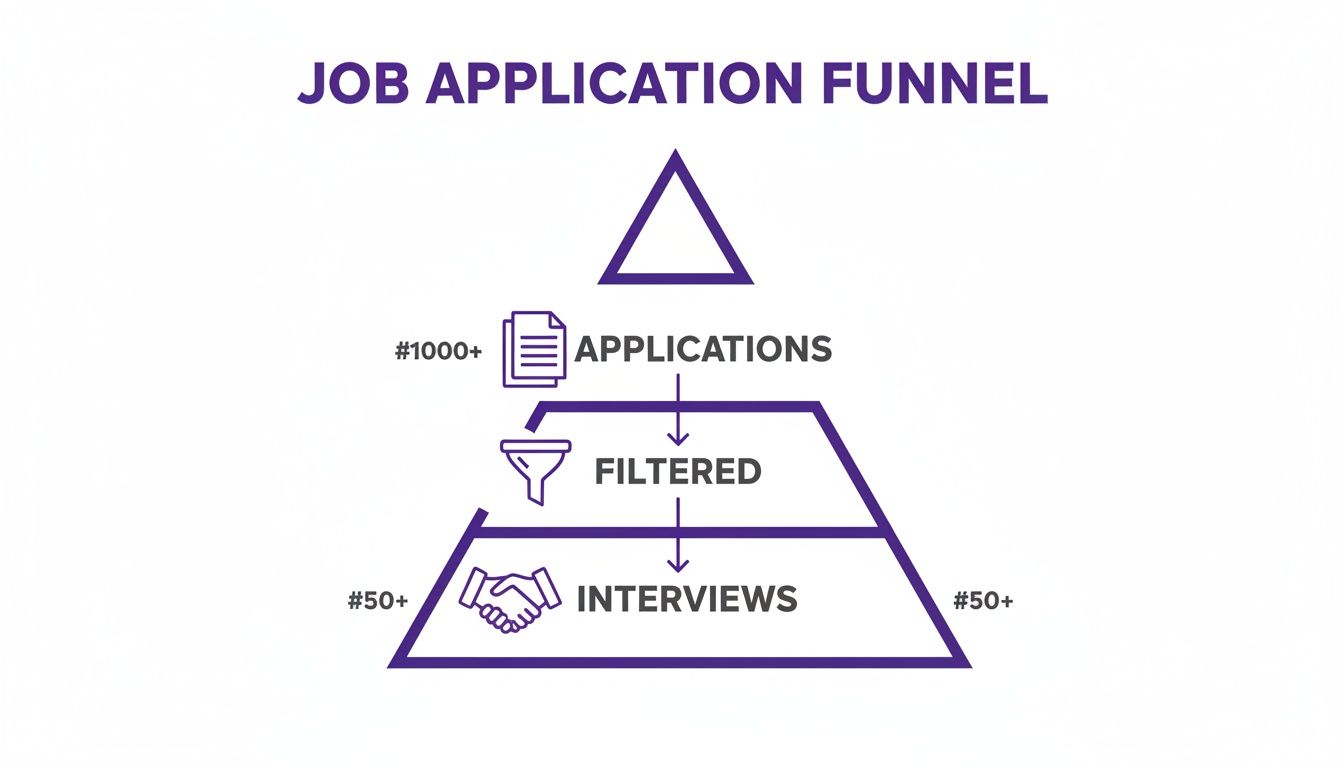
As you can see, what begins as a flood of applications quickly becomes a trickle. This isn't about luck; it's about learning how to navigate a system designed for elimination.
Taking Control Of Your Job Search
To beat these odds, you have to stop thinking like a passive applicant and start acting like the project manager of your own career. That means ditching the old "spray and pray" method for a smarter, more organized approach. Instead of just guessing what's working, you need to track your efforts and look for patterns.
This is where a job application manager like Eztrackr becomes your command center. It helps you organize, track, and analyze everything you're doing. With it, you can finally see:
- Which application strategies are actually getting you responses.
- The perfect time to send a follow-up email so you don't get lost in the shuffle.
- Which versions of your resume perform best for different types of roles.
The endless waiting and silence can really take a toll on your mental health. It’s absolutely vital to protect your well-being during this process. Finding practical strategies for coping with job search anxiety can make all the difference.
By treating your job hunt like a project you can manage, you take back control and start building a process that actually works. A huge piece of that puzzle is knowing when and how to follow up—a step most people skip. Don't be one of them. Check out our guide on how to follow up on job applications and learn how to turn that silence into a conversation.
How To Fix Your Resume To Beat The Bots
If you're sending out applications and hearing nothing back, your resume is likely getting knocked out of the running before a human ever lays eyes on it. The culprit? A piece of software called an Applicant Tracking System, or ATS. These systems are the digital gatekeepers for over 98% of Fortune 500 companies, and they’re becoming standard everywhere.

Think of the ATS as a club bouncer with a very strict list—the job description. It scans your resume looking for specific keywords and phrases. If you don't have the right "credentials," you're not getting past the velvet rope. It doesn’t matter how perfect you are for the job in reality; if you can't pass this initial digital screening, your application is dead on arrival.
Speak The Language Of The Bots
The single biggest mistake I see job seekers make is blasting out the same generic resume for every opening. To get past the ATS, you have to treat it like a simple matching game. It’s not smart, it’s literal.
Your job is to mirror the language in the job description. Find the most important skills, qualifications, and duties they list and make sure those exact terms are woven into your resume. If the company is looking for "digital marketing analytics," your resume had better say "digital marketing analytics," not just "analyzed campaign data."
Here’s a quick-and-dirty process for this:
- Analyze the Job Description: Copy the entire job description and drop it into a free word cloud tool. The biggest, boldest words are your primary targets.
- Identify Core Keywords: Hunt for specific skills ("Salesforce," "Python," "SEO strategy"), job duties ("project management," "client relations"), and required qualifications ("Master's Degree," "PMP Certification").
- Integrate Keywords Naturally: Sprinkle these keywords throughout your resume—in your professional summary, your skills list, and especially in the bullet points describing your work experience. Just make sure it reads naturally. Don't just list them.
Formatting Your Resume For Readability
Those beautiful, design-heavy resume templates with columns, icons, and custom fonts might look impressive, but they’re poison to an ATS. The software is built to read simple, linear text. When it hits complex formatting, it gets confused, garbles your information, or just skips it entirely.
Keep your resume clean and straightforward.
- File Type: Stick with a .docx or .pdf file unless the application says otherwise.
- Fonts: Use a standard, boring font. Think Arial, Calibri, or Times New Roman.
- Structure: Absolutely no tables, text boxes, columns, or images. A simple, top-to-bottom, single-column layout is your best bet.
- Headings: Use obvious, standard headings like "Work Experience," "Education," and "Skills." The ATS looks for these to understand how to categorize your info.
A well-structured resume isn't just for the bots. Once you get past the initial screen, a real person will look at it. The catch? They'll only spend an average of six to seven seconds on that first glance. A clean, scannable format helps them spot your value immediately.
Transform Responsibilities Into Achievements
Okay, so your resume is now keyword-optimized and properly formatted. The final, crucial step is making it compelling for the human on the other side. Too many resumes just list job duties—a boring checklist of what you were supposed to do. To actually get noticed, you have to show them what you accomplished.
Turn every bullet point from a responsibility into a quantifiable win. A simple but powerful formula for this is: Accomplished [X] as measured by [Y] by doing [Z].
Let’s see how that looks in practice.
Before (Responsibility-Focused):
- Responsible for managing social media accounts.
- Wrote blog posts for the company website.
- Handled customer service inquiries via email.
After (Achievement-Focused):
- Increased social media engagement by 35% across three platforms by developing and executing a new content calendar.
- Drove a 20% increase in organic site traffic by writing SEO-optimized blog posts on key industry topics.
- Improved customer satisfaction ratings by 15% by implementing a streamlined email response system.
See the difference? This reframing shows a hiring manager the value you bring, not just the tasks you can perform. To go even deeper on this, check out our guide with powerful applicant tracking system resume tips.
Doing all of this—tailoring keywords, reformatting, and rewriting achievements for every single application—is a ton of work. This is where modern tools can be a lifesaver. An AI-powered resume builder, for example, can analyze a job description and help you tweak your resume in a fraction of the time.
Tools like the Eztrackr AI Resume Builder automate the tedious parts, identifying skill gaps and suggesting keywords so you can focus on telling your story. It helps you beat the bots and impress the humans, every single time.
Moving From Mass Applying To Strategic Targeting
If your job search feels like you’re shouting into a void, the problem might not be what you think. It's almost certainly not your qualifications—it’s your strategy. The old “spray and pray” method of blasting out hundreds of generic applications is a direct path to burnout, not interviews. It treats the job hunt like a numbers game, but hiring managers aren't looking for a lottery ticket; they're looking for a perfect fit.

This is where you need a fundamental shift in your approach. Forget about the sheer quantity of applications. Your new goal is to maximize the quality and impact of every single one you send. Strategic targeting means you stop applying to everything that moves and start focusing only on the roles where you can build a genuinely compelling case for yourself.
Create Your Target Company List
The first step away from the application firehose is to define what you actually want. Instead of just reacting to whatever job alert hits your inbox, you need to proactively build a list of 10-20 companies that genuinely excite you. This simple act moves you from being a passive applicant to an active career planner.
When building your list, think about:
- Industry Alignment: What fields are you actually passionate about? Tech, healthcare, a non-profit?
- Company Culture: Do you come alive in a chaotic startup, or do you prefer the guardrails of a more structured corporation?
- Values Match: Does the company's mission actually resonate with you, or is it just corporate jargon?
- Growth Opportunity: Look for companies with a real track record of promoting from within and investing in their people.
Having this list gives your search a sense of direction and purpose. Now, you’re not just applying for jobs; you’re actively pursuing opportunities at places you truly want to work. That genuine interest will absolutely shine through in your applications.
Dissect The Job Description Like A Detective
Once you’ve found a target role, you have to become a detective. Your goal isn't just to skim the job description; it’s to uncover what the hiring manager is really looking for. Think of it this way: the job description is a list of their problems, and your application needs to be the solution.
Read through the description and highlight the top 3-5 core requirements. These are the absolute non-negotiables. Then, dig deeper to identify the underlying pain point. Are they bleeding customers? Are their internal processes a mess? Is their online presence nonexistent?
Your application isn’t about listing every single thing you've ever done. It’s about figuring out exactly what the employer needs and then tailoring your story to prove you are the person who can solve their specific problems.
Answering "why am I not getting interviews" often comes down to this one simple step. If your resume and cover letter don't speak directly to the company's biggest headaches, you'll be passed over for someone whose application does.
The Art Of Tailoring Your Application
Armed with a clear understanding of what they need, you can now tailor every single document you submit. Generic applications are the number one reason well-qualified candidates get rejected. A tailored application shows effort, real enthusiasm, and a deep understanding of the position.
Focus on customizing these key areas:
- Resume Summary: Rewrite your summary to mirror the language in the job description. Highlight the 2-3 achievements that are most relevant to this specific role.
- Work Experience Bullet Points: Reorder your bullet points. Put the most relevant accomplishments at the top. Tweak the language to include keywords you pulled from the job description.
- Cover Letter: This is your most powerful tool. Don't just repeat your resume. Use the cover letter to connect the dots, telling a clear story about why your unique skills and experiences make you the perfect solution to their problems.
Yes, this process takes more time. There's no getting around that. But the return on that time is massive. You might send only five highly-tailored applications in the time it takes to send 50 generic ones, but those five are infinitely more likely to land you an interview.
To speed this up without sacrificing quality, an AI Cover Letter Generator can be a huge help. Tools like the one built into Eztrackr can analyze a job description and spit out a highly personalized first draft in seconds. All that's left for you to do is polish it up. This lets you apply both strategically and efficiently, turning a draining task into a serious advantage.
Using Networking To Skip The Application Black Hole
Relying only on online applications feels a lot like playing the lottery. You're up against hundreds, sometimes even thousands, of other people for one job, just hoping your resume is the lucky ticket that gets pulled from the pile. But what if you could skip the line altogether?
That's where networking comes in. It’s not about being slick or begging for favors; it's about turning a cold, anonymous application into a warm introduction. Getting a referral from a current employee can instantly lift your resume from the bottom of a digital slush pile right to the top of a hiring manager’s desk.
The Human Side Of Hiring
At the end of the day, companies are just groups of people, and people trust recommendations from those they already know. An internal referral is a powerful vote of confidence. It tells the hiring team that you’re someone worth paying close attention to. It’s a shortcut through all the noise.
The data absolutely backs this up. The job market is incredibly competitive, with 56% of U.S. full-time workers looking for new jobs and 27% actively hunting. While job boards pull in 49% of all applications, they only result in 24.6% of actual hires. On the flip side, candidates sourced by recruiters—often through networking and referrals—are 8x more likely to be hired.
Making The Right Connections
Your networking should start on platforms like LinkedIn, the modern-day hub for professional connections. The goal here isn't to message a total stranger and ask for a job. Instead, you want to build real relationships by asking for advice and learning from people who are already in the roles or companies you're targeting.
First things first, make sure your own profile is polished and professional. It’s your digital first impression, so it needs to be sharp. If you need a hand with that, you can check out how to optimize your LinkedIn profile in our detailed guide.
Once your profile is ready, follow this simple game plan:
- Find Potential Contacts: Look for people at your dream companies who are in roles similar to what you want. Search for fellow alumni from your university or people with shared connections to get your foot in the door.
- Send a Personalized Connection Request: Ditch the generic "I'd like to connect" message. Keep your note brief, polite, and specific.
- Ask for a Quick Chat: After they connect, send a short message asking for just 15 minutes of their time to hear about their experience at the company. Always frame it as you seeking advice, not begging for a job.
Example Connection Request:
"Hi [Name], I came across your profile and was really impressed by your work in [Their Field/Project] at [Company Name]. I'm exploring opportunities in this space and would be grateful to connect and learn from your experience."
From Conversation To Opportunity
When you land an informational chat, your main job is to listen and learn. Ask thoughtful questions about what they do, the company culture, and the real challenges their team is up against. When you show genuine curiosity and respect their time, you start building rapport.
As the conversation wraps up, you can make a natural pivot. Try saying something like, "Thank you so much for your insights. Based on what we've talked about, it sounds like my background in [Your Skill] could be a great fit for the challenges you mentioned. I saw there was an open [Job Title] role and was planning to apply."
This approach often leads to them offering to pass your resume directly to the hiring manager. Just like that, you've turned an anonymous online application into a personal referral. To get around the frustrating online application black hole entirely, it pays to explore other methods. You can learn more about how to get job interviews without applying online and find other creative strategies.
Turn Your Job Search Into A Data-Driven Project
If you’re not getting interviews, it’s easy to feel like you’re just shouting into the void. You rewrite your resume again, you tweak another cover letter, you hit "apply" a dozen more times. But without knowing what’s actually moving the needle, you’re just guessing.
It’s time to stop treating your job hunt like a lottery and start treating it like a project. A data-driven project.

Think of yourself as a marketer, and the product is… you. A smart marketer wouldn't just throw an ad out there and hope for the best. They’d track every single click, view, and sale to figure out what works. You need to bring that same analytical mindset to your job search.
Key Metrics You Need To Track
You don't need a PhD in statistics to get started. Just begin by monitoring a few simple but incredibly powerful data points. These numbers are your job search KPIs (Key Performance Indicators), and they'll tell you the real story of what’s happening behind the scenes.
Here are the essentials to get you started:
- Application-to-Interview Rate: This is the big one. What percentage of your applications actually turn into an interview request? If this number is painfully low—say, below 5%—that’s a massive red flag. It’s a clear sign your resume or your overall application strategy is missing the mark.
- Source Effectiveness: Where are your best opportunities coming from? Keep tabs on which platforms get you the most bites. Are you getting more traction from LinkedIn, company career pages, or direct referrals? This tells you exactly where to double down on your efforts.
- Role Type Success: Are you getting more love for "Marketing Manager" roles than "Content Strategist" positions? Tracking this helps you see which job titles and descriptions are a better match for your profile in the eyes of recruiters.
By measuring what you're doing, you move from feeling powerless to being in control. Data shows you the bottlenecks, so you can stop asking "why am I not getting interviews?" and start making targeted fixes that actually lead to results.
Visualize Your Progress And Find The Bottlenecks
Sure, a basic spreadsheet can get you started, but a dedicated job tracker with a visual dashboard makes finding patterns almost effortless. When you see your data laid out in charts and graphs, the insights can jump right off the screen. To learn more about getting organized, check out our guide to creating an effective job hunt tracker.
For example, a quick glance at a dashboard might show you something glaring.
You might realize you’ve sent 30 applications through a major job board and heard nothing but crickets. Meanwhile, the 5 applications you sent through direct referrals all led to a phone screen. That’s not a coincidence; it's a crystal-clear signal to pivot your strategy toward more networking.
This is how you turn a frustrating, random process into a predictable system you can actually improve.
Frequently Asked Questions About The Job Search
Even the best job search strategy runs into snags. You’re not alone. Here are some of the most common questions we see, with straight-up answers to help you get unstuck.
How Long Should I Wait Before Following Up On An Application?
Give it about 5-7 business days after you hit "submit." That’s the sweet spot. If the posting had a clear closing date, a good rule of thumb is to wait a few days after that date has passed before you check in.
When you do follow up, keep it short, polite, and professional. You're just nudging them to say you're still very interested in the role and the company. A job tracker can be a lifesaver here, letting you set reminders so you never forget to follow up at the perfect time.
Is A Cover Letter Still Necessary For Every Job Application?
Yes. A thousand times, yes—unless the application specifically tells you not to. Think of it this way: the cover letter is your one real chance to talk directly to the hiring manager and explain why your skills are the solution to their problems.
It's your space to show you're genuinely excited about the opportunity, not just clicking "apply" on everything. It goes way beyond the bullet points on your resume. You can even use an AI cover letter generator to create a solid, personalized first draft in seconds, then add your own finishing touches.
How Do I Know If My Resume Is ATS-Friendly?
An Applicant Tracking System (ATS) is a robot, and robots like things simple. An ATS-friendly resume has a clean, straightforward format. That means no fancy tables, columns, or graphics that can scramble the software.
Stick to standard fonts and clear headings like “Work Experience” and “Education.” Most importantly, it needs to be packed with the right keywords and phrases pulled directly from the job description. The best way to be sure is to run it through a skill-match tool that scores your resume against the job post and tells you exactly which keywords you're missing.
I Am Applying For Jobs I Am Qualified For Why No Response?
This is probably the most frustrating part of the job search. It almost always boils down to two things: your resume isn't optimized, or you're getting lost in the crowd. Even if you're a perfect fit on paper, if your resume doesn't have the exact keywords the ATS is scanning for, it's getting screened out before a human ever sees it.
And let's be real, hundreds of people are applying for that same role. Just being "qualified" is the price of entry. To get a response, your application has to be perfectly targeted to that specific job, making it painfully obvious why you’re a better choice than anyone else.
Stop guessing what's wrong and start knowing what works. Eztrackr gives you the AI tools and data-driven insights to diagnose your job search, beat the bots, and finally land the interviews you deserve. Take control of your career journey today at https://eztrackr.app.