When to Apply for Summer Internships A Practical Timeline
If there's one mistake I see students make over and over again, it's waiting until spring to start thinking about summer internships.
The reality is, the race for the best roles kicks off right alongside the school year. For many top-tier companies, the prime opportunities are long gone by the time the New Year's confetti settles.
Why Your Internship Hunt Needs to Start in the Fall, Not Spring
Believing you can casually start your search in March is a common, and honestly, pretty costly myth. The recruiting calendar, especially for competitive fields, has shifted way earlier. The big names in tech, finance, and consulting fire up their recruitment engines in the fall to lock down the best talent early.
If you wait until the spring semester, you're not just late to the party—you're walking into a much smaller, more crowded room, fighting for whatever is left over.
This timeline breaks down the modern internship application cycle into three distinct phases.
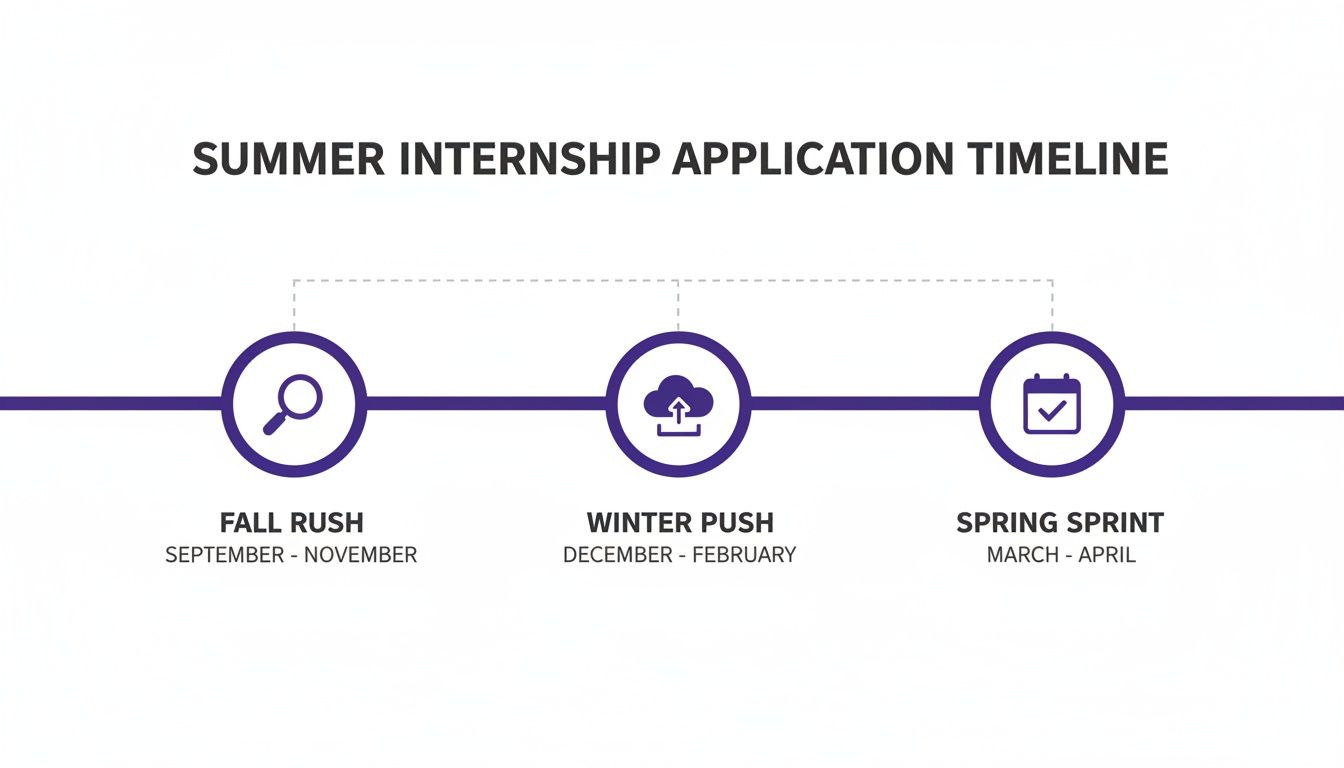
As you can see, the "Fall Rush" is where proactive students get ahead. The "Spring Sprint," on the other hand, is mostly a scramble for the remaining spots.
To give you a quick overview, here's a breakdown of the key application windows and what you should be focused on during each.
Summer Internship Application At a Glance
| Timeframe | Key Actions | Primary Industries |
|---|---|---|
| August–October (Fall Rush) | Researching companies, updating resume/portfolio, networking, submitting applications for competitive programs. | Tech, Finance (IB/PE), Consulting |
| November–January (Winter Push) | Continuing applications, preparing for interviews, following up on fall applications, exploring less-competitive roles. | Larger corporations, some tech, government |
| February–April (Spring Sprint) | Applying to smaller companies, startups, and nonprofits. Following up on all pending applications. | Nonprofits, startups, media, local businesses |
Think of this as your roadmap for the year. The earlier you start, the more control you have over the process.
The New Competitive Reality
Let's be real: the internship market is tough. A 2025 report from Handshake found that internship postings dropped by over 15% between January 2023 and January 2025, while student applications doubled.
The tech sector alone saw a jaw-dropping 30% decrease in postings, leading to an average of 273 applications for every single role.
This isn't meant to scare you. It’s a wake-up call.
An early start isn't just an advantage anymore—it's a necessity. You have to shift your mindset from a last-minute scramble to a strategic, year-long plan. That's how you compete for the best roles before they're even on most students' radar.
Understanding this new timeline is everything. The average job search can take a surprisingly long time, and the internship hunt is no different. Kicking things off in the fall gives you the breathing room to do your research, network properly, and craft applications that actually stand out, all without the stress of a looming deadline. This guide will walk you through exactly what to do, month by month, to make sure you’re always one step ahead of the competition.
Mastering the Fall Rush: September to November
Alright, let's talk about the main event. If you’re serious about landing a top-tier summer internship, September through November is your prime time. This isn't just about getting a head start; it's the peak season, especially for the most competitive industries.
The heavy hitters in finance, consulting, and big tech swing their doors wide open during the fall. Why? They want to lock down the best talent long before the spring semester even gets rolling.

Think about it this way: if you’re eyeing a FAANG internship, you should be hitting up virtual career fairs in September, not just scrolling through job boards in March. Waiting until later in the year means you’ve already missed the boat on some of the most sought-after roles.
Your Fall Application Checklist
To really nail this critical window, you need to focus your energy. This is about more than just firing off applications—it’s about building a solid foundation for your entire search.
- Polish That Resume: Your resume is your handshake. Now is the time to get obsessive about the details. Quantify your accomplishments with hard numbers and tailor every bullet point to the specific industry you're targeting. Don't be afraid to use a resume tool to check how it stacks up against real job descriptions and make sure it gets past those pesky Applicant Tracking Systems (ATS).
- Draft a "Master" Cover Letter: Write one killer, versatile cover letter that really tells your story. This master document can then be quickly tweaked for each specific role you apply for. It saves a ton of time but still feels personal. Focus on your motivation, your core skills, and what unique value you bring to the table.
- Get Your Networking Game On: Don't wait until you're desperate for a referral. Start reaching out to people on LinkedIn now, especially alumni from your school working at companies you admire. A simple, polite message asking for a 15-minute chat to learn about their experience can open doors that a cold application never could.
The real goal this fall is to be ready before that perfect opportunity drops. With your documents polished and your networking in motion, you can apply quickly and confidently the moment an application goes live.
The Power of an Application Tracker
Trying to manage dozens of applications, deadlines, and networking contacts in a spreadsheet is a recipe for chaos. Seriously, I've seen it happen. This is the perfect time to get organized with a tool built for the job.
Using a dedicated application tracker can be a total game-changer. Imagine saving a role from LinkedIn or Indeed with a single click, no more tedious copy-pasting. You can see your whole pipeline on a Kanban board, dragging applications from "Saved" to "Applied" to "Interviewing." To see how this can completely transform your job hunt, check out our guide on using a job hunt tracker.
Key Industry Application Windows
Not every industry moves at the same pace. Knowing the typical timeline for your target field is crucial for focusing your efforts during the fall rush.
Here’s a quick breakdown of when the floodgates usually open for different sectors.
| Industry Sector | Peak Application Opening | Typical Deadline Range |
|---|---|---|
| Investment Banking | Early September | Late September to mid-October |
| Management Consulting | September | October to early November |
| Big Tech (FAANG) | Late August / Early September | October (often rolling) |
| Government (e.g., NASA) | September | Often later, but early is key |
As you can see, the window for top finance and consulting gigs is incredibly tight—blink and you might miss it. For big tech, many spots are filled on a rolling basis, which means the earlier you get your application in, the better your shot.
Don't let these deadlines sneak up on you. Plan your autumn calendar around them.
The Winter Push: Your Prime Time to Apply (December–February)
If you missed the early fall rush for those hyper-competitive roles, don't sweat it. The period between December and February is when the internship floodgates really swing open. For the vast majority of opportunities out there, this is the main event.

Once the new year hits, company budgets are finalized and summer hiring plans are set. Suddenly, platforms like LinkedIn and Handshake are buzzing with new postings. It’s your best chance to cast a wide net, but this requires a totally different strategy—one built on volume, killer organization, and efficiency, all without letting your quality slip.
How to Prioritize When You’re Drowning in Postings
With so many roles going live, it’s incredibly easy to get overwhelmed. The trick is to quickly sort applications into two buckets: hard deadlines and rolling admissions.
- Hard Deadlines: These are exactly what they sound like—firm, non-negotiable cutoff dates. Miss it, and you're out. I always tell students to mark these on their calendars in bright red and aim to submit at least a few days early. You never want a last-minute website crash to ruin your chances.
- Rolling Admissions: This is where speed is everything. Companies with rolling deadlines review applications as they arrive and will literally hire people on the spot. Waiting until the listed "deadline" is a classic mistake, because by then, most—if not all—of the spots could already be gone.
Treat every single rolling application like its real deadline is tomorrow. The longer you wait, the bigger the pile of applications you're competing against for a smaller number of open roles.
As you dive in, it's a great time to brush up on our internship application tips to make sure your materials actually stand out from the crowd.
Tailoring Your Resume Without Burning Out
Let's be real: you can't spend five hours writing a custom cover letter for every single one of the dozens of roles you'll be applying to. This is where you need to work smarter, not harder.
The first hurdle is the Applicant Tracking System (ATS), the software that a staggering 75% of recruiters use to filter resumes. To get past it, your resume has to echo the language in the job description.
A skill-match analyzer can be a lifesaver here. It quickly scans a job posting and tells you which keywords and skills are missing from your resume. This lets you make targeted, high-impact edits in just a few minutes. For instance, if a posting keeps mentioning "project management" and "data analysis," you better believe those exact phrases should be in your bullet points.
This is what separates a smart, high-volume application strategy from just blindly spamming your resume into the abyss.
Staying Organized When It Gets Chaotic
The winter application season is a marathon, not a sprint. To avoid burnout and make sure no opportunities fall through the cracks, your organizational system has to be on point. If fall was about prep, winter is all about execution and meticulous tracking.
You have to manage a complex timeline for every single role. A solid tracking system helps you keep a handle on everything:
- When you submitted each application
- Reminders to follow up with networking contacts
- Interview requests and scheduling details
- Quick notes from every conversation you have with recruiters
Staying on top of these details shows you're professional and prepared at every step. It turns a process that feels completely chaotic into a manageable, strategic job search.
Succeeding in the Spring Sprint from March to May
So you’re just kicking off your internship search in March. First, take a deep breath. You haven't missed the boat entirely, but the game has definitely changed. Forget those massive corporate portals you were eyeing last fall; the spring sprint is all about being nimble, targeted, and a little more strategic.
The good news? Tons of incredible companies work on a much more fluid hiring timeline. Think startups, non-profits, and small-to-mid-sized businesses. They often don't even know what their summer needs are until the spring. When they do, they move fast—and you need to be ready to match that pace.
Pivoting Your Search for Spring Opportunities
Your first move is to completely re-think where you're looking. Those well-known, large-scale internship programs are almost certainly full by now. It’s time to uncover the hidden gems your classmates might be overlooking.
- Zero in on Startups: These fast-paced companies often figure out their internship needs much later in the game. Check out platforms like AngelList and follow venture capital firms to see which companies in their portfolio are hiring.
- Explore Non-Profits: Organizations in this space often have completely different budget cycles and hiring timelines. You'll see many posting roles well into March and April.
- Think Local: Your neighborhood small businesses often need summer help but don't have the budget for a massive recruiting campaign. A direct, personal outreach can be incredibly effective here.
This is also the time to get real about unpaid internships, especially if you can swing it for academic credit. While a paid role is always the goal, an unpaid position at a mission-driven organization can give you invaluable experience and portfolio-worthy projects. That kind of real-world work will make you a much stronger candidate for the paid gigs next year.
The spring internship search isn't a numbers game—it's about precision. Your network just became your most powerful asset. A direct connection can get your resume in front of a hiring manager instantly, letting you bypass the black hole of online applications.
Accelerating Your Interview Prep
When you apply for an internship in April, the timeline from application to offer can be shockingly fast. I'm talking a week or two, tops. You simply won't have the luxury of several weeks to prep. This means your interview game needs to be sharp before you even hear back.
Start practicing common behavioral questions now. A great technique is to have five to seven solid stories ready to go using the STAR method (Situation, Task, Action, Result). Make sure these stories highlight your best skills—teamwork, problem-solving, leadership, you name it.
With that prep work done, you won't be scrambling when you get that surprise email for an interview the very next day. Instead, you can spend that precious time researching the specific company and tailoring your pre-made stories to their mission and values. It’s all about being ready to jump on an opportunity the second it appears. If you stay organized and prepared, you can turn this late-season pressure into a serious advantage.
How to Optimize Your Search with Smart Tools
Let’s be real: trying to manage dozens of internship applications in a spreadsheet is a recipe for disaster. It’s a surefire way to mix up deadlines, forget to follow up, and let incredible opportunities slip through the cracks. As the whole application game gets more competitive, your organization system needs to be just as sharp as your resume.
This is where moving past spreadsheets to a dedicated application tracker can completely change the game. It transforms the administrative headache of the job hunt into a clear, manageable strategy. That frees you up to focus on what actually matters—networking your butt off and nailing your interviews.
Visualize Your Progress and Stay Motivated
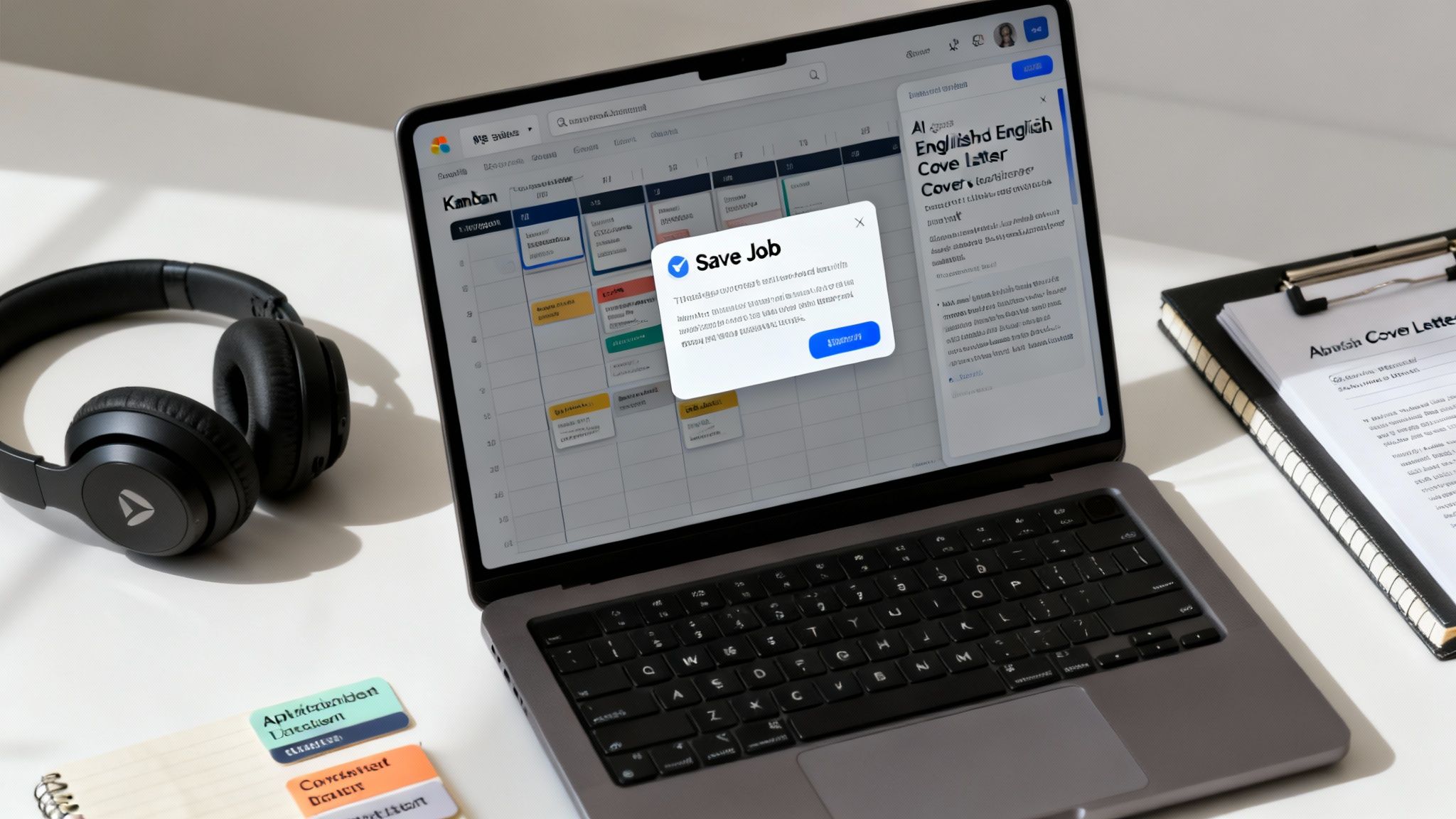
Imagine you’re shooting for over 30 internships. Instead of a messy, overwhelming spreadsheet, picture a clean Kanban board where you can visually track every single role. This lets you see your entire pipeline at a glance, moving applications from "Saved" to "Applied," "Interviewing," and—hopefully—"Offer."
Here’s a quick look at how you can lay out your application stages.
This kind of visual system gives you an instant, birds-eye view of your progress, showing you exactly where you need to focus your energy next. Honestly, it’s just incredibly motivating to physically drag an application from one column to the next.
Work Smarter with AI-Powered Tools
In today's market, you have to be efficient. The competition for summer internships has gotten fierce, with applications per posting doubling while the number of listings actually dropped by 15% between 2023 and 2025. That climate demands a high-volume, high-quality approach. (If you want to dive into the data, you can read the full research on NACEWeb).
This is where smart tools become a necessity, not just a nice-to-have. Modern application trackers are often packed with features that give you a serious leg up.
- One-Click Job Saving: A simple browser extension can grab all the key details from a job posting on LinkedIn or Handshake in an instant. No more tedious copy-pasting.
- AI Cover Letter Generation: Instead of starting from scratch every single time, an AI generator can whip up a personalized draft based on the job description and your resume. You can then spend a few minutes editing and refining it, saving hours while keeping the quality high.
These features make it possible to personalize applications at scale, which is exactly what you need to do when you're applying to dozens of roles. For more ideas on leveling up your strategy, check out our guide on AI-powered job search tools.
By automating the repetitive, mind-numbing parts of your internship search, you get so much valuable time back. You can pour that energy into preparing killer interview answers and building real connections with recruiters and alumni—the stuff that actually gets you an offer. An organized, tool-assisted approach isn’t a luxury anymore; it’s a core part of any successful modern internship search.
Answering Your Biggest Internship Application Questions
It can feel like you're navigating a maze when applying for internships. There are tons of unwritten rules and everyone seems to have different advice. Let's clear up some of the most common questions students run into.
Is It Ever Too Late to Apply for a Summer Internship?
While getting started in the fall or winter is definitely your best bet, it’s never truly “too late.” You just have to change your game plan.
Plenty of smaller companies, startups, and non-profits don't finalize their summer hiring needs until April or even May. At this point, you'll want to stop scrolling through huge corporate job boards and get more targeted.
Start networking like crazy, reach out directly to companies you'd love to work for, and keep a close eye on your university's specific job boards. They often post last-minute openings you won't find anywhere else. The real key here is to stay persistent and be flexible.
How Many Internships Should I Apply For?
There's no single magic number, but let's be realistic—it's competitive out there. A solid goal is to aim for 30-50 well-researched applications.
The trick is balancing volume with quality. Firing off 100 generic, copy-pasted applications won't get you nearly as far as 30 applications where you actually took the time to personalize things.
Don't mistake activity for achievement. Focus on tailoring your resume and cover letter for each role. This personalization is what helps you stand out from the hundreds of other applicants and shows genuine interest.
Trying to manage that many applications without a system is a recipe for disaster. This is where an application tracker becomes your best friend, helping you manage the details without losing your mind.
What if I Have No Experience as a Freshman or Sophomore?
Don't sweat it. Recruiters don't expect underclassmen to have a stacked resume. In fact, tons of great companies now offer programs specifically for first- and second-year students.
When you're searching, look for keywords like "externships," "leadership programs," or "discovery" internships.
As for your resume, you have more to offer than you think. Focus on what you do have:
- Relevant Coursework: List the classes that actually line up with what the job asks for.
- Class Projects: Go into detail about any projects where you built something, solved a tough problem, or worked in a team.
- Extracurricular Activities: Show off any leadership roles or skills you've picked up from clubs or volunteering.
And honestly, networking is your secret weapon here. A real connection can get a recruiter to see your potential, even if your resume is a little light.
Does a Rolling Application Mean I Can Apply Anytime?
Absolutely not. This is a huge misunderstanding that trips up so many students. "Rolling" just means the company reviews applications as they come in and fills spots on a first-come, first-served basis.
If you wait, you're putting yourself at a massive disadvantage. For any role with rolling admissions, it's critical to apply as early as you possibly can. The longer you wait, the fewer spots are left, and the more intense the competition gets for what remains.