AI Powered Job Search Tools Your Unfair Advantage
Think of AI-powered job search tools as your personal career co-pilot. They’re built to automate the grunt work and sharpen your strategy for landing a new role. These platforms use artificial intelligence to help you build a killer resume, find jobs that are actually a great fit, and even prep you for interviews.
Essentially, they take a manual, soul-crushing process and turn it into a smart, data-driven plan to get you hired faster.

Navigating the Modern Job Market with AI
Let's be honest: scrolling endlessly through irrelevant job listings is a soul-sucking experience. The modern job hunt is a battlefield, and it’s easy to feel overwhelmed. But this is where AI-powered tools give you a serious leg up. They represent a huge shift in how successful careers are built, helping you move from just another applicant to a proactive strategist.
Imagine having a personal career agent working for you 24/7. That's what these tools are. They don't just find jobs; they decode them. By analyzing a job description, the AI can pinpoint the exact skills and keywords hiring managers are scanning for, making sure your application actually gets seen. This kind of intelligent backup saves you dozens of hours and dramatically boosts your chances of getting that callback.
The Rise of AI in Hiring
This isn't just a trend; it's the new reality. One in three job seekers—that’s 33%—are already using AI to help with their search. And on the other side of the table? A whopping 88% of companies are using AI to screen candidates before a human ever sees their resume.
This completely changes the game. If you're not using these tools, you're falling behind. They give you the edge you need to cut through the noise and get noticed.
By leaning on AI, you're not just applying for jobs anymore. You're engineering a smarter, more efficient path to your next big opportunity. It’s all about working smarter, not harder.
A Strategic Co-Pilot for Your Career
Imagine a system that not only flags the right opportunities but also helps you present the absolute best version of yourself. These tools take over the tedious, repetitive tasks so you can focus on what really matters: acing interviews and building real connections.
- Automated Optimization: The AI helps you craft resumes and cover letters tailored perfectly to each specific job you apply for.
- Targeted Matching: Instead of you sifting through hundreds of roles, the AI brings the best-fit opportunities directly to you.
- Data-Driven Insights: You can finally get a clear picture of how your applications are performing and spot where you can improve.
For some, like AI/ML engineers navigating the U.S. job market, combining these tech tools with soft skills is key. Things like accent coaching specifically for AI/ML engineers can be the perfect complement. While a great job application tracker keeps you organized, AI tools supercharge the quality of every single thing you send out, giving you an advantage from every angle.
To get ahead with AI, you first have to know what you’re up against: the Applicant Tracking System (ATS). These are the "resume robots" that act as gatekeepers for pretty much every big company out there. They're designed to sift through thousands of resumes before a single human ever lays eyes on them.
Think of an ATS as a strict bouncer at a club with a very specific dress code. Your resume is your ID, but if it's not formatted correctly or doesn't have the right keywords, you're not getting past the velvet rope. This is exactly where AI-powered job search tools give you a serious edge. They help you craft the perfect entry pass, every single time.
And this isn't just a big-company problem anymore. As of 2025, AI in hiring is standard practice everywhere. A jaw-dropping 90% of employers now use these automated systems to filter and rank candidates, from massive corporations to small businesses.
Decoding the Job Description
The first step to beating the resume robots is figuring out exactly what they're programmed to look for. An AI tool works like a codebreaker, scanning a job description to pinpoint the critical keywords and skills the ATS is hunting for.
It's not just a simple word search, either. A good AI understands context. It can spot the difference between hard skills like "Python" or "SEO" and crucial soft skills like "project management" or "team collaboration" that are buried in the job post. This way, nothing important gets overlooked.
- Keyword Identification: The tool pulls out the most frequent and high-priority terms from the job description.
- Skill Gap Analysis: It then compares what the company wants against what your resume has, showing you exactly what’s missing.
- Contextual Understanding: The AI is smart enough to know that "customer relationship management" and "CRM" are the same thing, so you get credit for the right skills.
Building an ATS-Proof Resume
Once the AI has cracked the code of the job description, it helps you build a resume that sails right through the initial screening. It’s not about mindlessly stuffing keywords into your resume. Instead, it guides you to weave them naturally into your experience and summary sections so it still sounds like you.
This goes way beyond a basic text editor. The AI provides real, actionable feedback to boost your resume's chances. For example, you can use a built-in resume scorer to see how well your document matches a specific job, which gives you a clear score before you hit "apply."
An AI tool essentially translates your human experience into the language that resume robots understand. It ensures your qualifications are not just present, but also perfectly visible to the automated systems making the first cut.
With this kind of targeted approach, your application has a much better shot at landing in the "yes" pile, where a real hiring manager can finally see the value you offer.
The Strategic Advantage of AI
Using AI in your job search isn't about cheating the system—it's about leveling the playing field. These tools give you the same kind of intel that recruiters have, helping you present the absolute best version of yourself for each specific role. The end result is a much more efficient and way less frustrating job search.
By optimizing your application for that first automated hurdle, you get to save your energy for the parts of the job hunt that actually matter—networking, prepping for interviews, and making a genuine human connection. To really get an edge, you should also look into strategies to get job interviews without solely relying on online AI systems. Combining smart tech with smart networking is the real key to landing your next great role.
Choosing Your AI Job Search Ally
With a flood of new AI-powered job search tools hitting the market, picking the right one can feel like a full-time job in itself. The trick is finding a platform that becomes a real partner—an ally that sharpens your edge and buys you back time, all without erasing your unique voice.
The best tool isn't always the one with the flashiest features. It's the one that lines up with your career goals, your industry, and how you actually like to work. Are you firing off dozens of applications a week, or are you carefully targeting a few select roles? Do you need to build a resume from the ground up, or just get a final polish on your existing one? Figuring that out first will make your choice a whole lot easier.
The whole point is to get your resume past the initial automated screening and into the hands of a real person. Think of the AI as a bridge that translates your experience into a language that both algorithms and hiring managers can understand and appreciate.
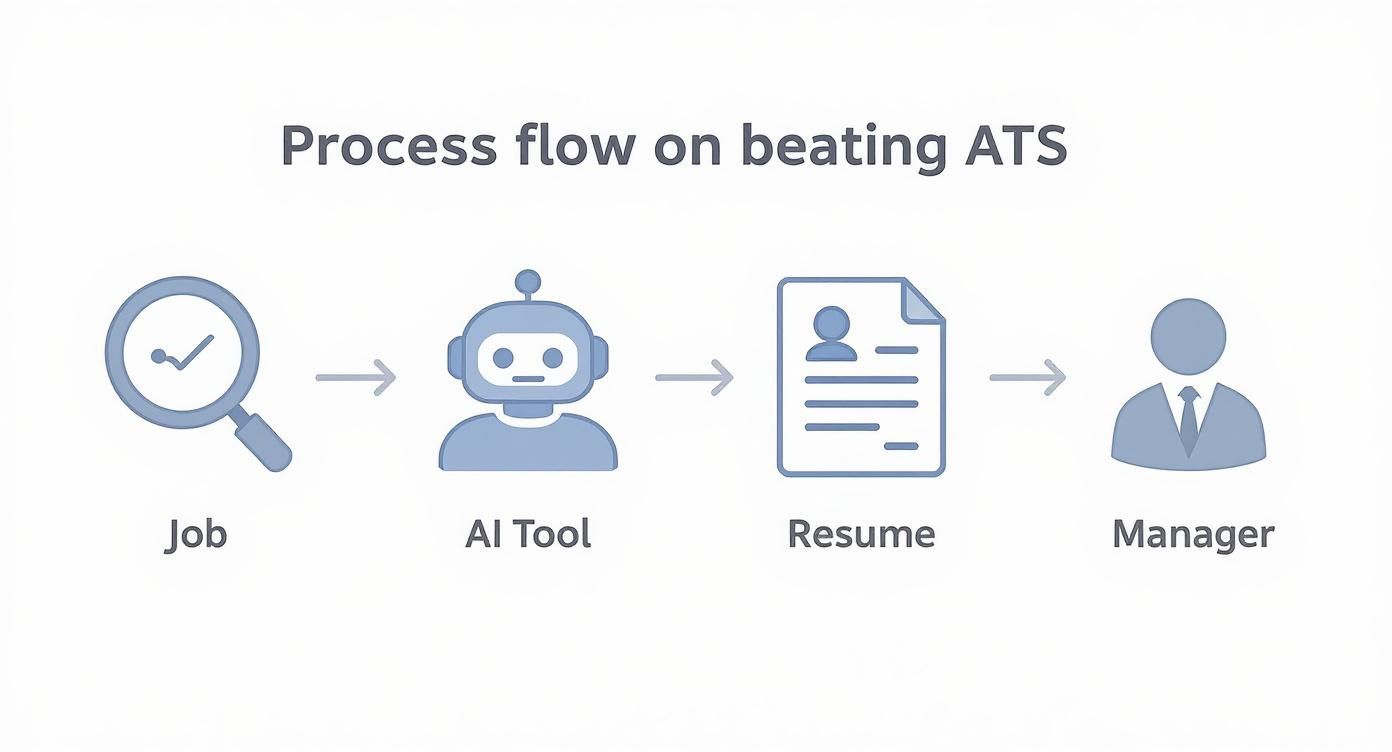
This process is critical. A good tool doesn't just stuff your resume with keywords; it helps you strategically navigate the system.
Define Your Core Needs
Before you even start looking at different platforms, take a minute to map out your biggest frustrations. What are your main pain points? Getting clear on this will act as your compass, pointing you toward the tool that will actually help.
Think about what's eating up most of your time. Is it tweaking your resume for every single job? Is it trying to write a compelling cover letter that doesn't sound like a template? Or maybe it's just the chaos of keeping track of everything. A dedicated job search organizer can be a lifesaver here, centralizing all your efforts.
To help you narrow it down, see which of these profiles sounds most like you:
- The High-Volume Applicant: If you're playing the numbers game and applying to many jobs daily, you need a tool built for speed. Look for features like one-click resume tailoring and quick cover letter generation.
- The Career Changer: When you're jumping into a new industry, your goal is to connect the dots. You need a tool that’s great at spotting transferable skills and reframing your old experience for a new audience.
- The Niche Specialist: For highly technical roles, you need an AI that speaks your language. Look for advanced keyword analysis that understands the jargon and specific qualifications of your field.
- The Polisher: If your resume is already in good shape, you might just need a final boost. A tool with a top-notch ATS checker and grammar refinement can give you that winning edge.
Create Your Evaluation Checklist
Once you know what you're looking for, make a simple checklist to size up your options. This will keep you from getting swayed by clever marketing and help you focus on what actually matters. Don't settle for a tool that just spits out generic text; find one that gives you transparency and puts you in the driver's seat.
A good AI tool should feel like a collaborator, not a black box. It should offer up insights, not just hand you a finished document with zero explanation.
Your goal is to find a tool that makes you a more informed and effective applicant. It should explain its suggestions, allowing you to learn and maintain full control over your personal brand and narrative.
Here’s a practical checklist to guide your decision:
- Transparency of Suggestions: Does the tool explain why it’s suggesting certain keywords or changes? Understanding the logic behind the recommendations is key to making smart choices.
- Customization and Control: How easy is it to edit what the AI generates? You have to be able to weave your own voice and unique stories into every document.
- ATS Compatibility Accuracy: Does it give you a clear score or detailed feedback on how your resume will fare against applicant tracking systems? Vague promises won't cut it.
- Integration with Your Workflow: Does it fit into how you already operate? A simple browser extension or integration with job boards can be a massive time-saver.
- User Experience: Is the platform actually easy to navigate? A clunky, frustrating interface just adds another layer of stress to the job hunt.
Best Practices for Using AI in Your Job Search

Having access to ai powered job search tools doesn't automatically land you the job. Your success really hinges on how you use them. The most important rule? Treat AI like a skilled co-pilot, not the autopilot. It's there to handle the heavy lifting, but you're still the captain of your own career.
This means you absolutely have to review, edit, and put your own spin on every single thing an AI generates. An AI is great at optimizing for keywords and nailing the structure, but it can’t fake your voice, your passion, or the real stories that make you stand out. Authenticity is what connects with a real human on the other side, and that’s a touch AI just can't replicate.
Create a Master Resume First
Before you even think about applying for a role, your first step should be creating a "master resume." This isn't the one you'll send out; it's a comprehensive document just for you, detailing every project, responsibility, and win from your entire career. Let it be as long and detailed as it needs to be. Think of it as your personal career database.
When you find a job that excites you, you'll pull from this master document to feed your AI tool. This little trick ensures you never forget a key achievement and gives the AI rich, accurate info to work with. The result is a much stronger, genuinely tailored resume every single time.
This approach also helps you spot any gaps in your experience. Our guide on how to perform a resume ATS check is a great resource for making sure this foundational document is solid before you start customizing it.
Personalize Every AI-Generated Draft
Once an AI tool spits out a resume or cover letter draft, that's when your real work begins. Think of that draft as a starting point—a well-structured, keyword-optimized foundation. Now it's on you to breathe some life into it.
- Add Your Stories: The AI might give you a generic line like, "Improved team efficiency." It's your job to turn that into a compelling story. For instance, "Spearheaded the adoption of a new project management tool that slashed report generation time by 40%."
- Refine the Tone: Read everything out loud. Does it actually sound like you? Tweak the wording to match how you naturally speak and get rid of any sentences that sound clunky or robotic.
- Fact-Check Everything: Always double-check the details. AI can sometimes get the context wrong or even "hallucinate" facts. Make sure every bullet point is a true reflection of what you actually did.
The goal is to merge AI's analytical power with your human experience. AI provides the structure and optimization; you provide the soul and the story that makes a hiring manager want to meet you.
This blend of tech and a personal touch is more important than ever. The job market itself is being shaped by AI, and hiring trends reflect that. In the first quarter of 2025 alone, the U.S. saw 35,445 AI-related job postings, a 25.2% jump from the previous year. You can dig into more insights on AI's impact on the job market from this labor analysis. By following these practices, you're not just using a tool; you're setting yourself up to win in this new landscape.
The Future of Your Career Starts Here
So, where does that leave us? It’s pretty clear that AI-powered job search tools aren’t just another tech trend. They’ve become a core piece of the modern career puzzle.
We started by pulling back the curtain on Applicant Tracking Systems—the automated gatekeepers—and now we’re using that same AI technology to build applications that get noticed. That’s not just a small step forward; it’s a complete shift in how we find work. The old spray-and-pray method of blanketing job boards with the same resume is officially dead. Success today is about quality, precision, and strategy. It's about sending a targeted application that speaks directly to what a company actually needs. And that’s where AI becomes your secret weapon.
Leveling the Professional Playing Field
Ever stop to think about the high-tech tools recruiters have at their disposal? They use sophisticated software and deep market data to pinpoint the perfect candidates. Well, AI job search tools put that same power right in your hands.
They basically democratize the job hunt, giving every motivated person access to the same level of insight and efficiency. You're no longer left guessing which keywords will catch an algorithm's eye or spending hours rewriting every cover letter from scratch. The tech does the heavy lifting, freeing you up to focus on what humans do best: networking, prepping for interviews, and building real connections. It flips the script from a reactive chore to a proactive career strategy.
The real takeaway is this: getting good with these tools isn't just about landing a job faster. It’s about learning how to market yourself effectively for the jobs of today and tomorrow.
Building Your Career Resilience
If there’s one skill that matters most in today's professional world, it’s adaptability. The job market is always changing, and technology's role is only going to get bigger. By getting comfortable with AI-powered job search tools right now, you’re basically future-proofing your career.
You’re building smart habits that will stick with you long after you’ve accepted your next offer. These skills—like strategic positioning, making data-backed decisions, and marketing yourself efficiently—are the foundation for a resilient and fulfilling career.
The future of your career really does start with the choices you make today. And bringing AI into your job search is a big, decisive step in the right direction. Think of it as an investment in your own adaptability and long-term success.
A Few Common Questions About AI Job Tools
Jumping into the world of AI powered job search tools can feel a bit overwhelming, and it's natural to have questions. As this tech becomes a regular part of how companies hire, it pays to know how to make it work for you. Let's clear up some of the most common things job seekers ask.
Think of these answers as your guide to making AI a strategic partner. You'll stay in the driver's seat of your job search, just with a much better engine.
Can an AI Write My Entire Resume for Me?
Not really, and you wouldn't want it to. While an AI can whip up a surprisingly solid first draft, it's best to think of it as a co-pilot, not an autopilot. You bring the raw material—your experience, your wins—and let the tool do the heavy lifting of optimizing the language, tweaking the format, and making sure it's packed with the right keywords for the job you want.
Always, always go back and add your personal touch. An AI has no idea about the late nights you pulled to finish that big project or the genuine passion you have for your industry. It's those human details, your authentic voice, that actually connect with another human reading your resume.
Are Paid AI Job Search Tools Worth the Cost?
Honestly, it depends on where you're at. Plenty of tools have free versions with great basic features, which are perfect if you're just starting out or applying to a few jobs here and there. But if you're serious about your search, the paid versions usually unlock the really powerful stuff.
Here’s what you typically get when you upgrade:
- Deeper Analytics: Find out exactly how your resume stacks up against an ATS and get much smarter keyword suggestions.
- Better Writing: The premium plans often tap into more sophisticated AI models, which means the resume and cover letter drafts are just plain better.
- No More Limits: Create and analyze as many documents as you need without hitting a frustrating cap.
For anyone in a full-on job hunt, the time you save and the edge you gain can easily make a one-month subscription a no-brainer.
Think of a paid tool as a small investment in your future salary. If it helps you land a great job just one week sooner, it’s probably already paid for itself.
Will Recruiters Know I Used AI on My Application?
They might, especially if your application sounds a little too perfect or uses bland, generic phrases. This is exactly why adding your own personality isn't just a nice-to-have—it’s essential. The goal isn't to fool anyone; it's to present the sharpest, most effective version of your professional story.
Let AI powered job search tools do what they're good at: the tedious, analytical grunt work like keyword matching and formatting. That frees you up to focus on what only you can do: showing off your unique skills, personality, and accomplishments in a way that makes a recruiter stop and pay attention.
Ready to stop juggling spreadsheets and start landing interviews? Eztrackr centralizes your entire job hunt with a smart kanban board, powerful AI tools, and insightful analytics. Take control of your search and see why over 45,000 job seekers trust us to get organized and get hired. Start optimizing your job search with Eztrackr today!