What are transferable skills: Identify and showcase them to unlock opportunities
Think of transferable skills as your career's secret weapon. They're the core abilities you can pack up and take with you from one job to another, no matter the industry. We're talking about things like communication, problem-solving, and leadership—skills that never go out of style.
Unlike the technical know-how for a specific role, these skills make you a versatile and adaptable pro, ready for whatever comes next.
Unpacking Your Professional Toolkit
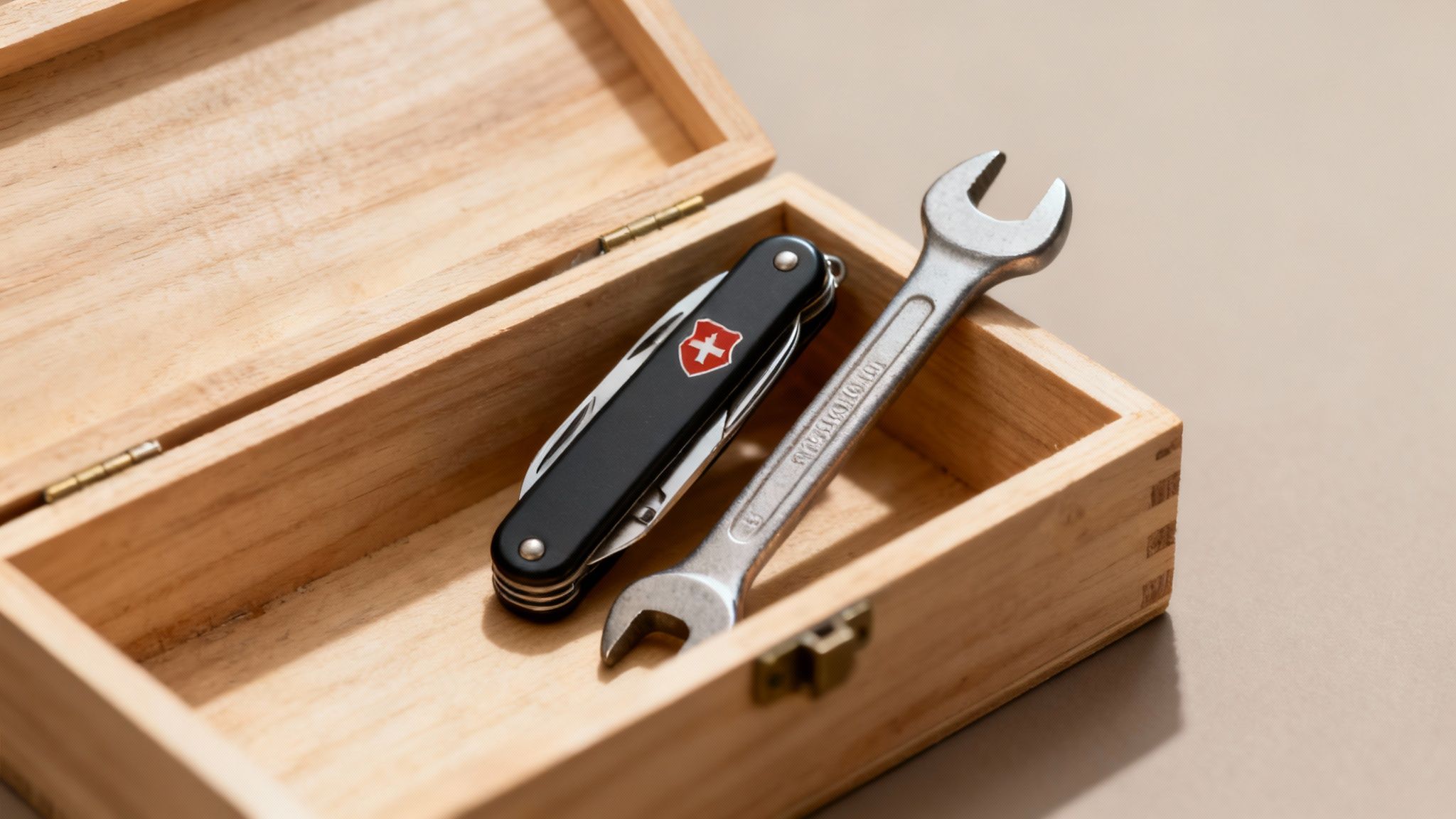
Here's a simple way to picture it: Imagine you have a specialized wrench designed for one specific type of bolt. It’s perfect for that one job, but pretty useless for anything else. Now, think about a Swiss Army knife. It can tighten a screw, open a can, or cut a rope—it adapts.
Transferable skills are your Swiss Army knife.
These are the powerful competencies you've been building your entire life, not just in your 9-to-5. You develop them through school projects, volunteer gigs, and even personal hobbies. They're often called "soft skills," but let's be clear: their impact on your career is anything but soft. They're the engine that drives how you work, collaborate, and innovate.
Transferable skills are all about your potential. While your past job titles tell a story about what you've done, these skills show an employer what you're capable of doing next.
Differentiating Your Skills
It's super important to know the difference between these all-purpose skills and the job-specific, or technical, ones. For example, a graphic designer's command of Adobe Photoshop is a technical skill. It's crucial for their job.
But what about their ability to listen to a client's vague idea, translate it into a compelling design, and then present it with confidence? That’s communication—a massively valuable transferable skill.
This distinction matters because so many people—especially those switching careers—think they're starting from square one. The truth is, you already have a rich toolkit of portable skills you can bring to the table. You might need to learn new software, but your foundational abilities are ready to go.
For a closer look at the other side of the coin, check out our guide on what are hard skills and their examples.
To make it even clearer, let's break down the key differences between these two types of skills.
Transferable Skills vs Job-Specific Skills at a Glance
This table provides a clear comparison between versatile transferable skills and niche job-specific skills, with examples for each to help readers quickly grasp the difference.
| Attribute | Transferable Skills | Job-Specific Skills |
|---|---|---|
| Applicability | Broad (across industries and roles) | Narrow (for a specific job or task) |
| How It's Acquired | Through experience, practice, life | Through formal training, education |
| Examples | Teamwork, Time Management, Empathy | Python Coding, SEO Auditing, Nursing |
| Career Value | Long-term adaptability and growth | Immediate performance in a role |
Understanding this table is the first step to recognizing the full scope of what you offer an employer. You're bringing both the specialized tools and the all-purpose multi-tool to every opportunity.
Why Transferable Skills Are Your Most Valuable Career Asset
In a job market where technology can make a hot technical skill obsolete overnight, transferable skills have become your best form of career insurance. More and more, employers are ditching the old way of hiring—obsessing over job titles—and shifting to a skills-based approach. They want to know what you can do, not just what you’ve done.
This means your real value isn't just locked into one specific role. It's in how you think, communicate, and adapt to whatever comes next.
Imagine a retail store manager who pivots into a tech project management role. On paper, it looks like a huge leap. But think about it: that manager’s day-to-day experience leading a team, managing a budget, and putting out fires is the perfect foundation for the new job.
Those aren't just fuzzy concepts. They're the practical, battle-tested skills that keep projects moving and teams collaborating, whether you're in a stockroom or a software sprint. It just goes to show that your experience is way more portable than you might realize. For anyone thinking about making a similar jump, smart career transition planning is all about framing these skills in the right way.
The Future of Work Is Built on Adaptability
The modern job market isn't for the rigid. It demands resilience and agility—and those aren't just buzzwords anymore. They're your ticket to long-term security and growth. A huge part of how you can future-proof your career by staying abreast of workplace trends boils down to mastering these adaptable skills.
The rapid pace of change means that your ability to learn and apply new knowledge is more critical than your existing expertise in any single area.
And the data backs this up in a big way. Employers now expect a staggering 39% of a worker’s core skills to change by 2030. According to recent research, the demand for skills like leadership and social influence has skyrocketed, jumping 22 percentage points in importance. At the same time, resilience, flexibility, and agility are up by 17 points.
This isn't just a minor tweak; it’s a fundamental shift in what employers are looking for. They're investing in people who can handle uncertainty and drive things forward, no matter their background. Your knack for problem-solving, your ability to work with a team, and your critical thinking are precisely what make you a future-ready hire. They’re what will help you not just survive but thrive through whatever career changes come your way.
The Four Core Categories of Transferable Skills You Already Have
Ever feel like you’re starting from scratch every time you look for a new job? You’re not. You've actually been building a powerful arsenal of transferable skills your entire life, whether you realized it or not.
To help you see them clearly, we can break them down into four core categories. Think of this as a simple framework to help you take inventory of the valuable abilities you already have. Let's dig in with some real-world examples you can probably pull straight from your own experiences.
Communication Skills
This is so much more than just being a good talker. Communication is really about how you receive, process, and share information to make sure everyone is on the same page. It’s the absolute bedrock of solid teamwork, good leadership, and happy customers.
Ever had to explain a really complex topic to someone who had zero background in it? Yep, that’s a communication skill right there.
- Persuasive Writing: That email you sent that finally got a hesitant client to say "yes" to the project.
- Active Listening: The time you calmed down an angry customer just by genuinely hearing them out before jumping to a solution.
- Public Speaking: Nailing your team's quarterly results presentation or even just speaking up confidently in a team meeting.
Critical Thinking and Problem-Solving
This bucket covers your knack for analyzing a situation, making a smart judgment call, and finding a way forward. Employers go crazy for this stuff because it proves you can handle challenges on your own and do more than just follow a checklist.
Every single time you've hit an unexpected roadblock and figured out how to get around it, you were building these muscles.
Key Insight: Critical thinking isn't about having all the answers. It's about knowing which questions to ask to find the best possible path forward.
Honing these skills is a lifelong project. If you want to take a deeper dive, check out our guide on how to develop analytical skills for some more focused strategies.
This diagram shows how foundational skills like leadership and agility are the building blocks for your biggest career assets.
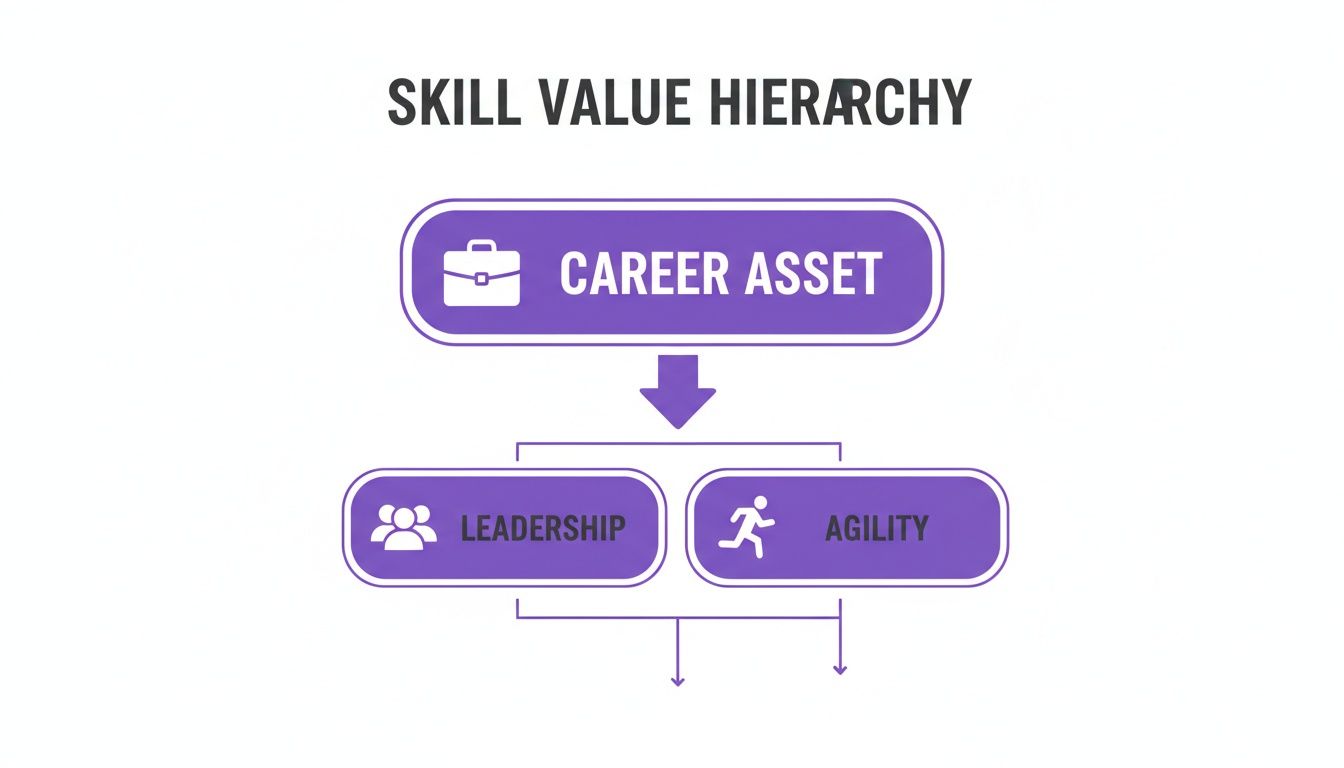
It’s a great visual for how these portable, fundamental abilities support your long-term value.
Leadership and Teamwork
Here’s a secret: you don’t need a fancy "Manager" title to have leadership skills. This is all about your ability to motivate, guide, and work with others to hit a common goal. It’s everything from taking the lead on a new project to just helping out a teammate who’s struggling.
Leadership often shows up in small, everyday moments.
- Conflict Resolution: Stepping in to mediate a disagreement between two colleagues and finding a way for them to work together again.
- Mentorship: Showing the new hire the ropes or sharing what you know to help a coworker level up.
- Delegation: Figuring out who on the team is best for which task to get a project over the finish line efficiently.
Adaptability and Resilience
In a world that changes by the minute, being able to pivot and stay cool under pressure is a superpower. Adaptability is how well you handle new tools, processes, or curveballs with a good attitude. Resilience is your ability to get knocked down and get right back up.
This skill shines brightest when things go completely off the rails. Think about that project where the deadline was suddenly moved up a week, or the client changed the entire scope at the last second. The fact that you adjusted and still delivered is a perfect example of adaptability in action.
How to Find and Frame Your Transferable Skills
Knowing you have a bag full of transferable skills is one thing. Being able to talk about them in a way that makes a hiring manager sit up and listen? That's the real game-changer. This is where we stop talking theory and start taking action. It's all about digging into your past and translating those experiences into the language recruiters actually understand.
Step 1: Conduct a Skills Autopsy
First things first, you need to perform a "skills autopsy" on your own history. And no, I don't just mean listing out old job duties. You have to go deeper. Think about every project, every volunteer gig, every challenging situation you've ever navigated—paid or unpaid.
Pick an accomplishment you're genuinely proud of. Don't just admire the final result; break down how you got there.
- What was the actual problem you had to solve? (That’s critical thinking.)
- Who did you have to wrangle or coordinate with to make it happen? (Hello, teamwork and communication.)
- What went wrong along the way, and how did you fix it on the fly? (That's pure adaptability and problem-solving right there.)
This kind of reflection helps you build a real inventory of your skills, all backed up by solid proof. If you're looking to connect these skills to a future career, there's a great guide on how to choose a career path that aligns with your skills.
Step 2: Translate Your Skills with the STAR Method
Once you’ve identified your skills, you need to package them properly. The STAR method is a classic for a reason—it helps you tell a compelling story instead of just making a bland claim. It’s a simple framework:
- Situation: Set the scene. Where were you, and what was going on?
- Task: What was your specific goal or responsibility?
- Action: What, exactly, did you do? Use strong, active verbs.
- Result: What happened because of your actions? Put a number on it whenever you can.
This is how you turn a generic statement like "I have good leadership skills" into a powerful story: "I led a team of three to reorganize our entire inventory system (Action), which ended up cutting our fulfillment errors by 25% in just one quarter (Result)."
This isn't just a nice-to-have anymore. Skills-based hiring is a massive trend, and companies are shifting their focus to these core abilities. They care more about whether you can solve problems than what your last job title was. In fact, it’s a top trend heading into 2025 as businesses look for people with digital literacy and adaptability that can work in any role.
For more ideas on how to showcase these stories, check out our deep dive into crafting a killer resume skills section with examples.
Using Modern Tools for Precision
Let's be real: trying to manually tweak your resume for every single job application is exhausting. Thankfully, modern tools can do the heavy lifting for you, making sure you’re always highlighting the right stuff.
Tools like Eztrackr’s Skill-Match Analyzer instantly scan a job description and compare it to your resume.
This tech pinpoints the exact keywords and transferable skills that both the automated screening software and the human recruiter on the other side are looking for. It gives you the confidence to tailor your application with precision, every single time.
Real-World Examples of Transferable Skills in Action
Okay, enough with the abstract ideas. The real magic happens when you see these skills at work in the real world. Let's look at a couple of mini-case studies to see how real people switched careers by reframing what they already knew. Think of these as a practical blueprint for translating your own experience.

These stories really drive home just how flexible your existing abilities are. It’s all about connecting the dots between what you’ve done and what a new employer is looking for.
From Teacher to Corporate Trainer
Picture a high school teacher who wants a job as a corporate trainer. At first, those two worlds—the classroom and the boardroom—seem miles apart. But if you dig a little deeper, the core skills are almost identical once you swap out the jargon.
- Before: The teacher might describe their job as "designing lesson plans and managing a classroom of 30 students." Accurate, but not very corporate-friendly.
- After: For the training role, they reframed it. Now, it's "managing complex projects from conception to delivery and leading diverse teams to achieve key learning objectives."
See what happened? That simple change in wording shines a spotlight on project management and leadership—two skills every company wants. They were there all along, just hiding behind different terminology.
When you focus on the function of the skill rather than the context, you build a powerful bridge from your past to your future. This is the heart of what transferable skills are all about.
From Hospitality Manager to Customer Success
Here's another one: a hospitality manager from a bustling hotel wants to break into tech as a customer success manager. All that experience handling guest needs is an absolute goldmine of transferable skills.
- Before: They might have said they "handled guest complaints and ensured a positive hotel experience."
- After: A much more impactful version is "managing client relationships and executing advanced conflict resolution to ensure high levels of customer retention and satisfaction."
This turns everyday problem-solving into strategic client management, which is exactly what a customer success role demands. They didn't have to learn a new skill; they just had to show off an old one in a new light. This kind of reframing is critical, especially when you consider that 63% of employers see skill gaps as a huge roadblock, according to the World Economic Forum. You can learn more in their Future of Jobs report.
These examples prove your work history is a treasure chest of valuable, portable assets. Once you learn how to spot them and talk about them effectively, you can unlock doors to opportunities you never thought were open to you.
Got Questions About Transferable Skills? We've Got Answers.
Alright, so you’ve started to map out your transferable skills. That’s a huge step. But it's natural to hit a few roadblocks when you try to put it all into practice. Let's tackle some of the most common questions that pop up so you can get unstuck and move forward with total confidence.
Which Transferable Skills Are Most in Demand Right Now?
Right now, employers are hunting for the skills that robots can't touch. We're talking about things like creativity, genuine leadership, and emotional intelligence. Future of work reports consistently show that skills like analytical thinking and resilience are at the top of every company’s wish list.
Of course, the specifics can change from one industry to another. But your ability to think on your feet, adapt to whatever comes your way, and communicate clearly will always make you a top contender. These are the truly human skills that keep you valuable.
How Should I List Transferable Skills on My Resume?
Whatever you do, don't just dump a generic list of buzzwords like "Problem-Solving" or "Team Player" under a boring "Skills" section. It’s a wasted opportunity. The best way to do this is to weave your skills right into the stories you tell in your work experience bullet points.
Show, don't just tell. Use the STAR method to give them solid proof. Instead of just listing "Leadership," paint a picture:
"Spearheaded a five-person team to roll out a new client onboarding system, cutting customer churn by a solid 15% in the first three months."
See the difference? That sentence doesn't just claim you're a leader; it proves it with a real, measurable business impact. That’s what gets a hiring manager's attention.
How Do I Talk About My Skills in an Interview Without Direct Experience?
This is your moment to shine, especially if you're making a career change. Your superpower here is storytelling. You need to connect the dots for the interviewer so they don’t have to do the mental gymnastics themselves.
Think about it this way: a retail manager didn’t just “do inventory,” they used data analysis to optimize stock levels. A teacher didn't just have "parent-teacher conferences," they excelled at stakeholder management and conflict resolution.
Try using phrases like, "In my last role, I handled [Task], which really sharpened my ability to [Skill]. I see that as being very similar to the [Requirement] you mentioned for this position." This approach shows them you get what they need and you’ve already pictured yourself fitting right in.
Are Soft Skills and Transferable Skills the Same Thing?
They're close cousins, but not identical twins. There’s a big overlap, but they aren't exactly interchangeable.
Here’s the simple way to think about it: most soft skills are transferable, but not all transferable skills are soft.
Soft skills are all about how you work with people—things like communication, empathy, and teamwork. The term transferable skills is a bigger umbrella. It can also cover hard skills you can pack up and take with you. For example, knowing your way around project management software like Asana or a coding language like Python is a transferable hard skill. It’s valuable at pretty much any company.
The key thing to remember is that a transferable skill, by definition, isn't locked down to one specific job. It’s portable.
Stop guessing which skills to highlight and let data guide you. With Eztrackr’s Skill-Match Analyzer, you can instantly see which of your transferable skills are most relevant to the jobs you want, ensuring your resume gets noticed every time. Take control of your job search today at https://eztrackr.app.