Resume for Retail Job: Step-by-Step Guide
You've applied for a retail role, matched the basic requirements, and submitted a resume that looks polished on your screen. Then nothing happens. No rejection, no interview request, sometimes not even a confirmation that anyone opened the file.
That silence often has less to do with your potential than with how your resume is processed. A resume for a retail job must work for two audiences at once: an applicant-tracking system that parses text and a hiring manager who makes a rapid decision on a small screen. The right structure, wording, and evidence can help your application survive both stages.
Why Your Retail Resume Gets Rejected Before Human Eyes See It
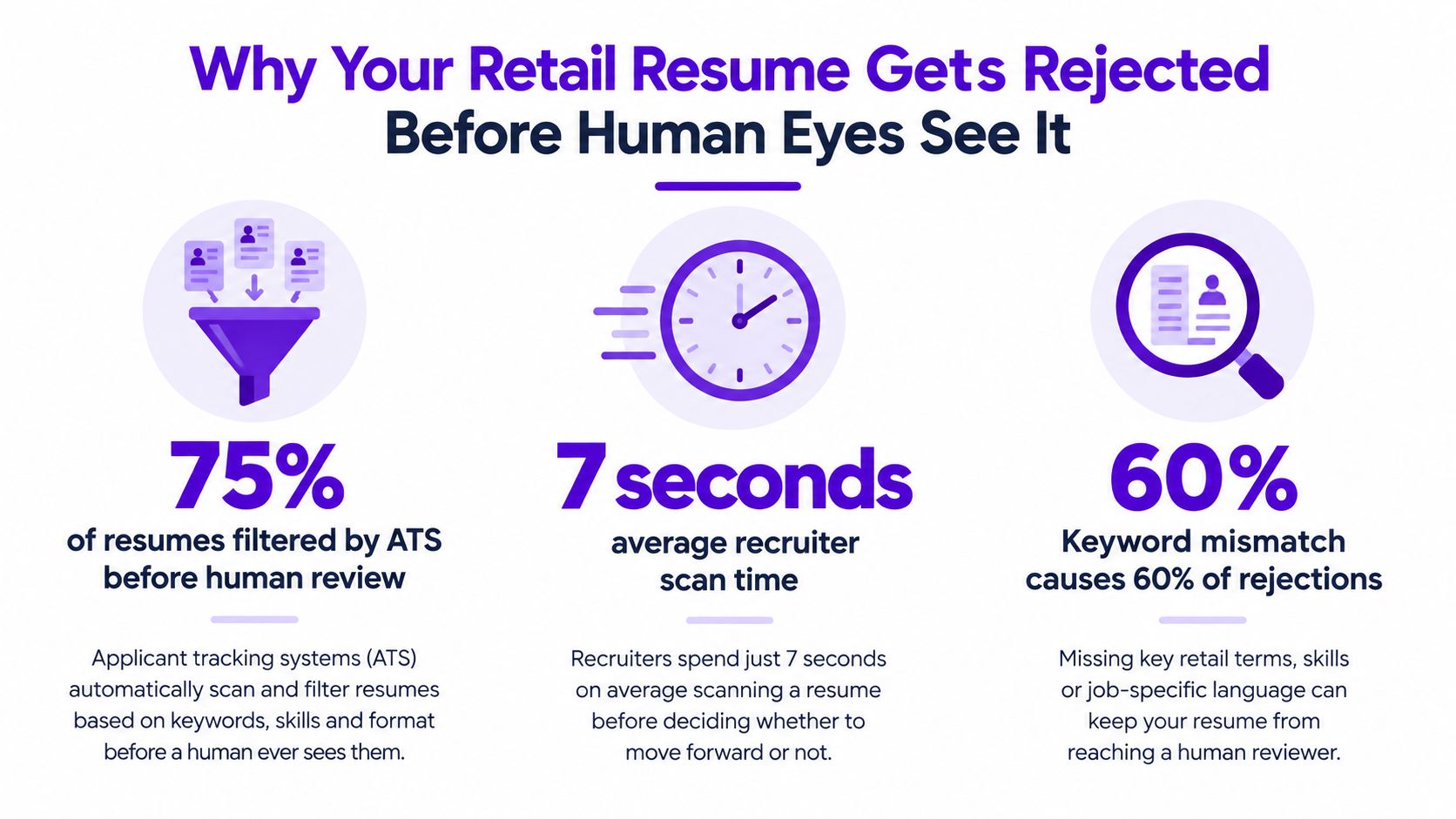
A candidate may have relevant customer service experience, dependable attendance, and the right attitude, yet still disappear from the hiring process. The reason is mechanical. Large retailers receive heavy application volumes, so software often sorts resumes before a recruiter evaluates them.
One 2026 industry analysis estimated that retail roles receive about 100 to 180 applications per opening, with an ATS rejection rate of 64% and a retail ATS filtering rate of 74% (industry analysis of retail ATS filtering rates). Those figures aren't a reason to add every possible keyword. They're a reason to make your resume easy to read, easy to parse, and closely aligned with the job posting.
What the software is looking for
Applicant-tracking systems extract fields such as your name, job titles, dates, skills, and employment history. The system may compare those fields with requirements in the posting. If your experience says “helped shoppers” but the employer asks for “customer service,” the meaning may be obvious to a person but less useful to a keyword match.
Common retail platforms include Workday, iCIMS, and Taleo. The same 2026 analysis identified them among frequently used systems, with reported shares of 41% for Workday, 29% for iCIMS, and 18% for Taleo (retail ATS platform analysis). Use standard headings such as Summary, Experience, Skills, and Education, and avoid text boxes, decorative columns, icons, and graphics that can interrupt parsing.
Practical rule: Design for clarity first. A plain reverse-chronological resume usually gives an ATS less to misread than a highly stylized template.
A useful overview of how applicant-tracking systems work can help you understand why a visually impressive file may still fail at the parsing stage. Save your document in the file type requested by the employer, use a conventional font, and check the extracted text by copying it into a plain-text editor before submitting.
The Essential Sections of a Winning Retail Resume
A strong retail resume has a predictable order. That predictability helps software identify the content and lets a hiring manager find the evidence quickly. Retail employers operate in a high-turnover environment, so recent, relevant contributions matter more than long descriptions of every task you've ever performed.
A 2026 retail resume guide cited annual retail employee turnover at roughly 60% and voluntary turnover at 26.7%, compared with a 13% national average. It also reported a 3.1% retail hire rate, about 603,000 retail job openings, and more than 70% of applications submitted on mobile devices (2026 retail resume guidance). The practical implication is clear: keep the document concise, scannable, and readable on a phone.
1. Contact details
Place your name, phone number, professional email address, city and state or region, and an up-to-date LinkedIn profile at the top. Don't include a full street address, personal identification details, or unrelated social media accounts.
Make the name the most prominent text. Keep contact details in ordinary text rather than a header or graphic so the ATS can capture them correctly.
2. Summary or objective
Use a summary if you have relevant retail, hospitality, food service, warehouse, or customer-facing experience. Mention your strongest match for the target role, such as POS operation, product knowledge, inventory work, sales support, or conflict resolution.
Use an objective when you're entering retail or changing industries. Focus on the value you can bring, not on what you hope the employer will teach you. For guidance on choosing between the two, compare resume summary versus objective.
3. Experience
Use reverse-chronological order. Each entry should include your job title, employer, location if relevant, and dates. Start with the most relevant evidence, then describe outcomes rather than reproducing a job description.
4. Skills
Create a focused list of skills that appear in the posting and that you can support elsewhere in the resume. Examples include customer service, POS, cash handling, inventory management, merchandising, product knowledge, conflict resolution, communication, and teamwork.
5. Education and additional evidence
List your school, qualification, and relevant training. If you lack formal retail experience, include volunteering, school activities, internships, language skills, or incomplete education when they demonstrate reliability or customer-facing ability.
Keep formatting consistent. Use the same date style throughout, align headings, and remove empty sections such as “References available on request.”
Translating Non-Retail Experience into Retail Value
A hotel receptionist, barista, warehouse assistant, caregiver, student, or volunteer may already have evidence a retail manager needs. The problem is usually translation. “Served customers” is accurate but too broad. “Handled customer requests, resolved service issues, and maintained accurate daily transactions” gives the reader a clearer picture of retail readiness.
Retail resume guidance often emphasizes generic skills such as teamwork and customer service, but applicants with limited experience need a stronger bridge from informal work to measurable retail behaviors (retail resume examples for transferable experience). Start by identifying the activity, the action you took, and the result or operating standard you supported.

Convert tasks into retail signals
A hiring manager isn't looking for a perfect industry label. They're looking for proof that you can manage customers, follow procedures, learn systems, and remain accurate during busy periods.
- Hospitality: Replace “checked in guests” with “welcomed guests, resolved service concerns, and coordinated requests across departments.”
- Food service: Replace “took orders” with “processed customer orders, handled payments, clarified preferences, and maintained service accuracy.”
- Warehouse work: Replace “moved stock” with “received, organized, and located inventory while following accuracy and safety procedures.”
- Campus activities: Replace “helped at events” with “guided attendees, answered questions, managed queues, and supported event operations.”
- Caregiving: Replace “looked after a family member” with “managed schedules, communicated changes clearly, and handled competing priorities reliably.”
- Volunteering: Replace “helped in a charity shop” with “sorted donations, replenished merchandise, assisted shoppers, and supported cash-register activity.”
Add evidence without inventing results
Use numbers only when you can verify them. A café schedule, transaction record, inventory count, customer feedback report, or supervisor note may help you identify legitimate measures. If you can't prove a number, describe the operating result qualitatively.
For example, “reduced customer wait times” is acceptable when you genuinely changed the process and can explain how. “Improved customer satisfaction by 30%” isn't acceptable unless that figure exists in your records.
A transferable skill becomes persuasive when the bullet shows the customer, the process, and the standard you protected.
Map each target requirement to one piece of evidence. If the posting requests cash handling, show payment processing. If it requests inventory accuracy, show stock checks or organized replenishment. If it requests conflict resolution, show how you handled a complaint without using confidential customer details.
The transferable skills identification guide can help you build this evidence map before rewriting your resume. Your goal isn't to pretend that non-retail work was retail. It's to make the relevant behaviors visible.
ATS Keywords and Systems for Retail Resumes
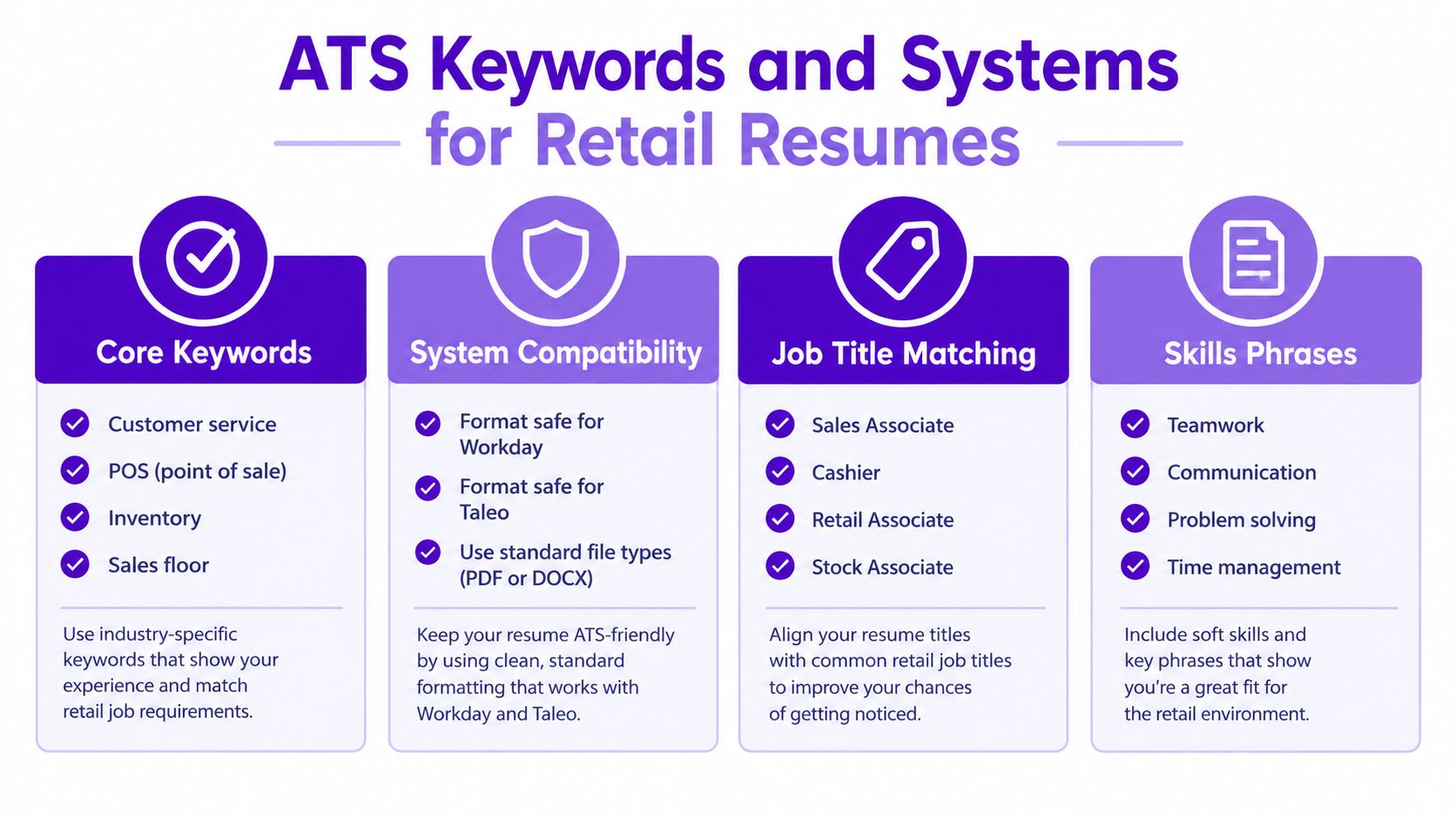
Keyword matching works best when it reflects the employer's language without making the resume sound artificial. Start with the job title, required skills, systems, and recurring responsibilities in the posting. Then use those terms in the summary, experience bullets, and skills section where they accurately describe your background.
Retail-focused guidance recommends matching the posting and using operational KPIs such as sales against target, units per transaction, shrink, and inventory accuracy rather than listing duties alone (retail resume KPI guidance). The same source cites a recruiter-eye tracking study that found resumes receive 7.4 seconds of initial attention on average, so the top third of your document must carry relevant information.
Build a controlled keyword set
Use exact wording when it accurately reflects your experience:
- Customer-facing terms: customer service, customer experience, product knowledge, communication, conflict resolution.
- Store operations: POS, cash handling, inventory management, merchandising, replenishment, sales floor.
- Performance language: sales target, units per transaction, shrink, inventory accuracy, upselling.
- Technology terms: name the POS, inventory, ordering, or scheduling systems you used.
- Job titles: use the title from the posting in your summary only when it describes the role you're seeking.
Don't paste a complete keyword list into a skills block. Recruiters notice unnatural repetition, and keyword stuffing doesn't demonstrate competence. A better approach is to place the most important terms inside credible achievement bullets.
Retail systems may parse standard text more reliably than columns, charts, skill bars, or image-based text. Use ordinary headings and consistent date formatting, then read the document as a hiring manager would. ATS resume keyword guidance offers a useful framework for checking whether your wording matches the target role without sacrificing readability.
A short visual explanation can reinforce the formatting principles discussed above:
Crafting Impactful Retail Resume Bullet Points
The difference between a duty list and a hiring argument is the evidence inside each bullet. Compare these two versions:
Weak: Responsible for helping customers and working on the register.
Stronger: Assisted customers with product selection, processed payments through the POS system, and resolved routine transaction questions.
The second version is better because it names the work. It still doesn't claim a result that the applicant can't prove.
Use the evidence you actually have
A reliable bullet usually combines an action, a retail process, and an outcome or standard. Outcomes can include sales performance, accurate inventory records, positive customer feedback, reliable cash handling, or smoother customer flow.
| Generic wording | Evidence-based wording |
|---|---|
| Helped with inventory | Completed stock checks and replenished the sales floor according to store procedures |
| Sold products | Matched customer needs with product features and supported purchase decisions |
| Handled complaints | Listened to customer concerns, explained available options, and escalated issues appropriately |
| Worked with a team | Coordinated handoffs with colleagues to keep service and replenishment moving |
| Used the register | Processed payments and followed cash-handling procedures through the POS system |
If you have verified figures, include them with context. Retail resume guidance specifically identifies sales versus target, units per transaction, shrink, and inventory accuracy as useful operational measures (retail resume metrics guidance). Don't add a number merely to make a bullet look impressive.
Show the situation behind the result
A simple structure based on situation, task, action, and result can prevent vague writing. These STAR method resume examples are useful when a bullet needs more context, especially for customer complaints, stock problems, or sales goals.
For example:
- “Supported store operations” becomes “Replenished priority merchandise, checked shelf availability, and reported stock discrepancies to the supervisor.”
- “Provided good customer service” becomes “Asked questions to identify customer needs, explained relevant product options, and supported an informed purchase.”
- “Prevented loss” becomes “Followed cash, stockroom, and closing procedures to protect merchandise and maintain operational accuracy.”
Start bullets with strong verbs such as assisted, processed, resolved, replenished, verified, organized, trained, recommended, and coordinated. Keep the most relevant bullets near the top of each role because the first scan determines whether the reader continues.
Final Checklist for Your Retail Job Resume
Before submitting, review the resume as both a parser and a store hiring manager. The parser needs clean text and recognizable labels. The manager needs an immediate answer to three questions: what can you do, where have you done it, and why does it match this store's needs?
Format and parsing
- Use standard sections: Label contact details, summary or objective, experience, skills, and education plainly.
- Check the file type: Follow the employer's instructions instead of assuming PDF or Word is preferred.
- Remove visual obstacles: Delete text boxes, graphics, unusual columns, icons, headers that hide contact details, and decorative skill bars.
- Test the text: Copy the finished resume into a plain-text document and check that names, dates, titles, and bullets remain in the right order.
- Read it on mobile: Zoom out and confirm that headings, line breaks, and bullet points remain easy to scan.
Content and targeting
- Match the posting directly: Use the employer's terms for customer service, POS, inventory, sales, or other requirements when they describe your experience.
- Lead with evidence: Put your most relevant operational achievement or capability near the top.
- Replace duty lists: Rewrite generic statements so each bullet shows an action, process, and verified outcome or standard.
- Include transferable proof: Add hospitality, food service, warehouse, volunteer, school, or caregiving evidence when it demonstrates retail behavior.
- Keep dates consistent: Use one format throughout and check for unexplained gaps or overlapping entries.
- Proofread contact details: One incorrect phone digit or email character can end the application before a recruiter reaches you.
Run this checklist for every application, not just the first. A master resume can hold your complete history, but the submitted version should contain the evidence most relevant to that particular store and role.
Eztrackr helps you save job postings, track applications, and use its resume builder to tailor your document to a specific retail description with keyword matching and ATS-focused suggestions. Visit Eztrackr to connect each application with the right resume version and keep your job search organized.