How to Write Thank You Email After Interview: A Quick Guide
You’ve just nailed the interview. You feel good about it. Now what? It's tempting to just kick back and wait for the phone to ring, but you're missing a golden opportunity.
That little thank-you email you're debating sending? It’s more than just good manners. It’s a strategic play that shows you're proactive, professional, and genuinely interested. In a tight job market, this simple step can be the thing that pushes you over the finish line.
Why This Email Is Your Secret Weapon
The post-interview thank-you is one of the most powerful—and most underutilized—tools in a job seeker's arsenal. It’s your first follow-up, and it instantly transforms you from just another name on a resume into a real, considerate person.
This is your chance to show your appreciation, subtly remind them of your key qualifications, and prove you have the communication skills they’re looking for.
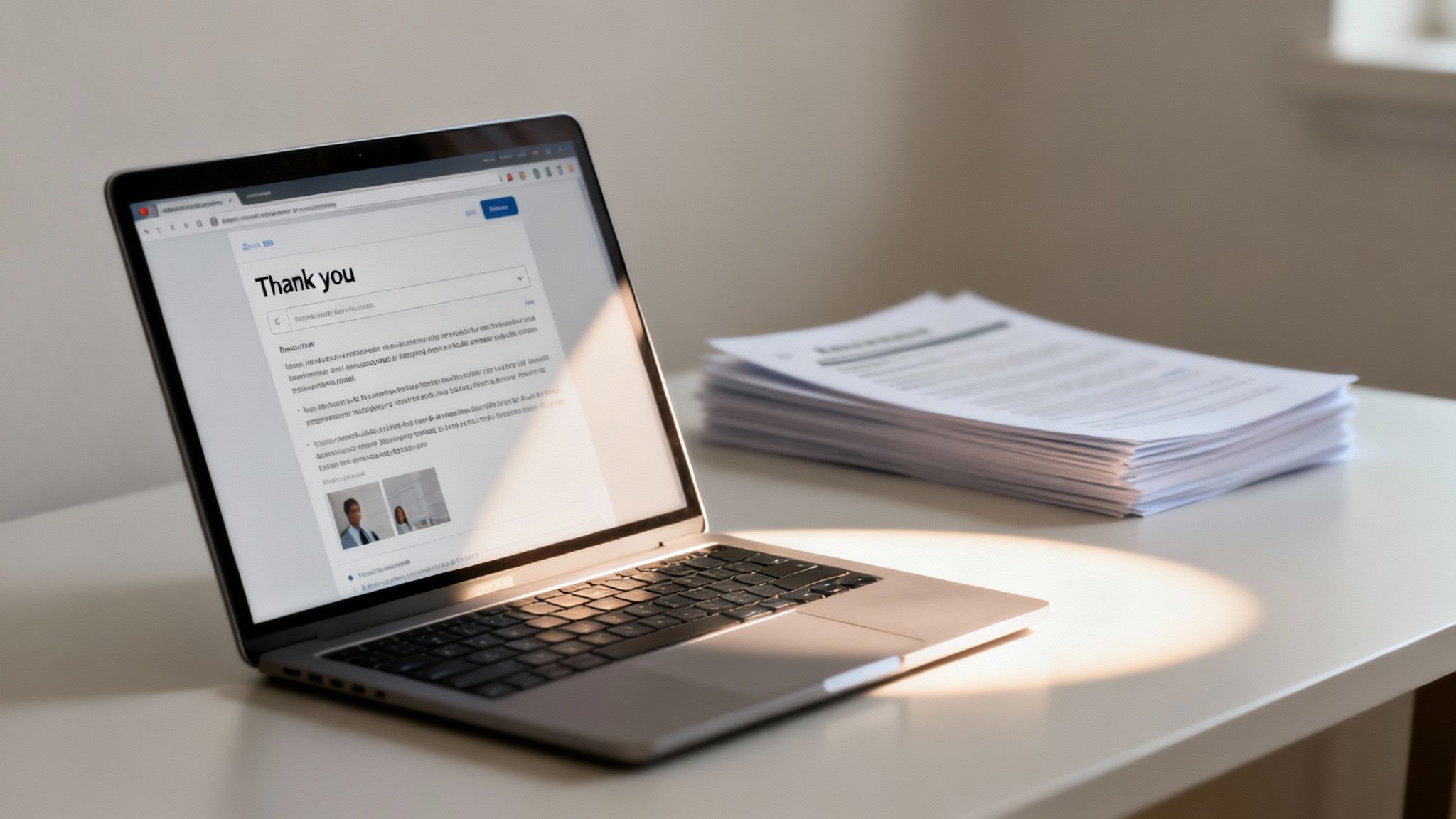
From Interview to Offer: Closing the Gap
Think of the thank-you note as the bridge between your interview and the job offer. Your performance in the room got you most of the way there, but this email can close that final gap. It keeps the conversation alive and keeps your name at the top of the pile while the hiring team makes its decision.
The numbers don't lie. A Breezy HR analysis uncovered a massive gap: while 80% of hiring managers say thank-you notes factor into their decisions, only 24% of applicants actually bother to send one.
That’s a huge opportunity for you to stand out with very little effort. If you want to dive deeper into the data, you can explore the full analysis on Wall Street Oasis.
Reinforce Your Value and Professionalism
A well-written email does so much more than just say "thanks." It's a multi-purpose tool.
- Confirm Your Interest: It shows you're still excited about the role and the company after learning more.
- Demonstrate Professionalism: It’s a mark of good follow-through and attention to detail.
- Add That One Last Point: It’s the perfect spot to mention a great skill or idea you forgot to bring up during the interview.
This email isn't just a formality; it's a final sales pitch. It's your last chance to articulate why you are the best fit for the role, solidifying the positive impression you made in person.
To get the most out of it, focus on mastering email etiquette for professionals. But remember, a great thank-you note can only follow a great interview. Brush up on our guide on how to improve interview skills to make sure you have plenty of good stuff to follow up on.
Crafting a Subject Line That Actually Gets Opened
Let’s be real: a hiring manager's inbox is a battlefield. Your thank-you email is just one of dozens, maybe even hundreds, of messages they'll see that day. A vague subject line like “Thank You” or “Following Up” is the digital equivalent of whispering in a crowded room—it’s going to get ignored.
Your first mission is to make sure your email even gets seen. A clear, specific subject line is how you do that. It needs to instantly tell the hiring manager who you are and why you're emailing them. This isn't just about being polite; it's about being effective.
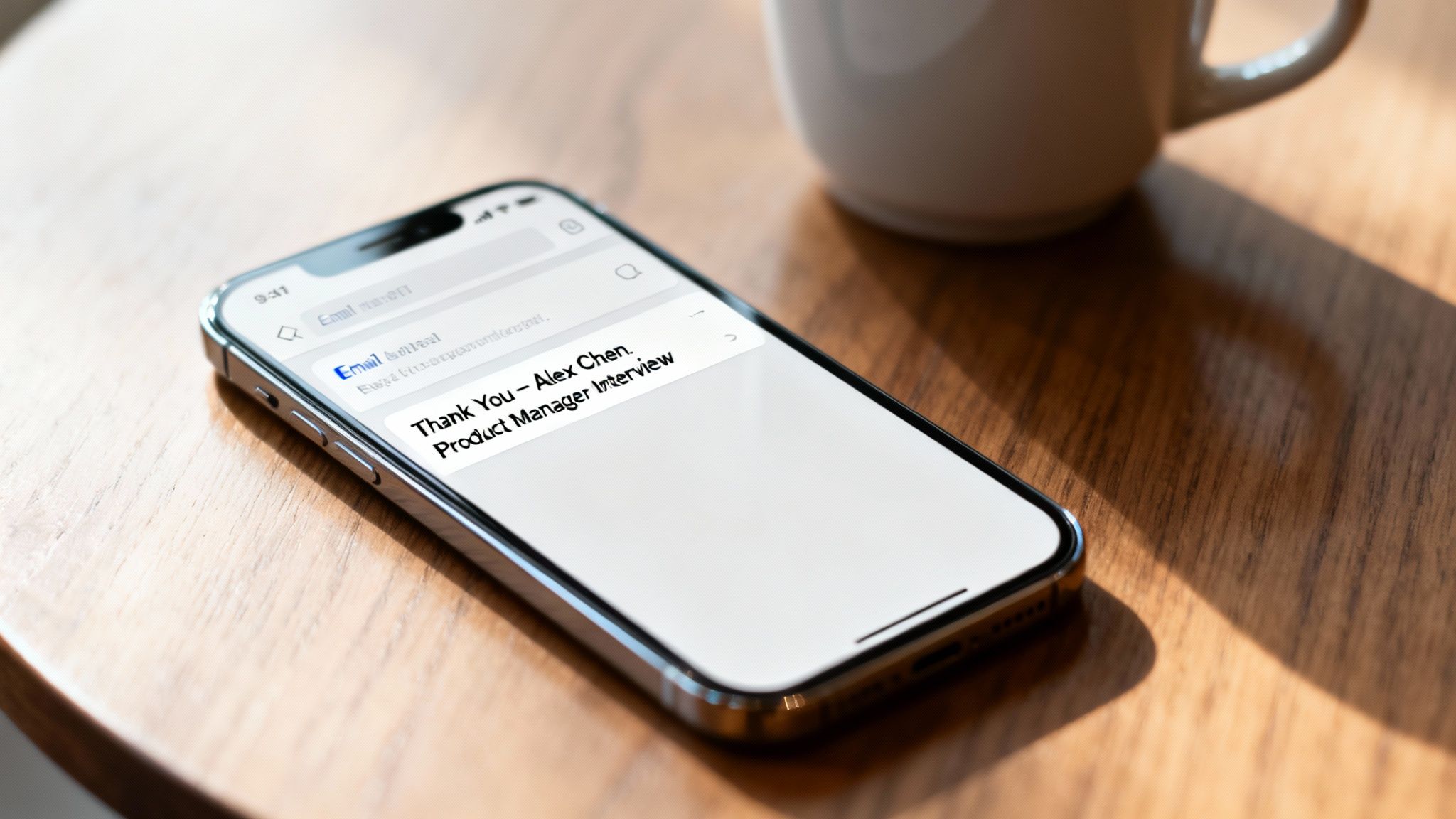
Simple Formulas That Work
You don't need to reinvent the wheel here. Clarity beats cleverness every single time. The goal is to make the interviewer's job as easy as possible. They should recognize your name and the interview context immediately, without any mental gymnastics.
Here are a few professional, no-nonsense subject line formulas that you can quickly adapt:
- Direct and Informative:
Thank you – [Job Title] Interview - A Bit More Personal:
Great speaking with you today, [Interviewer's Name] - Specific and Detailed:
Following up on our [Job Title] interview - Clear and Comprehensive:
Thank You – Interview for [Job Title] – [Your Name]
Your subject line acts as a digital handshake. A strong, clear one shows professionalism and respect for the recipient's time, setting a positive tone before they even open the message.
The non-negotiable part? Always include the job title. This is your lifeline, especially if the manager is interviewing for multiple roles. It instantly sorts you into the right mental folder for them. Honestly, mastering the art of crafting professional messages that get read is a career skill that pays dividends far beyond the job search.
Once that killer subject line gets your email opened, your first sentence has to stick the landing. Address the interviewer by name and get straight to the point by referencing the interview. If you want to really nail the finer points of digital communication, check out these excellent professional email writing tips to make sure every message you send is polished and impactful.
Connecting Your Skills to Their Biggest Challenges
This is where your thank-you email goes from a simple courtesy to a powerful closing argument. The body of the email is your last chance to drive home why you’re the one for the job. It's time to move past just saying "thanks" and start actively reminding them of the value you bring.
The best way to do this? Reference a specific challenge, goal, or interesting topic you talked about in the interview. This immediately proves you were paying close attention and are already thinking like a member of the team. It shows you’re not just looking for a paycheck; you’re genuinely invested in this specific opportunity.

Bridge Their Problem to Your Solution
Think back through the conversation. What kept the hiring manager up at night? Maybe they mentioned a nightmare with project management software adoption or a struggle to get customer retention numbers up. Your mission is to draw a direct line from that problem to a skill or experience you have.
This simple move transforms your email from a follow-up into a mini-case study, framing you as the problem-solver they’ve been looking for.
Key Takeaway: Stop just re-listing your skills. Instead, position your experience as the exact solution to a problem they mentioned. This makes your value concrete and helps them picture you in the role.
Let’s say the interviewer brought up their team's low social media engagement. You could write something like this:
"I really enjoyed our discussion about the challenges of growing organic social media engagement. It got me thinking about my work at [Previous Company], where I boosted our Instagram engagement by 40% in six months by rolling out a new content pillar strategy. I'm excited by the idea of bringing a similar approach to your team."
This one paragraph is a triple threat. It shows you:
- Were genuinely listening.
- Have a relevant, data-backed accomplishment.
- Are proactive and already brainstorming solutions.
Tailoring Your Message for Different Interviewers
So, what happens if you met with multiple people? Whatever you do, don't send the same generic, copy-pasted email to everyone. It’s a huge missed opportunity and, frankly, can come across as lazy. Each person you spoke with deserves their own unique email.
If you covered different ground with each person, your job is easy. Just focus on the unique points from each conversation.
- For the Hiring Manager: Connect your experience back to the high-level team goals they shared.
- For a Technical Interviewer: Bring up a specific coding problem or a technical roadblock you discussed.
- For a Culture-Fit Chat: Mention something about the team dynamic or company values that really clicked with you.
Even in a group interview, you can still add a personal touch. Try to remember a specific question one person asked you or an interesting point they made. Mentioning that small detail shows you see them as individuals, not just a panel. Learning how to write a thank you email after an interview is all about forging these small, memorable connections.
Closing Your Email with Confidence and Professionalism
Just like a firm handshake at the end of a great meeting, how you close your thank-you email leaves a lasting impression. It’s your last chance to reinforce your professionalism and show you’re a candidate who cares about the details.
The final paragraph needs to confidently circle back to your excitement for the role. This isn't a time for subtlety—be direct about your interest in the position and the company, but keep the tone enthusiastic, not desperate.
Reiterate and Sign Off
Your aim here is to leave the hiring manager with one final, positive thought. Keep it short and sweet. Focus on your genuine interest and what comes next.
A simple, effective closing line can make all the difference. Try something like this:
- "I'm genuinely excited about the possibility of joining the team and contributing to [Company Goal]."
- "Based on our conversation, I'm confident my skills are a great match for this role, and I'm looking forward to hearing about the next steps."
Don't underestimate this final touch. A survey of residency applicants found that 21.9% actually changed their program rankings after getting responses to their thank-you notes. As you can read more about on Breezy.hr, these follow-ups can have a real impact.
Your closing is your final handshake. Make it firm, confident, and professional. Avoid common mistakes like re-attaching your resume or using overly casual language like "Cheers" or "Talk soon."
Finally, pick a professional sign-off. You can’t go wrong with the classics.
- Best regards,
- Sincerely,
- Best,
- Respectfully,
All you need after that is your full name. This clean, polished ending wraps things up on a high note, cementing your image as a thoughtful and professional candidate.
When to Send Your Email (and Examples for Any Scenario)
The timing of your thank-you email is a bit of an art. Go too fast, and you might look a little desperate. Wait too long, and you risk fading from the interviewer's memory.
The sweet spot? Somewhere inside the 24-hour window after your conversation. This shows you're on the ball and genuinely interested, all while the details of your chat are still fresh in their mind.
Don't just take my word for it. This isn't some old-school formality people are forgetting. In competitive fields, it's standard practice. One study of medical residency applicants found that a staggering 76.8% sent thank-you notes, with most spending a good 15 minutes or more crafting them. It's a small step that makes a big impression, as detailed in these findings on post-interview communication.

To help you get it just right, here are a couple of go-to examples you can tweak for your own situation.
The Classic Professional (Corporate Roles)
This approach is your best bet for traditional, corporate settings. It's clean, respectful, and reinforces your skills without trying too hard. Think of it as the crisp, button-down shirt of thank-you notes.
Subject: Thank you – Marketing Manager Interview
Body: Dear [Interviewer Name],
Thank you again for your time today. I truly enjoyed learning more about the Marketing Manager position and the team's goals for the upcoming quarter.
Our conversation about the new market expansion project was particularly insightful. My experience in [mention a specific skill] aligns well with the challenges you described, and I’m confident I could help drive those initiatives forward.
I remain very interested in this opportunity and look forward to hearing about the next steps.
Best regards,
[Your Name]
The Enthusiastic Follow-Up (Startups or Creative Industries)
If you interviewed at a place with a more laid-back vibe, you can loosen up and let more of your personality shine through. This version shows you're not just qualified—you also get the culture.
Of course, knowing how to follow up on job applications in general is a skill that pays off at every stage of the search.
- Subject: Great connecting today!
- Body: Hi [Interviewer Name], Thanks so much for the great conversation earlier! I left feeling even more excited about the [Job Title] role and the creative energy at [Company Name]. I especially loved hearing about [mention a specific project or company value]. It sounds like a fantastic environment to be a part of. Thanks again, and I hope we can talk again soon! Best, [Your Name]
Common Questions About Post-Interview Emails
Even with the perfect template in hand, you’re bound to run into some tricky situations. Let’s walk through a few of the most common questions that come up after an interview.
What If I Don’t Have Their Email Address?
This happens more than you'd think. If a recruiter or HR coordinator was your main point of contact, it’s completely fine to send your thank-you note to them. Just add a simple line asking them to forward your message to the interviewer(s). Easy.
Feeling like a detective? You could try a quick search on LinkedIn or guess a common company email format like firstname.lastname@company.com. Sometimes it works, but going through HR is always the safest bet.
Is a Handwritten Note a Good Idea?
A handwritten note is a classy gesture, no doubt about it. But in the world of modern hiring, it’s just too slow. An email that lands in their inbox within 24 hours is the gold standard for being timely and professional.
For very traditional industries or maybe a C-suite role, a physical card can be a nice touch. But think of it as a bonus—it should be sent in addition to, not instead of, that prompt thank-you email.
What If I Don't Get a Reply?
First, don't panic. Hiring managers are juggling a million things, and not replying to a thank-you note is incredibly common. Seriously, a lack of response is not a bad sign.
Your thank-you email's job is to make a final, positive impression, not to start another conversation. Assume it was received and appreciated, and wait for the official next steps.
Now, if their stated decision deadline comes and goes with radio silence, then it’s appropriate to send a separate, polite follow-up. The approach is a bit different, and it helps to understand how to ask for feedback professionally, since some of the same principles apply.
Ready to stop juggling spreadsheets and start landing interviews? Eztrackr helps you manage your job search with a powerful Kanban board, AI-powered tools for resumes and cover letters, and insightful analytics. See why 45,000+ job seekers trust us to stay organized and motivated. Streamline your job hunt today at https://eztrackr.app