How to Improve Interview Skills and Land Your Next Job
If you want to get better at interviewing, you need to start long before you ever step into the room (or log onto the Zoom call). The real work happens behind the scenes.
It's about tearing apart job descriptions to figure out what the hiring manager actually wants, doing some real detective work on the company, and building an arsenal of your best career stories. When you do this, you stop reacting and start leading the conversation. It turns a scary interrogation into a confident chat between two professionals.
Build a Foundation of Confidence Before the Interview
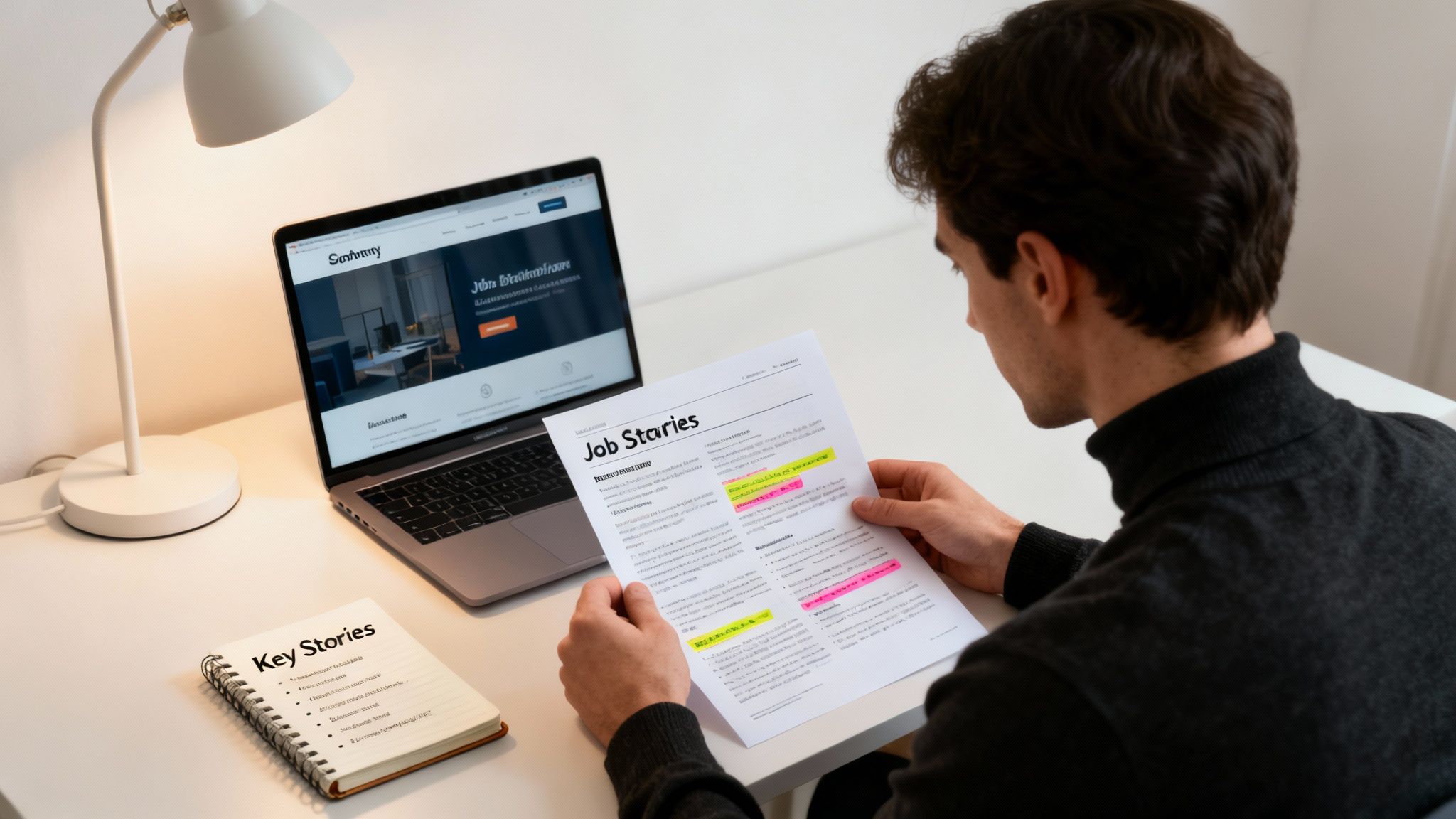
The secret to crushing an interview is walking in with unshakeable confidence. And I don’t mean faking it. Real confidence comes from deep preparation that lets you be yourself and think on your feet. When you genuinely understand the role, the company, and what you bring to the table, you can handle whatever they throw at you.
This prep work completely changes your mindset. You're no longer a candidate just asking for a job; you're a problem-solver showing them how you can help. If nerves are a major hurdle for you, tackling them head-on can be a game-changer. Learning how to reduce social anxiety is a practical step that can seriously boost that pre-interview calm.
Deconstruct the Job Description
That job description? It’s your cheat sheet. Seriously. Don't just give it a quick scan—print it out, grab a highlighter, and go to town. Zero in on the absolute core responsibilities and the must-have qualifications.
As you do this, you’ll start seeing patterns. Group the related points into bigger themes like "Team Collaboration," "Technical SEO," or "Client-Facing Communication." These are the pillars of the job. Your entire mission is to prove you've got those pillars covered. We actually break this down even further in our guide on how to prepare for a job interview.
Create Your Story Library
Okay, for each of those themes you just identified, you need a story. A real one. Think back to a time you nailed a complex project or turned an unhappy client into your biggest fan.
This is where you build your "Story Library"—a collection of your greatest career wins. Having these ready means you won't be fumbling for an answer when they hit you with "Tell me about a time when…"
A tool like Eztrackr is perfect for this. You can log each story and even link it to the specific jobs you're targeting. No more last-minute panic.
A well-prepared candidate doesn’t just answer questions—they tell compelling stories that prove their capabilities. Each story should be a mini case study of your success.
Go Beyond the Company Website
If your research stops at the company's "About Us" page, you're not digging deep enough. To really impress them, you need to know what's happening with their business right now.
Here's a quick checklist for your deep-dive:
- Recent News: What have they announced in the last six months? Look for press releases or major news articles.
- Leadership Insights: Check out the CEO's or other leaders' LinkedIn posts or recent interviews. What are they talking about?
- Product/Service Updates: Have they launched anything new? Get a handle on their latest and greatest offerings.
This level of detail is what allows you to ask smart, insightful questions that prove you’re genuinely invested. You'll sound less like a candidate and more like a future colleague.
Let's pull all this together. Building a strong pre-interview foundation is about methodical, focused effort.
Your Pre-Interview Preparation Checklist
A quick summary of the essential preparation stages that build a strong foundation for interview success.
| Pillar | Key Action | Desired Outcome |
|---|---|---|
| Analysis | Deconstruct the job description into key themes. | A clear understanding of the role's core requirements. |
| Storytelling | Build a library of career stories for each theme. | A ready arsenal of examples for behavioral questions. |
| Research | Investigate recent company news, leadership, and products. | The ability to ask insightful, impressive questions. |
| Mindset | Shift from "asking for a job" to "offering a solution." | Genuine confidence and a professional, conversational tone. |
By checking these boxes, you're not just preparing answers—you're building a comprehensive case for why you are the right person for the job.
Master the Art of the Behavioral Answer

You know the moment. The interviewer leans in and says, “Tell me about a time when…” and your mind goes blank.
These behavioral questions aren’t meant to trip you up. Far from it. They’re designed to see how you’ve handled real-world situations in the past, which is the best predictor of how you’ll perform in the future. The secret isn't a pre-written script; it's learning how to tell a great story.
And for that, you need the STAR method. It's a simple framework that helps you structure your answers to be clear, compelling, and full of proof of your value. Think of it as your guide to a knockout narrative.
Deconstructing the STAR Method
Let's break down exactly what each letter means and how you can use it to turn a vague question into a powerful example of your skills.
- Situation: First, set the scene. Briefly describe the context. Just a sentence or two is all you need to give the interviewer the lay of the land.
- Task: What was your specific goal or responsibility? What problem were you assigned to solve? This part clarifies your exact role in the story.
- Action: Now we get to the heart of it. Detail the specific steps you took to handle the task. Use strong action verbs and focus on your individual contributions, not just what the team did.
- Result: What happened because of your actions? This is where you bring it home by connecting your work to a real business impact. Use numbers to quantify your success whenever you can.
Here's a pro tip: The biggest mistake I see candidates make is spending way too much time on the Situation and Task. You should aim to dedicate at least 60% of your answer to the Action and Result. That’s where you truly shine.
Trying to build these stories on the fly is tough. If you need some help getting your thoughts organized, using an AI interview answer generator can be a great way to structure your ideas and practice your delivery.
Putting STAR into Practice
Let's walk through a classic question: “Tell me about a time you had to deal with a difficult client.”
Situation: "In my last role as a project manager, we were rolling out a new software feature for a major client. They were consistently missing their feedback deadlines, which was starting to jeopardize the whole project timeline."
Task: "My job was to get the project back on track without souring our relationship with this client, who was a key account for us."
Action: "I started by setting up a one-on-one call to understand what was causing the delays. I found out their team was swamped and understaffed. So, I created a much simpler feedback template and re-worked the schedule to have fewer, more consolidated review sessions. This cut down their required meeting time by 40%."
Result: "It worked. They hit every single one of the new deadlines. We launched the feature on time, and the client was so happy with how we handled the situation that they signed on for another year."
Handling Questions About Failure with STAR-L
So, what happens when they ask about a time you messed up? This is a test of your self-awareness and your capacity to learn. For these questions, just add one more letter: STAR-L.
The "L" stands for Learning.
After you've explained the Result (which, in this case, might not be a good one), you cap it off by explaining what you learned from the whole thing.
- Learning: "That experience taught me just how critical it is to establish clear expectations and a formal change-request process right from the start. I’ve used that system on every project since, and it's been invaluable in preventing scope creep."
This simple addition transforms a story about a mistake into a powerful example of your resilience and professional growth—exactly what every employer wants to see.
Turn Practice and Feedback into Performance

Knowing the right answers and having perfectly crafted STAR-method stories is a great start, but it's only half the battle. The real test comes when you have to deliver those answers clearly and confidently with the pressure on.
This is where the rubber meets the road. Rehearsal is what turns your carefully prepared notes into muscle memory. It helps you smooth out clunky phrases, nail your pacing, and build the kind of genuine confidence that only comes from actually doing it. You’re not trying to memorize a script; you're trying to get so comfortable with your stories that you can tell them naturally, no matter what curveballs come your way.
Setting Up Your Mock Interview
You've got a few solid options here, and each one offers something a little different. The most important thing? Treat it like the real deal. That means dressing the part, finding a quiet space, and committing to the role.
- Practice with a mentor or peer: Find a trusted colleague in your field. They'll ask the kind of pointed, industry-specific questions you're guaranteed to face.
- Ask a friend: Even if they don’t know the ins and outs of your industry, a friend is perfect for spotting weird body language or verbal tics you don't notice.
- Record yourself: This is a game-changer. Seriously. Use your webcam or phone to record yourself answering a few common questions. It’s the most direct way to see exactly what the interviewer sees.
Whichever path you take, the goal is to mimic the interview environment as closely as possible. This is a core part of learning how to improve interview skills because it builds your resilience to the inevitable stress of a live interview.
I know, I know—watching a recording of yourself can feel cringe-worthy. But it's hands-down the fastest way to spot and fix distracting habits. Did you say "um" twelve times? Were you fidgeting? Avoiding eye contact with the camera? This kind of self-awareness is pure gold.
A Framework for Actionable Feedback
"You did great!" feels nice to hear, but it does absolutely nothing to help you improve. You need targeted, constructive criticism to actually get better. Ask your practice partner to focus on a few key areas, or use this rubric when you're reviewing your own recording.
For a deeper dive, check out our guide on effective job interview practice. It’s packed with more frameworks to make every rehearsal count.
The Performance Review Rubric
Use a simple 1-5 scoring system for each category. This will help you quickly pinpoint what's working and what needs work.
| Category | What to Look For |
|---|---|
| Clarity & Conciseness | Was your answer easy to follow? Did you get straight to the point without rambling? |
| Confidence & Body Language | Did you maintain good posture and solid eye contact (with the camera!)? Was your tone steady? |
| STAR Method Execution | For behavioral questions, did you clearly lay out the Situation, Task, Action, and a quantifiable Result? |
| Vocal Fillers | How many times did you use crutch words like "um," "ah," "like," or "you know"? |
This structured feedback loop is everything. After each practice run, pick just one or two specific things to focus on next time. Maybe it's cutting down on "likes" or making sure every STAR story ends with a hard number.
This cycle of practice, feedback, and refinement is what turns a good candidate into a truly memorable one. It’s how you stop just knowing your material and start owning it.
Navigate Difficult Questions with Confidence
Let's be real. Every interview has that moment. The one that makes your heart skip a beat. It might be a question you never saw coming, a tricky hypothetical scenario, or the dreaded talk about salary expectations. Nailing these moments is a huge part of learning how to improve interview skills.
These high-stakes questions aren't there to trip you up. Hiring managers want to see how you think on your feet and handle pressure. The secret isn't having a perfect, rehearsed answer for every possible question. It's about having a solid framework for thinking clearly and staying cool, even when you're caught off guard.
When you get hit with a tough question, the most powerful thing you can do is pause. Just for a second. Take a breath and actually think. That small pause shows confidence and stops you from rambling.
When You Dont Know the Answer
It happens to the best of us. You get a technical question or a brain-teaser that leaves you drawing a complete blank. Don't panic—that’s the worst thing you can do.
Instead, just be upfront about it and talk them through how you would figure it out. This clever pivot changes the focus from "Do you know this specific fact?" to "How do you solve problems?"—which is what they really care about anyway.
For instance, you could say something like, "That's a great question. I haven't actually used that specific software, but my first step would be to dive into the official documentation. After that, I’d search for case studies to see how other companies in our industry have used it to avoid any common rookie mistakes."
Handling Gaps and Terminations
Questions about gaps in your resume or why you left a previous job can feel pretty personal and awkward. The goal here is to be honest without oversharing or getting defensive.
Keep your answer short, positive, and focused on what you learned or did during that time. You can frame the experience as a period of growth or a strategic move in your career.
A past setback doesn't have to define your story. A career gap can be a "sabbatical for professional development," and a layoff can be explained as a "company-wide restructuring that led me to find an opportunity that aligns better with my long-term goals."
Approaching Hypothetical Scenarios
Interviewers love "what if" questions because they reveal your judgment and how you strategize. When you get one, fight the urge to jump straight to a solution.
Break the problem down into smaller pieces. Think out loud, explaining your assumptions and the logic behind your thought process. It shows you’re methodical, not impulsive.
Try this simple framework:
- Clarify: Ask a few questions to make sure you've got the full picture.
- Structure: Outline the steps you’d take to tackle the problem.
- Conclude: Offer your solution, but also mention any variables that could change your approach.
The best way to get good at these is just practice. Using an interview question generator can throw a wide range of prompts your way, building up the mental muscle you need to handle anything. This kind of prep turns even the toughest questions into a chance to show off just how well you think.
Make a Lasting Impression Beyond Your Answers

Think the interview is over once the last question is answered? Think again. The final few moments—and what you do immediately after—can be just as crucial as any answer you gave. This is your chance to pivot from a candidate on the spot to a thoughtful professional having a real conversation.
It’s easy to get so wrapped up in perfecting your answers that you forget about the little things. But it's those finishing touches, like how you listen, the questions you ask, and your follow-up, that separate a good candidate from a great one. These details show your professionalism and genuine interest in a way a rehearsed answer never could.
Build Rapport Through Active Listening
This sounds obvious, but you’d be surprised how many people are just waiting for their turn to talk. Don't be one of them. Show you're locked in by nodding, maintaining eye contact, and using small verbal cues like, "I see," or "That's interesting." It’s not just about being polite; it’s about building a genuine connection.
When an interviewer mentions a specific team project or a company-wide challenge, they're handing you a golden opportunity. File it away. Later on, you can circle back with something like, "You mentioned the challenge with user retention earlier, and that really connects with a project I worked on where I…" It’s a simple move that proves you were paying close attention.
Ask Questions That Show You’re a Strategic Thinker
When the tables turn and they ask, "Do you have any questions for us?"—this is your moment. It’s not a formality; it's your chance to interview them and show you’re thinking bigger than just the job description. Steer clear of basic questions about salary or benefits unless they bring it up first.
Instead, dig deeper with questions that highlight your professional curiosity and forward-thinking mindset.
- "What would success in this role look like in the first 90 days?"
- "Could you walk me through the team's biggest challenge right now and how this position would help solve it?"
- "From your perspective, what are the most important qualities for someone to really excel on this team?"
These kinds of questions instantly reframe the conversation. You’re no longer just being evaluated; you’re positioning yourself as a problem-solver who is already figuring out how to deliver value.
Craft the Perfect Thank-You Note
Sending a prompt, personalized thank-you email is non-negotiable. Seriously. Most hiring managers expect one, yet a shocking number of candidates skip this step. Make sure you get yours out the door within 24 hours of the interview.
This is your final opportunity to drive home your value. Don't just send a generic, "Thanks for your time." Add a personal touch by referencing something specific from your conversation that really stuck with you.
For example: "I especially enjoyed our discussion about the upcoming platform migration. It sounds like a fascinating challenge, and it reinforced my excitement about how my background in X could support the team's goals." That one extra sentence makes your message memorable and subtly reminds them exactly why you’re the right person for the job.
Your Top Interview Questions, Answered
Let's face it, interviews can be tricky. Even with tons of prep, certain questions and situations always seem to pop up. Here are some quick, real-world answers to the questions I hear most often from job seekers.
How Long Should My Answers Be?
You're looking for the Goldilocks zone: not too short, not too long. The sweet spot is usually between 60 and 90 seconds.
That gives you enough runway to tell a compelling story, maybe using a framework like the STAR method, without seeing the interviewer's eyes glaze over. If you’re consistently going past the two-minute mark, you’re probably rambling. Time yourself when you practice. It feels awkward at first, but it's the best way to get a natural rhythm down.
Remember, a sharp, focused story always beats a long, meandering one. If you see the interviewer start to nod or look like they want to jump in, that's your cue to land the plane.
What Should I Do If I Get Nervous?
First off, take a breath. Feeling nervous is totally normal—it just means you care. The goal isn't to eliminate the nerves, but to manage them.
Before the interview even starts, try some slow, deep breathing to calm your system. If you feel a wave of anxiety hit you mid-answer, just pause. Take a sip of water. It's a natural way to buy yourself a second to regroup. The best defense, though? Solid preparation. Confidence isn't about being fearless; it's about knowing you've put in the work.
How Do I Talk About My Weaknesses?
Please, don't say you're a "perfectionist." Interviewers have heard it a million times. Instead, be genuine. Pick a real, but minor, weakness that you've actively been working on.
Here’s a simple, honest formula that works every time:
- Name the Weakness: Be direct. Maybe it's delegating tasks effectively or feeling anxious about public speaking.
- Show Your Work: What have you done about it? Talk about a course you took, a project management tool you started using, or how you've been asking for feedback from your manager.
- End on a High Note: Explain how tackling this has made you better at your job.
This approach shows you're self-aware and dedicated to growth, which is exactly what hiring managers want to see.
Is It Okay to Ask for Feedback After a Rejection?
Yes, absolutely—as long as you do it with grace. You're not trying to argue their decision. You're trying to learn.
A day or two after the rejection, send a short, polite email. Thank them again for the opportunity and ask if they’d be willing to share any feedback that might help you in your job search. Most won't have the time to reply, and that's okay. But when someone does, the insight you get can be pure gold for your next interview.
Nailing these little details is a huge part of learning how to improve interview skills. When you use Eztrackr to keep your applications organized, you free up mental energy to focus on what really counts—showing up and crushing the interview. Get your job search under control at https://eztrackr.app.