8 Sample Pharmacist Resumes That Get Noticed
The strongest pharmacist resume isn't the one packed with the most clinical terminology. It's the one that mirrors the target role's priorities, then proves readiness with relevant evidence. That matters in a profession with about 325,200 pharmacist jobs, a 2025 median annual pay of $140,910, and a projected 5% employment increase from 2025 to 2035, according to the U.S. Bureau of Labor Statistics pharmacist overview.
The eight sample pharmacist resumes below take different directions, from new graduate and hospital roles to oncology, geriatrics, retail leadership, and pharmaceutical industry work. For each model, inspect four things: the target audience, evidence of impact, ATS language, and proof of readiness. You'll also see how formatting choices affect scanning and which next action turns a generic draft into a role-specific application.
Eztrackr can help if you're comparing several opportunities. You can save job postings, compare requirements, and use its resume builder or skill-match analyzer while tailoring each version. The tool matters less than the method: identify what the employer values, match it truthfully, and make the evidence easy to find.
1. Entry-Level New Graduate Pharmacist Resume With Internship Emphasis
A new graduate resume has to make supervised experience feel relevant without pretending it was independent practice. The best structure places Pharm.D. education, licensure status, rotations, internships, and applied projects near the top, then explains what the candidate did in each setting.
A weak version lists “completed clinical rotations” and “assisted with pharmacy operations.” A stronger version names the environment and the work: reviewed medication profiles during an internal medicine rotation, prepared patient counseling materials in a community pharmacy, or supported medication reconciliation under pharmacist supervision. If a task involved drug interaction screening, dosing calculations, immunizations, prescription verification, or patient education, say so in the language used by the posting.
Treat substantial rotations as clinical experience, not as a footnote under education. Include the practice setting, specialty area, responsibilities, systems used, and any accepted intervention or completed project. Don't add a GPA unless it strengthens the application. If you include one, the plan should be to use it only when it's a strong academic signal.
What to emphasize
- Rotation evidence: Show the clinical question you worked on, the workflow you supported, or the intervention you presented.
- Technician experience: Translate dispensing, inventory, insurance adjudication, or customer counseling into pharmacist-relevant capabilities.
- Readiness signals: List Pharm.D. completion, state license or pending status, immunization training, CPR or BLS credentials, and relevant certifications.
- Career direction: Make the summary specific, such as “Pharmacist candidate pursuing acute care and medication safety roles,” rather than “hard-working Pharm.D. graduate.”
A recent graduate applying to a hospital should not lead with retail cashiering or a broad list of soft skills. That material can remain, but it belongs below rotation evidence that demonstrates clinical judgment and familiarity with interdisciplinary care.
Practical rule: Every rotation should answer three questions: where did you work, what pharmacy problem did you handle, and what changed because of your contribution?
Use this guide to writing a resume for internships when you need to turn limited experience into focused evidence. A clean, single-column format will help the ATS parse section headings, dates, credentials, and keywords without relying on graphics or text boxes.
2. Hospital Inpatient Pharmacist Resume With Clinical Rounding Focus
A strong inpatient pharmacist resume makes clinical participation visible within seconds. Hiring teams look for evidence of interdisciplinary rounds, medication safety programs, drug utilization review, formulary decisions, sterile compounding, and protocol-based care, not a generic list of dispensing tasks.
Choose a role label that matches the posting, such as “Inpatient Pharmacist,” “Clinical Staff Pharmacist,” or “Acute Care Pharmacist.” Your summary should connect the hospital setting to the work you performed. Name internal medicine, critical care, infectious disease, or emergency medicine only when your experience supports those specialties.
Use the Bureau of Labor Statistics' pharmacist information as a broad role reference, then narrow your resume to inpatient proof. Mirror the posting's collaboration language. Terms such as interdisciplinary rounds, antimicrobial stewardship, medication-use evaluation, and medication safety signal clinical integration, while order processing alone can suggest a dispensing-focused background.
The experience section should lead with interventions and decisions. “Verified medication orders” establishes a duty, but it does not show judgment. Explain whether you identified interactions, adjusted dosing, supported renal or hepatic monitoring, contributed to antimicrobial stewardship, or helped prevent medication errors. Include Epic Willow, Cerner, Pyxis, Omnicell, or another system only when you used it directly.
Build the evidence around safety
A hospital resume gains credibility when each bullet shows the pharmacist's place in a safety system. Describe near-miss identification, medication reconciliation, high-alert medication review, adverse event prevention, quality improvement projects, or committee work. State the clinical problem, your action, and the decision or workflow that followed.
Use qualitative wording when your records do not support a defensible measure, such as “documented medication safety interventions adopted by the clinical team.” If verified internal measures exist, present the baseline, action, and result clearly.
A useful example might show a pharmacist joining daily rounds, reviewing therapy plans, documenting drug interaction interventions, and contributing to a medication-use evaluation. The point is to show how the applicant improves care within a regulated hospital workflow. Keep the layout single-column so ATS software can parse headings, dates, credentials, and keywords without graphics or text boxes.

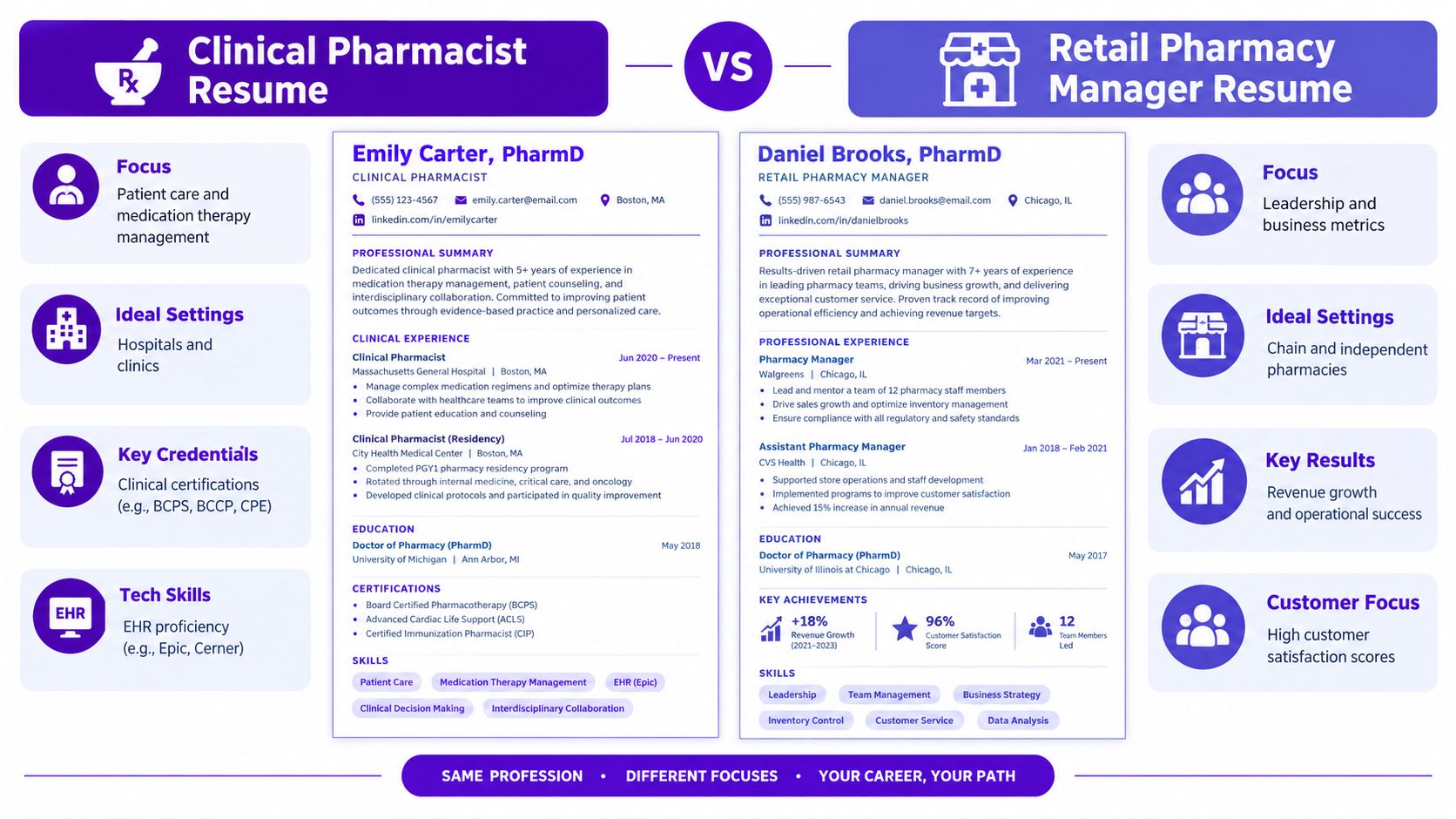
3. Clinical Pharmacist Resume With Patient Care Focus
A clinical pharmacist resume should make the patient visible. The hiring manager needs to understand how you assessed medication therapy, communicated recommendations, followed up with patients, and worked with prescribers to improve treatment.
Lead with medication therapy management, clinical interventions, medication reconciliation, therapeutic drug monitoring, patient counseling, and chronic disease support when those terms match the role. A clinical summary can also identify the care setting, patient population, and major specialty area. “Clinical pharmacist” alone is too broad to distinguish an ambulatory practitioner from an acute care specialist.
The experience bullets should follow a patient-care sequence: assess, intervene, educate, and monitor. For instance, describe reviewing a medication regimen, identifying a safety concern, discussing an adjustment with the care team, and documenting follow-up. Don't turn every bullet into a list of procedures. The resume should show judgment and communication as well as technical competence.
Make ATS language serve the reader
Exact terminology helps an ATS recognize relevance, but keyword stuffing makes the document harder for a person to trust. Use the job description's language naturally in the summary, experience bullets, and skills section. The pharmacist skills guidance from Jobscan identifies terms such as medication therapy management, prescription verification, drug interaction screening, dosing calculations, patient counseling, immunizations, drug utilization review, and pharmacy systems including Epic, Cerner, and PioneerRx.
Credentials deserve a prominent location. Put Pharm.D., active state licensure, board certification, residency training, and relevant life-support or immunization credentials where they can be found quickly. Don't bury a BCPS, BCACP, or other applicable certification inside a long skills block.
Consider a clinical pharmacist working in a specialty clinic. The strongest version won't merely say the pharmacist “managed medications.” It will explain the patient-care service, the treatment area, the collaborative relationship, and the type of intervention documented. That approach works for hospital, clinic, specialty, and transitions-of-care positions.
For more guidance on presenting healthcare capabilities, use this resource on healthcare resume skills. Then remove any keyword that doesn't reflect your actual practice.

4. Ambulatory Care and Primary Care Pharmacist Resume
Ambulatory care employers hire for a defined care model, so the resume must prove longitudinal patient management rather than general pharmacy capability. Lead with the population, setting, and decisions you made for patients over time.
A primary care resume may feature diabetes, hypertension, asthma, preventive care, health literacy, and access barriers. A community health center may value coordination with social services, while an urgent care employer may prioritize medication reconciliation, acute treatment recommendations, counseling, and communication across locations. Select the evidence that matches the posting.
Turn collaboration into documented practice
“Worked with physicians” provides little hiring value. Name the structure when accurate, such as a collaborative practice agreement, protocol-based medication adjustment, shared patient visits, referral management, or case conferences. Then state your scope, the recommendation or adjustment you made, and how you documented or communicated it.
A useful bullet might describe adjusting therapy under an approved protocol, following up with a patient after a medication change, and reporting the outcome to the care team. This format shows authorization, clinical judgment, communication, and follow-through in one compact example.
Retail pharmacists can frame their transition carefully. Immunization delivery, patient counseling, medication therapy management, adherence conversations, and high-volume prioritization transfer well. Add clinic projects, clinical rotations, continuing education, or documented patient-care work to show preparation for chronic disease management.
Broader employment context, such as the National Pharmacist Workforce Study reporting summarized by Drug Channels, should not replace practice-specific evidence. An ambulatory employer needs proof that matches its patients, workflows, and collaborative authority.
Use a focused skills line for chronic disease management, patient counseling, medication reconciliation, preventive care, immunizations, collaborative practice, and the clinical software you use. Keep the format easy to scan: credentials and setting near the top, evidence-led bullets below, and keywords that reflect documented work. Your next action is to compare each bullet with the target posting and replace broad duties with one patient-care example.
5. Retail Pharmacy Manager Resume With Leadership Emphasis
A retail pharmacy manager resume must prove leadership through operating decisions, not a manager title alone. Show how you directed technicians, protected compliance, improved workflow, controlled inventory, and maintained patient service during the pressure of a community pharmacy.
Open with the size and scope of your responsibility. Include technician supervision, intern development, scheduling, controlled-substance compliance, inspection readiness, inventory management, immunization programs, and patient counseling when those duties are documented in your record. State the setting and leadership level clearly so a hiring manager can distinguish store-level management from occasional shift coordination.
Replace task lists with operating evidence
“Managed pharmacy operations” is too broad to carry much weight. Replace it with the problem, decision, and result you can support. A stronger bullet might explain how you reorganized verification, coached technicians on error-prevention steps, tightened inventory controls, or introduced a patient-care service that supported adherence conversations. Include business results only when records verify them. Do not invent sales growth, satisfaction scores, retention improvements, or prescription volume.
Your audience should control your keyword choices. Retail postings may prioritize prescription verification, immunization administration, patient counseling, controlled-substance compliance, inventory management, PioneerRx, QS/1, Rx30, or pharmacy workflow. Keep those terms prominent when they match your experience. For a hospital application, reduce retail-system language and give space to clinical interventions, acute care, and rounding evidence instead.
Employment conditions make that distinction more important. Drug Channels reported that retail pharmacist employment fell by more than 8,000 positions in 2025, a 4.8% decline, while nearly half of pharmacists now work outside traditional retail settings. Its analysis of pharmacist salaries and employment reinforces the need to show specific leadership value rather than rely on the profession's title.
Use this guide to writing a resume for promotion when moving from staff pharmacist to manager or district-level work. Keep formatting conservative, place dates and credentials where they scan quickly, and add a leadership section if it separates people management from dispensing duties. Your next action is to revise each bullet around one operational decision and the evidence supporting it.
6. Oncology Pharmacist Specialist Resume
An oncology resume should show clinical depth through decisions, not a long inventory of treatment names. Put chemotherapy preparation, pharmacokinetics, drug interaction review, hazardous-drug handling, supportive care, clinical trials, patient education, and treatment-plan coordination where they match the target role and your evidence.
Place BCOP, oncology training, and relevant continuing education near the top, beside licensure and education. Then clarify the setting and responsibility behind tumor-board participation, protocol development, research, or trial operations. “Supported oncology services” is too vague. State whether you prepared hazardous drugs, reviewed protocols, coordinated trial medication, or advised the care team.
Show complexity through decisions
Strong bullets explain the clinical judgment involved. Describe reviewing a treatment protocol, identifying a dose or interaction concern, coordinating supportive medications, teaching patients about adverse effects, or contributing to treatment planning. Include the setting, your action, and the documentation or communication that followed.
Avoid unsupported oncology outcomes. Without approved internal measures, describe the intervention and patient-care process directly. If metrics are available, name what was measured and how it was recorded rather than claiming a broad improvement.
Match ATS language to the employer's environment. Include Epic Willow, Cerner, Pyxis, or Omnicell only when you have used them. Add USP 797 or USP 800 experience when it is genuine, along with sterile compounding, hazardous-drug compounding, medication safety, clinical decision support, or formulary review where relevant. A specialist role may reward technical detail, while a staff position may need a shorter skills block and more evidence from daily practice.
A hospital pharmacist moving into oncology should lead with transferable proof, then show the specialty direction. Medication safety, sterile preparation, interdisciplinary consultation, and patient counseling can support the transition. Oncology coursework, rotations, trial participation, and protocol work explain how you built role-specific expertise.
Use Eztrackr to compare oncology postings by certification, USP standards, systems, and clinical responsibilities. Record which requirements recur across employers, then place the most consistently requested credentials and keywords near the top. Your next action is to replace broad oncology claims with two or three bullets that show a decision, your role, and evidence you can defend in an interview.
7. Geriatric Pharmacist Resume With Age-Related Specialization
Geriatric pharmacy hiring managers want evidence that you understand the risks created by age-related physiology, multiple prescribers, complex regimens, and changes in care setting. A resume that merely repeats “medication management” misses the specialty.
Lead with polypharmacy management, deprescribing, medication reviews, age-appropriate dosing, transitions of care, caregiver education, long-term care, and adverse-effect prevention when those areas reflect your experience. A BCGP or other relevant credential should appear alongside licensure and education, not at the bottom of a general skills list.
Connect medication review to care coordination
A strong geriatric bullet explains the setting and the decision. You might describe reviewing a resident's complete medication profile, identifying duplicate therapy, communicating recommendations to prescribers, educating family members, or documenting follow-up after a transition between hospital and long-term care.
Avoid claiming that a deprescribing protocol reduced hospitalizations or fall risk unless you have reliable documentation. You can still show value with precise qualitative wording, such as “led structured medication reviews for residents with complex regimens” or “trained caregivers on administration and monitoring instructions.”
The pharmacist resume guidance from OnJob highlights the need to separate community, hospital, ambulatory, and specialty pharmacy evidence. The same principle applies here. A geriatric resume should make its population and care environment obvious in the first third of the page.
A candidate from retail pharmacy can draw on adherence counseling, caregiver communication, immunizations, medication therapy management, and coordination with prescribers. A candidate from long-term care should add consultant pharmacist responsibilities, facility communication, formulary or medication-use work, and documentation practices. Both candidates should avoid presenting a generic list of clinical terms without showing how those terms were used.
8. Industry and Pharmaceutical Company Pharmacist Resume
Industry resumes require a deliberate change in emphasis. Patient care may remain part of the background, but the headline should point toward medical affairs, regulatory affairs, pharmacovigilance, clinical development, scientific communication, quality, or clinical trial operations.
Start with a target title that matches the role. “Pharmacist” is too broad for a medical affairs application if “Medical Information Specialist” or “Regulatory Affairs Associate” better describes the position. The summary should connect pharmacy training to scientific writing, evidence review, stakeholder communication, data analysis, project management, or regulatory documentation.
Convert clinical experience into business relevance
A hospital pharmacist can demonstrate cross-functional communication by describing committee work, formulary reviews, education for clinicians, protocol development, or medication-use evaluations. A clinical pharmacist can highlight literature assessment, evidence-based recommendations, investigator collaboration, or patient-safety reporting. A community pharmacist may emphasize compliance, training, operational analysis, and communication with diverse stakeholders.
Publications, posters, presentations, research, and continuing education deserve more space here than they might on a retail resume. List the title or topic, your contribution, and the audience or purpose. Don't include a publication merely to fill space. It should reinforce the function you're pursuing.
Industry postings may mention regulatory submissions, pharmacovigilance, adverse event reporting, clinical trials, medical affairs, FDA regulations, quality systems, or cross-functional leadership. Match those terms only where your background supports them. A resume builder can help reorganize content, but no tool can replace a truthful explanation of your role in a project.
Use this guide to build a professional portfolio if your target role values presentations, publications, or project documentation. A portfolio can support the resume, while the resume itself should remain concise, searchable, and focused on the employer's business problem.
Comparison of 8 Pharmacist Resume Types
| Template | Complexity 🔄 | Resource needs ⚡ | Expected outcomes ⭐📊 | Ideal use cases 💡 | Key advantages ⭐ |
|---|---|---|---|---|---|
| Entry-Level / New Graduate Pharmacist Resume with Internship Emphasis | Low → template-driven, emphasize internships | Low–Moderate → transcripts, internship hours, academic projects | ⭐⭐⭐ → improved interview rate for entry roles; highlights trainability and potential | New grads, internship applications, ATS-focused entry roles | Highlights clinical rotations and volunteer work; positions limited experience as value |
| Hospital Inpatient Pharmacist Resume with Clinical Rounding Focus | High → requires clinical metrics and committee documentation | High → patient safety data, DUR metrics, rounding notes | ⭐⭐⭐⭐ → strong clinical credibility; measurable safety/quality impact | Hospital clinical pharmacist, medication safety roles, leadership track | Demonstrates patient-safety outcomes, committee leadership, clinical advancement potential |
| Clinical Pharmacist Resume with Patient Care Focus | High → outcome-driven, needs clinical terminology | High → MTM statistics, EHR examples, certification evidence | ⭐⭐⭐⭐ → emphasizes direct patient impact and therapy optimization | Clinical roles in hospitals/clinics, MTM programs, specialty care teams | Shows measurable patient outcomes and specialized clinical expertise |
| Ambulatory Care & Primary Care Pharmacist Resume | Medium → requires chronic disease program metrics | Moderate → collaborative agreements, chronic disease outcomes, EHR use | ⭐⭐⭐⭐ → positions candidate for preventive care and chronic management roles | Primary care clinics, ambulatory care, community health programs | Highlights collaborative practice, chronic disease outcomes, preventive-care impact |
| Retail Pharmacy Manager Resume with Leadership Emphasis | Medium → business metrics and leadership examples | Moderate → sales figures, staff metrics, customer-satisfaction data | ⭐⭐⭐⭐ → clear operational impact and promotability in retail chains | Store manager, district manager, operations-focused roles in chains | Strong quantifiable business results; scalable leadership evidence |
| Oncology Pharmacist Specialist Resume | High → niche technical content and research evidence | High → BCOP/oncology CE, compounding protocols, publications | ⭐⭐⭐⭐⭐ → high-specialty credibility; often command higher compensation | Cancer centers, academic oncology units, specialty clinics | Demonstrates advanced clinical expertise, certification, and research involvement |
| Geriatric Pharmacist Resume with Age-Related Specialization | Medium → requires program outcomes and deprescribing data | Moderate → CGP certification, long-term care metrics, MTM data | ⭐⭐⭐⭐ → strong relevance to aging-care settings; measurable quality-of-life gains | Long-term care, assisted living, geriatric clinics, MTM programs | Specialization in polypharmacy reduction and deprescribing; high patient-impact focus |
| Industry & Pharmaceutical Company Pharmacist Resume | High → business/regulatory language and project summaries | High → regulatory experience, clinical trial records, publications | ⭐⭐⭐⭐ → positions for higher-paying, non-clinical roles with stable hours | Medical affairs, regulatory affairs, pharmacovigilance, industry R&D | Emphasizes regulatory knowledge, scientific communication, and cross-functional leadership |
Turn the Best Example Into Your Version
Start with the role, not the template. Choose the sample pharmacist resume direction that most closely matches the posting, whether that's entry-level, inpatient, ambulatory, retail management, oncology, geriatrics, or industry. Then mirror the evidence categories the employer uses to define success.
For a hospital role, that may mean clinical interventions, medication safety, interdisciplinary rounds, sterile compounding, and EHR fluency. For retail management, it may mean staff leadership, workflow, compliance, inventory, immunization programs, and service operations. For an industry role, the evidence may center on scientific communication, regulatory knowledge, project management, and cross-functional execution.
Next, convert duties into accomplishments without manufacturing results. “Performed medication reconciliation” becomes more useful when you identify the care transition, patient group, collaboration, and follow-up process. “Managed pharmacy operations” becomes stronger when you explain the workflow, people, compliance, or inventory responsibility involved.
Keep credentials easy to find. Pharm.D., RPh, state licensure, license status, board certification, residency training, and relevant certifications should appear near the name or in a clearly labeled section. A recruiter shouldn't have to search through several paragraphs to determine whether you meet a basic requirement.
Final review before submitting
- Readable formatting: Use a simple single-column design, standard section headings, consistent dates, and enough white space.
- Clear hierarchy: Make the target title, credentials, recent role, and strongest evidence visually easy to locate.
- ATS-friendly text: Avoid text boxes, decorative graphics, unusual symbols, headers that hide contact details, and image-based text.
- Measurable outcomes: Add verified volume, intervention, quality, or operational evidence where you have reliable records.
- Role-specific keywords: Use exact terminology from the job description when it truthfully reflects your experience.
- Practice-setting fit: Remove prominent skills that belong to another pharmacy environment unless they support the target role.
- Interview defensibility: Be prepared to explain every system, certification, intervention, and result listed.
Save each target posting and track the resume version you submitted. Eztrackr can support that workflow by storing job details, linking documents, and helping compare requirements across applications. Over time, your records will show which evidence categories and resume versions deserve refinement.
The best resume isn't the most exhaustive one. It's the clearest proof that your training, credentials, systems knowledge, and pharmacy judgment match the work the employer needs done.
Eztrackr helps pharmacists save job postings, organize applications, build resumes, and compare skills against specific job descriptions. Visit Eztrackr to turn the sample that fits your target role into a focused application workflow.