Resume for Recent Graduate: A Quick Guide to Landing Your First Job
Gone are the days when your degree was enough to get your foot in the door. For recent grads, a modern resume has to do some heavy lifting—it needs to sell your potential and, just as importantly, get past the robots first. Just listing your qualifications won't cut it anymore.
Why Your Graduate Resume Needs a Modern Approach
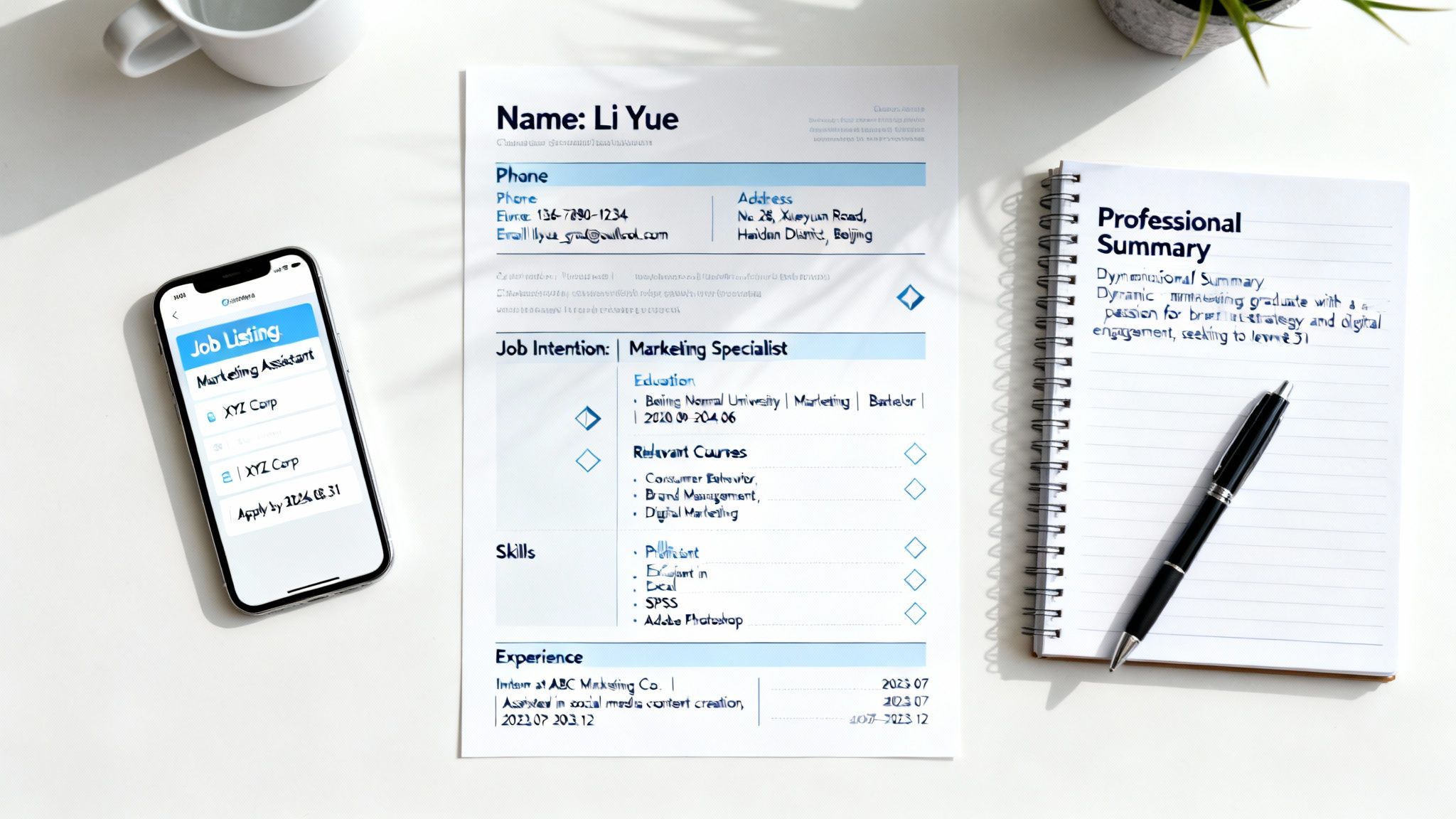
Graduating is a massive accomplishment, but now the real work begins. You're stepping into a job market that's more crowded and competitive than ever. Submitting the same generic resume to every opening is a recipe for radio silence.
Here's the first hard truth: before a hiring manager even lays eyes on your resume, it’s probably going through an Applicant Tracking System (ATS). This is software designed to scan for keywords and specific formatting. If your resume isn't optimized for these systems, it gets tossed into a digital black hole, no matter how qualified you are.
Shifting from Academics to Achievements
The mindset that got you through four years of college isn't the one that will land you a job. Academia is about learning and proving you know the material. The professional world is all about taking that knowledge and getting results.
Your resume has to reflect that change. Forget just listing your GPA and major. You need to translate every project, internship, and part-time gig into a tangible accomplishment.
Think about it this way:
- From Responsibilities to Results: Don't say you "were responsible for social media." Instead, show your impact: "Grew Instagram engagement by 20% over three months."
- From Coursework to Skills: Listing classes is pointless. Highlight what you can do: "Conducted market analysis using SPSS" or "Developed Python scripts for data cleaning."
- From Passive Language to Action: Kick off your bullet points with strong verbs that scream initiative.
A great first step is honestly evaluating your post-graduation prospects to understand where you stand.
Understanding the Modern Hiring Landscape
The fight for entry-level jobs is intense. Small and medium-sized businesses in the U.S. now get an average of 180 applicants for a single opening. At the same time, applications for these roles have shot up by 30%, while the number of available positions has actually decreased.
In short, you're up against a bigger, more determined pool of candidates fighting for fewer spots. A generic resume will get buried instantly.
Your resume needs to be a sharp, targeted marketing tool. It has to immediately tell a company what you can do for them and offer proof of your potential. When you understand what employers really look for in resumes, you can craft a document that meets their needs and dramatically boosts your chances of actually getting that interview.
Structuring Your Resume to Highlight Potential

Think of your resume's structure as the blueprint for your professional story. A clean, logical layout doesn't just look good—it guides the recruiter's eye straight to your most valuable qualifications, making it easy for them to see your potential.
For a recent grad, the right structure is everything. It shifts the focus away from a limited work history and puts a spotlight on your academic wins and the transferable skills you've worked hard to build.
To help you get it right, we’ll walk through the absolute must-have sections for a graduate resume. Here’s a quick overview of what they are and why they matter.
Essential Resume Sections for Recent Graduates
| Section | Primary Purpose | Key Information to Include |
|---|---|---|
| Contact Information | To make it incredibly easy for recruiters to get in touch with you. | Name, city/state, professional email, phone number, and a polished LinkedIn URL. |
| Professional Summary | To provide a compelling 2-3 sentence elevator pitch that grabs attention immediately. | Your degree, top 2-3 skills, and a clear connection to the company's goals. |
| Education | To showcase your most recent and relevant qualifications, since you're fresh out of school. | University, degree, graduation date, high GPA (3.5+), relevant courses, and key projects. |
| Skills | To offer a quick, scannable snapshot of your technical and transferable abilities. | Categorized lists of hard skills (software, languages) and soft skills (communication, leadership). |
Each of these components plays a distinct role in building a compelling picture of who you are. Let's dig into how to make every single one work for you.
Nailing the Contact Information
This section seems simple, but you'd be surprised how many people get it wrong. One typo can cost you an interview. Your contact details need to be professional, accurate, and impossible to miss right at the top of the page.
Here’s exactly what you need:
- Full Name: Make it stand out in a larger, bold font.
- City and State: No need for your full street address.
- Professional Email Address: Stick to a classic format like
firstname.lastname@email.com. Ditch the old student email—you might lose access after you graduate. - Phone Number: Your main mobile number is all they need.
- LinkedIn Profile URL: This is a non-negotiable. Go into LinkedIn and customize your URL to something clean like
linkedin.com/in/yourname.
Remember, a polished LinkedIn profile is basically a digital extension of your resume. An empty or outdated profile is a red flag, so give it a solid update before you add that link.
Crafting a Compelling Professional Summary
Forget the old-fashioned "Objective" statement. It's dead. Today, it’s all about the Professional Summary—a punchy, 2-3 sentence elevator pitch that sits at the top of your resume. This is your chance to immediately tell a hiring manager what you bring to the table.
Instead of talking about what you want, your summary needs to show what you can offer. It should quickly tie together your key skills, academic background, and career goals, all tweaked for the specific job you’re applying for.
Here’s an example for a marketing grad:
"Recent Marketing graduate from State University specializing in digital analytics and content strategy. Proven ability to drive social media engagement and conduct market research, demonstrated through a capstone project that increased brand awareness for a local business by 15%. Eager to apply data-driven insights to help [Company Name] achieve its growth objectives."
See the difference? It's specific, uses a real number, and connects the dots between their skills and the employer's needs. If you’re struggling to articulate your value without much work history, our guide on how to write a resume with no experience has some great strategies to help you out.
Making Your Education Section Work for You
As a recent graduate, your education is your prime asset. Don't just list your degree and call it a day. This section is your opportunity to show off your academic achievements and the relevant knowledge you've gained.
Put this section right after your Professional Summary. That placement tells employers that your academic background is fresh and directly relevant to the job.
Here’s how to pack it with value:
- University Name and Location: The full name of your school.
- Degree and Major: Be specific, like "Bachelor of Science in Computer Science."
- Graduation Date: Just the month and year will do.
- GPA: Only include it if it's 3.5 or higher. Otherwise, leave it off.
- Relevant Coursework: List 3-5 high-level courses that align with the job description.
- Academic Honors: Don't be shy. Mention Dean's List, scholarships, or summa cum laude.
- Key Projects: Briefly describe a major academic project, focusing on the skills you used and what you accomplished.
Organizing Your Skills for Recruiters and Robots
Your skills section has two audiences: human recruiters and Applicant Tracking Systems (ATS). A messy, unorganized list of skills will fail to impress either. The key is to categorize them.
By creating distinct subheadings, you make your resume far more scannable for a human and much easier for an ATS to match your skills to the keywords in the job description.
Think about breaking your skills down into logical groups:
- Technical Skills: This is for specific software, programming languages, and tools you know how to use. Think Python, SQL, Google Analytics, Adobe Creative Suite, Salesforce, C++, or Figma.
- Transferable Skills: These are abilities you've picked up from anywhere—academics, volunteering, part-time jobs—that apply to almost any role. Examples include Data Analysis, Project Management, Public Speaking, Content Creation, and Team Leadership.
- Languages: List any languages you speak other than English and your proficiency level, like "Fluent in Spanish" or "Conversational in French."
This simple, structured format ensures that no matter who—or what—is reading your resume, your core strengths are clear and impossible to ignore.
Turning Experience Into Compelling Accomplishments

Alright, let's talk about the heart of your resume: the experience section. Even if you've never held a "real" job, this is where the magic happens. We're going to take your internships, class projects, part-time gigs, and volunteer hours and turn them into solid proof of what you can do.
Your goal isn't just to list what you did. It's to build a rock-solid case for why you're the person they need to hire. This means shifting your mindset from responsibilities to results. A hiring manager doesn't care that you were "responsible for" something; they want to know the impact you made.
From Vague Duties to Powerful Achievements
Nothing gets a resume tossed faster than vague, passive descriptions. A bullet point like "Assisted with marketing campaigns" is a dead end—it tells the recruiter absolutely nothing useful. You need to be specific, using strong action verbs and, most importantly, numbers.
Here’s a quick before-and-after.
Before:
- Responsible for managing the company’s social media accounts.
It’s just… there. Totally forgettable.
After:
- Managed and grew the company’s Instagram account, increasing follower count by 15% and boosting post engagement by 25% over a three-month internship period.
See the difference? This version is active. It kicks off with a strong verb, throws in concrete metrics (15%, 25%), and gives context (three months). It transforms a simple task into a measurable win.
How to Quantify Your Impact
"But I don't have any numbers!" I hear this all the time from new grads, but I promise, you have quantifiable results hiding in plain sight. You just need to know where to look.
Think outside the box of just sales or revenue. Dig into these areas:
- Time: Did you finish a project early? "Reduced project completion time by 10% by implementing a new workflow process."
- Volume: How much stuff did you handle? "Processed and organized over 500 customer data entries with 99% accuracy."
- Frequency: How often did you do something? "Authored 3 weekly blog posts on industry trends, driving a 20% bump in website traffic."
- Scale: How many people were involved? "Collaborated with a 5-person team to develop a capstone project presented to a panel of 30 industry professionals."
Every part of your academic journey can tell a story. Think about it—even a graduation stole as a wearable résumé can visually show off your achievements and affiliations from college.
The STAR Method: A Simple Framework for Success
If you’re staring at a blank page, the STAR method is your best friend. It’s a simple, foolproof way to structure your accomplishments into the kind of clear, compelling mini-stories that recruiters love.
Here’s the breakdown:
- Situation: What was the background or challenge?
- Task: What was your specific goal or responsibility?
- Action: What, exactly, did you do? (Use those action verbs!)
- Result: What was the outcome? Slap a number on it if you can.
You don’t write out all four parts in the bullet point, of course. It’s a thinking exercise to help you get to a killer, result-focused statement.
Let's apply it to a classic group project scenario.
STAR Breakdown:
- Situation: Our capstone project was a mess. Communication was chaotic, and we were behind schedule.
- Task: I needed to get our team organized and back on track.
- Action: I introduced a Trello board to manage tasks, set up daily check-ins, and created a shared Google Drive for all our files.
- Result: We turned it around, submitting the final project two days early and landing an A. The professor even used our project as a "best practice" example for the class.
The Final Bullet Point:
- Spearheaded the adoption of Trello for a 5-person team project, improving task-tracking and collaboration, which led to submitting the final presentation 2 days ahead of the deadline.
In one line, you've shown initiative, project management skills, and a focus on getting things done. If you want more inspiration, check out our deep dive on how to write resume accomplishment examples.
The job market has changed. It's less about your GPA and more about what you can do. In fact, 65% of hiring managers say they're willing to hire someone based on skills alone, and nearly 90% of recruiters actively look for problem-solving skills on a grad's resume. Your bullet points are where you prove you have them.
Every single experience you've had is a chance to show a future employer what you're made of. Focus on action, quantify your results, and frame your achievements clearly. Do that, and you’ll have an experience section that truly sells your potential.
Before your resume ever lands on a hiring manager's desk, it has to get past the digital gatekeeper: the Applicant Tracking System (ATS).
Think of it as the bouncer for the company. This software scans every single application, looking for specific clues to decide if you're a good match. If your resume isn't formatted in a way the ATS can read, it gets tossed out. It's harsh, but it's the reality of today's job market.
The trick isn't to outsmart the system. It's to speak its language. That boils down to two things: using the right keywords and keeping your formatting clean and simple.

Weaving in the Right Keywords
The ATS is basically a matching game. It cross-references the words on your resume with the words in the job description. If a company wants someone with "social media management" and "SEO experience," the software is literally searching for those exact phrases.
So, your first move is to play detective.
Print out the job description and pull out a highlighter. Circle every skill, software, and qualification that pops up more than once. These are your golden keywords.
Once you’ve got your list, start weaving them into your resume where they make sense:
- Professional Summary: This is prime real estate. Pop your top 2-3 keywords here to make an immediate impact.
- Experience Section: Tweak your bullet points to mirror the company’s language. Instead of saying "wrote blog posts," use their exact phrasing, like "executed content marketing strategy."
- Skills Section: This is a no-brainer. Make sure your target keywords are listed clearly here.
This isn’t about just dropping words in randomly. It's about showing the ATS—and the human who reads it next—that you’re a direct match for what they need.
Don’t just stuff keywords where they don't belong. The goal is seamless integration. Your sentences must still make perfect sense to a human reader, who will hopefully be the next person to see your resume.
For a deeper dive, our guide offers more advanced applicant tracking system resume tips to help you master this process.
Choosing Formats That Help, Not Hurt
I’ve seen some beautiful, creative resumes in my time. The problem? They can be a total nightmare for an ATS. These systems crave simplicity and often choke on complex formatting, which means your info gets scrambled or ignored entirely.
To stay on the safe side, keep it clean and professional. Things like photos, icons, skill bars, and text boxes almost always cause parsing errors, meaning the software can’t pull your information correctly.
Let's look at how to build a resume that a machine can actually understand.
ATS-Friendly vs. Creative Resume Formats
| Formatting Element | ATS-Friendly Approach (Recommended) | Creative Approach (Use with Caution) |
|---|---|---|
| Layout | Single-column format with clear section headings. | Multi-column layouts, tables, or text boxes. |
| Fonts | Standard, sans-serif fonts like Arial, Calibri, or Helvetica. | Stylized, script, or custom fonts that can be hard to read. |
| Graphics | No photos, icons, or skill-level rating bars. | Headshots, logos, or visual skill indicators. |
| File Type | Save and submit as a PDF, unless a .docx is requested. | Submitting as an image file (JPEG, PNG) or other unsupported formats. |
When you're just starting out, clarity trumps creativity every time. A simple, standard format ensures your qualifications get read accurately. It’s a small step that makes a huge difference in getting your application past that first digital hurdle.
Tailoring Your Resume for Every Application
Firing off the same generic resume to dozens of job openings is a surefire way to get lost in the noise. It’s a rookie mistake, and in a competitive market, it’s a killer. Employers can spot a generic application from a mile away. What they really want to see is that you’ve done your homework and are genuinely pumped about their company and their specific role.
This doesn’t mean you need to reinvent the wheel every single time you hit "apply." Not at all. The trick is to create one comprehensive "master resume" that lists every single thing you've ever done. Then, for each application, you simply trim it down and sharpen the focus to create a tailored version.
It's a tough world out there for recent grads. I've seen the data, and it can be a real gut punch. About 60% of recent graduates get only one or two responses from employers. That means for every ten applications you send, you might only hear back once. It’s no wonder that 52% of grads worry they won't find a job in their field. You can read more about these graduate job confidence findings on TopResume.com.
Customizing your resume is your best weapon against those odds.
A Practical Workflow for Customization
The secret to doing this without losing your mind is the "master document" I mentioned. Think of it as your own personal career archive. This thing can be two, three, even four pages long—it doesn't matter. It should list every project, internship, volunteer gig, and skill you have, all with detailed bullet points.
Once you have that, the process for each application is pretty straightforward:
- Duplicate Your Master File: First thing's first, save a new copy. A good naming convention is "Resume_YourName_Role_Company.pdf." This keeps you organized.
- Dissect the Job Description: Print out the job description and grab a highlighter. Mark up every key skill, qualification, and responsibility they mention. These are your keywords.
- Tweak Your Professional Summary: Rewrite your opening 2-3 sentence summary so it speaks directly to the role. If they’re looking for "social media analytics" and "content creation," those exact phrases should be front and center.
- Reorder and Trim Your Bullets: This is where the magic happens. Go through your experience section and drag the most relevant bullet points to the top of each job entry. If a past project perfectly aligns with a key duty in the job description, make it the first thing the recruiter sees. And don't be afraid to delete points that are completely irrelevant. Keep it lean and focused.
Once you get into a rhythm, this whole process shouldn't take more than 20-30 minutes an application.
Match Your Skills to Their Wishlist
The skills section is prime real estate for quick and impactful customization. After you've highlighted the job description, you need to make sure your skills list directly mirrors what they're asking for.
Let's walk through an example.
You’re applying for a Junior Data Analyst role that calls for SQL, Python, and Tableau.
- Your Master Skills Section: It's a long list, maybe something like: Python, Java, C++, R, Microsoft Excel, Public Speaking, Project Management, SQL, Tableau.
- Your Tailored Skills Section: You'll want to reorder and group it to put their most-wanted skills on a silver platter:
- Technical Skills: SQL, Python, Tableau, R, Microsoft Excel (Advanced)
- Data Analysis: Statistical Modeling, Data Visualization, A/B Testing
- Professional Skills: Project Management, Client Reporting
See the difference? It's a small change, but it instantly makes your resume look like it was written just for them. Because, well, it was.
Think of your job search as a marketing campaign. Each tailored resume you send is a targeted ad. By paying attention to which versions get responses, you can refine your strategy over time and figure out what truly works.
This isn't about just swapping out a few words. It's about strategically positioning yourself as the perfect solution to that company's specific need. When you adopt this mindset, you stop playing the lottery and start playing chess.
A Few Lingering Questions You Might Have
Even with the best road map, you're bound to hit a few tricky spots when building your first real-world resume. Let's clear up some of the most common questions I hear from recent grads so you can get unstuck and move forward.
How Long Should My Resume Really Be?
Easy one: one page. That's it.
Recruiters are swimming in applications and spend just a few seconds on their first scan. A clean, concise, one-page document is your best friend. It proves you can prioritize information and respect their time.
The only exception? If you've got a Master's degree or Ph.D. with significant publications, or you've racked up multiple, highly relevant internships that are just too good to cut. Otherwise, think of that one-page limit as a helpful challenge—it forces you to be ruthless and include only what truly matters for the job you want.
Should I Put My GPA on There?
This is a classic dilemma, but the answer is pretty black and white. If your GPA is a 3.5 or higher, absolutely put it on. If it's lower than that, just leave it off.
An impressive GPA is a nice bonus, but a lower one won't sink you if it's not there. Hiring managers are way more interested in what you can do—the skills you've built and the experience you've gained.
Your resume is a highlight reel, not a confessional. If your GPA isn't one of your strongest selling points, don't waste precious space on it. Let your projects and skills do the talking instead.
What if My Major Has Nothing to Do With the Job?
Welcome to the club! So many people build amazing careers in fields totally unrelated to their degree. Your job is to simply connect the dots for the hiring manager so they don't have to guess.
You need to show them how the skills you learned are transferable.
Here’s how to do it:
- Lead with a Killer Summary: Start your resume with a powerful summary that explicitly states your interest in the new field. A history major gunning for a marketing role could highlight their knack for "in-depth research, data analysis, and persuasive storytelling."
- Showcase Relevant Projects: Dig through your coursework. Did that psychology project require you to run statistical analyses? Perfect for a data analyst role. Did that art history presentation hone your public speaking skills? Great for a sales position.
- Build a Dedicated "Relevant Skills" Section: Don't make them hunt for the good stuff. Group your most applicable skills right at the top of your resume so they’re the first thing a recruiter sees.
Your degree is just one part of your story. It's up to you to frame your academic background as a unique strength that you bring to this new field.
Stop drowning in spreadsheets and start landing interviews. With Eztrackr, you can save jobs in a click, build AI-powered resumes, and visualize your entire job search on one intuitive dashboard. Take control of your career journey and see why 45,000+ job seekers trust us to get organized and get hired. Try Eztrackr today!