How to Improve Recruitment Process for Faster, Better Hires
If you're constantly putting out hiring fires, it's time to stop reacting and start building a proactive, strategic foundation for your recruitment. The real path to improving your hiring process isn't about small, tactical fixes. It starts much earlier, with a hard look at how you redefine job descriptions and establish clear internal workflows.
Getting this right from the beginning ensures you attract the right people and cut out the frustrating bottlenecks that cause great candidates to slip away.
Building a Strategic Recruitment Foundation

Before you can fix the leaks in your hiring funnel, you have to inspect the pipes. A truly improved recruitment process starts with a strategic audit of what you're already doing, not just patching holes as they appear. This foundational work makes sure every other step you take is on solid ground, saving you time and dramatically improving your talent pipeline from day one.
The first pillar is the job description itself. Far too often, these are treated like administrative chores—a boring list of duties copied from an old template. This is a massive missed opportunity.
Crafting Compelling and Inclusive Job Descriptions
Think of your job description as a marketing asset. It should do more than just list what someone will do; it needs to sell the opportunity and your company culture to the exact person you want to hire. It's less about a rigid checklist and more about painting a clear picture of what success looks like in the role.
Here's how to do it:
- Focus on Outcomes, Not Just Tasks: Instead of "Manage social media accounts," try something like, "Develop and execute a social media strategy to increase follower engagement by 25% in your first year." This speaks directly to high-achievers.
- Use Inclusive Language: Ditch the corporate jargon and gender-coded words like "rockstar" or "ninja." I've seen tools like Textio or Gender Decoder work wonders for teams wanting to write more inclusive ads that attract a much broader, more diverse pool of qualified people.
- Highlight What's In It for Them: Don't just talk about what you need. What's the real draw? Talk about the growth opportunities, unique company perks, the impact they’ll actually make, and the team they’ll be joining.
When you refine your job descriptions this way, you start attracting candidates who are not just qualified on paper but are genuinely excited about your company’s mission. It’s a simple change that drastically improves the quality of applicants from the get-go.
Establishing a Clear Internal Workflow
The second pillar is your internal process for requisitions and approvals. One of the most common failure points I see is a slow or disorganized internal workflow. When a manager needs to hire someone, is the process clear and efficient? Does everyone involved know their part?
A disorganized requisition process is where momentum dies. Delays in getting a job posting approved and live can mean losing out on top talent who are actively interviewing elsewhere. A clear, documented workflow is non-negotiable.
This means getting hiring managers, department heads, and HR in a room (or a Zoom call) to map out the entire process—from identifying the need for a role to hitting "publish" on the job post. Who signs off on the role? What’s the budget? What are the absolute must-have skills versus the nice-to-haves?
Answering these questions upfront prevents the endless back-and-forth that stalls the entire recruitment process. This kind of structure is also the backbone of strong pipeline management. If you're new to the concept, it's worth understanding what pipeline management is and how it directly impacts hiring speed.
For those in specialized fields, these foundational steps are even more critical. For example, adopting the top talent acquisition best practices for law firms can make a significant difference. By building this strategic foundation, you create a system that is not only faster but far more effective at attracting and keeping the talent your company needs to grow.
Modernizing Your Sourcing and Attraction Strategy
Let's be honest: the old "post and pray" approach to hiring is a recipe for falling behind. If you're just waiting for applications to trickle in, you’re only seeing a tiny fraction of the talent pool. To really get ahead, you have to meet skilled people where they already are. It's about shifting your entire mindset from reactive to intentional.
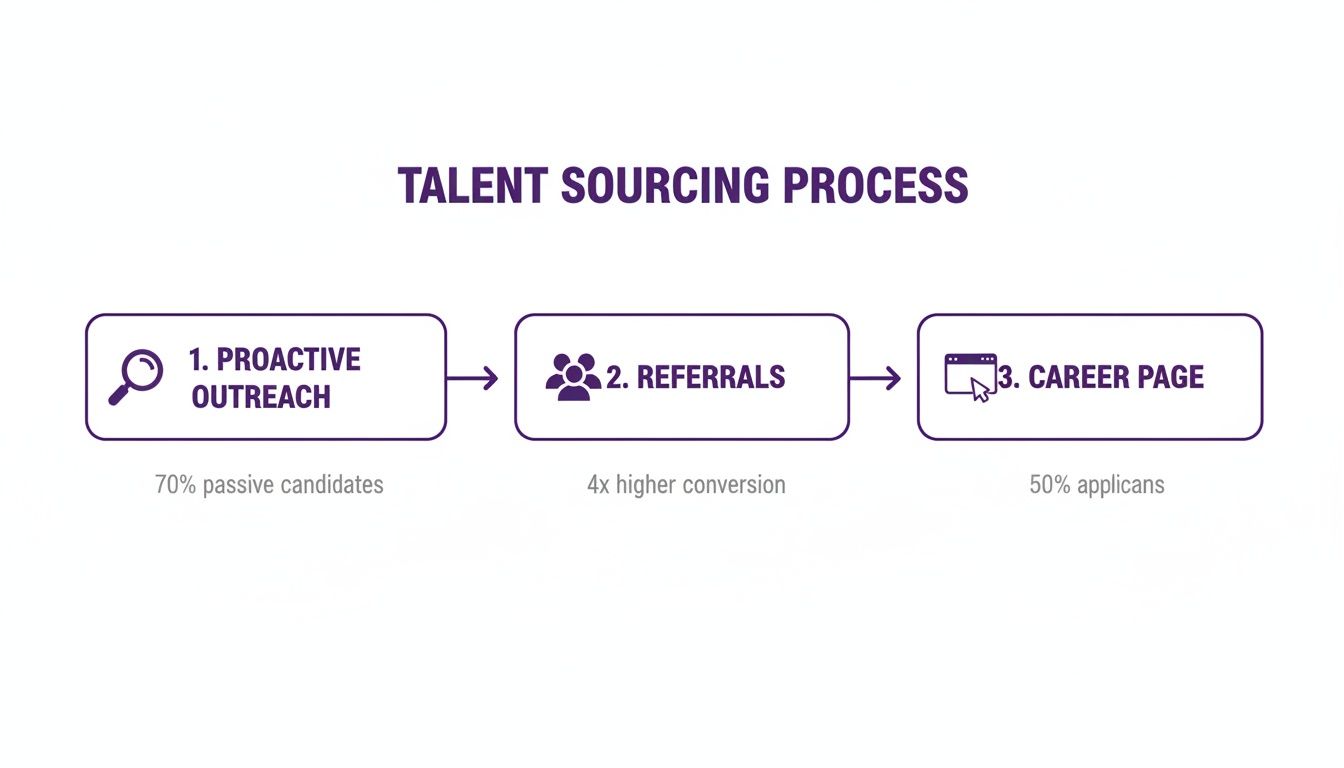
This isn't about just one trick; it's about building a multi-channel system that consistently pulls in both active and passive candidates. That way, your pipeline is never running on empty when a new role opens up. This means getting active on professional networks, building a referral engine that actually works, and turning your careers page into a true marketing asset.
Go Beyond Passive Job Postings
Relying only on job boards means you're talking to a very small, specific audience: people who are actively, right-this-minute, looking for a job. The real gems—the top performers—are often happily employed but would be open to the right opportunity. These are your passive candidates.
Reaching them requires a more direct, human touch. LinkedIn is a goldmine for this, but success isn't about spamming inboxes with generic templates. It’s about building genuine relationships. Start by identifying people with the skills you need, then actually engage with their content. A personalized connection request that references a specific project they worked on or a mutual connection will always outperform a copy-paste job.
This kind of direct outreach shows you’ve done your homework and respect their expertise. It’s the first step in starting a real conversation.
A passive candidate today could be your perfect hire in six months. The goal of proactive sourcing isn't just to fill an immediate opening, but to build a warm pipeline of pre-vetted talent you can tap into for future needs.
Cultivate a Powerful Employee Referral Program
Your own team is one of your best-kept sourcing secrets. Their networks are full of qualified peers, and they can speak authentically about your company culture in a way no recruiter can. The problem? Most referral programs are an afterthought and fail because they lack structure, promotion, and real incentives.
To build a program that people actually use, get practical:
- Offer Meaningful Incentives: A $50 gift card isn’t going to cut it. Think about tiered bonuses that increase for hard-to-fill roles. A payout on hire and another at 90 days can also do wonders for participation.
- Make it Easy to Participate: Don't make your employees do all the work. Give them pre-written job descriptions and social media posts they can share with one click. The less friction, the better.
- Keep Referrers in the Loop: Nothing kills motivation faster than feeling like your referral vanished into a black hole. Give people regular updates on where their candidate is in the process, even if it's just to say they weren't a fit this time around.
Transform Your Career Page Into a Magnet
Your company’s career page should do more than just list job openings. It’s your best chance to show off your employer brand and convince top talent that you're the place they want to be. Think of it as a destination, not just a directory.
A truly compelling career page needs to feature:
- Employee Testimonials: Short videos or quotes from current team members bring your culture to life and provide powerful social proof.
- A Clear Value Proposition: Why should someone work for you? Don’t be vague. Highlight your mission, your values, unique benefits, and real opportunities for growth.
- A Glimpse into Your Culture: Use authentic photos and videos to show your team working together, celebrating wins, or participating in company events.
Building these talent pipelines and nurturing candidates over the long haul requires a strategic system. For a deeper look at managing these relationships effectively, exploring the benefits of dedicated candidate relationship management software can be a game-changer. By combining proactive outreach, a killer referral program, and a magnetic career page, you create a powerful system that consistently brings the best people to your door.
Optimizing Your Application and Screening Stages
If your recruitment process has a leak, I’d bet it’s right here. A slow, clunky, or confusing application is the number one reason top candidates just give up and go somewhere else. This is where you can score the biggest wins—by focusing on speed, clarity, and the candidate's experience.
The goal is to build a system that’s fast for the applicant but still laser-focused on identifying the best talent for your team. Every extra question you ask and every day you add to the timeline is another chance to lose a great hire to a competitor.
This is the main entry point for everyone, whether they come from direct outreach, a referral, or your careers page.
All roads lead to your application, so it has to be good.
Designing a Frictionless Application Experience
Think about the last time you tried to fill out a long form on your phone. Was it fun? Of course not. A staggering 60% of job seekers have bailed on an application simply because it was too long or complicated. Your process has to be designed for how people live today, which means mobile-first and incredibly efficient.
Here’s how you can cut out the friction:
- Keep it short and sweet. Only ask for the absolute essentials upfront. Do you really need their full address and three references on the initial form? Probably not. Stick to contact info, a resume, and maybe one or two killer screening questions.
- Design for mobile. Over half of all applications are now submitted on a mobile device. Test your own application on a smartphone. Can you actually complete it without endless pinching and zooming?
- Offer "Easy Apply" options. Integrating with platforms like LinkedIn lets candidates apply with their existing profile. This reduces manual data entry to almost zero and will absolutely boost your completion rates.
The main idea here is simply respecting the candidate's time. A short, clean process tells them your organization is modern, efficient, and values their effort. This one change can make a massive difference in the quality and quantity of applications you receive.
Harnessing Automation with an Applicant Tracking System
Manually sifting through hundreds of resumes is a terrible use of anyone’s time. An Applicant Tracking System (ATS) is the engine that automates the most tedious parts of screening, freeing up your team to actually connect with qualified people.
An ATS isn't just a digital filing cabinet; it’s a powerful tool for consistency and speed. You can set up knockout questions to automatically filter out applicants who don't meet the basic criteria (e.g., "Are you authorized to work in the US?"). You can also send automated confirmation emails, so no one feels like their application vanished into a black hole. For a deeper dive, it's worth reading up on everything a job application tracking system can do.
To get even more efficient, many organizations utilize resume analyzer tools that quickly parse qualifications and highlight the most relevant candidates.
The real power of an ATS is consistency. It ensures every candidate goes through the same initial screening, which helps reduce unconscious bias and keeps your entire process fair and organized from the get-go.
Slashing Your Time-to-Hire
One of the most critical metrics you can track is time-to-hire. This number has ballooned to an average of 68.5 days in 2025—a huge jump from just 44 days back in 2023. This long wait not only risks losing top talent to faster-moving companies but also drives up costs. Every single day you can cut from this cycle is a major competitive advantage.
Many teams struggle with the same bottlenecks that drag out their hiring timeline. Below is a quick breakdown of common issues and how to fix them.
Time-to-Hire Reduction Strategies
| Bottleneck | Impact | Solution |
|---|---|---|
| Slow Internal Approvals | Delays job posting and offer extensions, causing top candidates to accept other offers. | Pre-approve headcount and salary bands before the search begins. Create a clear, documented approval workflow with designated backups. |
| Scheduling Conflicts | Multiple rounds of interviews with busy stakeholders can take weeks to coordinate. | Use scheduling automation tools. Implement "interview blocks" where managers dedicate specific times for interviews each week. |
| Vague Feedback | Interviewers provide generic feedback like "not a good fit," leading to indecision and repeated interviews. | Create a structured interview scorecard based on the core competencies for the role. Require specific, evidence-based feedback. |
| Lengthy Application | High-quality candidates abandon the process before they even finish applying. | Limit the initial application to 5 minutes or less. Collect additional information later in the process. |
By proactively identifying and addressing these choke points, you can create a much faster and more effective hiring machine. Getting this right means you're not just filling roles; you're landing the best people before your competitors even get a chance.
Conducting Structured and Unbiased Interviews
The interview is where a candidate’s resume finally comes to life. It’s a make-or-break moment, but it's also where unconscious bias can creep in and sabotage your efforts to find the best person for the job. If you want to elevate your recruitment process, you have to build an interview system that’s consistent, objective, and fair to every single person who walks through your door (or logs into the video call).
The alternative is what most companies do by default: unstructured, "go-with-your-gut" chats. These conversations might feel comfortable, but they often lead interviewers to favor candidates who are just like them, not necessarily the most qualified. This is a classic case of affinity bias, and it's just one of many mental shortcuts that can throw your decision-making off course.
A structured interview process is your best defense. It levels the playing field, giving every candidate the same questions and the same chance to prove they've got what it takes.
Designing a Standardized Interview Framework
A solid structured interview starts with a standardized set of questions—all tied directly to the core competencies needed for the role. Before a single interview is scheduled, the hiring team needs to get on the same page about what "good" actually looks like. What are the absolute must-have skills, behaviors, and attitudes for success?
Once you’ve defined those competencies, you can build your questions around them. For instance, if "problem-solving" is critical, every candidate gets a question designed to test exactly that. This simple act of standardization is a giant leap toward a more equitable and effective process.
An unstructured interview is like giving students different tests and then trying to compare their grades. A structured interview gives everyone the same test, making the final comparison fair and data-driven.
This consistency doesn't mean your interviews have to feel stiff or robotic. It simply provides a solid framework for objective evaluation, which is the whole point of improving your recruitment game.
Using Behavioral and Situational Questions
To get a real sense of what a candidate can do, you have to dig deeper than questions like, "Are you a team player?" The answers are too generic and easy to fake. Instead, you need to focus on two types of questions that pull out real-world proof of their abilities.
- Behavioral Questions: These work on the principle that past behavior is the best predictor of future performance. They almost always start with prompts like, "Tell me about a time when…" or "Give me an example of…"
- Situational Questions: These present a hypothetical work scenario to see how a candidate thinks on their feet. They often begin with, "What would you do if…" or "Imagine a situation where…"
Let's say you're hiring for a customer success role. Here’s how you could apply this:
- Behavioral Question: "Tell me about a time you had to handle a particularly difficult or angry customer. What was the situation, what steps did you take, and what was the outcome?"
- Situational Question: "Imagine a key client reports a critical bug right before a major holiday weekend, and the engineering team is unavailable. What steps would you take to manage the client's expectations and address the issue?"
These questions force candidates to move beyond buzzwords and share concrete examples, giving you far more valuable insight than a resume ever could.
Implementing Interview Scorecards and Training
Asking the right questions is only half the battle. If everyone on the panel is evaluating answers differently, you’re still left with a subjective mess. This is where an interview scorecard changes everything.
A scorecard is a simple grid listing the role's core competencies with a rating scale (like 1-5) for each. After an interview, every panel member independently fills one out, scoring the candidate's answers against the predefined criteria. This shifts the debrief from a vague "I liked them" to a data-backed "They demonstrated strong project management skills, and here's the specific evidence."
Of course, a tool is only as good as the person using it. You have to invest in training your hiring managers and interviewers. This training should cover the essentials:
- Understanding Unconscious Bias: Teach them to recognize common pitfalls like the halo/horns effect, confirmation bias, and affinity bias.
- Conducting Structured Interviews: Show them how to stick to the plan while asking insightful follow-up questions.
- Using the Scorecard: Make sure everyone is aligned on the rating scale and knows how to provide evidence-based feedback.
When you combine standardized questions, behavioral techniques, and objective scorecards, you create an interview process that isn't just fairer—it's dramatically more effective at identifying the right person for the job.
Mastering the Candidate Experience

Think about it: in a world where a bad review can go viral in minutes, your candidate experience is your employer brand in action. It's the real, human-to-human reality of your company culture, and it touches everyone who applies—not just the people you end up hiring.
A great experience can turn a rejected applicant into a brand advocate or a future referral. A bad one? It can seriously damage your reputation and ability to attract top talent down the road.
Getting this right really comes down to one core idea: treat candidates with respect and be transparent. It’s about making people feel like their time and effort mattered, no matter how things turn out.
The Power of Proactive and Transparent Communication
Radio silence is the absolute killer of a good candidate experience. I've seen it time and time again. When someone hits "submit," the worst thing you can do is make them feel like their resume just vanished into a black hole.
Consistent, timely communication is the bedrock of a process that builds trust instead of anxiety.
This doesn't mean you need to hand-write a novel for every single applicant. Smart automation is your best friend here, but you have to use it thoughtfully.
- Acknowledge Immediately: An automated email confirming you've received their application is non-negotiable. It’s such a simple thing, but it provides instant peace of mind.
- Set Clear Expectations: In that first email, set a realistic timeline. A quick note like, "Our team will be reviewing applications over the next two weeks and will be in touch if you're selected for an interview," manages expectations and cuts down on those "just checking in" emails.
- Provide Meaningful Updates: If things get delayed—and they often do—send a brief, honest update. Something simple like, "We've had a huge number of applicants and our review is taking a bit longer than expected," shows you respect their time.
Personalizing the Candidate Journey
While automation can handle the basics, personalization is what makes an experience stick. Candidates know they aren't the only person in the running, but small, personal touches can make them feel seen. This becomes absolutely critical once you get to the later stages.
For instance, instead of a generic interview confirmation, try including a link to the interviewer’s LinkedIn profile and a short, humanizing bio. This small effort helps the candidate prepare and makes the whole thing feel less like an interrogation.
Personalization shows you see them as an individual, not just another entry in your ATS. If you're looking to really nail this, I highly recommend diving into these essential candidate experience best practices.
The goal is to make every single candidate, hired or not, walk away feeling respected. A candidate who has a positive experience is 38% more likely to accept a job offer, and even those who don't get the role are more likely to reapply in the future.
Closing the Loop with Constructive Feedback
Here's one of the bravest—and most impactful—things you can do: give feedback to rejected candidates. I’m talking specifically about those who made it to the final interview rounds.
I know, many companies avoid this for fear of legal issues, but a brief, constructive conversation can be invaluable. You don’t need to provide a line-by-line takedown of their resume. A simple, honest reason can make all the difference.
For example: “We were incredibly impressed with your project management background. Ultimately, we decided to move forward with a candidate who had more hands-on experience with the specific software stack we use daily.”
This approach does three powerful things:
- It provides closure. The candidate isn't left wondering what went wrong.
- It shows respect. You valued their time enough to give them a real answer.
- It builds your brand. That candidate leaves the process feeling good about your company, even in rejection.
Finally, flip the script and ask for feedback yourself. Send a short, anonymous survey to everyone who completed an interview. This is your best source for finding and fixing the pain points in your own process, ensuring you’re always getting better.
Frequently Asked Questions About Improving Recruitment
Trying to untangle a messy hiring process often brings up more questions than answers. Whether you're an HR veteran or a hiring manager just getting your feet wet, improving how you recruit is a constant learning curve. Let's tackle some of the most common questions I hear with some straight-up, practical advice.
What Is the First Thing to Fix in a Broken Hiring Process?
Always, always start with the candidate experience. If your applicants are dropping out of the process, ignoring your messages, or even worse, leaving negative reviews online, that's a massive red flag. Your process is creating friction. Before you even think about buying new software or overhauling job descriptions, walk a mile in their shoes.
A quick win? Fix your communication. At a minimum, every single person who applies should get an automated confirmation email right away. This one tiny step avoids that dreaded "application black hole" and shows you respect their time from the get-go.
How Can We Reduce Our Time to Hire?
Shaving days or even weeks off your time-to-hire is a huge competitive advantage. The reality is, the best candidates are often off the market in just 10 days. To get faster, you have to hunt down and eliminate bottlenecks. Are interviews getting snarled up in scheduling back-and-forth? Get an automated scheduling tool. Are offer approvals taking an eternity? Get your salary bands pre-approved before you even post the job.
The interview process itself is another place you can gain a lot of ground.
- Consolidate interview rounds: Can you combine two separate one-on-one calls into a single panel interview? Do it.
- Block interview time: Ask your hiring managers to proactively block out "interview time" in their calendars each week. This stops the scheduling dance before it starts.
- Use scorecards: Make those post-interview debriefs quick and objective. Have everyone score candidates against the same criteria right after the call.
These small adjustments prevent the process from dragging on, which is one of the main reasons you lose great people to other offers.
What Is the Best Way to Measure Recruitment Success?
While time-to-hire is a big deal, it's not the end-all-be-all. A truly successful process isn't just about filling seats—it's about filling them with the right people. That's why the most important metric you can track is quality of hire.
Quality of hire is the ultimate report card. It looks past the hiring process itself and asks, "Did we actually get it right?" You measure it by looking at a new hire's performance reviews, how quickly they get up to speed, and if they're still with you after a year.
Tracking this means you have to connect the dots between your recruiting data and your performance management data. Doing this will show you exactly which sourcing channels, interviewers, or screening questions consistently bring in your top performers. It's the ultimate feedback loop for making your strategy smarter over time.
Of course, a few other metrics are essential for painting the full picture:
- Source of Hire: Where are your best people actually coming from?
- Offer Acceptance Rate: Are your offers competitive enough to close the deal?
- Candidate Satisfaction: What do applicants really think of your process?
Focusing on these KPIs helps you shift from simply filling roles to strategically building a team that will knock it out of the park.
Tired of the administrative grind that comes with job hunting? Eztrackr puts you back in control. Our platform helps you manage applications, generate AI-powered cover letters, and track your progress all in one place, so you can focus on what really matters—landing your dream job. Get started with Eztrackr for free and transform your job search today.