How to Improve Job Application Process in 2026
The average job posting received 244 applications in 2025, up from 115 in 2022, so competition roughly doubled in three years, according to Greenhouse data summarized by NovaResume. If your response is to send more generic applications, you're treating a pipeline problem like a motivation problem.
A better job search works like a measurable funnel. You source the right roles, pass screening, convert applications into interviews, follow up without becoming a nuisance, and learn where your applications stall. Fixing the biggest leak usually produces more progress than adding another evening of low-fit submissions.
Why Your Job Application Process Matters More Than Volume
Raw application volume is a weak measure of job-search quality. A crowded market makes every stage more important, from choosing a role to preparing for the offer conversation. When hundreds of people apply to one posting, a generic resume gives recruiters little reason to move you forward.
The funnel has four practical stages:
- Sourcing: You find roles that match your experience, location, work preferences, and career direction.
- Screening: Your resume parses correctly and demonstrates the requirements in the posting.
- Interview: Your application earns a conversation, and your answers prove the match.
- Offer: You manage timing, follow-up, expectations, and competing opportunities.
Your task isn't to maximize the number at the top. It's to improve the percentage that moves from one stage to the next.
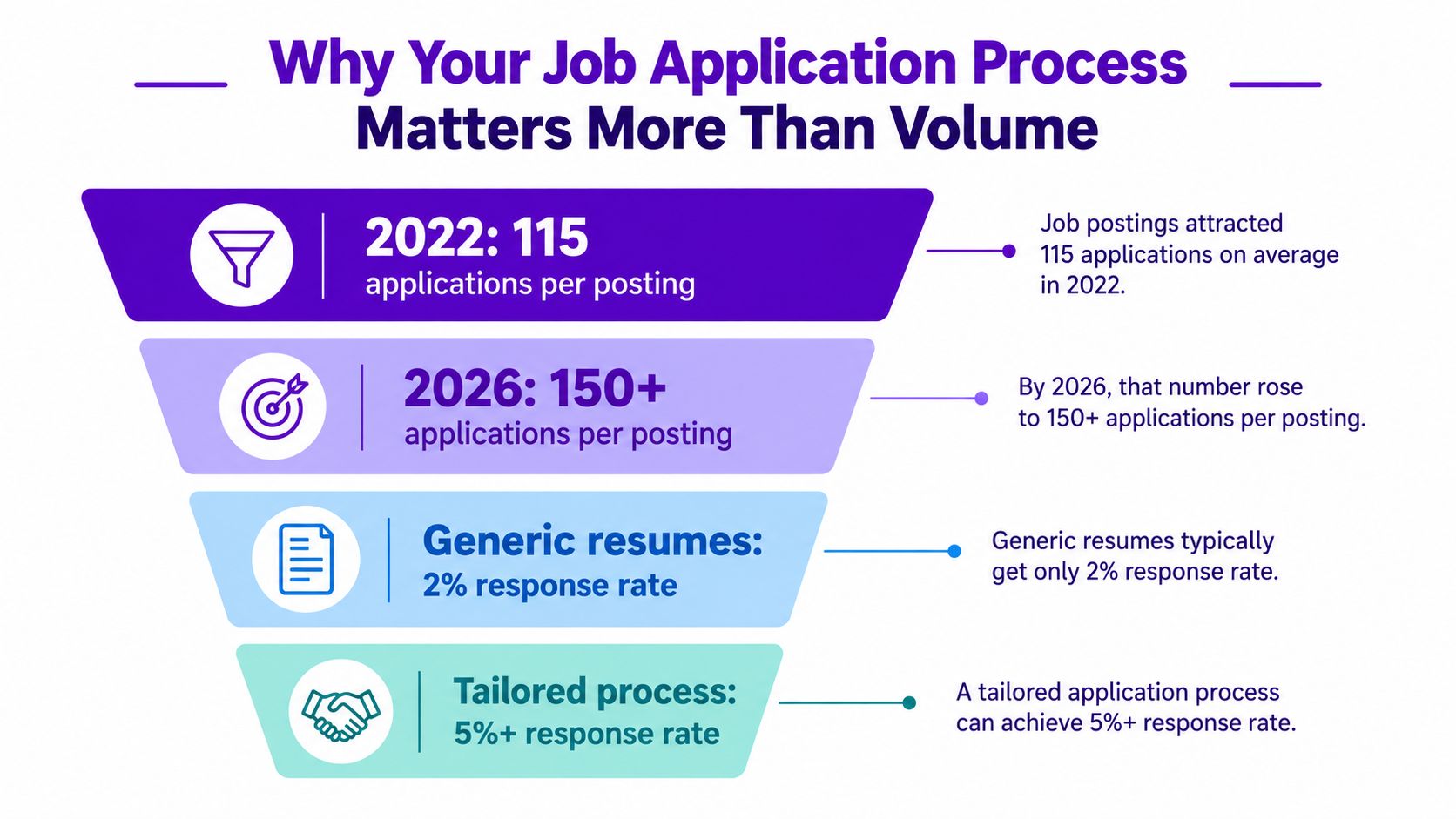
The evidence favors deliberate applications. In one survey of American workers, candidates who sent the same resume everywhere had a 20.5% zero-interview rate, while those who customized every application had a 6.4% zero-interview rate. Manual tailoring also produced an average of 2.6 interview invitations, compared with 1.7 for applicants who didn't tailor, as reported in NovaResume's 2026 resume report.
That doesn't mean every application deserves an hour. It means every application should pass a quality threshold before you submit it. A focused search lets you spend time where the probability of a useful conversation is highest.
Practical rule: Don't ask, “How many applications did I send?” Ask, “Where did qualified applications stop progressing?”
The rest of your process should follow that question. Target roles more carefully, tailor the evidence, make your resume readable to screening software, track every stage, and review the numbers weekly. You also need a realistic timeline. A quiet third week doesn't automatically mean your strategy has failed. It may mean your pipeline hasn't produced enough properly targeted opportunities yet.
Sourcing Smarter and Targeting the Right Roles
Your resume can't rescue a role that was a poor fit from the beginning. Start by filtering opportunities before you write a single bullet point.
Use a simple role-fit test. Keep a posting only when it meets most of these conditions:
- Core work match: You can point to recent experience that resembles the role's main responsibilities.
- Requirement match: You meet the genuine must-haves, not merely the attractive extras.
- Level match: The title and scope fit your current capability or a credible next step.
- Evidence availability: You can show outcomes, projects, tools, or decisions connected to the work.
- Motivation match: You'd accept the day-to-day reality, not just the company name.
This filter prevents the classic career-change mistake: treating every vaguely related title as a viable target. A marketer moving toward product operations might initially save roles across product, project management, customer success, and operations. A better approach is to identify the shared work, such as process ownership, stakeholder coordination, reporting, and workflow improvement, then prioritize postings where those responsibilities are central.
Research each role on a desktop before applying. Read the complete description, inspect the employer's careers page, check the reporting context, and note repeated requirements across similar postings. Desktop research makes it easier to compare postings and capture useful details than relying on scattered browser tabs or quick mobile applications.
Build a shortlist you can actually manage
Don't save a posting just because the title sounds familiar. Record the role title, company, location, source, closing information if provided, core requirements, and your fit judgment. Add one sentence explaining why you qualify. If you can't write that sentence, the role probably needs more research or should be rejected.
Look beyond broad job boards. Company career pages, specialist communities, professional associations, referrals, and direct outreach can reveal roles that don't deserve to compete for attention in a general search. The channel matters less than whether the role aligns with your evidence and direction.
A browser workflow can reduce the cost of this research. Tools such as Eztrackr's job-board integration guide describe ways to capture job details while you browse instead of copying them into a separate document later. The principle is simple: save promising postings at the moment you find them, then review them during a dedicated targeting session.
Set a weekly shortlist limit that forces judgment. A smaller list of credible roles gives you enough context to tailor materials, prepare intelligently, and follow up. A huge list creates administrative noise and encourages one-resume-for-everything behavior.
Tailoring Every Application Without Burning Out
Tailoring isn't cosmetic editing. It's the process of making your evidence legible to the employer's specific problem.
A large analysis of 1.39 million applications found that resumes matched to each posting produced a 5.75% application-to-interview conversion rate, compared with 2.68% for generic resumes, a 115% improvement, according to JobsTrack's analysis of AI job application tools. That difference is too large to dismiss as a minor optimization.
Start with the exact job title. If the posting calls the role “Lifecycle Marketing Manager,” don't lead with a vague label such as “Growth Professional” when the more precise title accurately describes your target. Then extract the posting's repeated skills, competencies, tools, and responsibilities.
Use a repeatable tailoring routine
Work in this order:
- Read for priorities: Identify what the employer needs the person to own, improve, build, or manage.
- Create a keyword set: Separate technical skills, functional competencies, tools, industry terms, and role language.
- Rewrite the headline and summary: Position yourself around the job's central problem, not your entire career history.
- Reorder relevant evidence: Move the most applicable experience and projects higher on the page.
- Adapt selected bullets: Use the posting's accurate terminology, then prove the claim with your own responsibilities and results.
- Check context: Confirm that every keyword appears in a sentence that demonstrates genuine experience.
You don't need to rewrite every line. Adapt the headline, summary, skills emphasis, and the bullets most connected to the posting. Keep a master resume library with strong versions of recurring skills, projects, and achievements so you can assemble a role-specific document without starting from a blank page.
AI can reduce the mechanical work. An answer generator can help draft responses to screening questions, a cover letter tool can organize relevant evidence, and a skill-match analyzer can highlight missing or weakly represented terms. Use this guide to an AI cover letter writer as a reference for the role of automation in the process, not as permission to submit unedited text.
The standard is not “AI-written.” The standard is “accurate, specific, and recognizably yours.”
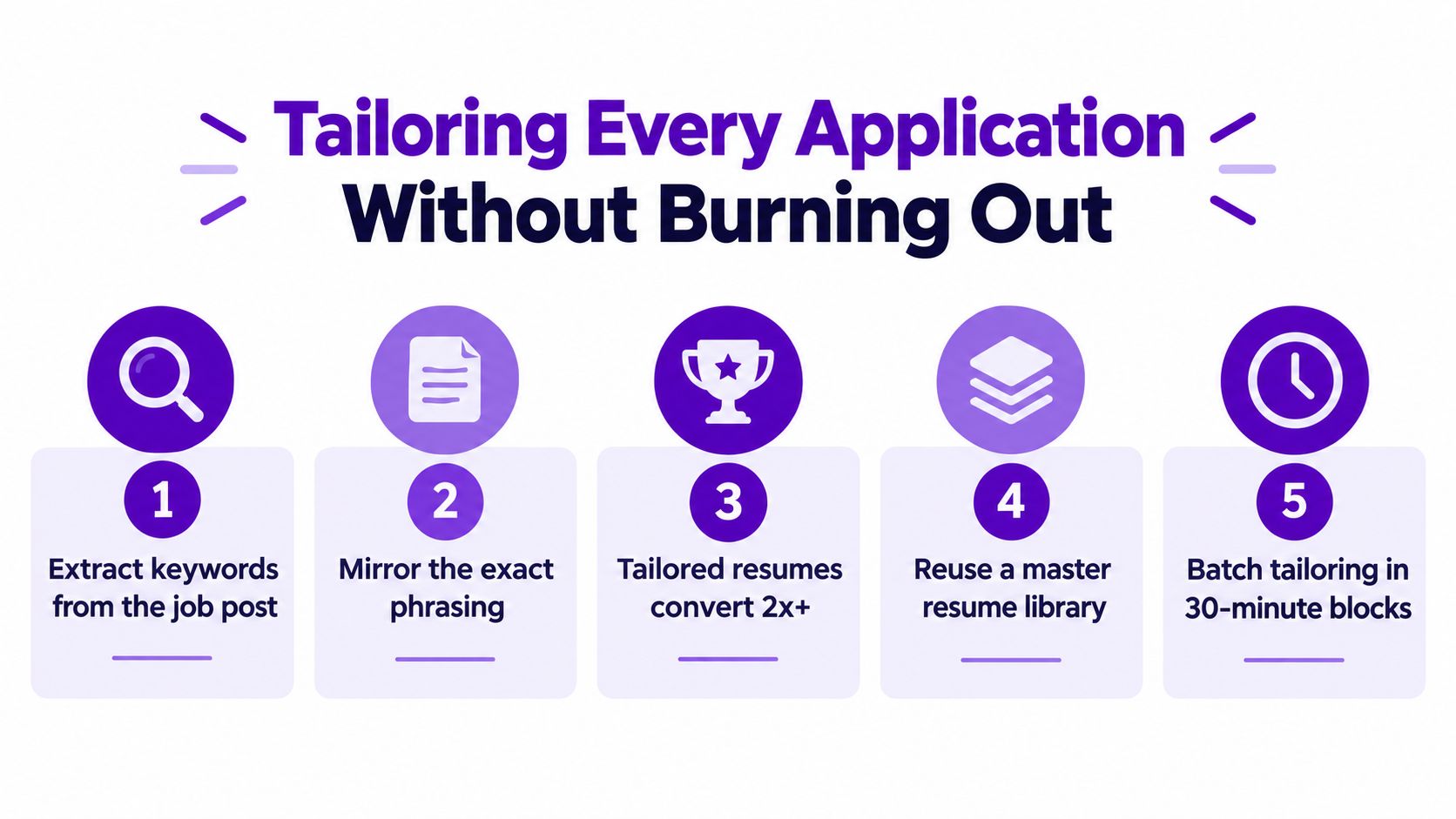
Avoid keyword stuffing. Repeating a skill without showing how you used it creates a suspicious document and can make your application sound detached from your actual background. Tailoring should sharpen your positioning, not manufacture qualifications.
Optimizing Your Resume for ATS Screening
Applicant tracking systems are a gate, not a substitute for a good resume. Roughly 97.8% of Fortune 500 companies use ATS, about 75% of resumes are rejected before a recruiter sees them, and 43% of technically qualified candidates fail ATS screening because of keyword or context misalignment, according to Apollo Technical's resume statistics.
Treat parseability as a basic deliverable. Before judging your wording, make sure the system can identify your name, contact details, work history, education, skills, and dates.
Make the document easy to parse
Use standard section headings such as Summary, Experience, Education, and Skills. Choose a conventional font, keep the layout linear, and avoid placing essential information inside graphics, text boxes, headers, footers, or decorative columns.
Use the job title and relevant phrases naturally. If a posting asks for stakeholder management, your experience should use that phrase when it accurately describes your work. Don't rely on a synonym that a parser or recruiter may interpret differently.
| Element | ATS-Friendly | ATS-Risky |
|---|---|---|
| Layout | Simple, linear structure | Complex columns and floating text |
| Section headings | Standard labels such as Experience and Education | Creative labels that obscure meaning |
| Skills | Exact, relevant terms supported by context | Keyword lists with no evidence |
| Typography | Conventional font and readable hierarchy | Decorative typefaces and dense styling |
| File structure | Clean document with selectable text | Scanned image or text embedded in graphics |
| Dates | Consistent month and year formatting | Inconsistent or unclear timelines |
Open the finished file and select the text with your cursor. If you can't select a section cleanly, screening software may struggle too. Copy the document into a plain-text editor and inspect whether the order still makes sense. The contact details should appear first, followed by the sections in the intended sequence.
A common failure looks harmless to a human. A candidate places their job title and dates in a side column, uses icons for phone and email, and puts skills in a graphic sidebar. The visual design may look polished, but the parser can separate the dates from the roles, omit the contact information, and miss the skills entirely.
Fix it in three moves:
- Replace the columns with a single reading path.
- Remove icons and move contact information into selectable text.
- Repeat the relevant skills in experience bullets where the context proves them.
You can learn the mechanics before making changes with this explanation of how applicant tracking systems work. The highest-impact improvement is usually not adding more content. It's removing ambiguity between what you did and what the system needs to recognize.
Building a Tracking and Follow-Up Workflow That Sticks
Submitting an application without recording the next action is how good opportunities disappear. Your tracker should show not only where each application sits, but also what you need to do next and when.
Use a kanban pipeline with stages such as Saved, Ready to tailor, Applied, Screening, Interview, Offer, and Closed. Add fields for the posting URL, contact person, submission date, resume version, follow-up date, and notes from every conversation.
Turn follow-up into a scheduled task
A follow-up should add context, not demand attention. If you have a recruiter or hiring manager contact, send a concise note that identifies the role, states your continued interest, and adds one relevant qualification. If you don't have a contact, use the employer's stated process rather than sending messages across unrelated channels.
Review the pipeline at a fixed weekly time. Move applications to the correct stage, schedule the next action, archive dead opportunities, and identify stalls. A stalled application tells you something different from a rejected application. The first may require a polite check-in or patience, while the second may signal a fit or positioning problem.
Application friction also affects the employer-side funnel. Industry reporting estimated that about 60% of job applications are abandoned because they take too long, while 35% of candidates abandon applications that are too lengthy, especially when they must re-enter resume data, according to the 2025 Job Seeker Nation Report. For candidates, that makes saved profile information and reusable documents practical safeguards against wasting time.
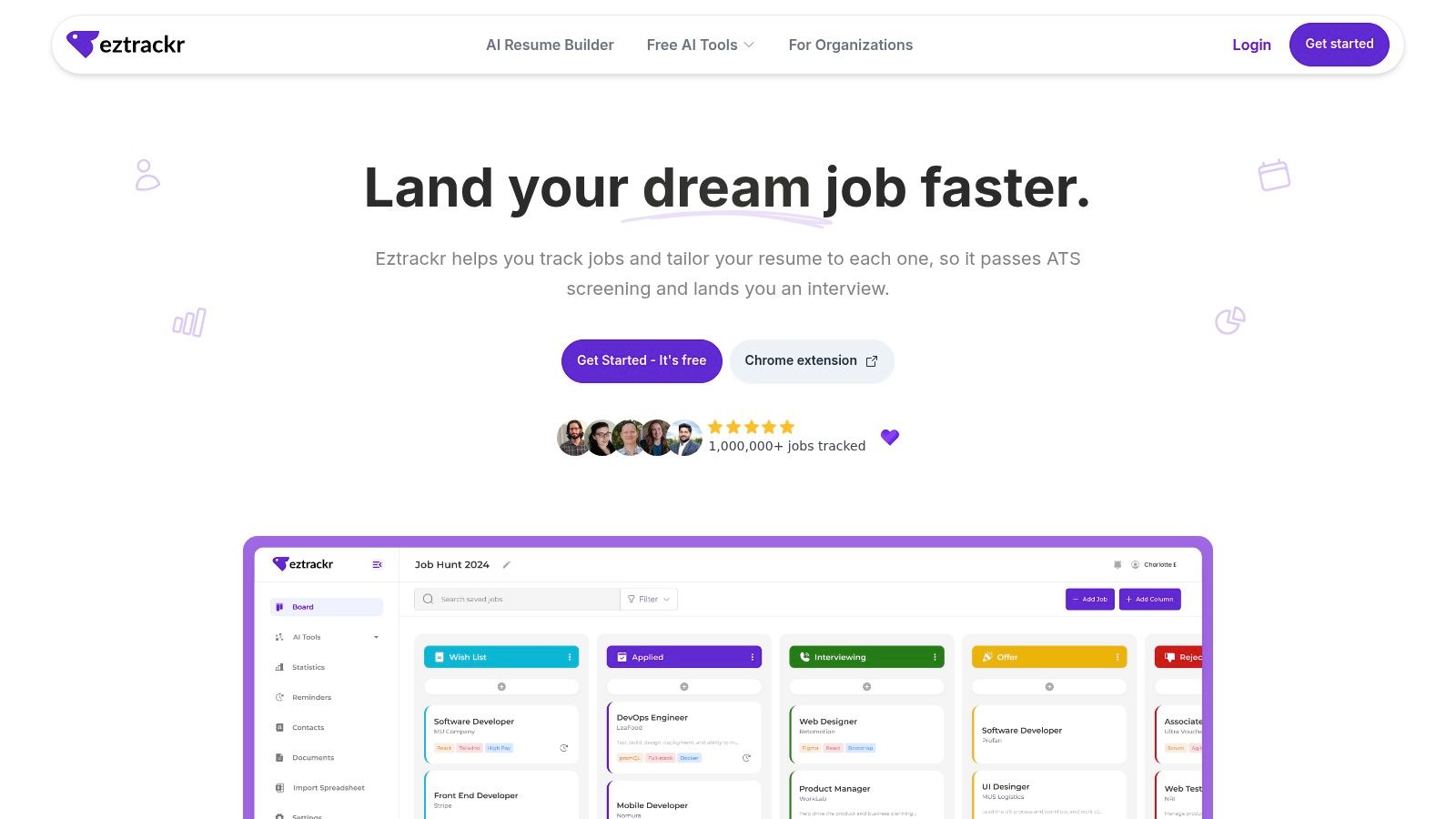
A tracker such as Eztrackr's job tracker can organize applications on a kanban board, connect documents to roles, and surface follow-up tasks. You can also start with a spreadsheet, then import the existing rows into a dedicated workflow once manual maintenance becomes a distraction.
Keep daily administration short. Save the posting when you find it, tailor before submission, record the next step immediately, and reserve one weekly block for review. The system works when it removes decisions from busy moments.
Measuring What Works and Setting Realistic Expectations
Your job search needs a dashboard, not a mood. Track applications sent, replies, interviews, stage progression, and offers by role type and resume version. These measures show whether the problem is weak targeting, poor screening performance, or stalled late-stage execution.
Global benchmark data reports an average of 73 applicants per role, with only 3 interviewed and 1 offer made. The same SmartRecruiters Recruitment Benchmarks 2025 report reports a median time to first offer of 68.5 days in Q2 2025.
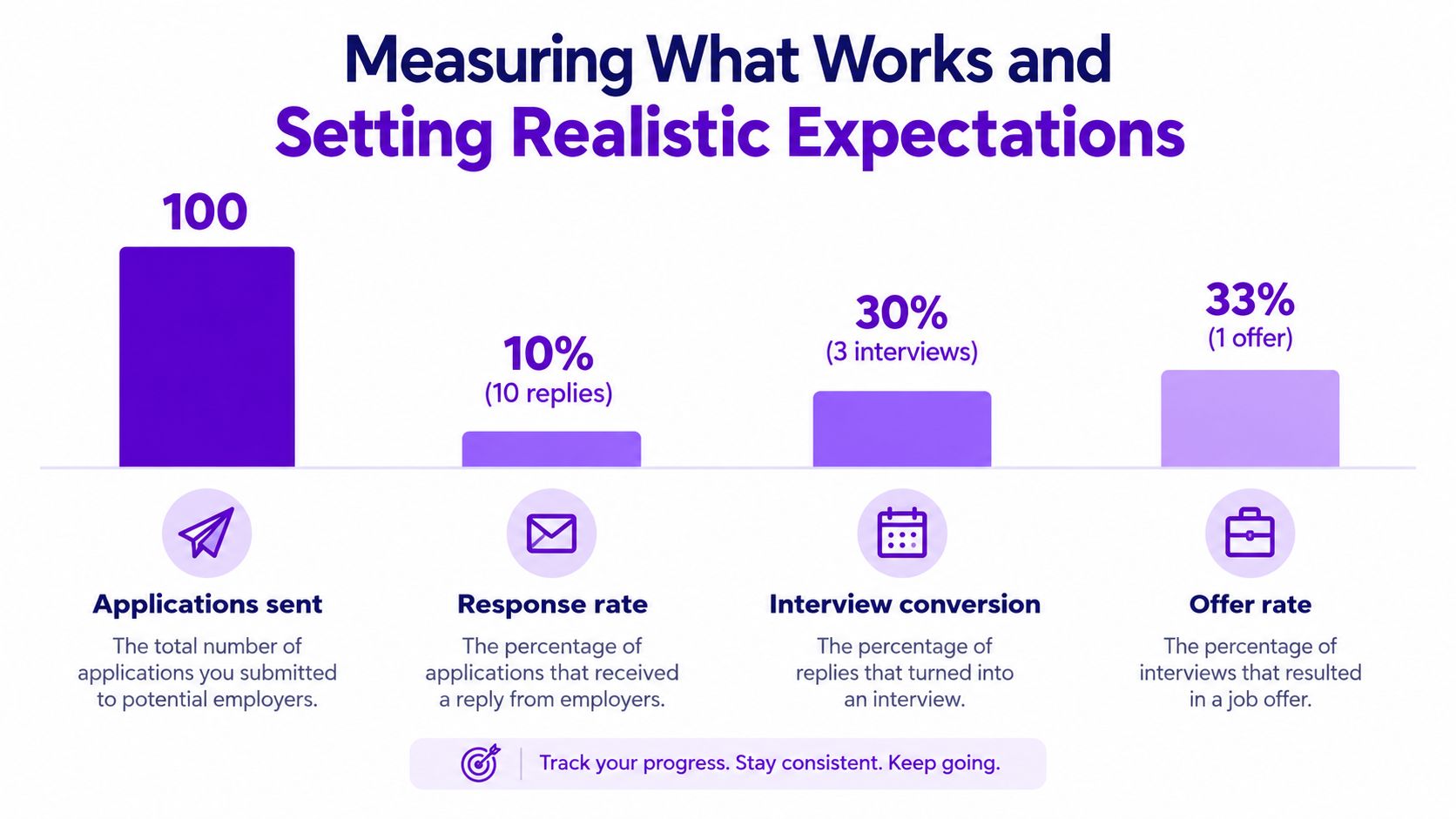
Use those benchmarks as context, not as a promise about your outcome. Your own funnel is more useful when you have enough entries to compare patterns. A low interview rate points you toward role selection, resume tailoring, ATS readability, or all three. Interviews without progression point toward preparation, communication, examples, or role fit. Late-stage stalls may require sharper follow-up and clearer expectation management.
Diagnose the leak before changing tactics
| Signal | Likely issue | First adjustment |
|---|---|---|
| Few relevant postings saved | Weak targeting | Narrow the role filter and research better channels |
| Applications submitted but little response | Positioning or screening | Rework the headline, keywords, format, and evidence |
| Recruiter screens but no interviews | Early conversation mismatch | Prepare concise proof for core requirements |
| Interviews but no progression | Interview performance or fit | Review answers, examples, and role expectations |
| Final stages stall | Follow-up or process delay | Confirm next steps and maintain appropriate contact |
Don't judge the entire strategy from one quiet week. Compare role families, document versions, and stages. If customized applications perform better than generic ones in your own tracker, allocate more time to customizing and less to indiscriminate submission.
Use the following video as a supplementary visual explanation of funnel thinking, then return to your own data before changing your process.
A realistic timeline protects your confidence and improves decisions. Hiring teams don't all move at the same speed, so follow the stated process, keep other applications active, and treat silence as a reason to maintain the pipeline rather than panic.
Your Action Plan for a Better Application Process
Start with the largest likely drop-off, then work downward. A polished cover letter won't help if your resume can't be parsed, and a perfect tracker won't help if you're applying to roles you can't credibly target.
Complete this sequence this week
- Fix the resume foundation. Remove graphics, unusual columns, unclear headings, and non-selectable text. Test the reading order and align the document with the role you want.
- Create a master evidence library. Store strong bullets, projects, skills, and answers by theme so tailoring becomes assembly rather than reinvention.
- Set a targeting filter. Keep roles that match your level, core work, requirements, and motivation. Record why each retained role fits.
- Tailor before submitting. Match the accurate job title, reflect the posting's language, and move the strongest relevant evidence into view.
- Track the next action. Record the submission, document version, contact, follow-up date, and current stage immediately.
- Review the funnel weekly. Count replies, interviews, progression, and stalled applications. Change the weakest stage first.
Avoid the habits that create activity without progress: sending one generic resume everywhere, applying before researching the role, skipping follow-up, and letting applications vanish into browser tabs.
Expectations also need correcting. 70% of job seekers believe they'll land a job within 10 applications, according to NovaResume's resume statistics. That belief can turn a normal delay into premature discouragement, especially when hiring timelines stretch across several stages.
A deliberate process gives you better information after every submission. It tells you whether to improve targeting, rewrite evidence, repair formatting, prepare for interviews, or just keep the pipeline active. Use automation for repetitive administration, then spend the recovered time on the conversations where offers are decided.
Eztrackr helps you save job postings, organize applications in a kanban workflow, connect role-specific documents, and monitor progress across your search. Visit Eztrackr to replace scattered tabs and spreadsheets with a clearer application process you can review and improve.