follow up email after application template: 7 tips
You've polished your resume, crafted the perfect cover letter, and hit ‘send’ on your application. But in a competitive job market, the game isn't over. The silence that follows can be deafening, leaving you to wonder if your application landed in a black hole. This is where a strategic follow-up email becomes your most powerful tool. It’s not about being pushy; it’s about being persistent, professional, and memorable. A well-timed and thoughtfully written follow-up can rescue your application from the bottom of the pile, reiterate your enthusiasm, and showcase your proactive communication skills, qualities every hiring manager values.
Knowing exactly what to write and when to send it can feel daunting. A generic message might do more harm than good, while a well-crafted one can be the catalyst that moves your candidacy forward. This is why having a versatile follow up email after application template is crucial. For a complete and in-depth understanding of crafting impactful follow-up emails, consult the ultimate guide to writing a follow-up email, which offers foundational strategies that complement the specific examples we will cover.
In this comprehensive guide, we move beyond basic templates. We'll break down seven distinct follow-up email scenarios, analyzing the strategic purpose behind each one. You will learn not just what to say, but why it works and how to adapt it for maximum impact. From a simple status check to a value-add approach, these examples are designed to get your application seen and help you secure that interview.
1. The Value-Add Follow-Up
The Value-Add Follow-Up is more than a simple check-in; it’s a strategic move to reposition yourself from a passive applicant to a proactive, insightful professional. Instead of just asking, "Have you reviewed my application?" this approach provides something of genuine value to the hiring manager. This could be a relevant industry article, a thoughtful comment on a recent company achievement, or a brief analysis of a market trend. The goal is to demonstrate your engagement and expertise beyond your resume.

This method works because it respectfully re-opens the conversation while showcasing your genuine interest and industry acumen. It’s a powerful way to stand out in a crowded inbox and reinforce your alignment with the company’s goals and challenges.
Strategic Breakdown
This follow up email after application template is designed to accomplish three key objectives:
- Reinforce Interest: It proves you are actively thinking about the company and its place in the market.
- Demonstrate Expertise: Sharing a relevant insight positions you as a knowledgeable peer, not just another applicant.
- Create a Memorable Impression: Hiring managers see hundreds of applications. A value-add email makes you memorable for your contribution, not your persistence.
Key Insight: The most effective value-add contributions are concise, directly relevant to the role or company, and require no action from the recipient other than a quick read. Your goal is to give, not to ask for more of their time.
Example Template & Analysis
Subject: Following up on my Application for [Job Title] & a thought on [Relevant Topic]
Body:
Dear [Hiring Manager's Name],
I hope this email finds you well.
I submitted my application for the [Job Title] position last week and wanted to briefly reiterate my strong interest in this opportunity.
I recently read an article in [Publication Name] about [Topic Relevant to the Role/Company], and it made me think of [Company Name]'s recent work on [Specific Project or Initiative]. I thought you might find it insightful.
Here is the link: [Link to Article/Resource]
My experience in [Your Relevant Skill/Experience] aligns directly with the challenges and opportunities discussed, and I am confident I can contribute to your team's success.
Thank you again for your time and consideration.
Best regards,
[Your Name]
[Your Phone Number]
[Link to your LinkedIn Profile/Portfolio]
Actionable Takeaways
- Timing is Crucial: Send this email 1-2 weeks after your initial application. This gives the hiring team enough time to process applications without letting yours get lost.
- Authenticity Over Everything: Only share something you genuinely find interesting and relevant. A forced connection is easy to spot and can backfire.
- Keep it Concise: Your value-add should be a brief, one-sentence observation. The hiring manager is busy; make your point quickly and effectively.
- Triple-Check Relevance: Ensure the insight you share directly connects to the role's responsibilities, the company’s industry, or a recent company announcement. The more specific the connection, the more impactful your email will be.
2. The Simple Status Check
The Simple Status Check is the quintessential follow-up. It's a brief, direct, and polite email designed to inquire about your application status without unnecessary fluff. Unlike more elaborate follow-ups, its primary goal is to serve as a gentle reminder of your candidacy and confirm your continued interest. This approach respects the hiring manager's time while keeping your name visible in a high-volume recruitment environment.
This method is effective because of its simplicity and professionalism. It’s a low-pressure way to reopen communication, get a quick update, and show you are organized and diligent. It is the perfect choice when you don’t have a specific "value-add" to share but still want to prevent your application from falling through the cracks.
Strategic Breakdown
This follow up email after application template is engineered for efficiency and clarity, aiming to achieve three core objectives:
- Serve as a Polite Nudge: It gently reminds the hiring manager about your application without being demanding or impatient.
- Confirm Continued Interest: It signals that you are still actively and enthusiastically pursuing this specific role.
- Provide Clear Context: Including the job title and application date helps the recruiter quickly locate your file, which is crucial in high-volume hiring.
Key Insight: In situations where hundreds of applications are received, clarity and brevity are your greatest assets. A simple status check is often more effective than a long, complex email because it is easy for a busy recruiter to process and respond to quickly.
Example Template & Analysis
Subject: Following up on my [Job Title] Application
Body:
Dear [Hiring Manager's Name],
I hope you are having a productive week.
I am writing to follow up on my application for the [Job Title] position, which I submitted on [Date of Application]. I wanted to reiterate my strong interest in joining the team at [Company Name].
The opportunity to contribute my skills in [Mention 1-2 Key Skills from Job Description] is very exciting, and I am confident that my background aligns well with the requirements of the role.
Could you please let me know if there is any update on the timeline for the hiring process? I am eager to learn more about the next steps.
Thank you for your time and consideration.
Best regards,
[Your Name]
[Your Phone Number]
[Link to your LinkedIn Profile/Portfolio]
Actionable Takeaways
- Wait 5-7 Business Days: Sending this email too soon can appear impatient. Wait at least one full business week after applying before checking in.
- Reference Key Details: Always include the specific job title and the date you applied. This makes it incredibly easy for the recipient to find your application.
- Keep the Tone Professional and Patient: Your language should be polite and respectful. Avoid any phrasing that sounds demanding or frustrated.
- Send Mid-Week: Aim to send your email on a Tuesday, Wednesday, or Thursday morning. Mondays are often for catching up, and Fridays are for wrapping up, making the middle of the week ideal for visibility.
3. The Reiteration of Qualifications
The Reiteration of Qualifications follow-up is a direct and confident approach designed to remind the hiring manager of your core strengths. Instead of simply checking in on your application status, you strategically re-highlight the one or two qualifications that make you a perfect fit for the role. This method serves to refresh their memory of your application and connect your specific skills directly to the needs outlined in the job description.
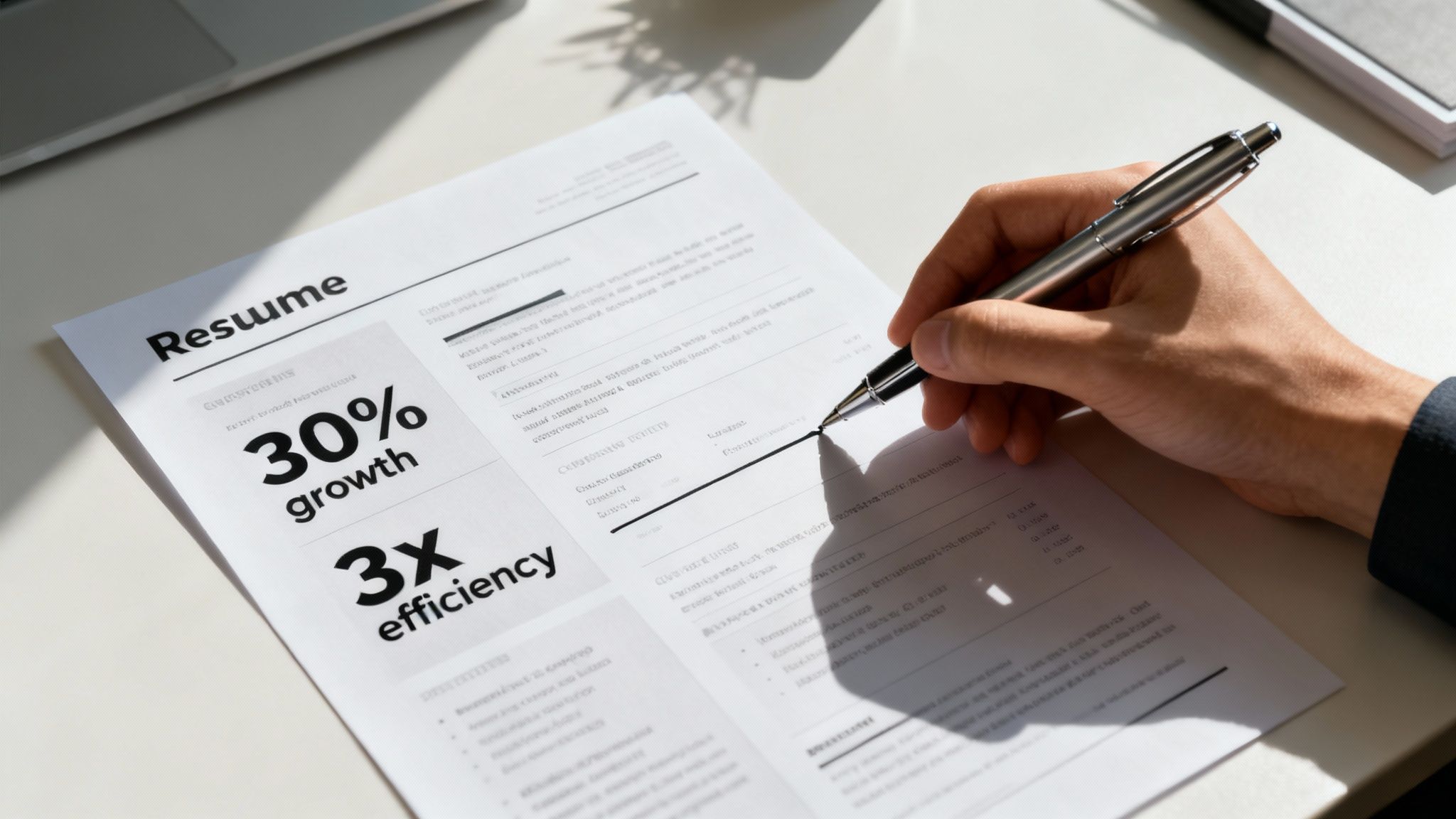
This tactic works because it saves the hiring manager time. It pulls the most crucial information from your resume and cover letter and places it front and center, making a compelling case for why you deserve a closer look. It shows you've carefully considered the role’s requirements and are confident in your ability to meet them.
Strategic Breakdown
This follow up email after application template focuses on accomplishing three primary goals:
- Reinforce Fit: It explicitly links your most impressive skills and experiences to the specific requirements listed in the job posting.
- Demonstrate Confidence: By restating your qualifications, you project confidence in your abilities and your suitability for the position.
- Keep Your Application Top-of-Mind: It acts as a powerful reminder, ensuring your application stands out from the many others they have received.
Key Insight: The power of this email lies in its precision. Do not relist your entire resume. Select the top two or three qualifications that are most impactful and directly address the core needs of the role.
Example Template & Analysis
Subject: Following up regarding the [Job Title] position
Body:
Dear [Hiring Manager's Name],
I hope this message finds you well.
I am writing to follow up on my application for the [Job Title] position I submitted on [Date of Application]. My enthusiasm for this role has only grown, particularly because my skills align so well with your requirements.
Specifically, my [Number] years of experience in [Key Skill #1] and my proven success in [Key Achievement/Skill #2, e.g., increasing user engagement by 25%] match the needs you outlined for this position.
I am confident that my background would enable me to contribute significantly to your team's goals. I have attached my resume for your convenience and remain very interested in discussing this opportunity further.
Thank you for your time and consideration.
Best regards,
[Your Name]
[Your Phone Number]
[Link to your LinkedIn Profile/Portfolio]
Actionable Takeaways
- Timing is Crucial: Send this email 10-14 days after applying. This timing is late enough to be a useful reminder but not so early that it seems impatient.
- Mirror the Job Description: Reread the job posting and pull keywords and required qualifications directly from it. Use their language to describe your skills.
- Quantify Your Achievements: Use numbers and metrics whenever possible (e.g., "managed a $50k budget," "improved efficiency by 15%"). This makes your qualifications more tangible and impressive. For more tips on this, learn about crafting a resume that gets noticed and how to make your resume better.
- Keep it Brief: Your reiteration should be a concise, powerful statement contained in one or two sentences. The goal is to make a quick, memorable impact.
4. The Networking Connection Follow-Up
The Networking Connection Follow-Up leverages a powerful asset in any job search: a personal referral. This email moves beyond a cold follow-up by referencing a mutual connection, an internal employee, or a contact made at a networking event. Mentioning a trusted name immediately adds a layer of credibility to your application, encouraging the hiring manager to give your materials a closer look.
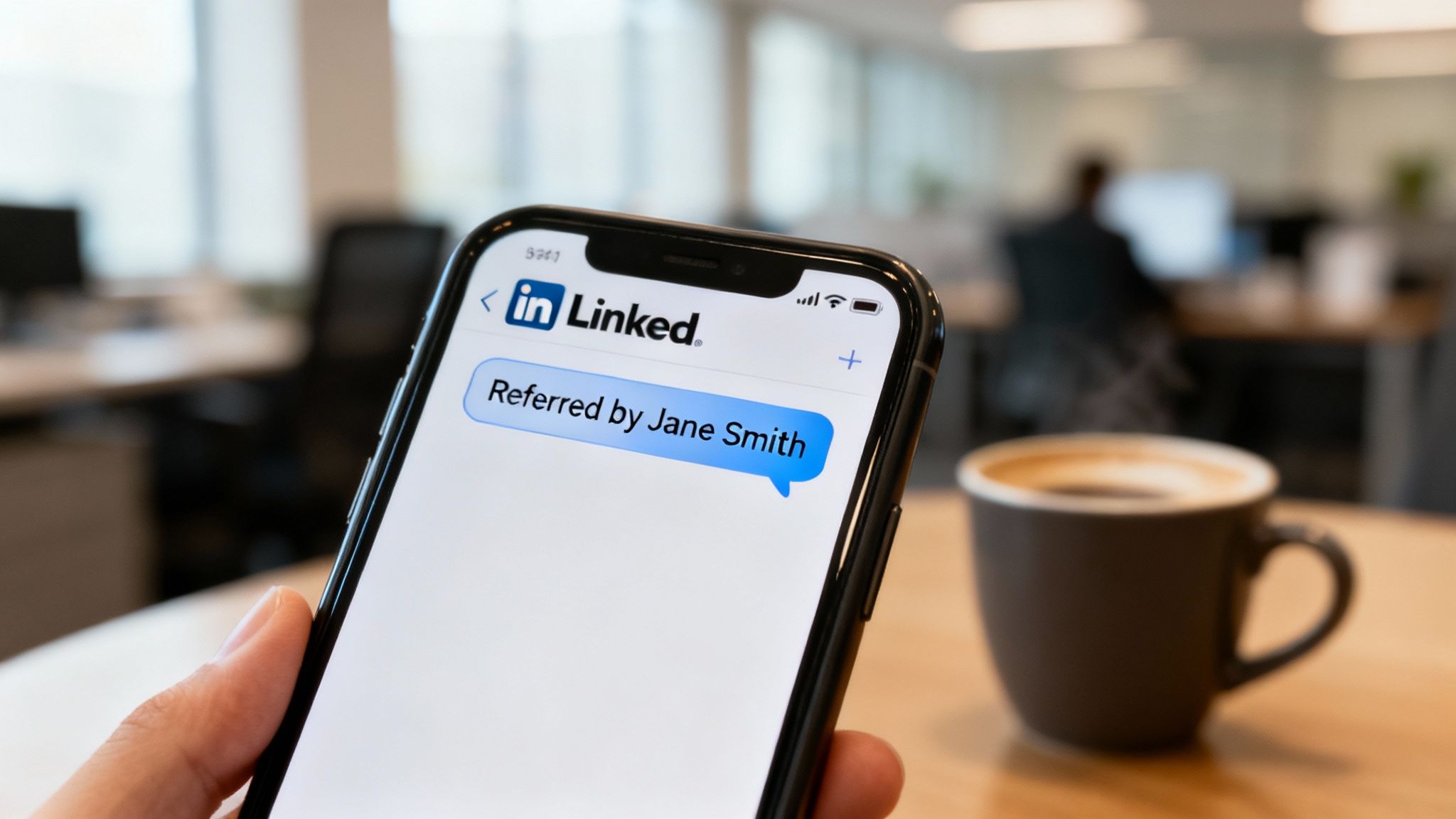
This approach is effective because it taps into the power of social proof. A recommendation, even an informal one, can separate your application from the anonymous stack. It shows you are proactive in building professional relationships and have already been vetted, to some degree, by someone the company knows and trusts. For more insights on this topic, you can learn more about effective job search networking strategies.
Strategic Breakdown
This follow up email after application template is crafted to achieve specific goals:
- Increase Visibility: A familiar name in the subject line or opening sentence can prevent your email from being overlooked in a crowded inbox.
- Establish Credibility: It borrows trust from your mutual connection, giving the hiring manager a reason to view your application more favorably.
- Create a Personal Touch: Referencing a person instead of just a job ID makes the interaction feel more human and less transactional.
Key Insight: The power of this email lies in its authenticity. Only use this approach if you have a legitimate connection and have received explicit permission to use their name. A fabricated or unapproved reference can damage your credibility instantly.
Example Template & Analysis
Subject: Following up: [Mutual Connection's Name] & my application for [Job Title]
Body:
Dear [Hiring Manager's Name],
I hope this message finds you well.
I submitted my application for the [Job Title] position last week. My colleague, [Mutual Connection's Name] from your [Department Name] team, suggested I reach out to you directly to reiterate my strong interest.
[Mutual Connection's Name] and I worked together on [Brief Context, e.g., the Project X launch at Company Y], and they believed my experience in [Your Relevant Skill] would be a great match for this role.
My background in [Specific Accomplishment or Skill] aligns with your team's goals, and I am very enthusiastic about the possibility of contributing to [Company Name].
Thank you for your time and consideration. I look forward to hearing from you.
Best regards,
[Your Name]
[Your Phone Number]
[Link to your LinkedIn Profile/Portfolio]
Actionable Takeaways
- Get Permission First: Always ask your connection if you can mention their name in your follow-up. This is a critical step that shows professionalism and respect.
- Be Specific and Brief: Clearly and concisely state how you know the person. A single phrase like "we worked together at [Previous Company]" or "we met at the [Event Name]" is sufficient.
- Pivot Back to Your Value: The connection is the opener, not the main event. Quickly transition the focus back to your qualifications and how you can specifically help the company.
- Thank Your Connection: Regardless of the outcome, send a separate thank-you note to your contact for allowing you to use their name. It maintains a strong professional relationship.
5. The Timeline-Specific Follow-Up
The Timeline-Specific Follow-Up demonstrates your professionalism and respect for the hiring process. When a recruiter or hiring manager provides a specific date or timeframe for when you can expect to hear back, this template allows you to follow up precisely and appropriately. Instead of guessing when to reach out, you are acting on direct information, showing you are an attentive and detail-oriented candidate.
This method works because it aligns with the recruiter's own schedule and expectations. It's a non-intrusive check-in that references a prior conversation, reminding them of their commitment to provide an update. It’s a subtle yet powerful way to keep your application top-of-mind without appearing impatient or pushy.
Strategic Breakdown
This follow up email after application template is designed to accomplish three key objectives:
- Show You're Listening: It proves you paid close attention to the details provided during the application or interview process.
- Respect Their Time: By waiting for the specified date, you show that you understand and respect their busy schedule and internal processes.
- Prompt a Response: Referencing a specific timeline gently nudges the recipient to provide the update they had planned to give.
Key Insight: The power of this follow-up lies in its precision. Following up the day after the stated deadline passes is the sweet spot. It gives them a small buffer in case of internal delays but holds them accountable to the timeline they provided.
Example Template & Analysis
Subject: Following up regarding the [Job Title] position
Body:
Dear [Hiring Manager's or Recruiter's Name],
I hope you are having a productive week.
Following up on my application for the [Job Title] role. In our last communication, you mentioned that you were hoping to finalize decisions by [Mention the Specific Date or End of the Week].
I wanted to gently check in to see if there have been any updates on the timeline for this position. I remain very enthusiastic about the opportunity to bring my skills in [Your Key Skill #1] and [Your Key Skill #2] to your team.
Thank you for your time and I look forward to hearing from you.
Best regards,
[Your Name]
[Your Phone Number]
[Link to your LinkedIn Profile/Portfolio]
Actionable Takeaways
- Document Everything: Immediately after an interview or conversation, write down any timelines mentioned. This information is crucial for planning your follow-up strategy.
- Follow Up the Day After: If the recruiter said you'd hear by "the end of the week," send your email on Monday morning. If they gave a specific date, like March 15th, send it on March 16th.
- Reference the Timeline Directly: Always start by politely referencing the specific timeline they gave you. This provides context and justifies your reason for reaching out.
- Maintain a Gracious Tone: Hiring timelines can often shift due to unforeseen circumstances. Be understanding and polite, even if the deadline has passed. A positive attitude is a key part of learning how to get hired faster.
6. The Question-Based Follow-Up
The Question-Based Follow-Up transforms your email from a simple status check into a meaningful conversation starter. Instead of a one-way inquiry about your application, this approach poses a thoughtful, specific question about the role, team, or company. This demonstrates a deeper level of engagement and critical thinking, encouraging the hiring manager to provide a more substantive response than a standard "we'll be in touch."
This method is effective because it shows you've moved beyond just wanting the job to actively considering how you would succeed in it. A well-crafted question reveals your curiosity, professional insight, and genuine desire to understand the role's context, making you a more memorable and compelling candidate.
Strategic Breakdown
This follow up email after application template is structured to achieve three primary goals:
- Initiate Dialogue: It prompts a specific answer, making it more likely you'll receive a personalized response rather than a generic template.
- Showcase Engagement: Asking an intelligent question proves you have thoroughly considered the job description and researched the company.
- Clarify Role Expectations: The answer can provide valuable insights into the role's priorities and team dynamics, helping you prepare for a potential interview.
Key Insight: The best questions are forward-looking and cannot be answered by rereading the job posting. Focus on team collaboration, success metrics, or the role's connection to broader company goals to showcase strategic thinking.
Example Template & Analysis
Subject: Following up: Application for [Job Title]
Body:
Dear [Hiring Manager's Name],
I hope you are having a productive week.
I am writing to follow up on my application for the [Job Title] position I submitted on [Date of Application]. My enthusiasm for this role has only grown since learning more about your team's work.
As I was reflecting on the position, a quick question came to mind: Could you share what success in this role might look like in the first 90 days? I am particularly interested in understanding the key priorities for a new team member.
My background in [Mention a Specific Skill/Experience] has prepared me to tackle these types of challenges, and I am confident I can make an immediate contribution.
Thank you for your time and consideration. I look forward to hearing from you.
Best regards,
[Your Name]
[Your Phone Number]
[Link to your LinkedIn Profile/Portfolio]
Actionable Takeaways
- Limit Your Questions: Stick to one, maximum two, well-chosen questions. Overwhelming the hiring manager with inquiries can seem demanding.
- Ensure It’s Un-Googleable: Never ask a question that could be answered with a quick search of the company's website or the job description. This shows a lack of basic research.
- Frame with Positivity: Phrase your question to demonstrate enthusiasm and a desire to succeed, not to express doubt or concern about the role.
- Connect it Back: Briefly tie the potential answer back to your own skills or experience to reinforce why you are the right candidate for the job. This makes the question feel strategic, not random.
7. The Multi-Touch Sequential Follow-Up
The Multi-Touch Sequential Follow-Up is a disciplined, multi-stage strategy for staying on a recruiter’s radar. This approach acknowledges that a single email can easily be missed in a busy inbox. Instead of sending one message and hoping for the best, it uses a sequence of 2-3 thoughtfully timed emails, each with a slightly different angle, to maintain visibility without coming across as desperate. This method demonstrates persistence, organization, and genuine interest over a sustained period.
This technique works because it adapts to the modern workflow of a hiring manager. By varying your approach from a simple check-in to a value-add to a networking angle, you increase your chances of connecting at the right time with the right message, proving your tenacity and strategic thinking.
Strategic Breakdown
This follow up email after application template sequence is built to achieve several goals over time:
- Sustain Visibility: It keeps your name and application top-of-mind over several weeks, which is crucial during long hiring cycles.
- Showcase Versatility: Each email reveals a different facet of your professional character: your politeness, your industry insight, and your proactive nature.
- Maximize Response Rate: By using different hooks, you increase the probability that one of your messages will resonate and prompt a reply.
Key Insight: The power of this sequence lies in its patience and progression. Each message builds on the last without repeating the same ask. The goal is to be a consistent, positive presence, not a persistent pest.
Example Template & Analysis
Email 1 (Day 7-10): The Gentle Check-In
Subject: Following up on my application for [Job Title]
Body:
Dear [Hiring Manager's Name],
I hope you're having a productive week.
I am writing to briefly follow up on my application for the [Job Title] position I submitted on [Date of Application]. The opportunity to contribute to [Company Name] is very exciting, and I am confident that my skills in [Skill 1] and [Skill 2] align well with your requirements.
Could you please let me know if there is any additional information I can provide?
Thank you for your time and consideration.
Best regards,
[Your Name]
[Your Phone Number]
[Link to your LinkedIn Profile/Portfolio]
Email 2 (Day 14-20): The Value-Add
(Reply to the first email to maintain context)
Subject: Re: Following up on my application for [Job Title]
Body:
Dear [Hiring Manager's Name],
Just wanted to follow up on my previous email. I came across this article on [Relevant Topic] and thought it might be of interest in relation to your work on [Company Initiative].
Link: [Link to Resource]
My experience in [Relevant Experience] is directly related to this, and it reinforced my excitement for the [Job Title] role.
Best regards,
[Your Name]
Actionable Takeaways
- Timing is Key: Space each follow-up by at least 7-10 business days. This respects the hiring manager's time and prevents you from appearing impatient.
- Vary Your Angle: Never send the same "just checking in" email twice. Your first can be a status request, the second a value-add, and a potential third could be a brief note congratulating the company on a recent achievement.
- Know When to Stop: A sequence should have a maximum of three touchpoints. If you receive no response after the third attempt, it's time to move on. Persisting further can damage your professional reputation.
- Track Everything: Using a system to track your outreach is critical. To stay organized with this multi-step process, consider a job application tracking template to log when you sent each email and what the content was.
7 Post-Application Follow-Up Email Templates
| Follow-Up Type | Implementation 🔄 | Resources & Speed ⚡ | Expected Outcomes 📊⭐ | Ideal Use Cases 💡 | Key Advantages ⭐ |
|---|---|---|---|---|---|
| The Value-Add Follow-Up | Medium–High — tailored insights and company research required | High time investment; slower to prepare | ⭐⭐⭐⭐ — Memorable, higher-quality responses; moderate uplift in consideration | Senior roles; competitive industries; companies valuing thought leadership | Differentiates candidate; shows initiative and company fit |
| The Simple Status Check | Low — short, direct message | Low time; very quick to send | ⭐⭐ — Maintains contact; low differentiation; modest reply rate | All industries; entry to mid-level; high-volume hiring | Universal, fast, easy to respond to |
| The Reiteration of Qualifications | Low–Medium — concise selection of key achievements | Moderate time to craft metrics and tie to role | ⭐⭐⭐ — Refresher for hiring manager; can push candidate higher on list | Competitive roles; career changers; candidates with strong track records | Reinforces strengths with quantifiable results |
| The Networking Connection Follow-Up | Medium — requires permission and context from referrer | Moderate effort; depends on referrer availability | ⭐⭐⭐⭐ — Significantly higher response and credibility (often 3–4x) | Candidates with internal referrals or industry network | Provides social proof; may bypass initial screening |
| The Timeline-Specific Follow-Up | Low — simple, date-referenced message | Low time; timed for immediacy (fast to send when due) | ⭐⭐⭐ — Professional impression; respectful to process; modest response | Corporate/professional roles with formal timelines | Shows attention to detail; less likely to seem pushy |
| The Question-Based Follow-Up | Medium — craft 1–2 focused, role-specific questions | Moderate research required; moderate speed | ⭐⭐⭐⭐ — Encourages replies; demonstrates curiosity and fit | Strategic or consultative positions; roles valuing engagement | Invites dialogue; differentiates from standard check-ins |
| The Multi-Touch Sequential Follow-Up | High — planned sequence, tracking, varied angles | High resource/time; sustained effort over weeks | ⭐⭐⭐⭐ — Higher aggregate response rate; multiple chances to engage | Highly competitive roles; career-changing opportunities | Persistence with varied hooks; increases visibility over time |
Turning Templates into Interviews: Your Action Plan
We've explored a comprehensive arsenal of templates, from the value-add follow-up to the multi-touch sequential approach. But possessing a powerful follow up email after application template is only the starting point. The real magic happens in the execution, turning a generic script into a compelling, personalized message that secures an interview. The journey from "Application Submitted" to "You're Hired" is paved with strategic, timely, and thoughtful communication.
The core lesson from every example provided is that personalization is non-negotiable. A template is a scaffold, not a finished product. It provides the structure, but you must supply the substance that connects your unique skills and enthusiasm directly to the company's needs and the specific role's challenges.
Recapping Your Strategic Toolkit
Let's distill the most critical takeaways from the templates we've analyzed. Mastering these principles will elevate your follow-up from a simple check-in to a strategic career move.
- Timing is Everything: Your first follow-up should ideally be sent 5-7 business days after the application deadline, or about two weeks after you applied if no deadline was listed. This strikes a balance between showing initiative and respecting the hiring team's process.
- Value-Driven Communication: Always aim to add value. Whether you're reiterating a key qualification, referencing a recent company achievement, or sharing a relevant insight, your goal is to reinforce your candidacy, not just ask for an update.
- Clarity and Brevity are Key: Hiring managers are busy. Your email should be scannable, with a clear subject line and a concise body. Get straight to the point while maintaining a professional and courteous tone.
- Adaptability is Your Superpower: The right template depends entirely on the context. A follow-up after a referral requires a different touch than a simple status check after weeks of silence. Use the appropriate tool for the job.
Your Action Plan for Effective Follow-Ups
Having the right knowledge is one thing; putting it into practice is another. Here are your immediate next steps to transform these templates into tangible results and manage your job search like a pro.
- Organize Your Applications: Before you send a single email, you need a system. Create a simple spreadsheet or use a dedicated job tracker to monitor every application: the company, role, date applied, and the link to the job description.
- Set Your Follow-Up Calendar: For each application, schedule a follow-up date. This proactive step ensures no opportunity slips through the cracks simply because you forgot to reach out.
- Customize Your Chosen Template: Select the follow up email after application template that best fits the situation. Spend 10-15 minutes personalizing it. Research a recent company announcement, re-read the job description to find a key responsibility you can highlight, or mention a specific reason you're excited about their mission.
- Proofread Meticulously: A single typo can undermine your professionalism. Read your email aloud, use a grammar checker, and then have a friend or family member give it a final look before you hit send.
For job seekers managing a high volume of applications, manually sending each follow-up can become a significant time-sink. To truly put your follow-up email templates into action and scale your outreach, consider implementing automation. You can learn more with a definitive guide on automated emails from Gmail using templates to streamline this process. By mastering these communications, you are no longer a passive applicant waiting by the phone. You are an engaged, professional, and memorable candidate who takes control of their career journey.
Stop juggling spreadsheets and missed follow-up dates. Eztrackr centralizes your entire job search, allowing you to save these templates, set automated reminders, and visualize your application pipeline on an intuitive Kanban board. Take control of your job hunt and turn applications into interviews by signing up for Eztrackr today.