7 Examples of Retail Management Resumes That Work
You've found a store manager opening that fits. You've handled difficult shifts, coached struggling associates, and kept the store running when deliveries, staffing, and customer complaints collided. But your resume still reads like a job description: managed staff, monitored inventory, supported sales.
The recruiter needs to see what you owned, what you changed, and whether your experience matches the store they're hiring for. Your format is part of that first assessment. If promotions are buried, dates are hard to follow, or achievements sit inside graphics, the reader has to reconstruct your career before evaluating it.
These seven examples of retail management resumes send different hiring signals. Some emphasize steady promotion. Others establish multi-store scope, readiness for a first store manager role, or transferable leadership from another industry. Each needs a different balance of achievements, chronology, and skills.
Choose the format that explains your career, not the template you find most attractive. Then check both versions of the page: what a recruiter sees and what an applicant tracking system extracts. A clean layout helps, but it won't compensate for vague claims. The strongest resume gives the reader clear evidence they can discuss with you in an interview.
1. Chronological Store Manager Resume
Best for candidates with steady retail progression, this format puts your most recent role first and makes increasing responsibility easy to follow. A recruiter can see the move from cashier to shift lead, assistant manager, and store manager without hunting through separate skills categories.
Use this order: professional summary, Work Experience, Skills, and Education. Within each job, establish store scope before describing improvements. The reader needs to distinguish managing an entire operation from supervising a department.
Make Progression Visible in the Bullets
A representative bullet in Himalayas' retail management resume guide combines scope and outcome: supervising 18 associates and increasing quarterly sales 12% through localized merchandising and coaching. Treat those figures as an illustration, not numbers to copy.
Build your own entry around the same logic:
- Scope: Identify the team, department, or store operation you managed.
- Intervention: Explain the scheduling, coaching, merchandising, or inventory change you introduced.
- Result: Give a documented outcome and its measurement period.
Keep promotions under the same employer when appropriate, but give each position its own title and dates. That helps the recruiter recognize progression and reduces ambiguity when software associates achievements with jobs.
The comparison below highlights the main format trade-off.
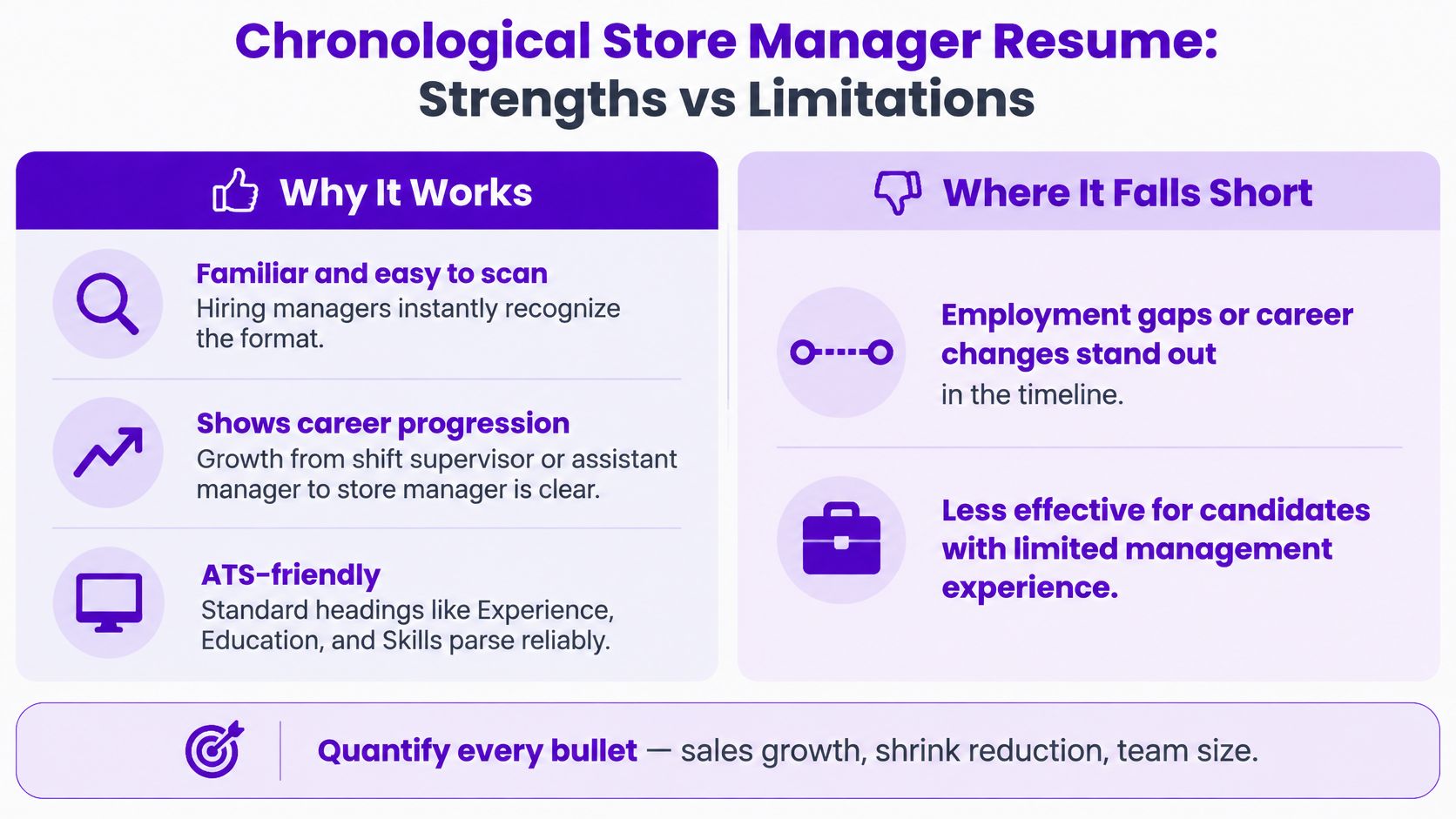
Chronology also makes gaps and short tenures visible. Don't distort dates to conceal them. Use a brief explanation where needed, and keep the resume focused on performance.
If a promotion or relocation needs context, these sample cover letters for retail can help you explain it without crowding the employment history.
2. District or Multi-Store Operations Manager Resume
A district manager resume shouldn't read like a store manager resume with more locations added. The hiring signal is repeatable performance through other managers. Recruiters need evidence that you can set priorities, compare locations, and develop leaders without personally directing every shift.
Lead with portfolio scope: locations, reporting structure, and financial accountability where disclosure is permitted. Then distinguish direct reports from the broader workforce. Managing store managers isn't the same claim as directly supervising every associate in their stores.
Show the Operating System Behind the Results
A useful entry pairs a portfolio-wide change with evidence of local execution. Say you coordinated an inventory-system rollout across a district. Describe how you prepared store managers, monitored adoption, and handled exceptions rather than listing system implementation as a skill.
The SkillsForResume retail example demonstrates useful scope-and-baseline reporting at store level: a 22-person team, £2.4 million annual turnover, 104% of annual sales target, shrink reduced from 1.8% to 0.9%, and retention improved from 62% to 81%. A district candidate needs that same precision while clearly identifying whether a result covers the portfolio or selected stores.
Scope rule: A strong result from a flagship location is not automatically a district-wide result. Name the population you actually measured.
Keep the experience section chronological. Under each senior role, group related accomplishments around commercial performance, operational consistency, and manager development. Avoid decorative location maps or charts that require interpretation.
The trade-off is detail versus breadth. Retain enough operational explanation to show how you led, but remove routine opening, closing, and cashier duties unless they explain a specific turnaround. For a broader operations-oriented structure, review this sample operations manager resume.
3. Assistant Store Manager to Store Manager Transition Resume
Your title says assistant manager. Your resume must establish where you've already exercised store-level judgment without pretending you held the manager's job permanently.
Readiness comes from decisions, not proximity to the store manager. Covering leave, approving schedules within delegated authority, running the cash office, and resolving escalated customer issues can all demonstrate readiness. State exactly what you controlled and what still required approval.
This is the kind of team leadership your bullets should explain.

Prove Readiness Without Manufacturing Sales Figures
Candidates don't always have access to revenue, payroll, or customer dashboards. The ethical alternative is a verifiable operational measure. ResumeTrick's retail manager guidance offers a useful example: training 8 new hires to independent closing responsibility within 3 weeks.
That works because the outcome is observable. A hiring manager can ask how readiness was assessed, who signed off, and what the training covered.
- Acting responsibility: Describe the period when you ran daily operations and the decisions delegated to you.
- Functional ownership: Identify whether you owned recruitment coordination, replenishment, scheduling, or cash controls.
- People development: Show what associates could do independently after your coaching.
Keep your official job title in Work Experience. You can describe acting-manager coverage in a bullet or summary, but don't rename the position to match the vacancy.
Don't claim full P&L ownership if you only reviewed sales reports. Explain the commercial decisions you actually made.
Use these approaches to presenting leadership on a resume to replace supporting-language habits with accurate ownership. The distinction between helped with training and designed the closing checklist matters more than a more senior-sounding title.
4. Sales and Visual Merchandising Focused Retail Manager Resume
A beautiful display isn't enough. The hiring signal is commercial judgment expressed through presentation, selling behavior, and customer experience. This format suits fashion, specialty, and luxury candidates whose strongest evidence connects store execution with buying behavior.
The image illustrates the activity. Your resume needs to explain the decision behind it.

Say you moved complementary products beside a featured category and coached associates on relevant add-on recommendations. A useful bullet identifies the category, the intervention, and the result you can substantiate. If you measured transaction value or sell-through, include the actual reporting period and comparison basis.
Separate Execution From Commercial Impact
Use achievement-led bullets, but keep them attached to employers and dates. A recruiter needs to know whether you set the merchandising strategy, adapted a head-office plan, or maintained established standards.
- Commercial evidence: Connect the reset or selling initiative to documented category performance.
- Execution evidence: Explain launch readiness, replenishment coordination, or compliance with brand standards.
- Leadership evidence: Describe how you trained associates to maintain the presentation and sell the featured range.
Don't imply that merchandising alone caused a sales improvement when pricing, promotion, or stock availability also changed. State your contribution accurately.
Keep photographs out of the resume itself. If you have permission to share a portfolio, provide a descriptive link, while retaining the essential evidence in readable text. An ATS shouldn't need to interpret an image to find your achievement.
For a supplementary visual walkthrough, use the video below.
The trade-off is specialization. Keep inventory, staffing, and cash-control evidence visible so the recruiter sees a retail manager, not solely a display specialist.
5. Skills-Based Functional Retail Management Resume
A hospitality supervisor moving into retail may have substantial scheduling, service-recovery, and training experience but no retail manager title. A skills-led format can make that connection visible. It can also help someone returning after a career break put relevant capabilities near the top.
The risk is credibility. If achievements float beneath broad skill headings without employers or dates, a recruiter can't easily establish where the experience happened. Use a hybrid approach: relevant achievements first, followed by a complete chronological employment history.
Translate Skills Without Renaming the Work
A ResumeTemplates analysis of retail manager resumes found inventory management on 76% of sampled resumes and team leadership on 65%. Those findings support a practical balance: show operational capability alongside people management, rather than filling the page with personality adjectives.
For a hospitality-to-retail transition, organize evidence around:
- Team leadership: Scheduling, onboarding, coaching, and resolving staff issues.
- Operational control: Stock counts, deliveries, cash reconciliation, and documented procedures.
- Customer experience: Complaint resolution, service standards, and escalation handling.
Under each heading, identify the employer or role associated with the accomplishment. Add a genuine count, timeframe, or before-and-after measure where records support it. Don't translate restaurant stock handling into retail inventory forecasting unless you performed forecasting.
Credibility test: Could a former supervisor recognize the work and confirm your level of responsibility?
For a merchandising-related transition, reviewing visual merchandising assistant duties and skills can help distinguish transferable presentation work from unfamiliar responsibilities.
Use conventional headings such as Skills and Work Experience. Avoid replacing the employment section with a narrative biography. A skills-led opening can explain your relevance, but it shouldn't require the recruiter or parser to reconstruct your timeline.
6. Early-Career Retail Management Resume for Recent Graduates
Management potential needs evidence of responsibility, not a declaration that you're a natural leader. A recent graduate applying to a management trainee program should connect education with part-time work, internships, and genuine leadership activity.
The recruiting challenge doesn't remove that requirement. In Robert Half's consumer-goods and retail employment research, 87% of retail hiring managers in 2025 reported that finding skilled talent was somewhat or very challenging. Your task is to make relevant capability visible, not assume employers will infer it from your degree.
Put Your Strongest Evidence First
Lead with Education when your degree and relevant projects are more substantial than your work history. Lead with Work Experience when you've already held meaningful shift responsibility. Either way, replace a generic objective about gaining experience with a targeted summary that names the role you're pursuing and the capabilities you bring.
Consider a business graduate who worked as a shift lead while studying. Their entry should explain opening or closing responsibility, new-hire support, and stock-control work before listing routine transactions.
- Work evidence: Record the actual number of colleagues trained or shifts supervised if you can verify it.
- Project evidence: Name the analysis, recommendation, and deliverable rather than implying a classroom exercise produced business results.
- Leadership evidence: Explain what you organized, who depended on you, and what was completed.
Label internships, volunteer roles, and academic projects accurately. Don't give a student society position a corporate management title.
Keep Education and Experience in separate text sections so application forms can identify them cleanly. If the portal imports your coursework as an employer, correct the fields before submitting. The trade-off is space: relevant evidence earns room, while an extensive module list usually adds less than a clear example of responsibility.
7. ATS-Optimized One-Page Retail Manager Resume
This format is for candidates who need a concise application document with straightforward text extraction. ATS optimization is not a different career story. It's a presentation discipline you can apply to chronological, transitional, or early-career resumes.
The page should look restrained enough that the reader notices your evidence before the design.
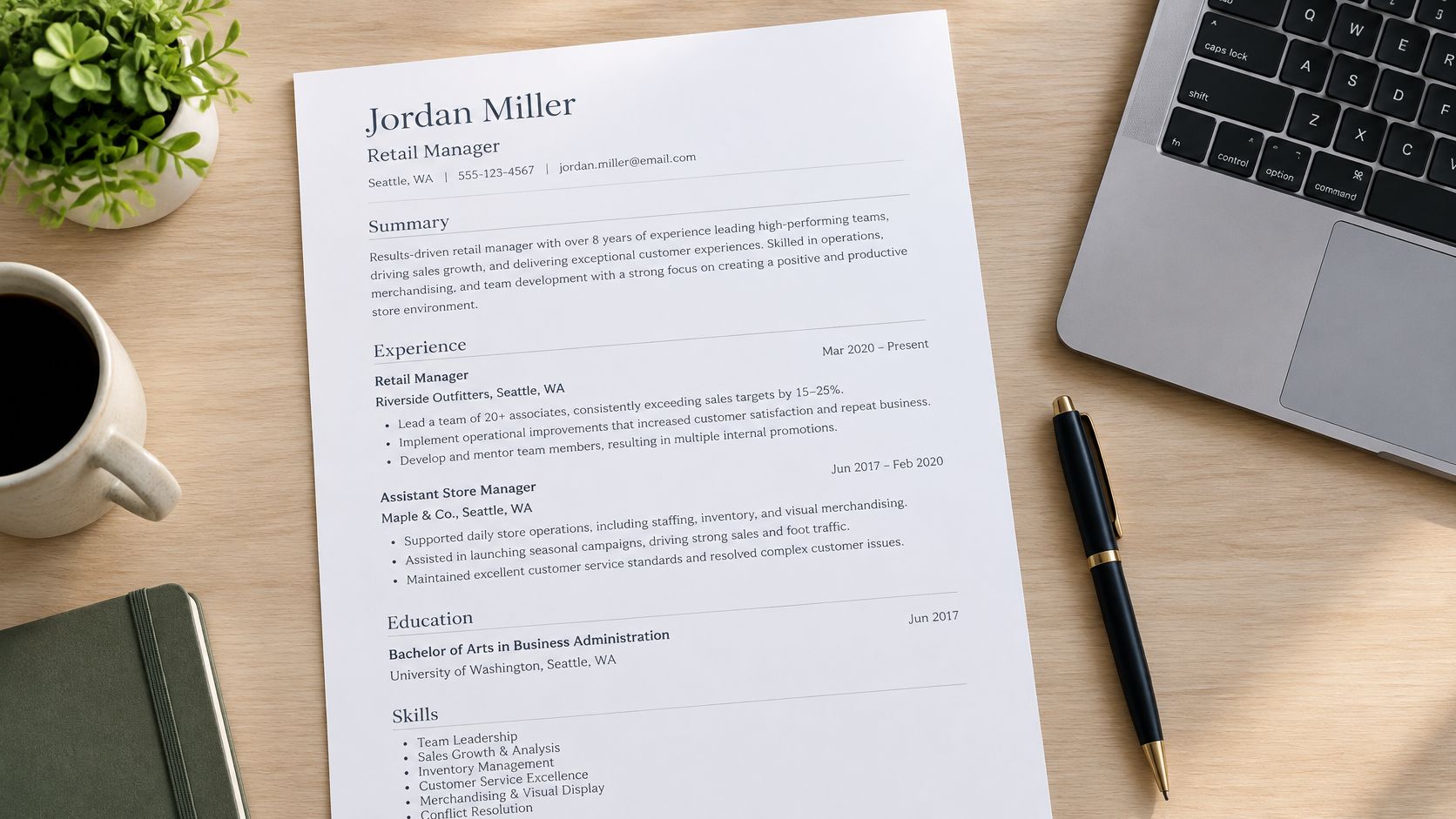
Use a single text column, standard headings, and clearly separated employer, title, and date lines. Keep contact information in the main document body rather than relying on icons or a decorative header. Follow the employer's requested file type.
Match Vocabulary to Evidence
Hirekit's retail manager keyword guidance connects relevant terminology to outcomes through an example combining a 30% reduction in inventory shrink, supervision of 25+ associates across two locations, and 92% customer satisfaction for three consecutive quarters. The principle is stronger than keyword repetition: operational terms should appear beside evidence of doing the work.
If a posting asks for inventory control, loss prevention, and workforce scheduling, use those terms where they accurately describe your experience. Don't add P&L ownership merely because the employer requests it.
Test the document before submitting:
- Text extraction: Copy its text into a plain-text editor and inspect the reading order.
- Field accuracy: Review imported titles, employers, dates, education, and contact details.
- Evidence retention: Confirm that shortening the page hasn't removed the context behind your strongest achievements.
These one-page resume formatting techniques can help with editing. But don't force a complex multi-unit career onto a cramped page. A readable, relevant longer document is preferable to tiny text and unexplained results, and no layout guarantees an interview.
How the seven retail management resume formats compare side by side
| Example | Best For | Format Style | ATS Friendliness | Standout Strength |
|---|---|---|---|---|
| Chronological Store Manager Resume | Candidates with steady retail work history | Reverse-chronological | High with standard headings | Clearly shows career progression |
| District or Multi-Store Operations Manager Resume | Senior and regional retail leaders | Scope- and impact-focused | Strong when job-posting keywords are included | Demonstrates measurable impact across multiple locations |
| Assistant Store Manager to Store Manager Transition Resume | Assistant managers seeking their first store manager role | Achievement-focused transition | Strong when both job titles appear where accurate | Shows practical readiness for store leadership |
| Sales and Visual Merchandising Focused Retail Manager Resume | Sales-driven, fashion, specialty, and luxury retail roles | Sales metrics and merchandising highlights | Strong with simple formatting and a linked portfolio | Connects sales results with brand presentation |
| Skills-Based Functional Retail Management Resume | Career changers and candidates with employment gaps | Skills grouped by competency, with work history below | Mixed; functional layouts may challenge parsers | Emphasizes transferable abilities |
| Early-Career Retail Management Resume for Recent Graduates | Recent graduates and management trainee applicants | Education- and leadership-focused | Strong when tailored with relevant keywords | Highlights leadership potential despite limited experience |
| ATS-Optimized One-Page Retail Manager Resume | Applicants to large retailers using automated screening | Concise, single-column, keyword-focused | High with standard headings and simple formatting | Easy for both parsers and recruiters to scan |
Choose the Format, Then Let Results Decide
Pick the example that makes your career easiest to understand. Steady promotion favors chronology. District leadership needs portfolio scope and manager development. An assistant manager needs evidence of independent judgment, while a career changer needs an explicit connection between previous work and retail responsibilities.
Rewrite three bullets before redesigning the whole page. Start with what you controlled, explain the intervention, and finish with an outcome you can defend. Check records such as training logs, approved schedules, performance reviews, inventory reports, or audit results rather than guessing at an impressive percentage.
If a figure is confidential, use an approved alternative. Team scope, training completion, delegated authority, and process adoption can demonstrate management value without disclosing store revenue. If you can't establish a reliable measure, describe the responsibility and observable outcome plainly.
Final submission rule: Every achievement should survive a follow-up question, and every important field should survive text extraction.
Then test the layout. Copy the document into plain text, inspect the sequence, and review whatever the application portal imports. A visually clean PDF can still produce incorrect fields, so don't treat appearance as proof that parsing worked.
Keep a customized version with each application. Record the role, employer, submission date, resume version, and subsequent response. Distinguish a recruiter reply from an interview invitation so you don't mistake administrative contact for stronger hiring interest.
Compare results cautiously. A district role and an assistant manager opening aren't equivalent tests, and a rejection doesn't establish that the format failed. Look for patterns among comparable roles, then adjust the summary, ordering, or evidence that seems least aligned with the posting.
We offer a Resume Scorer that evaluates format, content, impact, and relevance, which can help identify areas to review before submission. Treat that feedback as an editing aid, not a substitute for accurate achievements or the employer's application instructions.
Your resume is a working document. Keep the evidence that earns useful conversations, revise what creates confusion, and choose the version that generates interviews rather than the one that looks best in isolation.
Use our Resume Builder to create an ATS-friendly resume and tailor it to the retail management role you're pursuing. Visit Eztrackr to build your version, keep application documents with each job, and track which applications progress to interviews.