8 Objectives for a Teaching Resume: Examples for 2026
A single hiring decision in a school can separate a classroom by a full year of student learning. In Stanford economist Eric Hanushek's chapter on teacher effectiveness, teachers near the top of the effectiveness distribution produced approximately 1.5 grade-level equivalents of learning in one academic year, compared with 0.5 for teachers near the bottom. Principals live with the consequences of that gap every fall, so they scan applications looking for concrete proof of classroom readiness.
When a hiring committee reviews a stack of applications on a tight timeline, a vague opening line like passionate educator seeking a challenging role gets skipped immediately. It gives a principal zero evidence of your license, your grade band, your instructional approach, or the student outcomes you can deliver. Strong objectives for a teaching resume replace empty enthusiasm with a tight positioning statement: target role, verified credential, instructional method, and measurable evidence.
Below are eight worked examples organized by career stage and specialty. Each example comes with a practical tailoring routine so you can mirror the right keywords for applicant tracking systems (ATS), double-check every claim before an interview, and decide whether an objective serves you better than a summary built with professional summary writing tips.
1. Early-Career Teacher Objective (New Graduate or Student Teacher)
New graduates enter a massive hiring pipeline with low formal barriers on paper, which creates fierce competition at the screening stage. For the 2024 to 2034 projection period, the U.S. Bureau of Labor Statistics Career Outlook projects an average of 91,000 annual openings for elementary-school teachers excluding special education, an occupation with a 2024 median annual wage of $62,340 that typically requires a bachelor's degree and no prior related work experience. Because hundreds of recent graduates share the exact same degree on paper, your objective has to replace a long work history with evidence from your student teaching placement.
A graduating candidate can move straight from preparation coursework to a clear classroom pitch, as illustrated below.

Sample objective: Recent elementary education graduate with a [State] teaching license seeking a 3rd grade position. Completed a 14-week student teaching placement where I designed differentiated reading units that raised small-group assessment scores by 18 percent. Skilled in positive behavior supports and family communication.
This example works because it answers the three questions a principal asks first: are you licensed, have you managed a real room, and did students learn under your instruction? Instead of saying you are "seeking a teaching position," it names the exact grade, the length of the practicum, and a verifiable literacy gain. The trade-off is specificity. If you apply to both a kindergarten opening and a 5th grade opening with that exact 3rd grade wording, the mismatch will look careless.
Tailoring This Objective to a First-Year Posting
Never recycle one early-career objective across multiple districts. Spend ten minutes customizing the top three lines before every upload, especially when you are comparing local openings alongside strategies for finding new graduate jobs near you.
- Mirror Exact License Titles: Copy the posting's credential phrasing word for word, whether it asks for an Initial Educator License, Preliminary Credential, or K to 6 Endorsement, so district screening filters register a match.
- Audit Your Practicum Numbers: Pull the exact pre-test and post-test scores or the count of students in your reading group directly from your student teaching binder so you can explain the assessment method during an interview.
- Match One Core Instructional Skill: Read the posting's top three responsibilities and swap in the matching classroom routine you ran, such as Positive Behavioral Interventions and Supports (PBIS), guided math groups, or phonics intervention.
- Keep the Objective Over a Summary: Stick with an objective for your first two years in the field, because a summary draws attention to limited years of lead teaching while an objective directs attention to your preparation and target grade.
2. Experienced Classroom Teacher Objective
Sample objective: Middle school science teacher with 8 years of experience across grades 6 to 8. Developed a project-based curriculum that increased proficiency on state science assessments from 61 percent to 78 percent over three years. Experienced in mentoring new teachers and aligning instruction with NGSS standards.
Seasoned applicants often sabotage themselves by listing daily duties like grading papers or attending staff meetings. Hiring committees already assume a veteran teacher can write a lesson plan. What they evaluate instead is sustained instructional impact, a priority reflected in the Wing Institute's guide on teacher selection, which notes that application materials help assess content knowledge, certification, teaching and learning knowledge, communication ability, and demonstrated classroom performance, and that sample-lesson performance links to later value-added contributions to student achievement.
That example clears the bar because it pairs tenure with a before-and-after outcome (61 percent to 78 percent proficiency) and signals value beyond one classroom through new-teacher mentoring. Naming Next Generation Science Standards (NGSS) shows curriculum fluency without stuffing the sentence with buzzwords.
When to drop the objective: If you have five or more years of classroom results and you are applying for the same grade band and subject, replace the objective with a tight professional summary. Keep an objective only when you are changing districts with distinct priorities, shifting grade levels, or stepping into a curriculum lead role where your direction needs explanation.
Verifying Metrics and Mirroring District Standards
Pick one or two of your strongest, cleanest numbers rather than crowding three lines with five different percentages. Every figure you write at the top of your resume becomes an immediate interview question. Keep a private reference sheet with the assessment name, cohort size, and academic years behind your proficiency gain so you never hesitate when a principal asks how you calculated the growth.
Before submitting, scan the job description for named frameworks, pacing guides, or learning management platforms like Canvas, Schoology, or Common Core. If the district emphasizes Professional Learning Communities (PLCs) or Multi-Tiered System of Supports (MTSS), weave the exact term you have practiced into your final sentence. Pairing an objective with a separate summary rarely works; choose one opening block so you don't waste prime top-of-page space repeating yourself.
3. Special Education Teacher Objective
Special education hiring starts with legal compliance and caseload readiness before anyone asks about your teaching philosophy. Principals need to know immediately whether you can write legally defensible Individualized Education Programs (IEPs), hit Individuals with Disabilities Education Act (IDEA) timelines, and collaborate smoothly inside an inclusive classroom. A generic claim about supporting diverse learners won't get past the first pass.
Hands-on instructional support and structured intervention materials sit at the heart of special education work, and your opening lines need to reflect that daily reality.
Certified special education teacher with experience supporting students with specific learning disabilities and autism spectrum disorder in inclusive settings. Authored and monitored over 40 IEPs annually, maintaining full compliance with IDEA timelines. Skilled in co-teaching and data-based progress reporting.
Look at the balance in that statement. It specifies the disability categories served, quantifies annual IEP management volume without risking student privacy, and names co-teaching alongside data-based progress reporting. One clear trade-off applies here: if your background is in self-contained classrooms and the job is a push-in resource model, you must foreground your collaboration and general-education modification skills rather than leading solely with self-contained management.
Matching State Endorsements and IEP Software
Special education credentials carry strict state-by-state labels, and applicant tracking filters often reject resumes that use informal shorthand. Because special education roles combine instruction with heavy documentation and coordination across specialists, framing your administrative precision using strong case management skills on your resume separates ready-to-hire candidates from applicants who need heavy onboarding.
- Use Exact Endorsement Language: Write the precise title printed on your state certificate, such as Learning Behavior Specialist I (LBS1), Mild to Moderate Disabilities, or Extensive Support Needs, rather than just writing Special Ed.
- Name District IEP Platforms: If the job listing mentions Frontline IEP, SEIS, EasyIEP, or Infinite Campus and you have used it, include the platform name once to pass keyword screening cleanly.
- Protect Student Privacy Strictly: Quantify caseload totals, compliance percentages, or progress-monitoring cycles, and never include school-identifiable cohort details or individual student descriptions anywhere in your resume.
- Lead With Co-Teaching Models: Many districts prioritize inclusion, so specify whether you have delivered station teaching, parallel teaching, or push-in accommodations with general education partners.
4. STEM Subject Specialist Objective (Math or Science)
Say a high school science department chair opens forty applications for a chemistry vacancy in April. Across the U.S. educational-services sector, May 2024 Bureau of Labor Statistics employment data recorded approximately 1,067,580 secondary-school teachers and 619,200 middle-school teachers, alongside 1,388,940 elementary-school teachers, illustrating how sharply hiring separates by school level and subject specialization. Even in shortage areas like physics, chemistry, and advanced math, administrators screen hard for the exact state endorsement and proven lab safety habits.
Sample objective: High school chemistry teacher with an endorsement in physical science and five years of laboratory instruction. Designed inquiry-based labs aligned with NGSS performance expectations and led a robotics club to two regional championships. Committed to safe lab practices and equitable access to STEM learning.
This objective earns a second look because it names the exact subject endorsement, highlights five years of hands-on laboratory management, and backs up instructional quality with concrete student engagement through robotics leadership. Calling out safe lab practices speaks directly to a real administrative liability concern that non-science applicants overlook.
Balancing Technical Credibility and ATS Readability
STEM candidates often make one of two opposite mistakes: writing an objective so broad it sounds like a general teaching template, or packing in dense scientific acronyms that confuse a human resources screener who isn't a chemist. Keep your core endorsement and course names crystal clear, and reserve granular lab instruments or coding libraries for your skills section.
Watch this walkthrough for a closer look at how hiring managers evaluate resume wording and keyword alignment during initial screening.
Check the posting before you include extracurricular STEM coaching. If the school runs an active FIRST Robotics, Science Olympiad, or Mathletes program, naming your coaching record strengthens the pitch. If the posting focuses strictly on algebra remediation and credit recovery, replace competition trophies with an outcome tied to scaffolded problem solving or formative assessment gains, and ensure the exact subject keywords appear consistently in both your objective and your work history bullets.
5. ESL and English Language Learner (ELL) Teacher Objective
Hiring across education and corporate sectors is shifting rapidly away from generic job-title matching toward documented competencies. According to RecruitBPM's ATS resume guide, 85% of employers were reported to be using skills-based hiring practices in 2025. For ESL and multilingual educators, that trend matters twice as much: district software screens for specific endorsements and instructional frameworks, while international or bilingual applicants often hold credentials whose titles don't automatically match local district terminology.
Sample objective: TESOL-certified ESL teacher serving grades 3 to 5 with experience supporting learners at beginning through intermediate English proficiency levels. Implemented sheltered instruction strategies that helped students meet grade-level reading benchmarks within one academic year. Fluent in Spanish and experienced in bilingual family outreach.
This statement works because it ties three verifiable assets together: an exact credential (TESOL-certified), a defined learner profile (grades 3 to 5 at beginning through intermediate proficiency), and a measurable instructional result linked to sheltered instruction. Adding Spanish fluency and bilingual family outreach signals immediate community value without claiming an endorsement you don't hold.
- Name Your Recognized Framework: Specify the standards or instructional model you use, such as WIDA English Language Development Standards, SIOP (Sheltered Instruction Observation Protocol), or ELPA21, whenever the job posting references them.
- State Exact Credential Wording: Distinguish clearly between a state ESL Endorsement, Bilingual Education Certificate, TESOL, or TEFL certificate, because public districts cannot substitute a private certificate for a state license.
- Define Proficiency Bands and Delivery Models: State whether you taught newcomers, long-term English learners, pull-out intervention groups, or push-in co-taught classrooms.
- Connect Language Skills to Academic Outcomes: Pair multilingual ability with a classroom result, such as reading benchmark growth, writing rubric progression, or higher parent-teacher conference attendance.
Credential Accuracy Versus Broad Keywords
Here is the trade-off for ESL candidates: stuffing every possible acronym (ESL, ELL, ELD, ESOL, MLL) into your objective looks robotic to a principal, yet using only one acronym can miss a district's ATS search filter. Solve this cleanly by matching the exact label used in the job title inside your objective, then placing the standard equivalent once in parentheses or in your certifications block. If you already hold six or more years of state-licensed ESL experience and you're staying within the same grade band, consider converting this opening into a results-first professional summary instead.
6. Career Changer Teaching Objective
Every career changer faces the same unspoken skepticism from a hiring panel: why should we trust a first-time lead teacher whose career happened outside K to 12 schools? As LearnVerta's guide to teaching objectives notes, alternative-certification routes are a common pathway for degree-holders entering teaching, and applicants are best served by leading with certification progress and prior teaching or training experience. That guidance answers the toughest question non-traditional candidates ask: "What should a career changer put in the objective if certification is incomplete?"
Sample objective: Former software engineer completing an alternative certification program in secondary computer science. Brings eight years of applied experience in software development and has delivered technical training to over 200 employees. Committed to building accessible computing pathways for high school students.
Compare how a vague career-pivot draft falls flat next to an evidence-backed objective in the breakdown below.
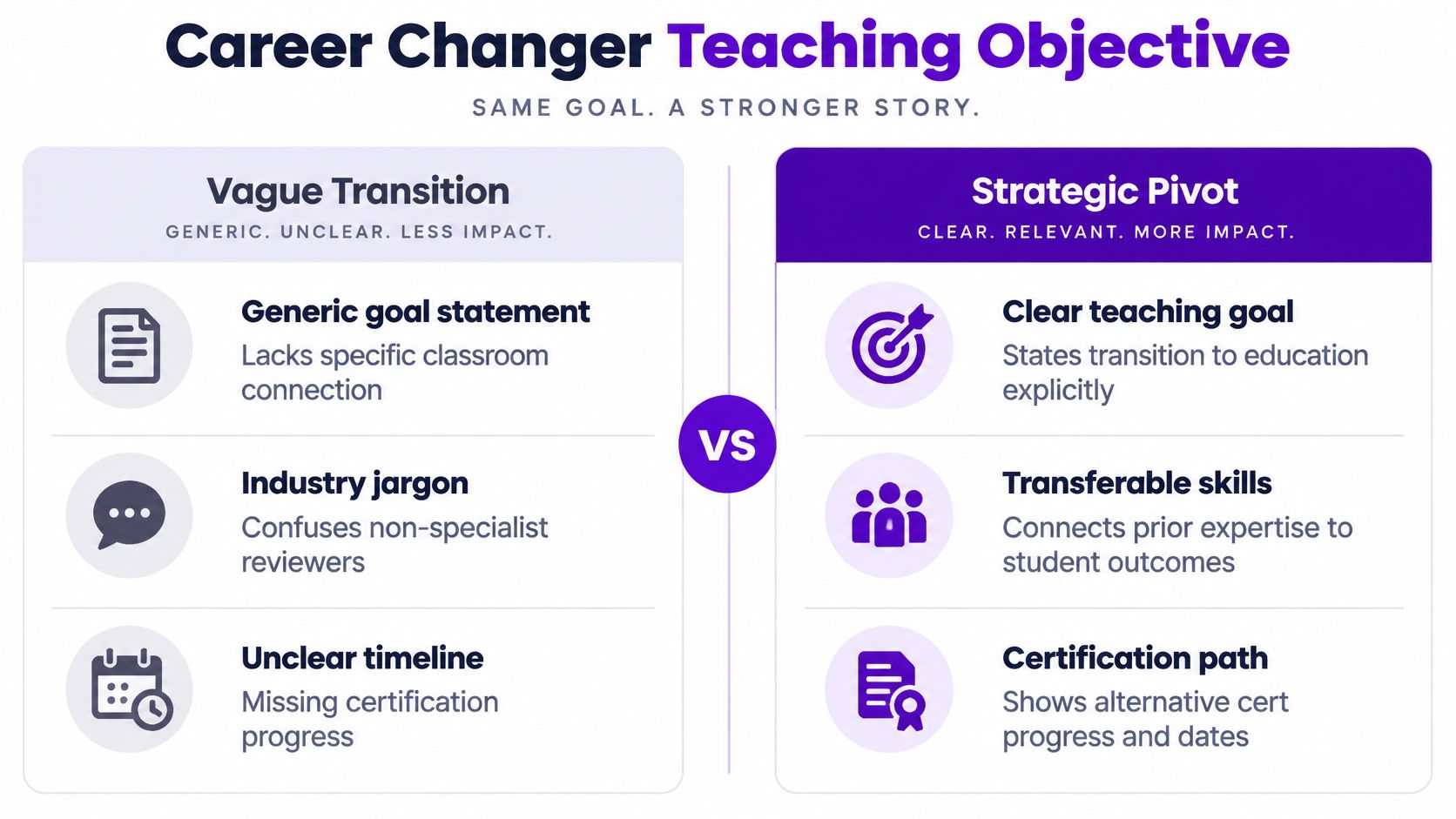
This example works because it owns the transition without sounding defensive. It states the exact certification pathway up front, converts eight years of industry work into instructional relevance (delivering technical training to over 200 employees), and names the target subject and grade level clearly.
Translating Corporate Experience Without Overstating Licensure
Your tailoring routine starts with stripping out corporate jargon. Terms like stakeholder alignment, sprint velocity, or client enablement mean very little to a high school principal. Translate them into classroom-adjacent equivalents such as curriculum pacing, group facilitation, formative coaching, or parent communication, a framing approach covered in detail when building a resume summary for changing careers.
Licensure transparency check: Never imply you hold full state certification if you are still taking coursework or exams. Distinguish clearly between a completed license, an emergency or provisional permit, and an alternative certification program with a specific expected completion month and year.
Track each district's posting requirements side by side before editing your draft. Some schools weigh tutoring, youth coaching, or volunteer instruction heavily, while Career and Technical Education (CTE) programs prioritize years of verified industry practice. Career changers should almost always keep an objective rather than a standard summary until they complete their first full year as a teacher of record, because the objective explains the pivot immediately before the reader reaches an unconventional work history.
7. Instructional Coach or Teacher Leader Objective
Moving from a classroom role into instructional coaching, department leadership, or curriculum design requires a sharp pivot in how you describe impact. Strong student test scores inside your own room prove you can teach kids, but they don't automatically prove you can move adult practice across a building. Principals hiring coaches look for evidence of facilitation, peer trust, and schoolwide data routines.
Collaborative leadership happens in team meetings, data reviews, and curriculum planning sessions, which is the exact work your objective needs to spotlight.

Sample objective: Literacy-focused teacher with 10 years of classroom experience seeking an instructional coach role. Led monthly professional learning sessions for 25 teachers and co-designed a schoolwide writing framework that improved writing scores across three grade levels. Experienced in observation-based coaching and data cycles.
This statement hits the exact balance hiring panels expect. It anchors credibility in ten years of classroom teaching so colleagues won't view you as out of touch, then immediately shifts to adult-facing scale (25 teachers, three grade levels) and formal coaching methods (observation-based coaching and data cycles).
Proving Schoolwide Reach Beyond Your Own Classroom
Coaching interviews dig relentlessly into how you handle hesitant veteran colleagues and how you measure whether professional development changed instruction. Preparing your metrics now will also sharpen your answers for common interview questions for school leaders and principals.
- Claim Only Documented Leadership Roles: Cite formal titles or verified committee work such as Grade-Level Chair, Mentor Teacher, or Literacy Team Lead, and avoid inflating casual peer advice into formal coaching.
- Quantify Adult Reach Clearly: State the number of teachers, departments, grade teams, or school buildings you supported so the committee can gauge the scope of your influence.
- Measure Changes in Adult Practice: Pair student growth with an adult-level output, such as rubric calibration adoption, coaching cycle completion, or common formative assessment rollout across a grade band.
- Keep Classroom Excellence Visible: Retain one brief anchor to your own instructional track record, because teachers take coaching feedback far more seriously from someone who has delivered results with students.
Notice the objective-versus-summary decision rule here. If you are a classroom teacher stepping into your first formal coaching role, an objective clarifies that upward shift immediately. Once you have held an official Instructional Coach or Curriculum Specialist title for two or more years, drop the objective and lead with a concise leadership summary.
8. Early Childhood Educator Objective
Sample objective: Early childhood educator holding a Child Development Associate (CDA) credential with four years of experience in pre-K classrooms. Designed play-based learning centers aligned with state early learning guidelines and documented child progress through portfolio assessments. Committed to strong family partnerships and a safe, inclusive environment.
Early childhood directors evaluate resumes through a distinct lens: credential compliance, child development fluency, observational documentation, and health and safety readiness. Calling yourself warm or patient adds zero differentiation because every applicant writes that. Naming the Child Development Associate (CDA) credential, the exact age group (pre-K), play-based learning centers, and portfolio assessments proves you understand how accredited programs operate and pass licensing inspections.
One important trade-off involves program jargon. Public pre-K programs, Montessori schools, Head Start grantees, and private childcare centers use different terminology for the exact same developmental goals. Leaving an overly academic phrase in a play-based preschool application, or leaving informal daycare language in a state-funded pre-K application, can drop you to the bottom of the pile.
Adapting Your Objective for Head Start or Private Centers
Before submitting an early childhood resume, pull the exact compliance and assessment requirements from the job ad and adjust three specific elements.
- State Credentials and Expiration Status Accurately: Write the exact credential name as issued, such as CDA Preschool Credential, Associate Degree in Early Childhood Education, or State Pre-K Licensure, and note current renewal status in your certifications block.
- Specify Age Band and Program Setting: Distinguish clearly between infant/toddler rooms, 3-year-old preschool, and pre-K, and align your wording with the employer's setting, whether Head Start, Universal Pre-K, Montessori, or a private NAEYC-accredited center.
- Name Observation and Safety Tools: If the posting references Teaching Strategies GOLD, CLASS observations, Ages and Stages Questionnaires (ASQ), or current Pediatric CPR and First Aid, include the tools you actively hold and use.
Verify every training expiration date before you click submit. Directors check CPR, First Aid, and mandated-reporter certifications early in the hiring sequence because licensing rules prohibit placing uncertified staff in ratio-counted classrooms.
How the eight teaching resume objectives compare by audience, length, and proof point
| Item | Best for | Typical length | Key credential or proof point |
|---|---|---|---|
| Early-Career Teacher Objective (New Graduate or Student Teacher) | New graduates and student teachers with limited lead-teacher experience | 2 to 3 sentences | Teaching license or pending certification; student teaching outcomes |
| Experienced Classroom Teacher Objective | Teachers with several years of classroom experience | Usually 3 to 4 sentences | Quantified student achievement and subject expertise |
| Special Education Teacher Objective | Candidates pursuing special education roles | 2 to 4 sentences | Special education licensure or endorsement; IEP and IDEA experience |
| STEM Subject Specialist Objective (Math or Science) | Math, science, technology, or engineering teachers | 2 to 4 sentences | Subject endorsement; lab, STEM program, or competition experience |
| ESL / English Language Learner (ELL) Teacher Objective | Teachers supporting English learners and multilingual students | 2 to 4 sentences | ESL, ELL, or TESOL certification; language proficiency |
| Career Changer Teaching Objective | Professionals transitioning into teaching | 2 to 4 sentences | Alternative certification progress; relevant professional expertise |
| Instructional Coach or Teacher Leader Objective | Teachers seeking coaching, curriculum, or leadership roles | 2 to 4 sentences | Professional development leadership; team- or school-wide outcomes |
| Early Childhood Educator Objective | Educators working with infants, toddlers, preschool, or pre-K children | 2 to 4 sentences | CDA or state early childhood certification; child development experience |
Use this table as a staging tool, not as a script. The audience column tells you who the opening needs to reassure. A new graduate needs proof of readiness. An experienced teacher needs proof of impact. A career changer needs a bridge from prior work to the classroom.
Length matters because an objective that runs too long repeats the resume. Keep the shortest version for early-career candidates with limited lead-teacher experience. Give experienced teachers enough room to name subject expertise and verified student results. Use 2 to 4 sentences when the role depends on a endorsement, certification, or a specific learner population.
The proof point column is where tailoring starts. Pull keywords from the posting, then mirror only the ones you can support. For applicant tracking systems, that means using the exact wording for licensure, grade band, instructional framework, or student group where it fits. If the ad names IEPs, TESOL, lab instruction, or early childhood certification, your objective should echo that language only when your resume proves it.
Trade-offs are real. A tight objective gives a recruiter a fast fit check. A longer objective can carry nuance for leadership roles or a career switch. A vague objective wastes both. If your background is already clear from the first two resume sections, drop the objective and use a short professional summary instead.
Turn These Examples Into Your Next Interview Invitation
Writing strong objectives for a teaching resume is not an exercise in creative writing. It is an alignment check between what a school needs this semester and what you can prove on day one. Choose the example above that matches your current career stage, then run a quick four-step tailoring routine before every application.
First, pull the job description into a separate document and highlight four items: the exact license or endorsement required, the target grade band or learner population, the named instructional framework or software platform, and the top measurable priority. Second, rewrite your opening three lines so those exact terms appear naturally without stacking buzzwords. Third, verify every single number against your own records, whether that's a student-teaching assessment gain, an annual IEP count, or the number of teachers who attended your professional learning sessions. If you don't have a verified percentage yet, use an auditable output instead, such as the number of intervention groups served, curriculum units delivered, or observation cycles completed.
Fourth, check whether you even need an objective for this specific application. Keep an objective if you are a recent graduate, a career changer, a teacher moving into a new specialty or leadership track, or an educator relocating to a district with very different priorities. Switch to a tight professional summary once you hold several years of proven results in the exact grade level and subject you are targeting again.
Once your draft is ready, test it against the posting before you hit submit. Eztrackr offers job-specific scoring that evaluates your resume against a specific job description and suggests relevant improvements, and creating a resume with Eztrackr is free. Checking your match on each application takes far less time than wondering why a generic resume never earned a callback, and it puts your strongest, most verifiable teaching evidence right at the top of the page where hiring committees look.
When you're applying across multiple districts and grade levels, keeping every objective, keyword match, and follow-up note organized gets messy fast. Eztrackr brings a free ATS-ready resume builder, job-specific resume scoring, and a visual job application tracker into one workflow so you can customize each teaching application in minutes and track every interview stage without spreadsheets. Build and score your teaching resume today at Eztrackr.