10 Different Styles of Resumes to Land Interviews in 2026
Your resume is more than a list of past jobs; it's the strategic blueprint for your next career move. In a competitive job market where the average corporate role attracts hundreds of applicants, the structure of your document can determine whether you land in the 'interview' pile or the digital discard bin. Simply listing your experiences is no longer enough. The format you choose tells a story about your professional journey, and picking the wrong one can obscure your most compelling qualifications.
With most companies relying on Applicant Tracking Systems (ATS) to filter candidates, selecting the correct format isn't just a matter of preference. It's a critical step in ensuring your skills are even seen by a human recruiter. A poorly structured resume can be automatically rejected before it ever reaches a hiring manager, regardless of how qualified you are for the role. This is why understanding the different styles of resumes is fundamental to a successful job search.
This guide dives deep into the most effective resume styles available today. We will explore each format's unique strengths, ideal use cases, and potential drawbacks. You will learn precisely which blueprint to use for your specific career situation, whether you are a seasoned professional with a linear career path, a recent graduate, or making a significant industry change.
We’ll break down which format to use and show you how to leverage each style to its fullest potential, ensuring you not only pass the ATS but also captivate the hiring manager. We will also reveal how you can use Eztrackr’s powerful resume builder and skill-match analyzer to create, tailor, and track each version with precision, transforming a generic document into a powerful career-advancing tool.
1. Chronological Resume
The chronological resume is the gold standard and one of the most widely recognized of all the different styles of resumes. It presents your work history in reverse-chronological order, starting with your most recent position and working backward. This format’s primary strength is its linear, easy-to-follow narrative that highlights a clear and steady career progression.
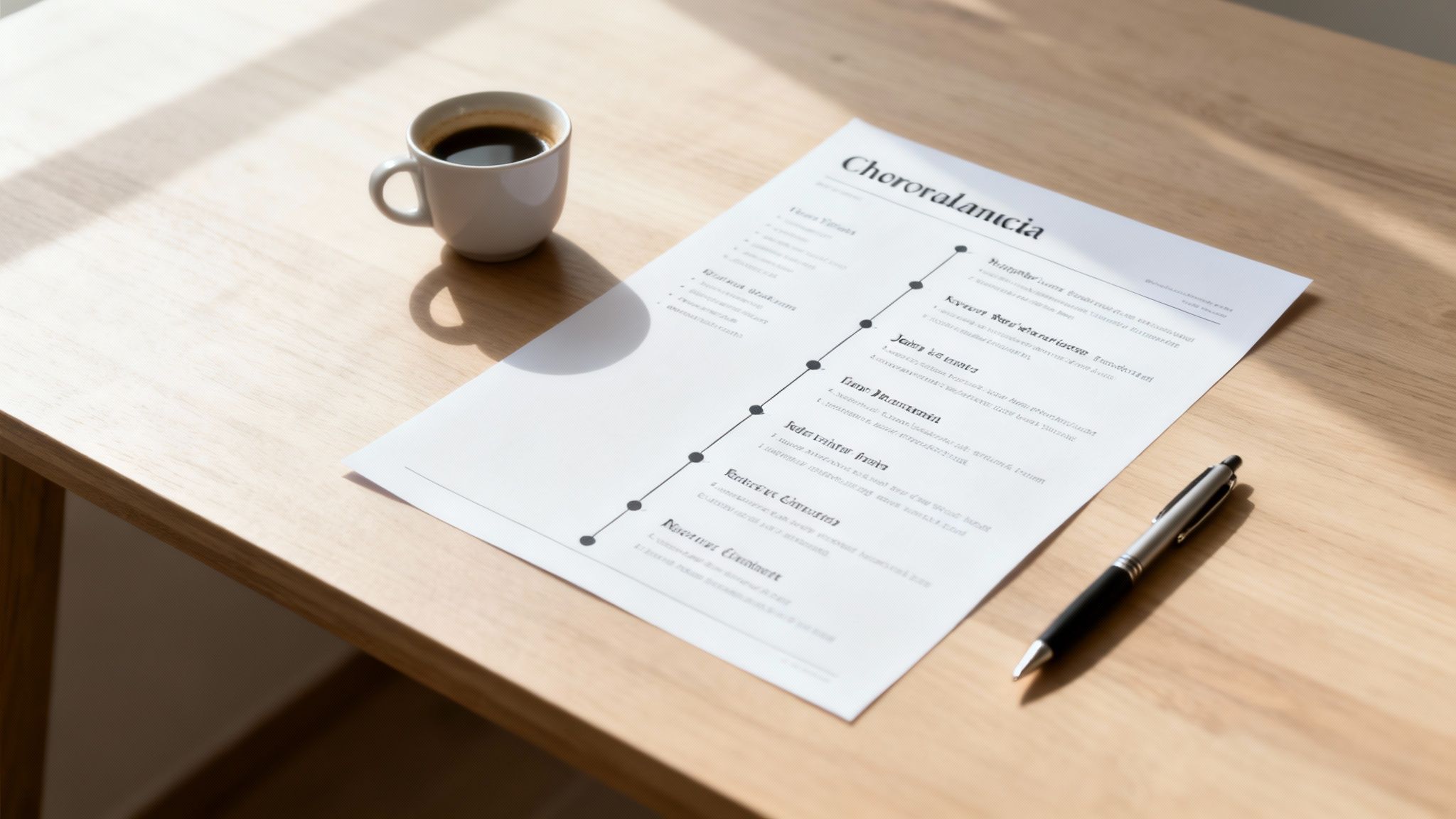
This structure is highly favored by both recruiters and Applicant Tracking Systems (ATS) for its predictability and clarity. Recruiters can quickly scan your career trajectory, while an ATS can parse the information with a high degree of accuracy, ensuring your qualifications are not missed.
Who Should Use This Format?
This style is ideal for job seekers with a consistent and strong employment history, particularly those looking to advance within the same industry. It effectively showcases growth, loyalty, and increasing responsibility over time. If your career path demonstrates a logical sequence of promotions and relevant roles, the chronological format is your best choice.
Key Implementation Tips
To maximize the impact of your chronological resume, follow these best practices:
- Quantify Achievements: Instead of listing job duties, lead each bullet point with a powerful action verb and a quantifiable result. For example, "Managed a project budget of $250,000, delivering the project 15% under budget" is more impactful than "Responsible for project budget."
- Maintain Consistency: Ensure all formatting is uniform. Use the same date format (e.g., MM/YYYY) for every entry and keep job titles, company names, and locations structured identically throughout. For a deeper dive into these specifics, you can review our comprehensive resume formatting guidelines.
- Prioritize ATS Compatibility: Simplicity is key for ATS parsing. Avoid using tables, columns, or excessive graphics. When using Eztrackr’s resume builder, selecting a chronological template automatically optimizes your layout for ATS success, and the feedback tool can score its readability before you apply.
2. Functional Resume
The functional resume is a skills-focused format that places the spotlight on your abilities and competencies rather than your chronological work history. Among the different styles of resumes, this one is unique because it groups related accomplishments under specific skill categories like "Project Management" or "Digital Marketing," showcasing your expertise upfront. The traditional work history is typically de-emphasized and listed briefly near the bottom.
This structure allows you to highlight your most relevant qualifications at the very top of the document. It directs a recruiter's attention to what you can do, making it a powerful tool for candidates whose career path isn't a straight line.
Who Should Use This Format?
This style is a strategic choice for career changers, individuals with significant employment gaps, or those re-entering the workforce after a break. It's also beneficial for job seekers whose most relevant experience comes from freelance projects, volunteer work, or multiple unrelated short-term roles. For example, a veteran transitioning to a civilian project management role could use this format to group leadership and logistical skills gained in the military.
Key Implementation Tips
To effectively leverage the functional resume format, consider these best practices:
- Align Skills with Job Descriptions: Create specific skill categories that directly mirror the keywords and requirements listed in the job posting. Use a tool like Eztrackr’s skill-match analyzer to identify the most critical competencies to feature for each application.
- Include a Brief Work History: While the focus is on skills, you must still include a concise, reverse-chronological work history section. This is crucial for transparency and for satisfying ATS requirements, as many systems are programmed to look for company names and employment dates.
- Use Specific, Accomplishment-Driven Statements: Under each skill heading, provide concrete examples of how you applied that skill. For instance, under "Content Creation," write, "Developed and launched a blog content strategy that increased organic traffic by 45% in six months."
3. Hybrid/Combination Resume
The hybrid resume, also known as a combination resume, is a modern fusion of the chronological and functional formats. It blends the best elements of both, creating a powerful document that is increasingly becoming the preferred choice among the different styles of resumes. This format leads with a prominent skills summary or qualifications section, followed by a reverse-chronological work history.
This structure allows you to immediately highlight your most relevant abilities for the target role while still providing the clear career progression that recruiters and Applicant Tracking Systems (ATS) expect. It offers the strategic advantage of showcasing your skills first, making a strong initial impression before the reader even gets to your work experience. This balance makes it highly effective for a wide range of job seekers.
Who Should Use This Format?
This style is particularly effective for mid-career professionals looking for advancement, individuals making a career change, or those in modern industries like tech where specific technical skills are paramount. It allows you to draw immediate attention to key competencies that might otherwise be buried within job descriptions. If you have a solid work history but want to emphasize a particular skill set that aligns perfectly with a new job, the hybrid format is an excellent choice.
Key Implementation Tips
To create a compelling hybrid resume, consider these best practices:
- Lead with Impact: Start with a "Summary of Qualifications" or "Key Skills" section that lists 4-6 of your most relevant skills. Use Eztrackr’s skill-match analyzer to identify and prioritize the exact skills mentioned in the job description for maximum impact.
- Maintain Clarity for ATS: While the top section is skills-focused, ensure your work history below is clean and simple. Clearly list job titles, company names, and employment dates in a standard reverse-chronological order so an ATS can parse the information without errors.
- Balance and Brevity: The goal is to provide a comprehensive snapshot, not an exhaustive biography. Keep the entire document to one or two pages. For those navigating a significant career shift, exploring examples of resumes for a career change can provide valuable inspiration for structuring your hybrid resume.
4. Targeted Resume
A targeted resume is less a distinct format and more a strategic approach to customizing any of the other different styles of resumes. It’s a hyper-focused document meticulously crafted to align with the specific requirements of a single job posting. Instead of a one-size-fits-all approach, this style involves a deep analysis of the job description to highlight the precise skills, experiences, and accomplishments the employer is seeking.
This method directly addresses the needs of both the hiring manager and the Applicant Tracking System (ATS). By mirroring the language and prioritizing the qualifications listed in the job description, a targeted resume significantly boosts its relevance and increases the likelihood of being selected for an interview. It demonstrates a candidate’s genuine interest and proactive effort.
Who Should Use This Format?
This style is a must for anyone applying to competitive roles in high-demand fields. It's also incredibly effective for career changers who need to strategically connect their transferable skills to a new industry. Essentially, any serious job seeker who wants to maximize their chances for a specific role should adopt this targeted approach rather than sending a generic document.
Key Implementation Tips
To create a powerful targeted resume that gets results, follow these best practices:
- Analyze and Extract Keywords: Thoroughly review the job description and identify core responsibilities, required skills, and specific qualifications. Use these exact keywords and phrases throughout your resume, particularly in your summary, skills section, and work experience bullet points.
- Create a Master Resume: Start with a comprehensive "master" resume that includes all your experiences and achievements. For each application, create a copy and edit it down, reordering bullet points and customizing descriptions to emphasize the most relevant details for that specific role.
- Quantify to Match Requirements: Align your quantified achievements with the employer's needs. If the job description emphasizes "increasing user engagement," prioritize bullet points like "Launched a social media campaign that boosted user engagement by 40% in Q3."
- Leverage Technology: Streamline the targeting process with specialized tools. For instance, you can use Eztrackr's skill-match analyzer to automatically compare your resume against a job description and get immediate feedback on which keywords to include for optimal ATS performance. Each version can be saved and tracked alongside the application on your job search board.
5. ATS-Optimized Resume
An ATS-Optimized Resume isn't a standalone style like chronological or functional, but rather a strategic formatting approach applied to other different styles of resumes. Its sole purpose is to pass through Applicant Tracking System (ATS) screening successfully. With over 98% of Fortune 500 companies using an ATS to filter candidates, creating a resume that this software can read and understand is no longer optional; it's essential for getting your application into a human recruiter’s hands.
This format prioritizes clean, simple design and strategic keyword integration over visual flair. It avoids elements that can confuse parsing software, such as tables, columns, images, and non-standard fonts, ensuring every piece of information is accurately captured and scored against the job description.
Who Should Use This Format?
Essentially, every job seeker applying for positions at medium-to-large companies online should use an ATS-optimized format. It is particularly critical for anyone applying to corporate roles, government jobs, or any position advertised on major job boards like LinkedIn or Indeed. If your application process involves uploading a document to a company portal, assume an ATS is the first gatekeeper.
Key Implementation Tips
To ensure your resume is fully optimized for automated screeners, implement these critical strategies:
- Integrate Keywords: Carefully analyze the target job description and naturally weave its specific keywords and phrases throughout your resume, especially in your skills and work experience sections. Eztrackr’s skill-match analyzer can automatically identify these crucial terms for you.
- Use Standard Formatting: Stick to standard resume sections like "Work Experience," "Education," and "Skills." Use web-safe fonts like Arial, Calibri, or Times New Roman, and avoid graphics, text boxes, and tables that can confuse the parsing software.
- Prioritize File Type: Save and submit your resume as a .docx or .pdf file unless the application specifies otherwise. These are the most universally compatible formats for ATS. For a comprehensive list of best practices, explore our guide to creating an ATS-friendly resume.
- Test for Compatibility: Before submitting, use Eztrackr’s built-in ATS compatibility scoring feature to see how your resume is parsed. This powerful tool provides instant feedback, identifying weak areas and ensuring your qualifications are not overlooked by the system.
6. Executive/Leadership Resume
The executive or leadership resume is a highly strategic document tailored for senior-level, C-suite, and board positions. Unlike other different styles of resumes, this format moves beyond a simple recount of job duties to highlight high-level strategic impact, quantifiable business results, and visionary leadership. Its primary goal is to present a candidate as a proven leader capable of steering an organization toward growth and profitability.
This polished, authoritative format is designed to capture the attention of board members and executive search committees. It focuses on the big picture, showcasing accomplishments that directly influenced revenue, market share, operational efficiency, and organizational transformation, proving you are more than a manager; you are a driver of success.
Who Should Use This Format?
This style is exclusively for seasoned professionals targeting top-tier roles such as CEO, COO, VP, Director, or board member positions. It's the perfect choice for leaders with a long track record of significant achievements, strategic initiatives, and P&L responsibility. If you are competing for roles where your ability to shape company-wide strategy and deliver substantial financial results is paramount, the executive resume is non-negotiable.
Key Implementation Tips
To craft a compelling executive resume that commands attention, follow these best practices:
- Lead with an Executive Summary: Start with a powerful 3-5 line executive summary or branding statement that encapsulates your value proposition, leadership philosophy, and core competencies. This replaces the standard objective or professional summary.
- Focus on Quantifiable Business Impact: Every bullet point should emphasize a significant, measurable outcome. Frame your accomplishments in terms of revenue generated, costs saved, market share captured, or efficiency gained (e.g., "Grew annual revenue by 35% from $50M to $67.5M by penetrating three new international markets").
- Highlight Strategic Leadership: Include specific examples of strategic initiatives you led, such as M&A activities, organizational restructuring, digital transformations, or new product launches. This demonstrates your ability to guide a company through complex changes.
- Maintain Brevity and Polish: Executives value conciseness. Keep the resume to a maximum of two pages, using a clean, professional design. Every word should justify its inclusion. Use the Eztrackr feedback tool to check for conciseness and ATS compatibility, ensuring your high-level document still passes initial digital screenings.
7. Creative/Design Resume
The creative/design resume breaks away from traditional text-only layouts, prioritizing aesthetics, custom design, and visual storytelling. Among the different styles of resumes, this one functions as both a career summary and a portfolio piece, using color, typography, graphics, and unique layouts to showcase a candidate's design sensibilities and personality. Its primary strength is its ability to demonstrate creative skills directly, rather than just describing them.
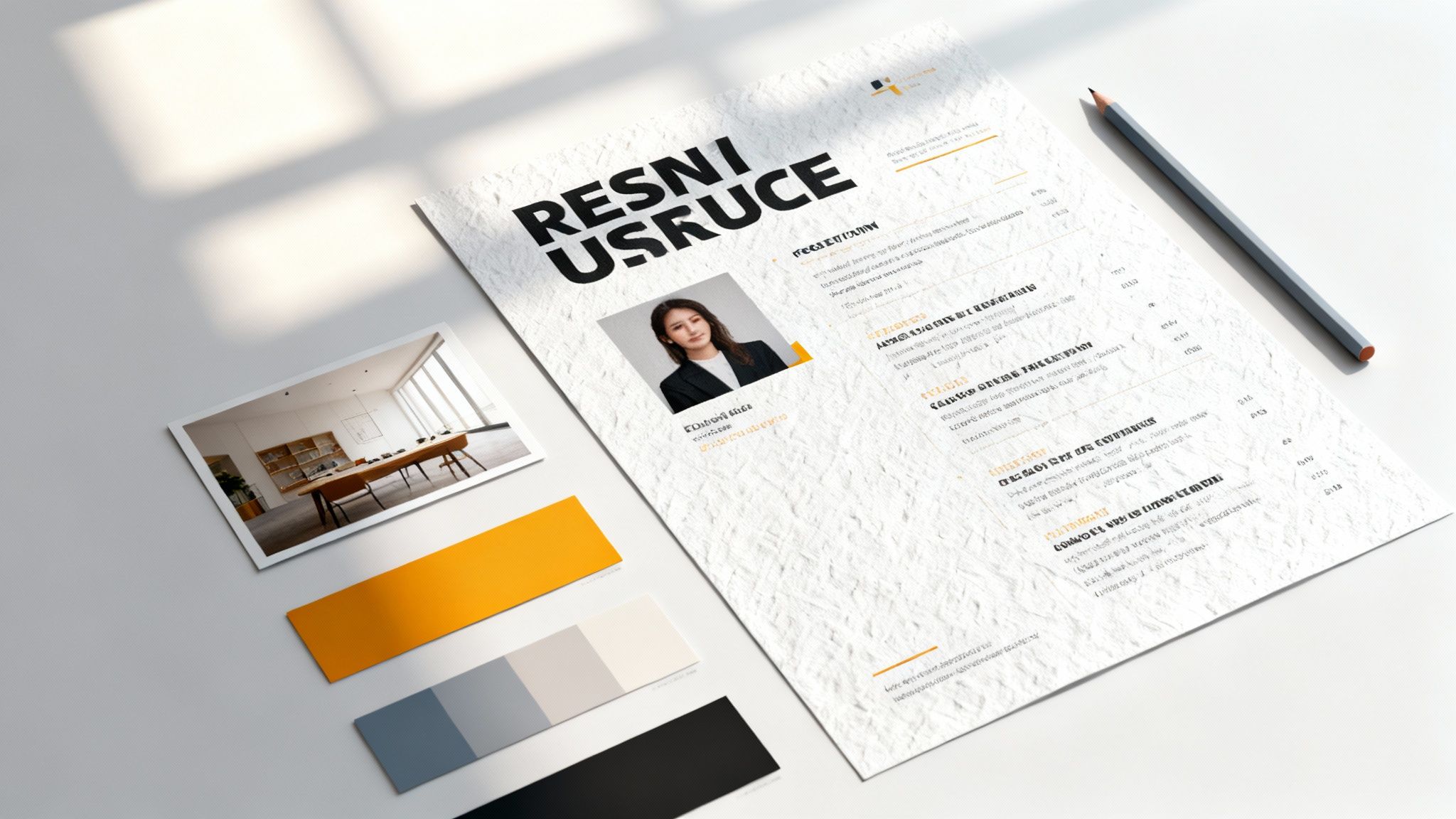
This format is a powerful tool for making a memorable first impression with creative directors, hiring managers, and marketing leads. However, it poses a significant challenge for Applicant Tracking Systems, as complex layouts, graphics, and custom fonts are often unreadable by automated software. Its use must be strategic and targeted to the right audience.
Who Should Use This Format?
This style is tailor-made for professionals in visual and creative fields. Graphic designers, UX/UI designers, marketing professionals, illustrators, and advertising creatives can use this format to prove their skills from the moment their application is opened. If the role you are applying for requires a strong aesthetic sense and design proficiency, a creative resume is an excellent choice.
Key Implementation Tips
To effectively use a creative resume without sacrificing your chances with automated systems, follow these tips:
- Always Submit a Plain-Text Version: When applying through an online portal, always attach a separate, ATS-friendly version of your resume. This ensures your information is parsed correctly, while you can send the designed version directly to a hiring manager via email.
- Prioritize Readability and Function: A creative resume must still be easy to read. Ensure your contact information is prominent and legible. Use a clear visual hierarchy to guide the reader's eye through your experience and skills, avoiding overly cluttered designs.
- Showcase Your Portfolio: A creative resume should seamlessly integrate with your broader professional brand. Include clear, clickable links to your online portfolio, Dribbble, Behance, or GitHub profiles to provide a deeper look into your work.
- Maintain an ATS-Optimized Master Copy: Use a tool like Eztrackr’s resume builder to maintain a master, ATS-optimized resume. You can then use this as the foundation for your creative design, ensuring all crucial information is accounted for and ready for any application system.
8. Academic/Research Resume (CV)
Often referred to as a Curriculum Vitae (CV), the academic/research resume is a comprehensive and detailed format used primarily in academic, scientific, and medical fields. Unlike a standard one or two-page resume, a CV has no length limit and is designed to provide an exhaustive overview of your scholarly and professional life. This is one of the more specialized different styles of resumes, focusing on intellectual contributions rather than corporate work experience.
This structure allows for an in-depth presentation of your education, research projects, publications, grants, conference presentations, and teaching experience. It is the standard application document for roles like university faculty, post-doctoral fellowships, and research scientist positions, where a deep dive into your academic background is required.
Who Should Use This Format?
This style is non-negotiable for anyone pursuing a career in academia or research. If you are applying for a tenure-track faculty position, a research grant, or a role at a scientific institution, a CV is expected. It is the only format that can adequately capture the breadth and depth of your scholarly work, from published papers to invited lectures and teaching portfolios.
Key Implementation Tips
To create a compelling academic/research resume or CV, adhere to these best practices:
- Structure by Academic Merit: Organize your CV with clear, distinct sections such as "Education," "Publications," "Grants and Funding," "Conference Presentations," and "Teaching Experience." List items within each section in reverse-chronological order.
- Be Comprehensive and Detailed: Include full citations for all publications, specify the funding amount and your role for each grant, and provide titles, dates, and locations for every presentation. There is no need to be brief; detail is expected.
- Tailor for Industry Transition: If you are transitioning from academia to a corporate role, you must create a condensed, industry-focused resume. Use Eztrackr’s resume builder to translate your extensive CV into a powerful one-to-two-page resume, focusing on transferable skills and quantifiable achievements relevant to the private sector.
9. Modern/Contemporary Infographic Resume
The modern or infographic resume is a visually dynamic format that stands out among the different styles of resumes by using charts, icons, and data visualizations to showcase your skills and achievements. This cutting-edge approach blends graphic design with professional history, creating an engaging and memorable document that tells a compelling story at a glance. Its primary strength lies in its ability to make complex information, like skill proficiency or project outcomes, instantly digestible and visually appealing.
This format is designed for human eyes, not automated systems. It grabs a hiring manager's attention in creative or data-heavy fields by demonstrating both your qualifications and your ability to present information innovatively. An infographic resume can be a powerful tool when you need to make a bold first impression.
Who Should Use This Format?
This style is best suited for professionals in creative, tech, and data-driven industries where visual communication and innovation are highly valued. It’s an excellent choice for graphic designers, data scientists, marketing professionals, and software engineers at tech startups. If you are applying to a company with a modern, innovative culture, or if you plan to send your resume directly to a hiring manager, this format can set you apart from the competition.
Key Implementation Tips
To effectively use a modern infographic resume, follow these critical guidelines:
- Maintain a Text-Based Version: This is non-negotiable. Always have a traditional, ATS-friendly resume ready. The infographic version is a supplement for direct outreach, not a replacement for online applications that use automated screening.
- Enhance, Don't Replace: Use visuals to complement, not substitute, essential information. For example, a bar chart can show your proficiency in various programming languages, but you should still list the languages as text for clarity and potential ATS scanning.
- Prioritize Readability: A busy or cluttered design defeats the purpose. Ensure your layout is clean, your font choices are professional, and the information is scannable in under ten seconds. The goal is clarity, not just creativity.
- Track Your Submissions: When sending both creative and traditional resumes, use a tool like Eztrackr to keep a record of which version you sent for each application. This prevents confusion and helps you tailor your follow-up conversations appropriately. You can find inspiration and tools by exploring some of the best free resume builders available that offer modern templates.
10. One-Page Resume
The one-page resume is a concise and highly focused format that challenges you to distill your entire professional story onto a single page. As one of the most disciplined different styles of resumes, its power lies in brevity and immediate impact. This approach forces you to be ruthless in your editing, ensuring every word and bullet point serves a direct purpose in demonstrating your value for a specific role.
This format is especially effective in high-volume application scenarios, such as at startups or for entry-level positions, where recruiters spend only seconds on their initial scan. A well-crafted one-page resume respects the hiring manager’s time by presenting the most critical information in a clean, digestible format, making it easier for them to quickly identify you as a strong candidate.
Who Should Use This Format?
The one-page resume is ideal for professionals at the beginning of their careers, including recent graduates and those applying for internships. It is also an excellent choice for career changers who need to highlight transferable skills over a long but potentially irrelevant work history. Additionally, professionals applying to fast-paced companies or roles where conciseness is highly valued will benefit from this streamlined approach.
Key Implementation Tips
To create a powerful and effective one-page resume, focus on precision and strategic content selection:
- Prioritize Ruthlessly: Focus on your most compelling achievements rather than listing every single responsibility. Highlight only the last 5-7 years of relevant experience to keep the content current and targeted.
- Quantify Your Impact: Use numbers and metrics to showcase your accomplishments. Stating you "Increased sales by 20% in Q3" is far more compelling than "Responsible for sales growth."
- Optimize Your Space: Use 0.5 to 0.75-inch margins and a readable font size (10-11pt) to maximize space without creating a cramped appearance. Using Eztrackr’s resume builder allows you to preview different one-page templates to ensure a professional and uncluttered layout.
- Lead with a Targeted Summary: Start with a strong professional summary that is tailored directly to the job description. Use a tool like Eztrackr’s skill-match analyzer to identify the top 3-4 competencies the employer is seeking and feature them prominently.
Comparison of 10 Resume Styles
| Resume Type | 🔄 Implementation Complexity | ⚡ Resource & Time Required | 📊 Expected Outcomes | 💡 Ideal Use Cases | ⭐ Key Advantages |
|---|---|---|---|---|---|
| Chronological Resume | Low — simple reverse‑chron order | Low — quick to assemble | Clear career progression; high ATS pass | Stable careers; corporate roles | Highest ATS compatibility; recruiter‑friendly |
| Functional Resume | Medium — skill grouping and framing | Medium — map skills to evidence | Highlights transferable skills; lower ATS parse | Career changers; gaps; recent grads | Emphasizes competencies over dates |
| Hybrid / Combination Resume | Medium — balance skills + history | Medium — needs curation | Strong balance: ATS + human appeal | Most job seekers; mid‑career; changers | Versatile; shows skills and progression |
| Targeted Resume | High — customize per job posting | High — time‑consuming to tailor | Highest callback potential when targeted | Competitive roles; specific companies | Best ATS keyword match; very persuasive |
| ATS‑Optimized Resume | Low–Medium — simple format, strategic keywords | Medium — requires keyword analysis | High ATS pass rate; more visibility | Large corporations; automated applications | Ensures automated screening success |
| Executive / Leadership Resume | Medium — strategic narrative crafting | Medium–High — quantify impact and results | Strong authority and senior‑role traction | C‑suite, VP, senior management | Showcases strategic impact and leadership |
| Creative / Design Resume | High — custom layouts and visuals | High — design and portfolio integration | Very memorable in creative fields; poor ATS | Designers, UX/UI, marketing creatives | Demonstrates design skills directly |
| Academic / Research Resume (CV) | High — extensive documentation | High — list publications, grants, presentations | Comprehensive academic credibility; expected in academia | Faculty, researchers, post‑docs, grant applicants | Shows scholarly depth and research output |
| Modern / Contemporary Infographic Resume | High — data viz + interactive design | High — design, testing, and conversions | Highly memorable for innovative firms; low ATS | Startups, data roles, marketing/product | Distinctive visual storytelling and data display |
| One‑Page Resume | Low–Medium — heavy editing to condense | Medium — careful curation to fit page | High scanability; concise impact | Entry‑level, interns, startups, concise requests | Brevity and focus; respects recruiter time |
From Format to First Interview: Streamlining Your Strategy
Navigating the landscape of different styles of resumes can feel overwhelming, but understanding their distinct purposes is the first step toward transforming your job search. We've explored the classic reliability of the Chronological resume, the skill-focused narrative of the Functional format, and the powerful synthesis of the Hybrid model. You now have a framework for deciding when to deploy a hyper-specific Targeted resume versus when a bold, Creative layout is appropriate for the industry you’re targeting.
The core lesson is this: your resume is not a static document. It's a dynamic, adaptable marketing tool. The most successful job seekers don't just pick one format and hope for the best; they build a strategic arsenal of resumes, each one fine-tuned for a specific role, company, and audience. This proactive approach ensures you're always presenting the most relevant and compelling version of your professional story.
The Strategic Advantage: Beyond Just One Resume
The true power lies in the implementation. Knowing the difference between a CV and a one-page resume is valuable, but actively managing multiple versions without confusion is what lands interviews. This is where a systematic approach becomes a non-negotiable asset. A career transition might demand a Hybrid resume to showcase transferable skills, while a freelance gig application could benefit from a Creative or Infographic style.
Key Takeaway: The goal isn't just to choose a resume format; it's to build a system that allows you to effortlessly select, tailor, and deploy the right format for every single opportunity.
Imagine this workflow:
- You create a comprehensive "master" resume in a standard ATS-friendly format.
- For a startup, you duplicate and reformat it into a modern, one-page style, highlighting innovation.
- For a corporate role, you generate a Targeted version, aligning your experience directly with the job description's keywords.
- For an academic position, you expand it into a detailed CV.
This level of precision is what separates a passive job seeker from a top-tier candidate. It demonstrates attention to detail and a genuine, tailored interest in the role. Once your resume has landed you that crucial first interview, remember that your personal presentation matters just as much as your document. Learn more about what to wear for an interview to ensure you make a confident and professional first impression.
Your Actionable Path Forward
Don't let this knowledge remain theoretical. Take immediate action to elevate your job search strategy:
- Audit Your Current Resume: Which of the different styles of resumes does it most closely resemble? Is it truly the best format for the roles you're currently targeting?
- Build Your "Base" Version: Create a comprehensive, ATS-optimized master resume. This will be your foundation for all future customizations.
- Identify Your Top 3 Target Roles: For each role, determine which resume style would be most effective and create a tailored version.
- Adopt a Tracking System: Stop using messy spreadsheets or relying on memory. A dedicated tool is essential for managing which resume you sent to which company, tracking follow-ups, and monitoring your progress.
Your career is your most valuable asset. Investing the time to master these resume strategies and implement a robust management system is an investment in your future success. You now have the blueprint to move beyond simply applying for jobs and start strategically engineering opportunities.
Ready to stop juggling files and start managing your career? Eztrackr is the all-in-one platform designed to help you build, tailor, and track every one of the different styles of resumes we've discussed. Use our resume builder and ATS checker to create winning documents, then manage every application on a visual kanban board. Take control of your job search today at Eztrackr.