Cover Letter Administrative Guide That Gets Interviews
94% of hiring managers say cover letters influence interview decisions, according to a 2026 hiring-manager survey, and 60% of American companies require one according to Resume Genius. If you're applying for administrative work, that should change how you think about the document immediately.
A good admin cover letter isn't a writing sample in the literary sense. It's a proof-of-systems document. It shows whether you understand process, whether you can mirror instructions, and whether you know how to present relevant information fast. That's why some letters get skimmed and forgotten while others get saved to the interview pile.
Why Administrative Cover Letters Still Decide Interviews
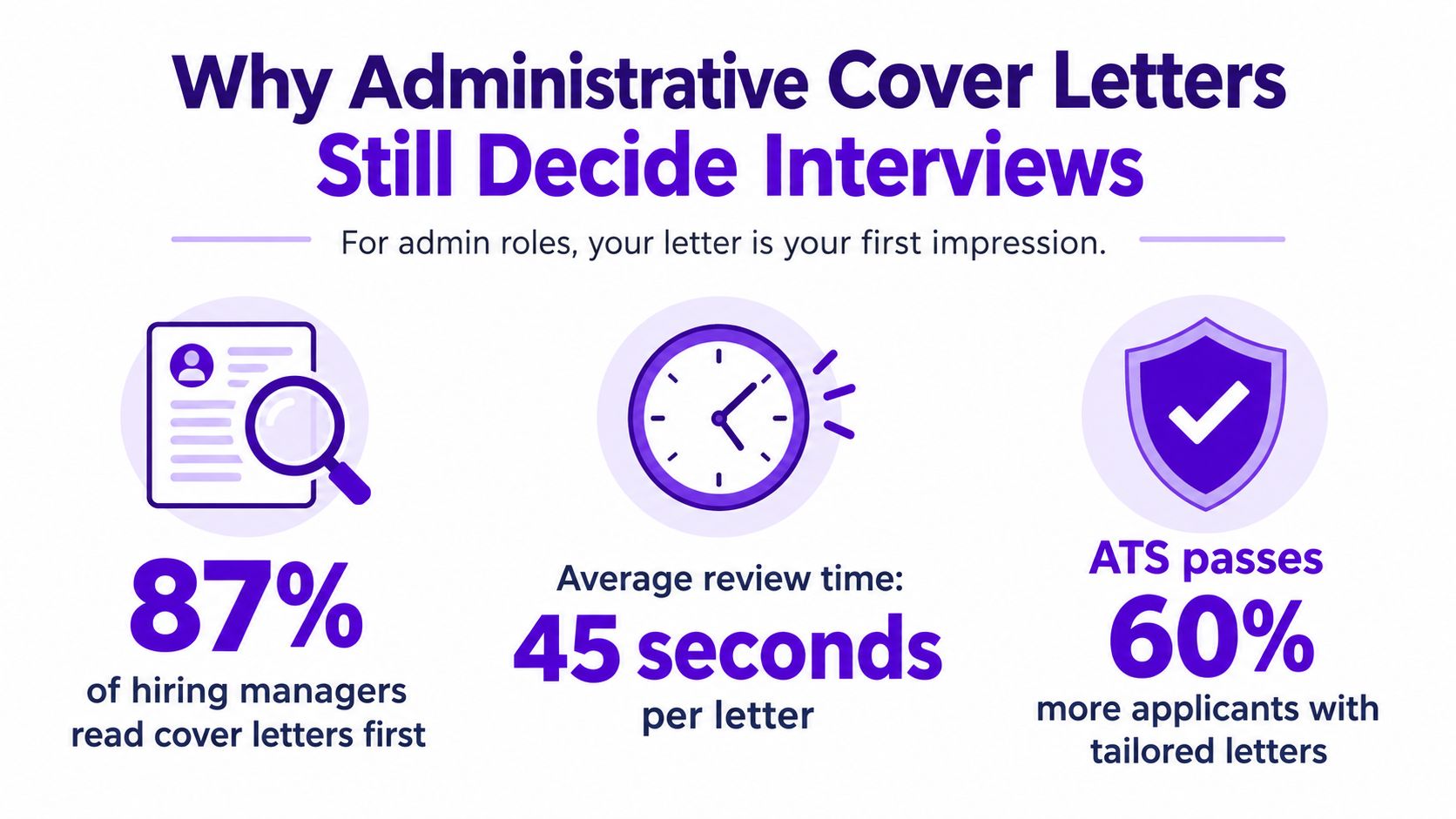
One number explains why this document still matters. 94% of hiring managers say cover letters influence interview decisions, according to Resume Genius, and 60% of American companies require one in at least some hiring workflows based on its survey roundup. For administrative hiring, that matters even more because the role itself is built on handling details, matching process, and reducing friction for other people.
A resume shows scope. An administrative cover letter shows control.
That distinction decides more interviews than applicants realize. In admin hiring, resumes often look similar on first pass. Many candidates have calendar management, meeting support, records handling, customer communication, and office coordination on the page. The cover letter helps answer the question that the resume cannot answer quickly enough: can this person organize information, mirror instructions, and make my life easier from day one?
What hiring managers actually scan for
After screening a large volume of administrative applications, I can say this plainly. Very few hiring managers read these letters as essays. They skim them as proof-of-systems documents.
They want to see whether the applicant can do three things fast:
- Mirror the job language: use the same terms the employer uses for scheduling, correspondence, records, travel, CRM updates, expense reporting, or executive support
- Show one real admin result: a specific example such as reducing scheduling errors, improving filing accuracy, speeding invoice processing, or coordinating a high-volume calendar without missed handoffs
- Tailor with control: make targeted changes that fit the posting instead of sending a generic letter that could belong to any office job
That is what gets saved. Generic enthusiasm gets skimmed.
The practical rule is simple. If the first paragraph does not sound tied to that exact team, that exact posting, and that exact type of support work, the letter is doing very little for you.
Applicant behavior creates an opening here. Resume.io reports that many job seekers skip cover letters altogether, and that creates a predictable split between applicants who treat the requirement casually and applicants who use it to strengthen their case in its cover letter statistics roundup. In administrative hiring pools, where many resumes share the same core tasks, that extra layer of relevance can be enough to move one application into the interview stack.
When the letter changes the decision
The cover letter matters most in close calls.
It helps when two candidates have similar experience and one of them makes the hiring manager's review easier by connecting past work directly to the job. It helps when the resume shows support tasks, but the letter shows judgment, prioritization, and follow-through. It also helps career changers, returners, and international applicants who need a short, credible explanation for context. If that is your situation, this guide on interview preparation for international professionals is worth reading before interviews start.
There is also a real trade-off now. AI has made it easier to produce polished but empty letters. Recruiters know that. Fortune noted the tension clearly in its reporting on AI-written applications and the weak value of AI detectors in hiring decisions in this article. The answer is not to write longer letters. The answer is to send a shorter letter with visible relevance: matched terminology, one quantified admin win, and evidence that you adapted intelligently without rebuilding the whole thing from scratch.
Anatomy of a High Impact Administrative Cover Letter
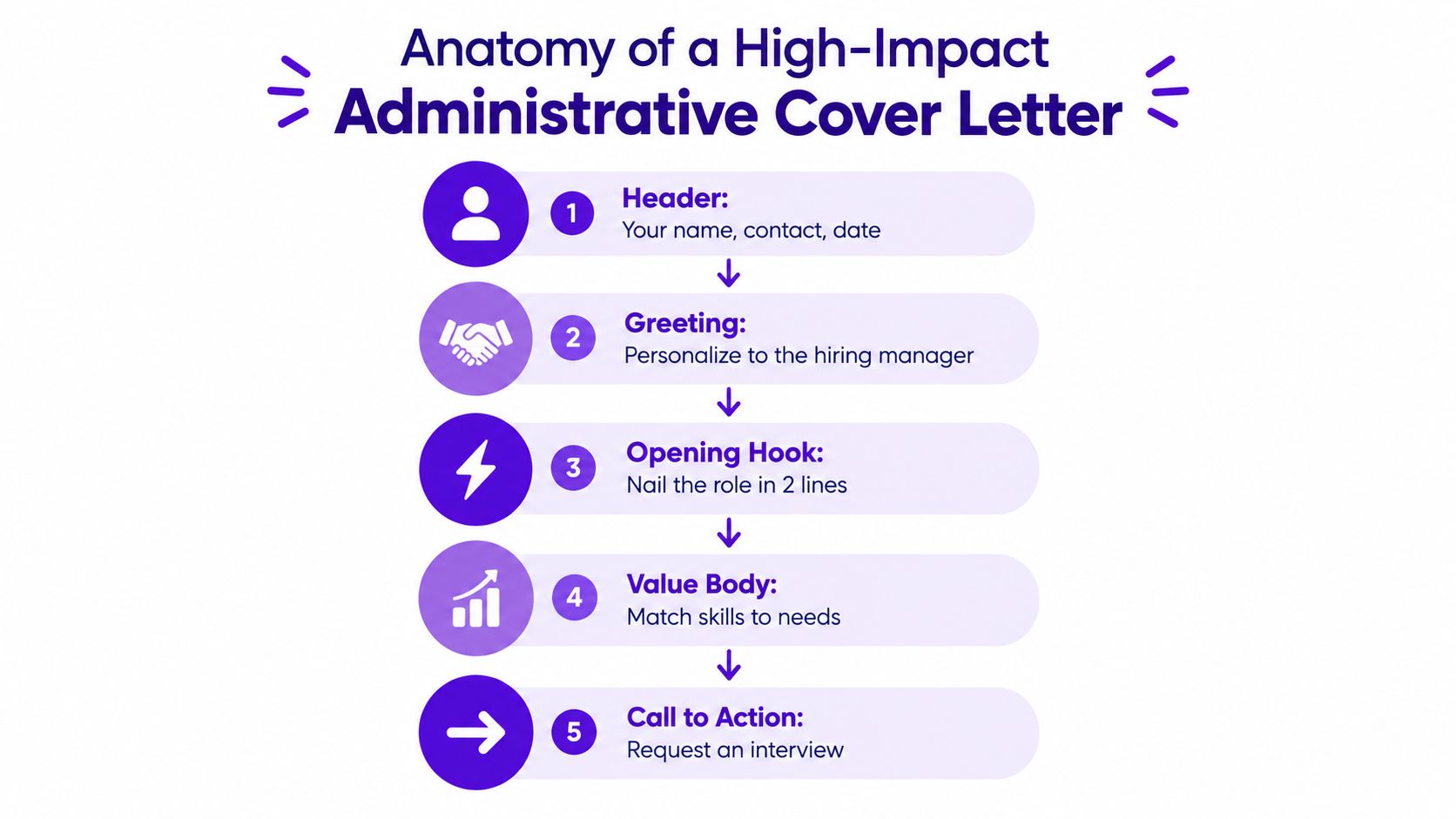
Most weak admin letters fail because they confuse length with substance. The format isn't complicated. What matters is that each part earns its place.
Header and greeting
Keep the header plain. Your name, phone, email, city, date, and the employer details if you have them. This isn't the place for design tricks.
The greeting should be personalized if you can identify the hiring manager. If you can't, use a team-based greeting tied to the function. "Dear Hiring Manager" is still better than a forced guess. For administrative roles, accuracy beats false familiarity every time.
Opening that proves fit fast
Your first two lines need to do real work. State the role and show direct relevance to the posting.
Weak opening:
"I am writing to express my interest in the administrative assistant position at your esteemed company."
Stronger opening:
"I'm applying for the Administrative Assistant role at Northfield Health. My background in calendar coordination, document control, and front-line team support matches the combination of scheduling, records accuracy, and cross-department communication described in your posting."
The difference is simple. The stronger version mirrors the employer's language and tells the reader what kind of admin support you provide.
Don't try to sound impressive. Try to sound usable.
Middle paragraph that translates duties into outcomes
A cover letter administrative draft should do something different. It should connect the job's needs to one or two examples of how you handle work.
Use one paragraph to show your primary value. Focus on one lane:
- calendar and meeting support
- office operations
- customer communication
- records and documentation
- executive support
- compliance-heavy admin work
Then add one concrete win. If you have a measured result, use it. If you don't, describe the operational improvement clearly.
A useful structure looks like this:
| Part | What to include |
|---|---|
| Need | A responsibility from the posting |
| Action | The system, tool, or process you used |
| Result | The improvement or outcome you produced |
Example:
"In my current support role, I manage shared calendars, prepare meeting materials, and track follow-up items across multiple stakeholders. I built a consistent scheduling and confirmation process in Outlook and Excel that reduced missed details, sped up handoffs, and gave managers a clearer view of pending requests."
That reads like an administrative professional. It shows systems thinking, not just effort.
A related resource on cover letter best practices is useful if you want a broader checklist for tightening phrasing and structure before sending.
Closing that sounds confident, not canned
Your final paragraph should do three things:
- Reinforce fit.
- Signal professionalism.
- Invite next steps.
Keep it short.
Example:
"I'd welcome the opportunity to discuss how I can support your team with scheduling, document accuracy, and day-to-day coordination. Thank you for your time and consideration."
Avoid closings that overreach. You don't need to promise transformation. For administrative hiring, a steady, specific close usually lands better than a dramatic one.
How to Tailor Your Letter to Any Job Description and Beat the ATS
Hiring teams often decide within a quick skim whether an administrative cover letter is relevant. That is why tailoring matters. This document is not a prose exercise. It is a proof-of-systems page built for two readers at once: screening software looking for role match, and a human reviewer checking whether you can step into their workflow without creating drag.
Recent guidance for AI-filtered hiring favors concise, specific evidence over broad claims. The same guidance also reinforces exact language match and a short, relevant draft in this 2026 guidance. That standard fits administrative hiring well because these roles are usually posted with clear operational needs.
The fastest tailoring workflow
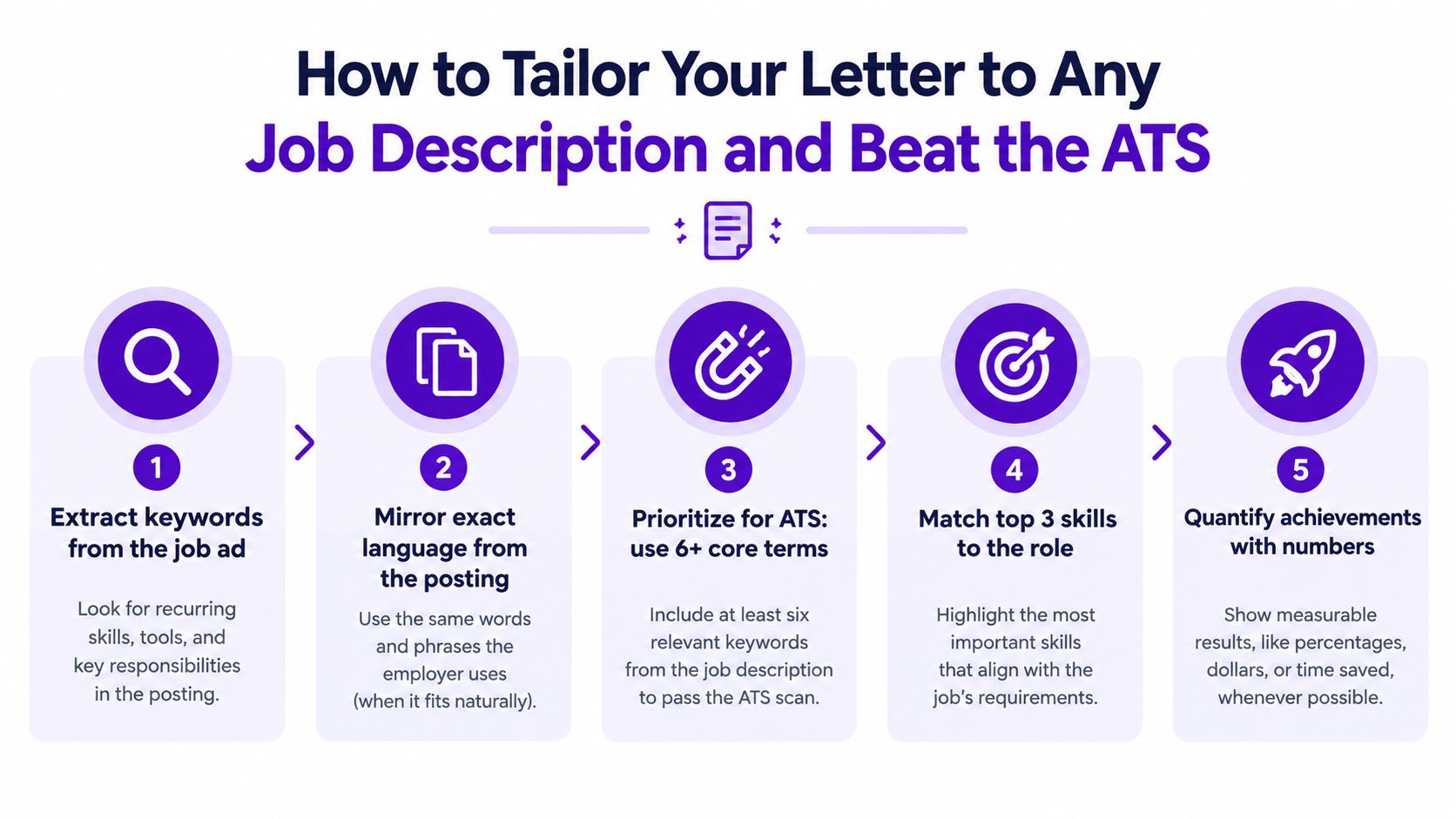
Start with the posting. Not your last letter.
Read the job description once for the overall role, then a second time with a highlighter. Mark repeated nouns and verbs first. In admin hiring, the repeated language usually points to the work that causes the manager the most pain right now.
Use this sequence:
Highlight repeated task language.
Look for terms like calendar management, expense reporting, travel coordination, records management, meeting logistics, confidentiality, customer communication, Excel, or Google Workspace.Identify the top three operational needs.
A posting may list fifteen duties. Usually three drive the hire. If a role mentions scheduling in three places and vendor communication once, schedule support is probably the pressure point.Match each need to proof from your background.
Add one line that shows you have handled similar work. If your experience is adjacent rather than identical, translate it.Mirror the employer's wording where it is accurate.
If the posting says "calendar coordination," use "calendar coordination." Do not swap in a looser phrase just to sound different.
This is what strong tailoring looks like in practice:
| Job posting need | What to write in your letter |
|---|---|
| Manage executive calendars and meeting logistics | Managed multi-party calendar coordination, confirmed scheduling details, and prepared meeting materials to keep leadership appointments accurate and on time |
| Maintain accurate records and reports | Maintained organized digital records and updated recurring reports with close attention to deadlines and document accuracy |
| Support vendors and internal stakeholders | Coordinated with vendors and cross-functional teams, tracked follow-ups, and kept requests moving without missed handoffs |
That approach gets you two things. Better ATS match, and a faster yes from a skim reader.
Where keywords belong
Candidates hurt themselves in two ways here. They either ignore job language, or they paste it into the letter without proof.
Use keywords in the places that carry the most weight:
- the opening sentence
- the body paragraph with your strongest example
- a brief closing line, if it fits naturally
That is usually enough. Once I see a phrase like "detail-oriented team player" repeated without any operational example, I stop trusting the letter.
A simple test works well. Remove the company name and read the letter again. It should still point clearly to one kind of administrative job, with the right tools, tasks, and pace. If it could be sent to a medical office, a law firm, and an events team without any edits, it is still too generic.
For a clearer view of how software screens resumes and letters, review this explainer on how applicant tracking systems work.
Later in your process, video guidance can help you catch phrasing issues you stop seeing in your own draft.
The one achievement that belongs in almost every admin letter
Administrative candidates often try to mention every duty they have touched. Hiring managers do not need a full inventory. They need one useful signal that you improve operations.
Choose one achievement that shows how you work inside a system. Good examples include reducing scheduling errors, tightening document control, improving follow-up discipline, speeding response handling, or keeping executive support organized under pressure. If you have a number, use it. If you do not, describe the before-and-after change plainly.
For example:
"In my current role, I coordinate calendars, meeting materials, and follow-up tracking for multiple stakeholders. After I standardized confirmations and status tracking in Outlook and Excel, handoffs became clearer and scheduling issues were caught earlier."
That works because it proves process thinking. It also gives the ATS relevant language without reading like it was written for the ATS alone.
If you use a tool to speed up tailoring, keep final control of the draft. Eztrackr's ATS article and related workflow tools can help you organize the process, but the saved version is the one that sounds specific to the job and true to your record.
Real World Examples for Entry Level Experienced and Specialized Roles
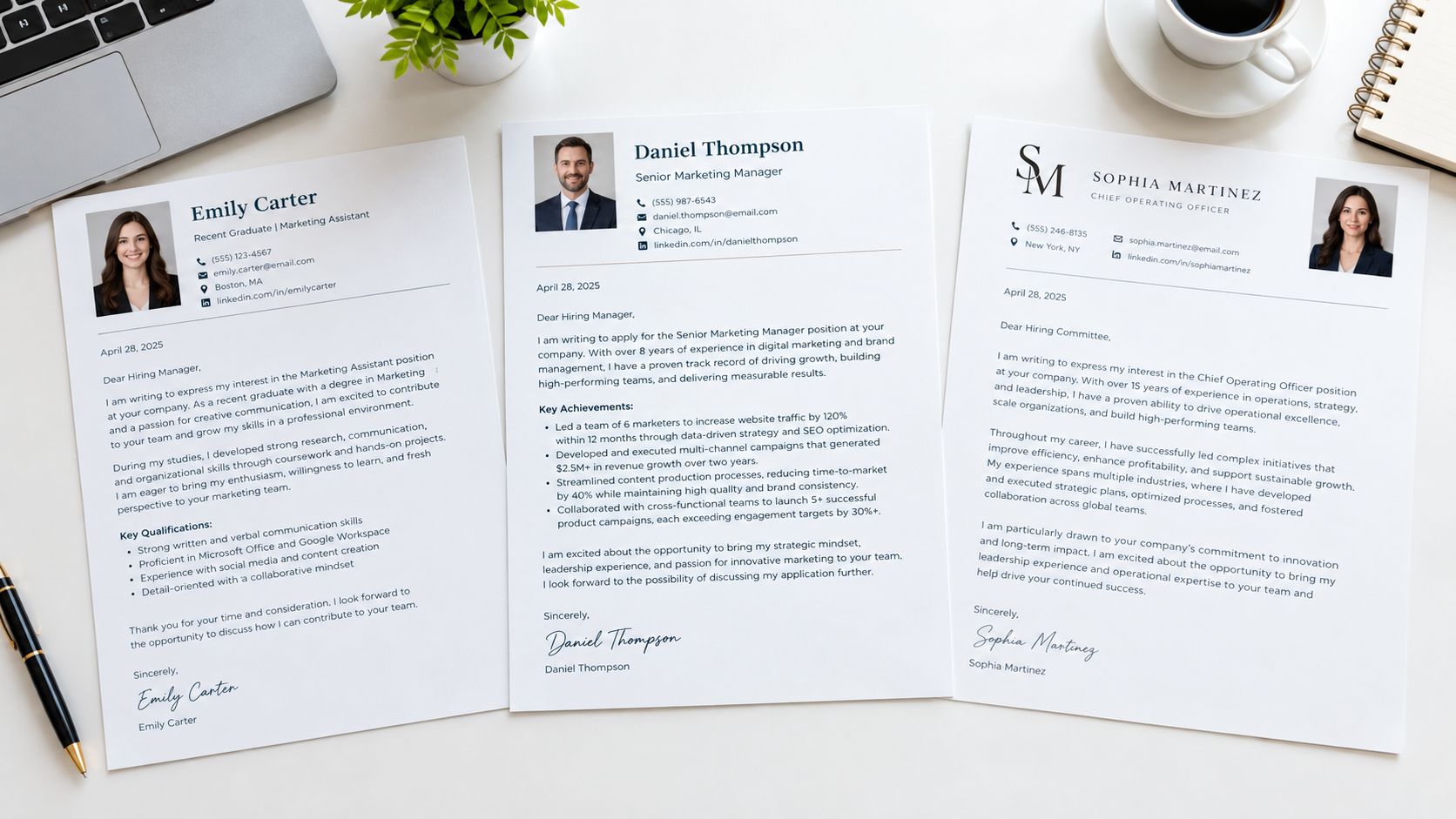
The easiest way to improve a cover letter administrative draft is to see how the same principles change by career stage and role type.
Entry level administrative applicant
Entry-level candidates often think they have nothing to say because they haven't held a formal admin title. That's rarely true. Schools, retail jobs, hospitality roles, internships, volunteer work, and student organizations all create administrative evidence if you frame it correctly.
A workable opening might sound like this:
"I'm applying for the Administrative Coordinator role at Pine Street Dental. Through front-desk customer service, appointment handling, and document organization in fast-paced settings, I've built the communication and follow-through your posting emphasizes."
Why it works:
- It names the role.
- It doesn't apologize for limited experience.
- It translates transferable work into admin language.
A proof paragraph can then focus on one operational behavior:
"When schedules changed or urgent requests came in, I updated information promptly, confirmed details with the right people, and kept records organized so handoffs stayed clear."
That sentence doesn't overclaim. It shows process.
Experienced administrative assistant
For experienced candidates, the trap is listing everything you've ever handled. That's too much. Senior admin hiring usually comes down to trust, judgment, and systems reliability.
A stronger experienced snippet:
"I'm applying for the Senior Administrative Assistant position at Redstone Partners. In prior support roles, I've managed executive calendars, prepared meeting materials, coordinated cross-functional communication, and kept shifting priorities organized without losing detail."
Then give one concrete systems example:
"In my recent position, I standardized meeting preparation and follow-up across recurring leadership sessions by using shared templates, calendar checkpoints, and action tracking. That made scheduling cleaner and reduced last-minute confusion for attendees."
This type of wording tells the employer you don't just complete tasks. You create order.
If you're targeting higher-level support work, these executive assistant cover letter examples can help you adjust your tone toward discretion, stakeholder handling, and executive support.
Specialized administrative roles
Medical, legal, education, and compliance-heavy administrative jobs need a different emphasis. The employer usually cares less about broad office support language and more about controlled process.
A medical admin example:
"I'm interested in the Medical Administrative Assistant role at Westlake Clinic. My background includes patient-facing coordination, schedule management, and careful handling of sensitive information in settings where accuracy and professionalism matter."
A legal admin version:
"I'm applying for the Legal Administrative Assistant role at Carter & Vale. My experience supporting document workflows, deadline-sensitive communication, and confidential records aligns closely with the filing, coordination, and detail control described in your posting."
The proof paragraph for specialized roles should focus on care, consistency, and procedural discipline. Mentioning confidentiality, records accuracy, and document handling is useful when it's true. Don't drift into vague "detail-oriented professional" language. Specialized admin employers want signs that you respect process.
What all three examples have in common
They aren't trying to tell a life story. They're doing three narrow jobs well:
- Naming the exact role and environment
- Showing one operational strength
- Giving the reader a reason to trust the candidate with workflow
That's the standard to aim for. Not flashy. Not overbuilt. Just credible and relevant.
Common Mistakes That Make Administrative Letters Get Skipped
Some letters get rejected before anyone finishes the first paragraph. Usually it's not because the applicant lacks ability. It's because the document creates friction.
The generic template problem
A generic template sounds safe, but in practice it tells the employer you didn't study the role. That's especially damaging in admin hiring because the work itself depends on paying attention to specifics.
Before:
"I am a highly motivated professional with strong communication and organizational skills."
After:
"My background includes calendar coordination, meeting preparation, and document tracking in roles where accuracy and follow-up mattered daily."
The second line gives the reviewer something concrete to hold onto.
Repeating the resume
Your resume already lists titles and duties. If your letter copies those bullets into sentence form, you've wasted the page.
Use the letter to answer a different question: How do you handle the work?
A large U.S. field experiment found that stronger detail, clarity, and structure in resumes and cover letters produced better outcomes. A one-point improvement in both materials was associated with about 7% more interviews per application and a job offer nearly 10 days sooner in the study published here. Better writing quality isn't cosmetic. It changes results.
Weak admin letters describe responsibilities. Strong ones show control, sequence, and follow-through.
Writing too long, too broad, or too polished
Administrative letters get skipped when they read like essays. Hiring managers don't need your full philosophy of service. They need evidence that you can support a workflow.
Watch for these common misses:
- Too broad: You mention teamwork, passion, and work ethic, but no systems, tools, or process.
- Too long: The letter keeps adding examples instead of choosing one good one.
- Too polished: AI-generated phrasing sounds smooth but generic, which makes the letter easier to ignore.
A controlled experiment reported by ResumeGo found that cover letters adjusted for the role produced a 53% higher callback rate than no cover letter, while generic letters offered little advantage in that experiment. That's the key trade-off. Reuse is fine for structure. Reuse is not fine for substance.
Quick audit before sending
Run these checks:
- Opening line: Does it name the exact role and reflect the posting?
- Body paragraph: Does it show one real admin proof point?
- Tone: Does it sound calm and specific rather than inflated?
- Length: Could a busy manager absorb it quickly?
- Details: Did you verify company name, role title, and any software references?
Administrative work is detail work. Your letter has to prove that before your first interview does.
Quick Templates and Final Checklist to Send With Confidence
The fastest way to write a strong letter consistently is to stop starting from a blank page. Build a short master draft with replaceable sections, then tailor the opening, one proof paragraph, and the close.
Three short templates
Entry-level admin template
"I'm applying for the [Role Title] position at [Company]. Through [transferable setting], I've built strong skills in [admin task], [admin task], and clear communication, which align with your need for [posting requirement].
In my recent experience, I handled [specific responsibility] by [brief process]. That helped keep [team/customers/students/patients] informed and supported while maintaining accurate records and follow-through.
I'd welcome the opportunity to discuss how I can support your team with reliable coordination and day-to-day administrative support. Thank you for your consideration."
Experienced admin template
"I'm applying for the [Role Title] role at [Company]. My background includes [core support area], [core support area], and [core support area], with an emphasis on keeping fast-moving teams organized and informed.
In my current or recent role, I supported [leader/team/function] by managing [specific workflow]. I used [tool/process] to keep tasks, communication, and documentation moving accurately through completion.
I'd welcome the chance to discuss how my experience can support your team's workflow, scheduling, and operational consistency."
Specialized admin template
"I'm interested in the [Role Title] opportunity at [Company]. My experience in [industry or setting] includes [specialized function], [specialized function], and careful handling of [records/confidential information/document workflows].
In prior work, I supported [process or department] by maintaining [specific system or responsibility] and making sure details were handled accurately and on time. That approach fits roles where process discipline and professionalism matter.
Thank you for your time. I'd be glad to discuss how I can contribute to your team."
Final pre-send checklist
Use this as your last pass:
- Job title matched: The role title in your letter matches the posting exactly.
- Company name checked: No leftover name from another application.
- Keywords mirrored: Core posting terms appear naturally in the opening and body.
- One proof point included: You showed one clear example instead of listing everything.
- Resume not duplicated: The letter adds context rather than repeating bullets.
- Formatting kept plain: Clean file, simple font, no visual clutter.
- Tone stayed practical: Calm, competent, specific.
- File naming handled: Save it clearly so the employer can identify it fast.
If you're managing multiple applications at once, systems help. A tool like Eztrackr's cover letter generator can help you produce a role-specific draft from job details, then save that draft alongside the posting so you can revise and track it without juggling documents manually.
The goal isn't to write a perfect letter every time. It's to send a relevant one every time. That standard is much easier to hit, and it's the one that gets interviews.
Eztrackr helps job seekers keep application materials attached to the right jobs, which is exactly what makes admin cover letters easier to manage at scale. If you're applying to multiple roles and want one place to save postings, organize documents, and build more targeted drafts faster, visit Eztrackr.