Crafting the Perfect AI Cover Letter That Gets You Hired
Let's be honest, what's an AI cover letter, really? It's simply a cover letter you create with the help of artificial intelligence tools. Instead of staring at a blank page, you give the AI your core ingredients—your resume and the job description—and it whips up a tailored draft for you to refine.
This simple shift changes the entire game. You go from the tedious, manual process of writing every single word from scratch to a much smarter workflow. It lets you apply to more jobs with personalized materials, saving you hours of valuable time.
Why AI Cover Letters Are Your New Job Search Superpower
Welcome to the modern job hunt. In today's market, the winning formula is a mix of speed and genuine personalization, and that's exactly where AI comes in. Using an AI cover letter generator isn't some futuristic idea; it’s a practical advantage that the sharpest candidates are already using to get ahead.
Think about it: the intimidation of that blank white screen is gone. Instead of agonizing over the perfect opening line for hours, you can get a solid, relevant first draft in a matter of minutes. This isn't about letting a robot write for you; it's about creating a better starting point so you can pour your energy into what actually matters—strategic customization and nailing the interview.
Overcoming Application Fatigue
The biggest enemy in any job search? Burnout. We've all been there. Crafting a truly unique cover letter for every single application is exhausting. It often leads to sending out generic, uninspired documents just to feel like you're making progress. AI is the perfect antidote to this.
The numbers don't lie. The share of applicants using AI to create their cover letters or resumes has more than doubled, jumping to over 32% in some of the biggest job markets. A global study also found that job seekers using AI completed 41% more applications on average. That's not just a small bump—that's the ability to chase dozens more opportunities every week without hitting a wall.
The real power of an AI cover letter is its ability to transform you from a tired applicant into a strategic candidate. It frees up your time and mental energy, allowing you to focus on high-impact activities like networking and preparing for interviews.
To see just how different the two approaches are, let's break it down.
Manual vs AI Assisted Cover Letter Writing
This table paints a clear picture of how the traditional, time-consuming method stacks up against a modern, AI-powered workflow.
| Factor | Traditional Manual Method | Modern AI Assisted Method |
|---|---|---|
| Time Investment | 30-60 minutes per cover letter, often more. | 5-10 minutes per cover letter, including review. |
| Personalization | High effort required to tailor each document from scratch. | AI instantly maps your skills to the job description keywords. |
| Consistency | Quality can dip due to fatigue and repetitive tasks. | Consistently high-quality drafts, no matter how many you write. |
| Keyword Optimization | A manual, often guessed, process of spotting keywords. | AI automatically identifies and incorporates key terms. |
| Application Volume | Limits you to a few highly tailored applications per day. | Enables you to send out dozens of tailored applications weekly. |
The takeaway is simple: using AI isn't about cutting corners. It's about working smarter so you can put your best foot forward, every single time.
Gaining a Competitive Edge
In a market flooded with applicants, you have to find a way to stand out. An AI cover letter helps you do just that by strategically aligning your skills with the specific requirements laid out in the job description. The tech can instantly pinpoint keywords and core competencies, making sure your application speaks directly to what the hiring manager is scanning for.
To really unlock this superpower, you'll want to explore the best AI writing software tools available and find one that fits your style.
This blend of AI efficiency and human oversight is where the magic happens. You can also see how this fits into a broader strategy by checking out our guide on other AI-powered job search tools. At the end of the day, this isn't just about automation; it’s about presenting the absolute best version of yourself for every single role you're serious about.
Mastering the Prompts That Generate Winning Drafts
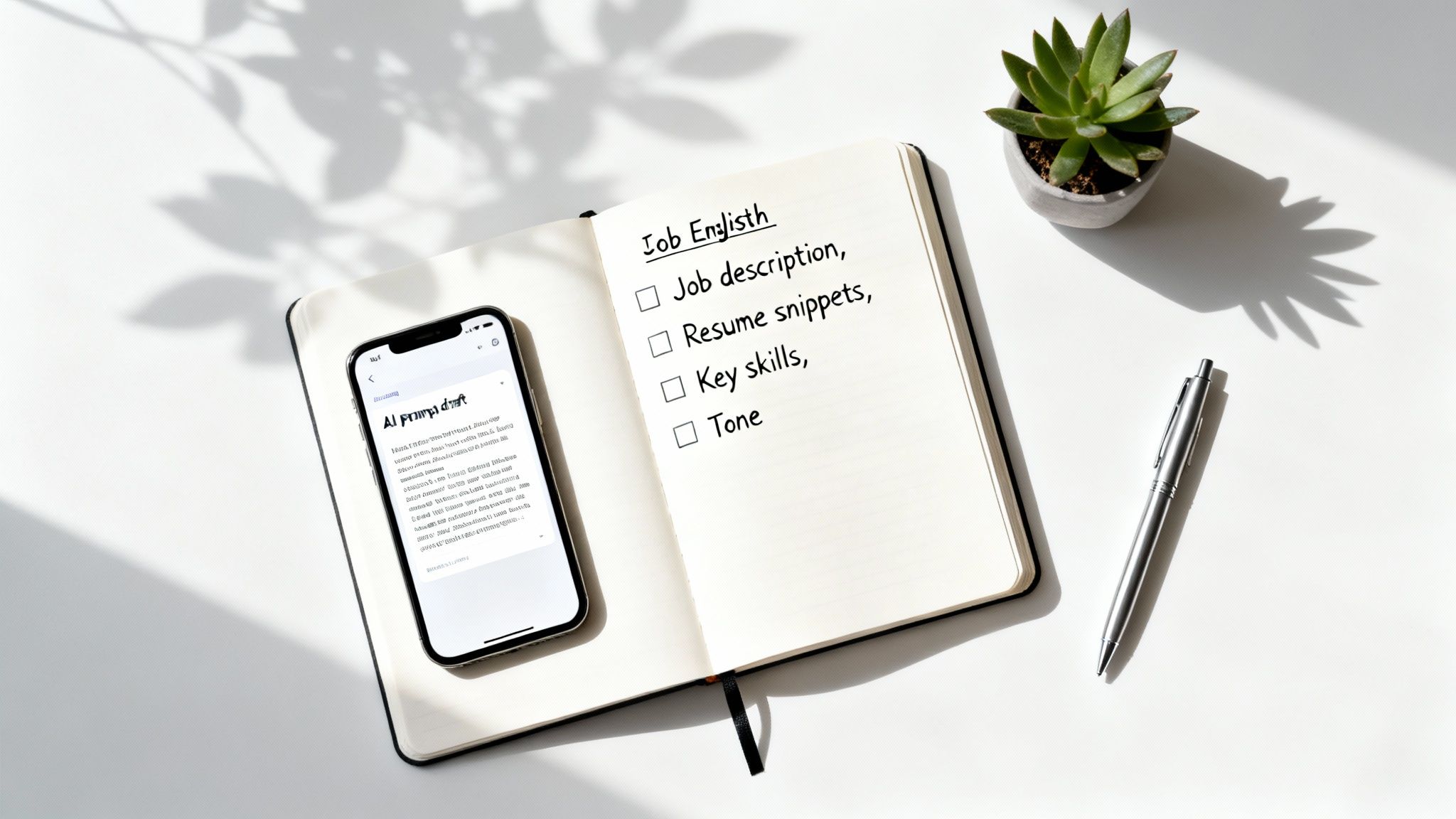
Here’s the unfiltered truth about getting a great AI cover letter: the tool doesn't matter nearly as much as the instructions you feed it. The final draft is a mirror, reflecting the quality of your initial input. That’s why getting your prompts right is the whole ballgame.
Think of it less like giving a command and more like handing a detailed creative brief to a super-talented (and super-fast) writing assistant.
The old saying "garbage in, garbage out" has never been more true. A lazy, vague request will get you a generic, forgettable letter every single time. To get the AI to produce something genuinely brilliant, you need a basic understanding of prompt engineering. It's what makes the difference.
The Core Ingredients of a Powerful Prompt
Your prompt isn't just one instruction; it's a bundle of context. Instead of a simple "write me a cover letter," you need to give the AI all the puzzle pieces. This is how you get a draft that feels like it was written just for that specific role and company.
So, what are the non-negotiables?
- The Full Job Description: Don't just give it the job title. Copy and paste the entire thing—responsibilities, qualifications, even the little notes about company culture. It all matters.
- Key Sections of Your Resume: Hand over your most relevant work history, achievements, and skills. Cherry-pick the parts of your resume that directly speak to what they're asking for in the job ad.
- A Clear Tone of Voice: You have to tell the AI what personality to adopt. Are you going for "enthusiastic and creative," or is "professional and analytical" a better fit? Maybe you want to sound "confident and innovative." Be specific.
- Specific Instructions: Point the AI in the right direction. For instance, you could say, "Make sure to emphasize my project management skills and my hands-on experience with Salesforce, which is mentioned in the job description."
When you provide all these components, you’re giving the AI the raw materials it needs to weave a compelling story that connects your experience directly to their problems.
A well-crafted prompt is the blueprint for your cover letter. Give the AI enough detail and clear instructions, and it can build a draft that’s already 80% of the way to a polished final document.
From Vague to Valuable: A Prompt Makeover
Let’s get practical. It's amazing how a few tweaks to a prompt can completely transform the output.
Here’s a classic weak prompt I see all the time:
Before (The Weak Prompt):
"Write me a cover letter for a Marketing Manager job. I have five years of experience."
This is just way too thin. The AI is left guessing about everything: the company, the industry, your actual achievements, and the tone you're going for. The result? A cookie-cutter letter that practically screams, "I put zero effort into this."
Now, let's juice it up.
After (The Strong Prompt):
"Act as a professional career coach. Write a cover letter for a 'Digital Marketing Manager' position at [Company Name]. The tone should be confident, professional, and slightly creative. Emphasize my 5 years of experience in B2B SaaS marketing. I want you to specifically highlight my success in leading a campaign that increased lead generation by 45%. Weave in keywords from the attached job description naturally. I've also pasted the 'Experience' section from my resume for context. Oh, and keep the whole thing under 400 words."
See the difference? This prompt gives the AI everything it needs to succeed. It defines the role, company, tone, and a killer metric-based achievement. It even sets a word count. This level of detail is what separates a bland, generic AI cover letter from one that actually gets a hiring manager's attention.
Transforming Your AI Draft Into an Authentic Story
An AI-generated draft is an incredible starting block, but it’s just that—a start. The real magic happens when you infuse that draft with your unique personality and experiences.
Trust me, simply copying and pasting is a fast track to the rejection pile. Hiring managers are getting shockingly good at spotting unedited AI content. It just has a certain sterile, overly formal tone and completely lacks the spark that comes from real stories.
The goal isn't to let AI speak for you. It's to use it as a tool to help you articulate your own story more effectively.
Injecting Your Personal Voice
First things first, read the draft out loud. Does it sound like you? If it feels robotic or stiff, it’s time to start swapping out those generic phrases for your own voice.
Think of it like tailoring a suit. The AI gives you the fabric and the basic cut, but you have to make the final adjustments so it fits you perfectly.
For example, an AI might spit out something like, "I am a results-oriented professional with a proven track record of success." It’s technically true, but it’s also a total cliché that makes eyes glaze over.
A much better, more human version? "At my last role, I was obsessed with finding ways to boost our team's numbers, which led me to overhaul our reporting process and increase efficiency by 20%."
See the difference? This small change does two critical things:
- It replaces a vague statement with a specific, quantifiable achievement.
- It injects your personality—"obsessed with finding ways"—which is far more engaging.
The most powerful AI cover letter isn't one that sounds perfect; it's one that sounds human. Your quirks, your enthusiasm, and your unique way of telling a story are your biggest assets. Don't edit them out.
From Automation to Authenticity
The risk of sending a generic AI letter is very real. A recent study analyzing 5 million cover letters found something startling. After AI tools went mainstream, the connection between a cover letter's keyword alignment and getting a callback dropped by 51%. The link to actually getting a job offer fell by an even sharper 79%.
The data shows that employers are adapting fast, with 62% now rejecting applications that feel unpersonalized. They're looking for signals that are much harder to fake.
But there's a clear silver lining: the study also found that the amount of time a candidate spent editing and personalizing their AI draft was positively correlated with getting hired. You can dig into the full study on AI's impact on job applications to see all the details.
Weaving in Company-Specific Passion
The final layer of personalization is showing you've actually done your homework. A generic AI draft won't have a clue why you're genuinely excited about this specific company.
This is where your research comes in. Find something that truly resonates with you—a recent project, a company value, or even a quote from their CEO. Then, weave it into your narrative.
Instead of, "I am excited by your company's innovative culture," try something like, "I was particularly inspired by your team's recent 'Code for a Cause' initiative. That commitment to community aligns perfectly with my own passion for using tech to make a positive impact."
This proves you aren’t just mass-applying; you chose them for a reason. For more foundational advice on structuring these elements, our guide on how to write a cover letter provides a great framework. This level of specific, genuine enthusiasm is something AI can't replicate on its own, and it's your ultimate competitive advantage.
Getting Your Letter Past the Robot Gatekeepers
Alright, you've got a killer, personalized cover letter ready to go. But before any human hiring manager gets to see it, you have to get past the first line of defense: the dreaded Applicant Tracking System (ATS).
Think of the ATS as a bouncer for your application. It’s not looking for a great story; it’s looking for specific keywords and a format it understands. If your letter doesn't check those boxes, it gets tossed into the digital void, never to be seen again.
Your goal is to thread the needle—write for a human, but optimize for the machine. The AI tool you used likely pulled in some keywords, but now it's your job to weave them in seamlessly. For example, if the job post is obsessed with "cross-functional team collaboration," don't just list it. Talk about a time you actually led a cross-functional project. Make the keywords part of your story.
Formatting That Won't Get You Rejected
Even a perfectly keyword-optimized letter can get tripped up by simple formatting mistakes. The ATS is powerful, but it's not smart. It gets confused easily.
To make sure your letter gets read correctly, you need to play by its rules.
- Stick to Boring Fonts: This isn't the time for creative flair. Use a universally safe font like Arial, Calibri, or Times New Roman. Anything fancy can turn your carefully crafted sentences into a garbled mess.
- Keep the Layout Simple: Forget columns, text boxes, or tables. They look nice, sure, but they can make an ATS read your letter completely out of order. A clean, single-column layout is the only way to go.
- Use the Right File Type: When in doubt, save your letter as a PDF or .docx file. These are the two formats most ATS platforms can handle without any hiccups.
Think of it like building a bridge for your application. A simple, sturdy one ensures all your information gets to the other side safely. This is where a tool like an ATS resume checker can be a lifesaver, flagging potential issues before you hit send.
It's a tough pill to swallow, but a simple formatting error can make your entire application invisible. Your experience could be a perfect match, but if the ATS can't read it, you might as well have not applied at all.
Staying Human in a Robotic World
Optimizing for machines is a necessary evil in today's job market. And it's only becoming more common. By next year, an estimated 83% of companies will use some form of AI to screen applications.
The problem is, these systems aren't perfect. Far from it. Studies have shown they can introduce bias, sometimes favoring certain names or backgrounds over others. You can dig into these findings on AI's role in recruiting.
This is why getting your ATS optimization right is so critical. You're not just trying to check a box; you're trying to give yourself a fair shot. By making sure your letter is clear, keyword-aligned, and machine-readable, you’re doing everything you can to get your story in front of a real person who can see the value you bring.
Integrating AI Into a Smarter Job Search Workflow
Let's be honest, an amazing AI-generated cover letter is a powerful tool, but it's just one piece of a much larger puzzle. To really get ahead, you need to think bigger than just one document at a time. It’s all about building a cohesive system that connects your AI writing with a smart application tracker.
Instead of drowning in spreadsheets, random bookmarks, and a chaotic desktop folder, a unified system puts everything you need in one place. Modern job trackers come with browser extensions that let you grab interesting job postings with a single click, automatically sucking all the important details into a central dashboard.
This is where the real magic happens. A connected workflow means you can go from spotting a great job post to generating a tailored cover letter in seconds, without ever leaving the platform.
From Chaos to Control
Getting organized isn't just about feeling less stressed—it's about making smarter, data-driven moves. When you can see every application laid out on a visual board, you cut out all that soul-crushing manual data entry that leads to mistakes and forgotten follow-ups.
Think of it like this: once you've used AI to generate the first draft, you still have a couple of critical checks to run before hitting 'submit.'
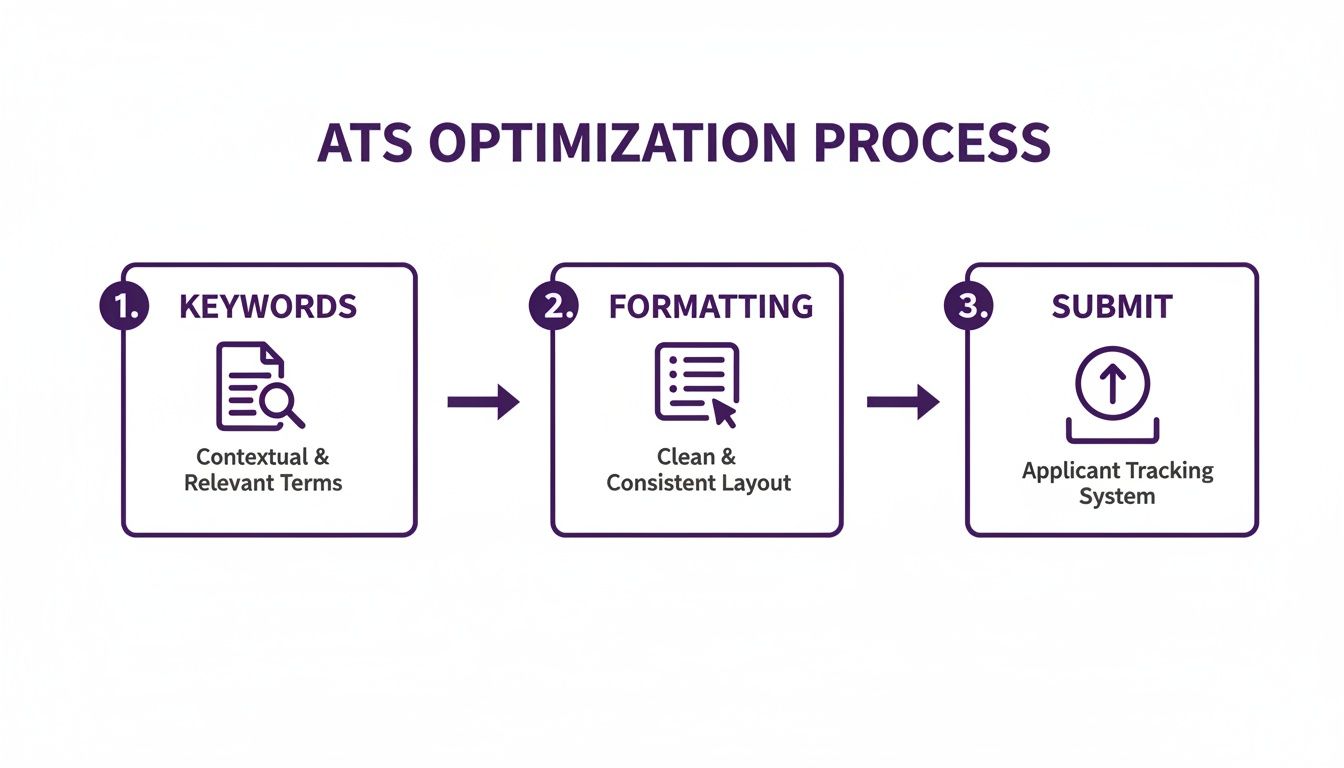
As the diagram shows, it’s a simple flow: generate your content, make sure it’s packed with the right keywords, and give it a clean format so it sails right through any Applicant Tracking System (ATS).
This kind of system keeps good opportunities from slipping through the cracks. Even better, it gives you a real-time pulse on your job hunt. You can instantly see how many applications are out there, which ones are moving forward, and where you might need to switch up your strategy.
A smart workflow transforms your job search from a series of disjointed tasks into a streamlined, strategic operation. It frees up your mental energy to focus on what truly matters—preparing to ace your interviews.
A Look at a Modern Job Tracker
Seeing your progress is a huge motivator. That's why the best tools use Kanban-style boards, letting you drag and drop applications through stages like "Saved," "Applied," and "Interviewing." It gives you an instant, at-a-glance overview of your entire pipeline.
This level of clarity turns what can feel like a chaotic mess into a manageable, day-to-day plan. If you want to see exactly how this works, we've got a deep dive on automating job applications that breaks it all down.
Ultimately, this approach is about more than just staying organized. It’s about building momentum and taking back control of your career journey.
Your Top AI Cover Letter Questions, Answered
As AI tools work their way into our job search routines, it's natural to have questions. Getting a handle on how to use this tech smartly and ethically is key. Let’s clear up some of the most common things job seekers wonder about when creating an ai cover letter.
Getting this right from the start helps you turn AI into a powerful sidekick, not a crutch that could trip you up.
Can Recruiters Tell if I Used an AI Generator?
Honestly? Yes, a seasoned recruiter can often sniff out a purely AI-generated letter from a mile away. They usually sound a bit too formal, lack any real personal stories, and completely miss the vibe of the company culture.
Think about it—they see hundreds of applications. The unedited AI letters all start to blend together.
That’s exactly why you can't just copy, paste, and send. The whole point is to let the AI build a solid foundation. Then, it's your job to layer on your unique voice, your experiences, and your genuine excitement to make it truly yours.
A recent survey found that over 60% of employers have seen obvious cases of AI being used in job applications. When it's used carelessly, the result feels impersonal and fails to stand out.
Is It Cheating to Use AI for a Cover Letter?
Not at all. It’s not cheating; it’s being resourceful.
A better way to think about it is like using a high-powered grammar checker or a really good template. You’re just using a tool to work faster and end up with a better, more polished product.
The ethics really boil down to honesty. As long as the final letter you send is accurate, authentic, and a true reflection of your skills and interest in the job, you’re in the clear. It's just a smart way to handle the grind of a modern job search.
What Are the Biggest Mistakes to Avoid?
The absolute number one mistake is hitting "send" on the first draft without adding a single personal touch. That’s how you end up with a generic letter that makes zero connection with the reader and gets tossed aside.
Here are a few other major pitfalls I see people fall into:
- Giving the AI Lazy Prompts: If you just tell it to "write me a cover letter," you're going to get a lazy, forgettable result back. Garbage in, garbage out.
- Skipping the Fact-Check: AI can occasionally "hallucinate" and just make things up. You have to verify every single claim, number, or skill it adds for you.
- Forgetting to Match the Tone: The cover letter you write for a funky creative startup should sound completely different from one for a buttoned-up corporate law firm.
- Leaving Out the Human Stuff: The best parts of your story—your passion, those "aha!" moments, your unique way of seeing things—are things only you can bring to the table.
Always, always treat the AI output as a rough draft. It’s a starting point that needs your critical eye and creative energy to really make it shine.
Ready to stop juggling spreadsheets and start landing interviews? Eztrackr gives you the tools to save jobs, generate tailored application materials, and track your entire job search in one place. Try Eztrackr for free today and see the difference.