Resume for Warehousing: How to Write One That Works
The posting asks for RF scanner experience, cycle counts, and a reach truck certification. You have all three. You send the resume anyway and never hear back, because the document the recruiter opened says you "picked and packed orders in a fast-paced environment" and nothing else.
That gap is the whole problem. Warehousing and storage employed approximately 1.876 million people in the United States in 2024, up from 1.705 million in 2021, according to Federal Reserve Bank of St. Louis data. When that many applicants share your duties, the resume that shows operating evidence gets the callback.
A resume for warehousing is judged on three things: whether the keywords match the posting, whether the layout parses, and whether the numbers hold up when someone asks about them in an interview. That last one trips people up. Most warehouse workers never see a productivity dashboard, so they either leave numbers out entirely or invent figures they cannot defend. Neither works. Every duty you performed has a measurable result attached to it, and this guide shows you how to find it, even when nobody was tracking your output formally.
Warehouse Skills and Keywords Recruiters Scan For
| Role | Keywords to use | Proof to show |
|---|---|---|
| Order picker | order picking, RF scanner, pick accuracy | orders or lines picked per shift and pick accuracy percentage |
| Forklift operator | reach truck, counterbalance forklift, powered industrial truck | certification held, incident-free hours, loads moved per shift |
| Receiving clerk | receiving, put-away, shipping documentation, invoice matching | trailers or PO lines received per shift, discrepancy rate |
| Inventory associate | cycle counting, inventory accuracy, WMS | count accuracy percentage, variances resolved, SKUs covered |
| Packer or shipper | packing, shipping, barcode scanning, on-time dispatch | packages packed per hour, on-time dispatch percentage |
Read that table as a filter, not a wish list. A recruiter working through a stack of applications isn't reading for effort. They're matching the posting's operating language against yours and looking for the number that proves it. A keyword only earns credit when it sits next to evidence. "Inventory control" in a skills block is noise. "Maintained 99.5% inventory accuracy across the full SKU catalog during weekly cycle counts" is a claim someone can interview you on.
Where the proof comes from
Most warehouse work produces at least one of these four kinds of evidence, even when nobody handed you a dashboard:
- Throughput: orders, lines, or pallets handled per shift, or trailers unloaded per day.
- Quality: pick accuracy, count accuracy, damage rate, or receiving discrepancy rate.
- Safety and reliability: incident-free forklift hours, attendance record, completed training.
- Scope: SKU count, square footage of the facility, dock count, number of systems you touched.
Name the equipment you drove. A reach truck and a sit-down counterbalance are different machines with different certifications, and a recruiter hiring for one will filter out the other if the resume is vague. If you operate a propane-powered lift, cylinder exchange and storage questions come up on the floor and in interviews, and the Gateway Propane cylinder safety guidance covers the handling basics worth knowing cold.
The two-second version: if the top third of your page doesn't name your role, your equipment, and one number, the rest doesn't get read.
Generic traits are the most common waste of space. "Hardworking," "reliable," and "team player" describe everyone who applied, so they differentiate no one. A hiring manager comparing two pickers will take the one whose resume says how many orders per shift and how accurate they were, because that person has given them something to verify.
If you want the mechanics of how applicant tracking systems match those terms, this guide to resume keywords for ATS walks through the matching logic.
Here's the fast test. Find your target role's row in the table above. Now check that your resume contains at least two of those keywords, each one sitting beside a number or a concrete outcome. If a keyword appears only in a skills list, it isn't doing any work yet.
How to Turn Warehouse Duties Into Measurable Bullets
Every strong warehouse bullet follows the same structure: action, then process or equipment, then measurable result. The action alone is a job description. The action with a tool and a number is evidence.
O*NET's task list for stockers and order fillers breaks the job into concrete activities: reading orders for catalog numbers, sizes, colors and quantities, receiving and counting stock, recording data manually or electronically, checking inventory for replenishment, comparing invoices against goods received, and operating forklifts or other loaders. Each of those is a starting point for a bullet, not the bullet itself.
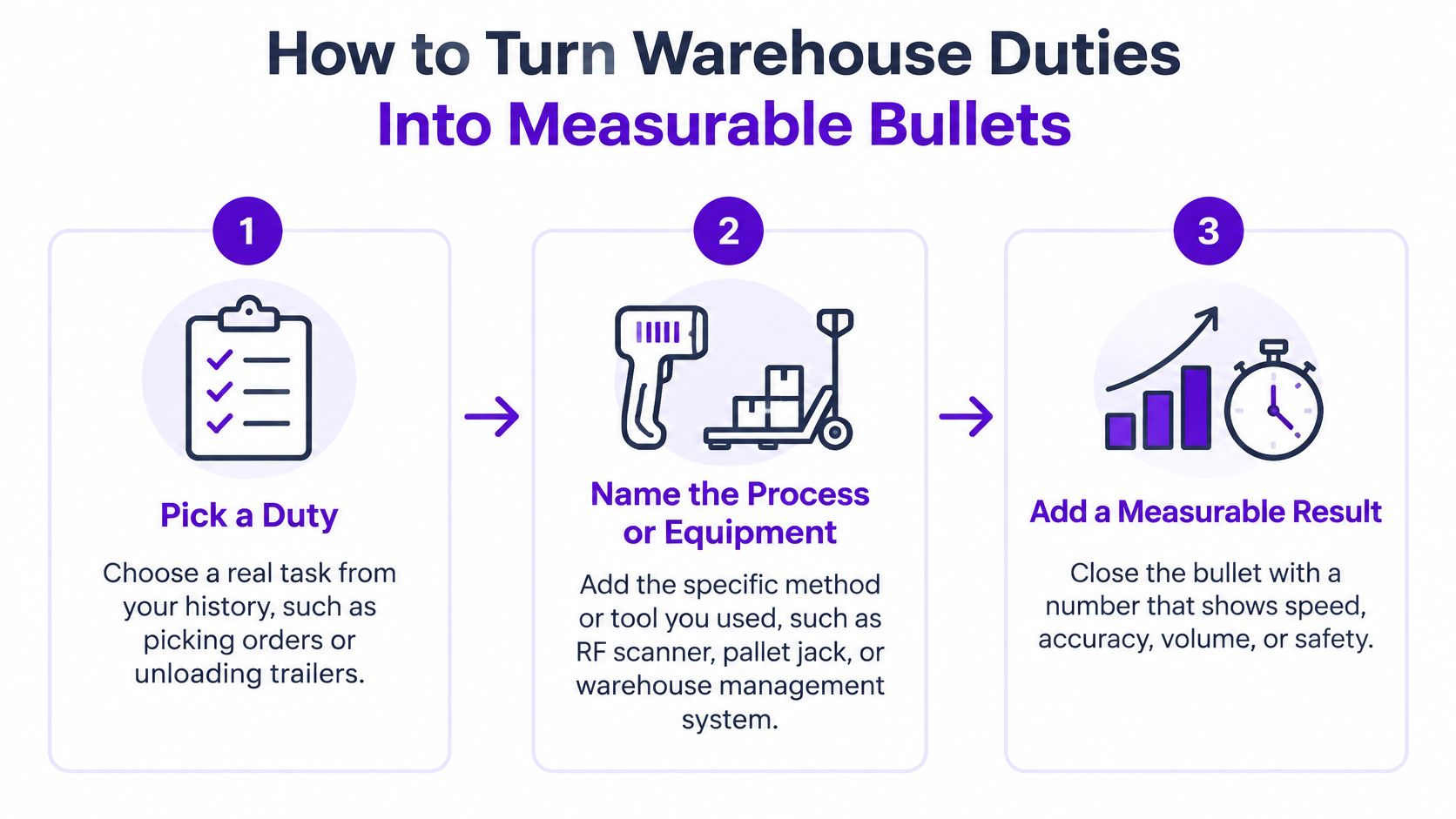
- Pick a real duty. Choose something you did repeatedly, such as picking orders, unloading trailers, or reconciling receiving paperwork. One-off tasks make weak bullets because there's no scale behind them.
- Name the process or equipment. Add the RF scanner, the WMS, the reach truck, the voice-pick headset, or the specific system you worked in. The posting's own vocabulary enters your resume here, which is why the tool name matters more than the duty name.
- Add the scale. Orders per shift, lines picked per hour, pallets moved, SKUs covered, trailers received. Scale is what separates a person who did the job from a person who did it at volume.
- Add the result. Pick accuracy, on-time dispatch, damage reduction, discrepancy rate, incident-free hours. Results tell the reader what your speed was worth to the operation.
- Stress-test the number. Ask yourself how you'd answer "how do you know that?" in an interview. If the honest answer is "I don't," replace the figure with scope you can describe.
A finished bullet reads like this: processed 180+ e-commerce orders per shift using RF scanners and a WMS, maintaining 99.5% pick accuracy. It's short, it's specific, and every element could survive a follow-up question.
Why this matters more than polish: hundreds of applicants for the same posting share nearly identical duty lists. Recruiters pick the candidate whose resume shows scale and reliability, because those are the two things that predict whether someone survives a peak season. Verbatim occupational descriptions, copied from a job bank, tell the reader nothing about how you perform.
When the exact figure doesn't exist, describe the scope instead. "Owned the returns and restocking workflow for the entire facility" is honest and still informative. Invented percentages are not. A fabricated metric creates a trap in the interview and a compliance problem if the employer verifies it. If you're hunting for the right verb to open each line, this collection of words to use on a resume helps you avoid opening every bullet with "responsible for."
Read each bullet aloud and ask what changed because you were there. If nothing changed, rewrite it until something did.
Format a Plain-Text Resume an ATS Can Read
Software reads your resume before a person does, and software is literal. Tables, text boxes, icons, and contact details parked in a header can scramble the parse, which means a human never sees the experience you spent hours quantifying. Build the plain version first, then tailor content inside it.
| Element | Safe choice | Risk to avoid |
|---|---|---|
| Layout | single column, one page for early career | tables, text boxes, multi-column layouts |
| Headings | Summary, Skills, Experience, Certifications, Education | creative or invented section names |
| Graphics | plain text only | icons, logos, photos, charts |
| Header and footer | contact details in the body text | contact details placed in the header or footer |
| Acronyms | spelled out once, such as warehouse management system (WMS) | unexplained abbreviations used throughout |
| File type | the format the portal asks for, usually PDF | scanned images of the resume |
Use those five headings in that order. Spell an acronym out the first time, then abbreviate freely. Reverse chronological order inside Experience, with the most relevant warehouse work and certifications near the top, because that's where attention lands.
The quickest diagnostic is free: paste your resume into a plain-text editor and look at what comes out. If sections jumble, merge, or vanish, the parser will likely miss them too.
For the Summary, write three lines: your role, your years of operating experience, the equipment and systems you hold, and one proven result. Something like "Order picker with four years in e-commerce fulfillment, certified on reach truck and counterbalance, 99.5% pick accuracy on 180+ orders per shift." Then list certifications by real name, such as an OSHA 10-Hour General Industry card or a site forklift training record, each with issuing body and current status. Whether a credential is current, employer-provided, or site-specific is information a recruiter needs and rarely gets.
Save the file in whatever format the portal requests, usually PDF unless it specifies DOCX, and name it professionally: first name, last name, and the word resume.
Tailor Keywords to Each Job Posting in Two Passes
A longer skills list does not rank higher. Recruiters and the systems they use reward terms placed inside proof, and a wall of 60 keywords reads as padding because it is.
US Bureau of Labor Statistics data on transportation and warehousing employment characteristics shows how varied the applicant pool is: in 2023, warehousing and storage workers were 65.6% men and 34.4% women, and 17.0% were ages 55 and over. Early-career applicants, experienced operators, and mature workers all compete for the same postings, which is exactly why a concise skills block plus achievement bullets makes candidates comparable.
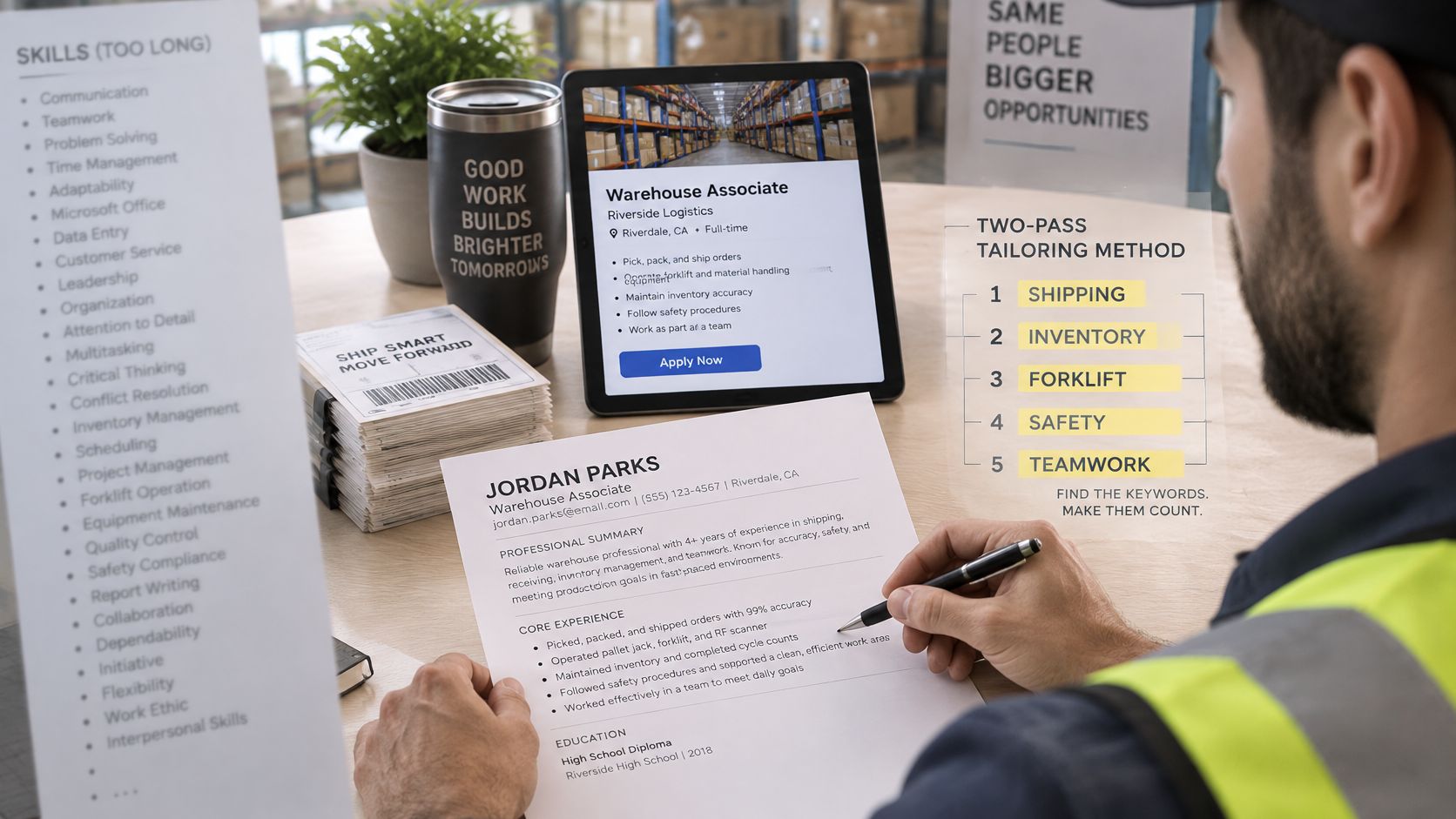
The second pass is where tailoring happens, and it runs in four moves.
- Harvest the posting's operational terms. Copy the phrases it repeats: inventory management, forklift operation, shipping and receiving, OSHA compliance, RF scanning, order picking, quality control, WMS, palletizing.
- Keep five to seven you hold. Indeed Flex's warehouse resume guide recommends at least five to seven applicable terms, and that's a sensible ceiling too. More than that and you're claiming things you can't defend.
- Move each term into a bullet. A term in context beats a term in a list, because the bullet gives it a number to stand on.
- Match platform names only where you've used them. Manhattan, SAP, and Oracle WMS are not interchangeable, and claiming one you've never opened falls apart on the first interview question.
When the posting names software or automation you haven't touched, describe the transferable workflow instead: scanning, exception handling, inventory accuracy, replenishment logic, troubleshooting, and learning new interfaces quickly. That framing works across manual warehouses, e-commerce fulfillment, cold storage, and automated distribution centers, because the underlying process is the same even when the interface changes.
Different experience levels lead with different evidence. Early-career applicants should open with scanning, lifting, and safety training. Experienced operators lead with equipment hours and throughput. Workers with 20 years in lead with accuracy, reliability, and a training record. The standard is identical for all three: proof, not adjectives.
The final test is positional. The first two requirements in the posting should be answered inside the top third of the page. If they're buried under a summary about being detail-oriented, the tailoring didn't land.
Show Relevant Experience Without a Warehouse Title
Plenty of people applying for warehouse work have never held the title. They ran stockrooms, restocked retail shelves, checked shipments, drove a pallet jack in a grocery backroom, or trained new hires on a scanner. The work is adjacent, and the resume's job is to translate it into the same operating language a warehouse manager uses.
That translation is where most candidates stall. Guidance on warehouse worker resume examples tends to recycle the same keyword lists without explaining how to convert a stockroom job into measurable evidence. The fix is to describe what you controlled and what changed.
Retail backroom replenishment becomes "replenished 60+ SKUs per shift from backstock to floor, scanning locations to keep on-hand counts accurate." Receiving discrepancies become "resolved invoice-to-delivery mismatches on weekly deliveries, cutting unresolved receiving variances." Training becomes "onboarded 6 new staff on scanner procedures and safe lifting, with no recordable incidents in the first 90 days."
Honest framing beats inflated framing. "Resolved receiving discrepancies for a 12-door dock" is stronger than a made-up accuracy figure, and it invites the interview conversation instead of ending it.
Separate what you did from what the team did. Use first person for your own work and label team outcomes as the team's, such as "the team cut dock-to-stock time by a shift." Attributing a group result to yourself is the fastest way to lose credibility when a reference check happens.
Don't compare your numbers with another employer's standards either. Two sites measure pick accuracy differently, one counting location errors and the other counting unit errors, so a figure that looks weak beside a competitor's may come from a stricter count. Present your metric with its context and let the reader judge.
Before writing each adjacent task, run four questions:
- What did I do? The task in plain words.
- Who saw it? A supervisor, a shift lead, an audit, a log.
- What's the evidence? A count, a report, a training record, a clean safety history.
- Which phrasing is safe? The version you could defend in 30 seconds.
Then lead your summary with the operations you ran, not the industry you ran them in. If you're checking how other sectors word the same requirements, the Blockchain Jobs warehouse operations listing shows receiving, inventory, and safety language applied outside traditional logistics, which is useful when your background came from somewhere else. For help framing a summary around transferable operations, this guide to a resume summary for changing careers covers the structure.
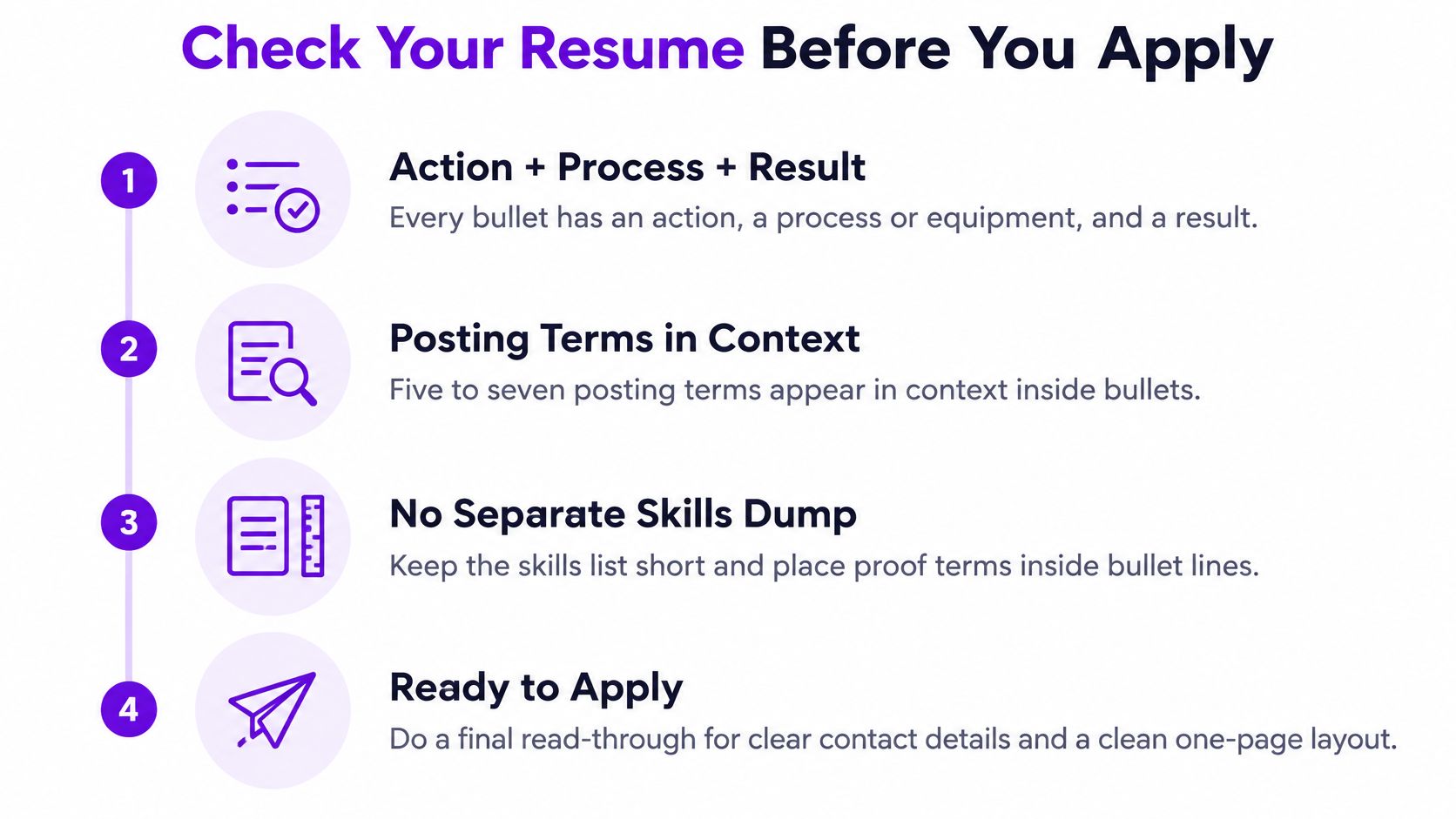
Check Your Resume Before You Apply
Run this before you hit submit, not after.
- Every bullet has an action, a process or equipment, and a result. If one of the three is missing, the bullet reads as a duty.
- Five to seven posting terms appear in context. Each one sits inside a bullet with a number, not in a keyword dump.
- Certifications show issuing body and status. Current, employer-provided, or site-specific, stated plainly.
- Every number survives an interview. You can explain where it came from and what it measured.
- The layout parses cleanly. One page for early-career applicants, and the paste-into-plain-text check passes.
- The file is named and formatted as requested. Usually PDF, professional filename, contact details in the body.
The last check is the one no tool can do for you. A resume builder will match keywords, rewrite bullets, and test formatting, but it cannot verify that the 99.5% was your number and not a colleague's. That burden stays with you, and it's the reason interviewers ask follow-up questions about metrics.
If you want a second opinion on the mechanics, this breakdown of common resume mistakes covers the errors that sink otherwise strong applications.
For a quick structural check, you can drop a PDF into Eztrackr and it parses experience, skills, and education in about 30 seconds. Creating a resume there is free, and an account is needed to save progress and use the optimization features. It's one optional pass, not a requirement, and it reads formatting and keywords rather than the truth of your figures.
The standard: a warehouse resume wins when every skill carries a number and every number is true.
Take the posting you're working on right now, run the six checks, and submit the customized version this week. One accurate, well-matched application beats five generic ones sitting in draft.
Eztrackr's Resume Builder takes the resume you already have, matches it against a specific warehouse posting, and rewrites your bullets into an ATS-ready draft you can review and download. It handles the formatting and keyword work so you can spend your time on the numbers that only you can verify. Visit Eztrackr to upload your resume and tailor it to your next posting.