Keywords for Project Manager Resume That Work
Stop copying a list of sixty skills and calling it tailoring. That's the most popular advice on keywords for project manager resume searches, and it's the weak move. A long list makes you look interchangeable, not qualified.
You're better off with a short set picked from real ad demand, scored against one live posting, and placed inside results a hiring manager can check. Keep fewer terms. Prove every one.
Project Manager Resume Keywords Ads Repeat
A copied list of sixty skills isn't a plan. It's inventory with no ranking. If everything's a priority, nothing stands out, and recruiters read that as padding fast.
Start instead with what ads repeat. A sample of 192 Project Manager postings found communication in 69% of ads, leadership in 46%, Agile in 20%, Jira in 19%, risk management in 18%, stakeholder management in 17%, and Scrum and Microsoft Project each in 8%. Those shares tell you where demand concentrates. They don't promise interviews, and you shouldn't treat frequency as causation.
Keywords seen in 192 project manager postings
| Keyword | Share of postings | Role on the resume | Attach it to |
|---|---|---|---|
| Communication | 69% | Base layer | A decision, status rhythm, or conflict you resolved |
| Leadership | 46% | Base layer | Team size, span, or a call you owned |
| Agile | 20% | Differentiator if the ad names it | Ceremonies, artifacts, and a delivery result |
| Jira | 19% | Differentiator if the ad names it | Workflow you configured or a board you owned |
| Risk management | 18% | Differentiator if the ad names it | A risk retired and the cost or delay avoided |
| Stakeholder management | 17% | Differentiator if the ad names it | How many stakeholders and what got approved faster |
| Scrum | 8% | Differentiator if the ad names it | Role, sprint cadence, and an outcome |
| Microsoft Project | 8% | Differentiator if the ad names it | A schedule you built and the milestone it protected |
Read that table from the top down. Communication and leadership are the base layer. Almost every employer expects them, so you can't win on those words alone. You win by showing what your communication changed, a decision reached, an escalation resolved, a weekly status rhythm that stopped surprise delays.
The rows below work differently. Agile, Jira, risk management, stakeholder management, Scrum, and Microsoft Project separate you only when the target ad names them. If the posting never mentions Scrum, adding Scrum doesn't make you technical. It makes you unfocused. If it does name Scrum, a naked claim still isn't enough. State your role, the cadence you ran, and what shipped.
Functional phrases that travel with those rows
When an ad uses these terms, they usually sit beside specific functional work. Pull only the ones you've done.
- Planning and scope: project planning, scope management, requirements gathering, roadmap, milestones
- Money and resources: budget management, resource allocation, vendor management
- Control and reporting: project scheduling, risk register, change management, KPI reporting
Don't paste that whole set into your skills line. That's the mistake you're trying to leave behind. Treat each phrase as a claim you'll be asked to defend in an interview. If you wrote risk register, be ready to name a risk you logged, owned, and retired. If you wrote vendor management, be ready to talk price, delivery, or performance you changed.
A keyword you can't attach to a budget, a headcount, a date, or a delivery change isn't an asset yet. It's an untested claim.
Mark the table now. Circle only rows you can back with a number, a scope, or a named outcome. That marked set is your starting pool, not your final resume.
Carry it forward and cut harder. The goal isn't breadth across all eight rows. It's a shortlist that matches one employer's language and your real work.
How to Score Keywords from One Job Posting
One master list reused for every application is lazy and visible. Do one scoring pass per posting instead. It takes longer than blasting the same file, and that's the trade-off worth making.
The method described in the PMI Talent Triangle flyer groups capability into Ways of Working, Power Skills, and Business Acumen. Use that structure so software names don't swallow the whole resume. PMI also identifies collaborative leadership, strategic thinking, relationship building, and creative problem-solving among the capabilities associated with successful project managers.
Use this visual walkthrough of the scoring pass before you rewrite anything.
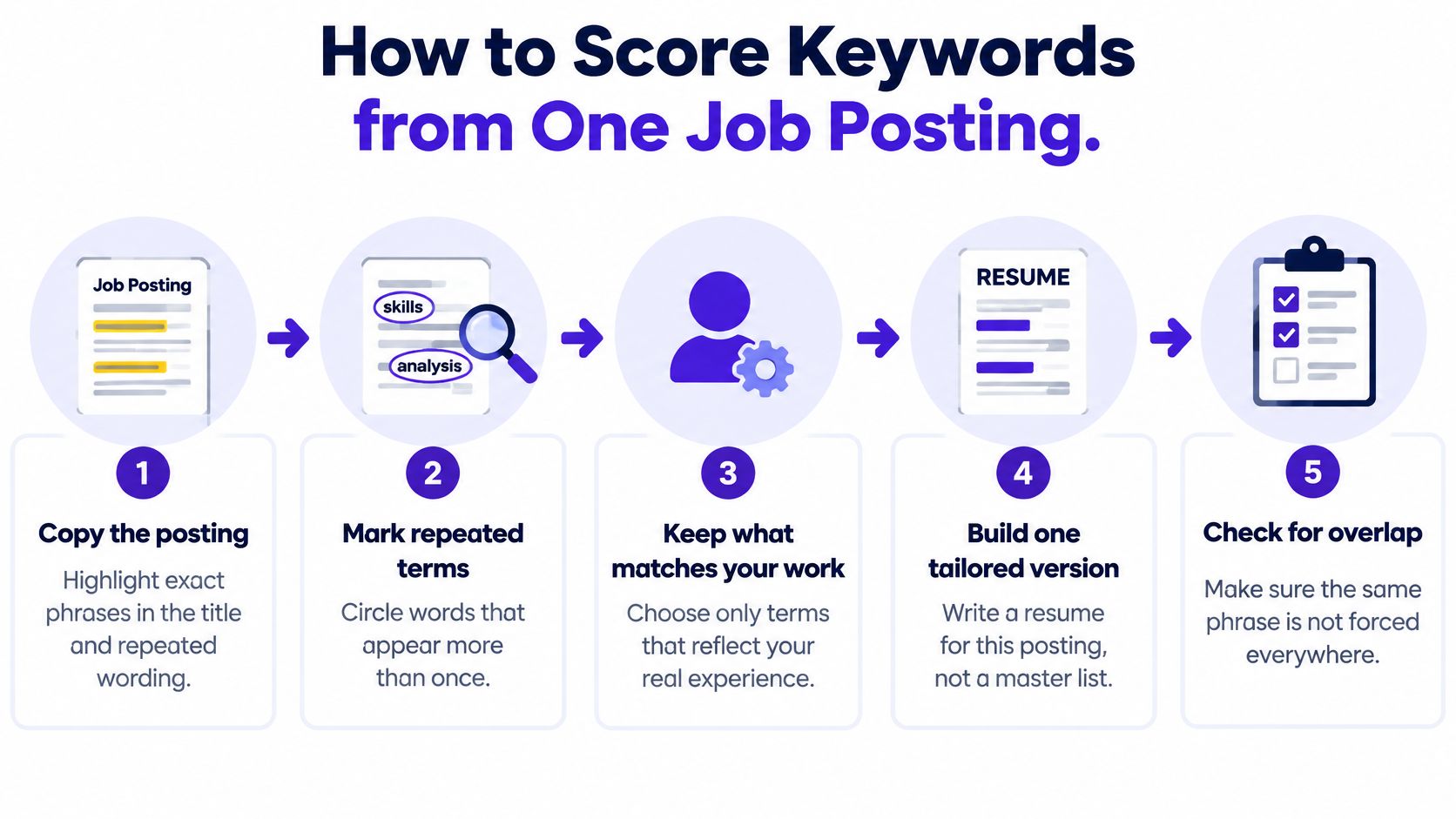
The six step scoring routine
- Copy the posting intact. Highlight exact phrases in the title and any phrase repeated in the body. Don't paraphrase yet.
- Score each highlight. Give 3 points to a phrase in the title or repeated in the description, 2 points to a clear technical requirement, and 1 point to a transferable competency such as organized.
- Sort into three buckets. Put every scored term under Ways of Working, Power Skills, or Business Acumen so you see gaps before you write.
- Keep the top 10 to 15. Retain only the highest scoring terms you've performed. A long tail of 1 point words goes first.
- Delete what you can't prove. Cut unsupported certifications, tools you only watched someone else use, and methods you sat near but didn't run.
- Draft an outcome clause. Write one short result for each keeper before it earns a place on the page. No clause, no keyword.
If you need a clean way to work from a single posting, use a target job description as your scoring sheet rather than memory. Memory inflates your skills. The ad doesn't.
What belongs in each bucket
Ways of Working covers delivery method and control. That includes Agile, Scrum, requirements management and traceability, schedule management, scope management, earned value management, governance, and benefits realization. These prove how you ran the work.
Power Skills covers how you led people through it. Think collaborative leadership, strategic thinking, relationship building, and creative problem-solving. Don't list them as traits. Anchor each one to a stakeholder, a conflict, or a decision.
Business Acumen covers commercial judgment. Budgets, benefits, vendor trade-offs, and scope calls with cost attached belong here. This bucket stops your resume from reading like a tool inventory.
A worked score you can copy
Say a fictional infrastructure ad titles the role Agile Project Manager and repeats risk management and stakeholder management three times each. Agile scores 3 for the title. Risk management and stakeholder management score 3 each for repetition. A single passing mention of Smartsheet scores 2 as a technical requirement, or less if you've barely touched it.
Your shortlist leads with those three 3 point terms. Smartsheet makes the cut only if you can write an outcome clause for it, such as a tracker you built that cut status chasing. If you can't, it waits for another ad.
Pair each keeper the same way. Agile delivery, led 3 cross-functional sprints. Risk management, reduced schedule exposure by 18%. Short, checkable, done.
End every pass with the same rule. A term with no outcome clause goes back to the discard pile, even if it scored 3. Scoring finds candidates. Proof decides.
Where to Place Keywords so They Prove Work
Placement matters because the same phrase means different things in different blocks. Put a term in the wrong home and it reads like decoration. Put it beside a result and it reads like work.
The U.S. Bureau of Labor Statistics describes project-management specialists as professionals who coordinate schedules, budgets, resources, deliverables, and stakeholder requirements. That supports concrete terms such as project planning, scope management, budget management, risk management, resource allocation, stakeholder management, project scheduling, and cross-functional coordination. It also explains why vague words fail. Coordinating real budgets and deliverables should leave numbers behind.
Use this placement checklist to give each scored term one clear home.
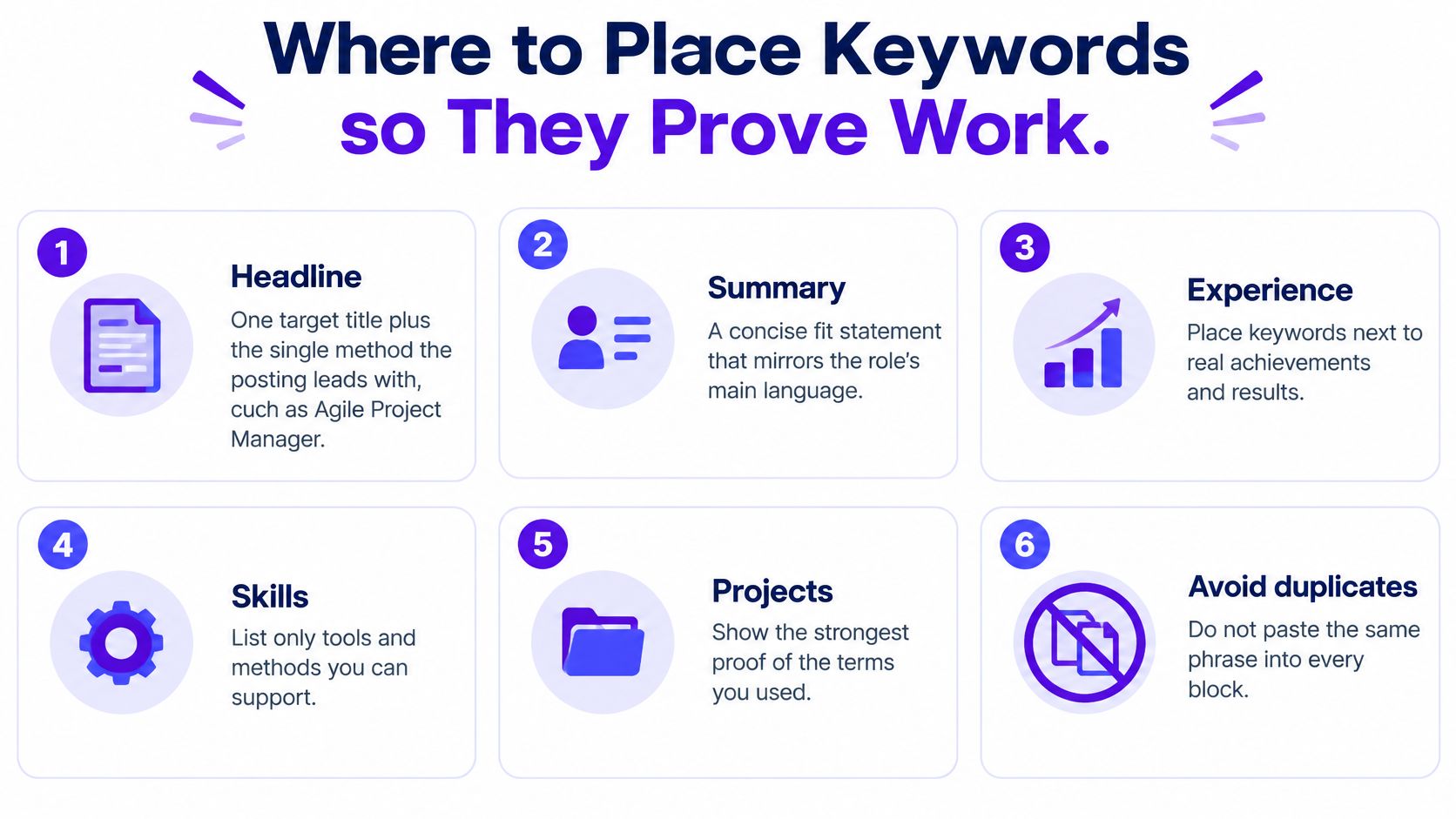
Headline and skills line
Your headline gets one target title plus the single method the posting leads with. Agile Project Manager works. Construction Project Manager works. A chain of five tools doesn't. It signals you're chasing a parser, not a role.
Your skills line holds the 10 to 15 scored terms in the posting's spelling. Include one honest synonym pair such as stakeholder management and stakeholder engagement if both fit, and write both PMP and Project Management Professional once if you hold that credential. Then stop. A third spelling is noise, not coverage.
Experience bullets do the real work
Bullets are where keywords earn their place. Adapt lines like these to your own history, don't copy them as your history.
The pattern to repeat: Managed a $2M budget. Reduced delivery time by 18%. Coordinated 12 cross-functional stakeholders. Name the duty, name the scope, name the change.
Build every strong bullet as keyword plus action plus number. Risk management that cut schedule exposure tells a reader more than risk management listed alone. Stakeholder management that shortened approval time beats a claim that you're great with people. Schedule ownership that pulled a milestone forward beats saying you're deadline driven.
That logic applies to power skills too. PMI's 2023 findings in that same Bureau of Labor Statistics coverage ranked communication as the most critical power skill, cited by 68% of respondents, followed by problem-solving at 65%, collaborative leadership at 62%, and strategic thinking at 58%. Those words are common, so they need a scene. Show the escalation you resolved, the trade-off you framed, or the decision your status report forced.
Cut the usual filler without regret.
- Cut organized and team player. They assert a personality and prove no delivery.
- Cut naked tool mentions. Jira alone says nothing about workflow ownership.
- Cut repeated phrases. Don't paste the same keyword into the headline, summary, skills, and every bullet.
Close this pass with one check. Every term on your skills line should appear again in at least one bullet with scope attached. If it doesn't, either write the proof or remove the term. A skills line that promises more than your bullets deliver is exactly what experienced recruiters catch first.
Keywords that Change by Project Specialty
Generic project language no longer separates anyone. According to Indeed Hiring Lab, business-operations skills, including project-management and analysis skills, appeared in nearly three-quarters of U.S. job postings in Q4 2025. When a phrase is everywhere, context is the differentiator.
This office review moment shows the key test, a second reader asking whether the language sounds like the specialty.

Specialty keywords and the proof that makes them credible
| Specialty | Keywords that differ | Proof the bullet should show |
|---|---|---|
| Technical | Sprint, backlog, requirements traceability, Jira workflow, CI/CD handoff | Sprints led and a defect or cycle-time change |
| Construction | Baseline schedule, change orders, subcontractors, safety, earned value | Cost held on a change order or a milestone protected |
| Healthcare | Clinical workflow, regulatory documentation, HIPAA-aware reviews, clinical vendors | A go-live without a compliance finding |
| Marketing | Campaign timeline, creative approvals, agency vendors, launch milestones | A launch date moved or a budget held |
| Operations | Process improvement, KPI reporting, resource planning, change management | Cycle time cut or a KPI that moved |
Notice how stakeholder management changes meaning by row. In healthcare it can mean sign-off from clinicians before a go-live. In construction it can mean inspectors and subcontractors aligned to a baseline schedule. In marketing it's brand owners approving creative on time, and in operations it's plant leads accepting a new process.
Write that specificity into the bullet. Saying you managed stakeholders tells a reader nothing about whose approval blocked delivery. Naming the approver and the approval you secured does.
A related point matters if you're crossing between project and program work. The distinction in scope described for program manager resumes is useful here because specialty language and scope language both signal fit. Borrow the scope clarity, keep your specialty proof.
Watch this short walkthrough on tailoring project language before you finalize specialty bullets.
Newer screening also rewards context over stuffing. Systems increasingly assess skill relevance and candidate and job fit rather than literal overlap alone, so a construction candidate who stuffs Scrum to look technical creates a mismatch a human will spot anyway. Stay in your lane and prove it well.
Use one final test per bullet. If a colleague in that specialty wouldn't recognize the work in that line, the keyword is in the wrong costume. Rewrite it with that specialty's artifacts, approvers, and risks, or cut it.
ATS Mistakes that Hide Real Project Work
Retire the phrase beat the ATS. It's an incomplete goal, and it pushes you toward tricks instead of clarity.
Technical literature summarized in Teknika notes that traditional ATS approaches can miss contextual relevance and create misclassification or bias, while AI resume analysis still shows weaknesses involving domain-specific performance, input-format sensitivity, and multilingual support. Translation for you is simple. Write for both an older rule based parser and a newer meaning based screen, then make sure a human can follow it.
What older ATS tools and AI screens do with resume choices
| Choice | Older keyword ATS | Newer AI screen | What to do |
|---|---|---|---|
| Exact phrase from the posting | Strong match | Still helps | Use it when it is true |
| One close synonym | Mild help | Helps meaning | Use once, then stop |
| Skill tied to a number | Weak by itself | Stronger fit signal | Put the number in the bullet |
| Graphics, icons, or text boxes | Often dropped | Format-sensitive | Remove them |
| Tables inside the resume file | Cells can scramble | Layout risk | Use plain lines instead |
| Unusual section labels | Section missed | Context missed | Use Experience and Skills |
| Tool used for a few weeks | False strength if listed alone | Weak signal | One clause or leave it off |
| Career-change retitle | Can look inconsistent | Fit depends on context | Keep the real title and name the duty |
Keep headings boring. Experience and Skills parse well everywhere. My Journey and Where I've Shipped Things don't. Leave tables out of your resume file even though articles use them for reading. Your file needs plain lines that survive conversion.
If you want the mechanics behind parsing, read how applicant tracking systems work before you redesign anything. Format decisions get easier once you see what parsers drop.
Three edge cases keyword lists skip
A tool you used briefly. Give it one clause inside a project bullet, or leave it off. Don't park a three week tool beside Jira and Microsoft Project on the skills line and invite questions you can't answer.
A career change. Keep your real past title and name the transferable duty in the bullet, such as budget ownership or vendor management. Retitling an operations role as Project Manager creates an inconsistency recruiters notice in verification.
An international credential or method name. Use the name in the posting once and your regional name once, for example PRINCE2 beside a local stage-gate label. Then stop. More variants look like you're hedging.
Five item check: Exact phrase, one synonym, a number, a standard heading, no graphics. If a line fails two of those, rewrite it.
Keyword alignment helps discovery. Readable structure and honest scope decide the human read that follows.
Score One Live Posting Before You Apply
A longer keyword list is the weak move. Score one live Project Manager posting, then keep only terms you can connect to real work and a result.
- Save the posting. Keep its title and full description so you can score the employer's exact wording.
- Run the 3, 2, 1 score. Keep the 10 to 15 terms that earn a place; discard the rest.
- Rewrite three bullets. Give each chosen term a scope and a result that fits the project specialty.
- Check the plain-text file. Make sure headings remain clear and no text box hides a line.
- Apply and log the terms. Record what this posting required so you can compare it with similar roles later.
Eztrackr keeps this work connected to the saved job. Its Chrome extension saves the posting, the skill-match view compares your resume with the description, and the resume builder holds your revised bullets. Before you submit, Eztrackr's skill-match analyzer shows how your rewritten bullets line up with the posting.
Keep a keyword only when it appears in the ad, reflects work you did, and supports a measured result.
A term that fails any of those tests does not belong in this version. Save it for a posting where it fits.
Save a Project Manager posting, score its terms, and rewrite three proof-based bullets while the ad is still in view. Eztrackr keeps the saved job, skill-match view, and custom resume together. Visit Eztrackr to run that process on your next application.