accountant cover letter: Craft a standout application
Your accountant cover letter isn't just a formality—it's the story behind your resume. It’s where you connect your financial modeling wizardry or your deep knowledge of GAAP directly to a company's bottom line, proving you’re much more than numbers on a page.
Why Your Accountant Cover Letter Is a Game Changer
Do cover letters even matter anymore? I get asked this all the time, and for the accounting field, the answer is a resounding yes.
Your resume does a great job of listing your qualifications and experience. But a thoughtfully written cover letter gives hiring managers the context they're desperately looking for. It's your single best opportunity to pull yourself out of a stack of otherwise identical applications.
Think of it like this: your resume is the balance sheet—a straightforward list of your assets (skills) and liabilities (maybe a gap in experience). Your cover letter? That’s the annual report narrative. It explains the story behind the numbers, allowing you to link your proudest achievements directly to the challenges you know that specific employer is facing.
More Than a Formality, It’s a Strategic Tool
A truly great cover letter accomplishes things a resume simply can't. It gives you the space to:
- Showcase Your Analytical Mind: You can talk about the company's recent performance or financial position and explain exactly how your skills can help them improve it.
- Highlight Attention to Detail: An error-free, meticulously crafted letter is immediate proof of the precision you'd bring to their books. It's your first work sample.
- Inject Some Personality: Let them see the human behind the CPA certification. This is where you convey genuine enthusiasm and show you’d be a great fit for the team.
A cover letter is your first real test. It’s a work sample that shows a hiring manager how you communicate, organize your thoughts, and present a persuasive argument—all critical skills for a successful accountant.
The demand for sharp finance pros is only getting stronger. Projections show an expected growth of 4% for accountants and auditors from 2022 to 2032. That translates to about 126,500 new job openings every year. To learn more about the accounting job market, you can check out these accounting and finance statistics.
In a field this competitive, every single advantage counts. Shifting your mindset from "cover letter as a chore" to "cover letter as a strategic tool" is the first step. For more advice on standing out, check out our guide on how to get more job interviews.
The Anatomy of a High-Impact Cover Letter
Thinking of your cover letter as just a basic intro, body, and conclusion is a huge missed opportunity, especially in a field as precise as accounting. To really stand out, you need to treat each section like a strategic tool, built for a specific purpose. Let's break down the blueprint for a letter that doesn't just get read—it gets results.
Before we dive in, remember that the fundamentals of a great cover letter apply here, just with an accountant's precision. For a broader overview, our guide on how to write a cover letter is a great place to start.
The Hook: Your First Paragraph
Your opening isn't just an introduction; it’s your hook. A hiring manager might only give your letter a few seconds, so you have to grab their attention right away. Ditch the tired old "I am writing to apply for…" and lead with something powerful.
A quantifiable achievement or a sharp observation about the company works wonders.
"Having recently led a project that streamlined our accounts payable process and cut invoice processing time by 20%, I was immediately drawn to [Company Name]'s focus on operational efficiency mentioned in your Staff Accountant job description."
See the difference? This approach immediately proves your value and shows you’ve actually read the job posting.
The Proof: The Body Paragraphs
This is where you make your case. The body of your cover letter should be two or three short, punchy paragraphs that connect your skills to real, measurable outcomes. Don't just list what you can do—prove it with mini-stories and hard data.
Instead of just saying you're great at month-end closing, give them the evidence.
- Showcase Technical Chops: "In my last role, I was responsible for all SOX compliance testing and used Oracle NetSuite to manage our financial reporting, which directly contributed to a 15% drop in audit discrepancies year-over-year."
- Demonstrate Soft Skills: "When we hit an unexpected snag reconciling a major client account, I developed a new verification checklist that not only fixed the issue but was adopted by the whole department, preventing future errors."
The same principles of showcasing your value concisely apply elsewhere, too. This kind of results-oriented storytelling is also key to crafting compelling LinkedIn summaries that make recruiters stop scrolling. This section is your chance to turn abstract skills into tangible proof.
To give you a clearer picture, here’s a quick breakdown of how each part of your letter should function.
Accountant Cover Letter Structure at a Glance
| Section | Purpose | Key Elements to Include |
|---|---|---|
| Contact Info & Date | Professionalism and logistics | Your name, phone, email, LinkedIn URL. Hiring manager’s name and title. Company address. |
| The Hook (Opening) | Grab immediate attention | A key achievement, a shared value, or a specific connection to the company’s recent news or projects. |
| The Proof (Body) | Connect your skills to their needs | 2-3 short paragraphs with quantifiable results (use bold for numbers), relevant software proficiency, and examples of problem-solving. |
| The Action (Closing) | Drive the next step | A confident summary of your value, reiteration of your enthusiasm, and a clear call to action for an interview. |
| Professional Sign-off | End on a strong, formal note | "Sincerely" or "Best regards," followed by your typed name. |
This table serves as your roadmap, ensuring every word in your cover letter has a job to do.
The Action: Your Closing Paragraph
Finally, your closing is your call to action. You need to sound confident, forward-thinking, and crystal clear about what you want to happen next. This is no time to be passive.
End with a powerful statement that shows you’re ready to move forward.
"I am confident that my experience in variance analysis and my commitment to process improvement would make me a significant asset to your team. I am eager to discuss how I can contribute to [Company Name]'s financial objectives in more detail."
This kind of ending leaves no doubt about your interest and proactively nudges the hiring manager toward scheduling that interview. It’s the professional and assertive final touch that a strong application needs.
Tailoring Your Letter for Any Accounting Role
Think about it: sending a generic cover letter is like handing the same financial report to every single department. Sure, the numbers are there, but it's not actually useful to anyone. Customization isn't just a nice-to-have; it's the only way to show you get what the company needs and how you can deliver.
Every accounting role—from staff accountant to auditor—has its own language, priorities, and pain points. Your job is to speak that language fluently. When you align your experience with the specific demands of the role, you stop being just another applicant and become the obvious solution to their problem.
Staff Accountant: Precision and Efficiency
When you're going for a Staff Accountant role, the hiring manager is hunting for three things: precision, reliability, and efficiency. This position is the engine room of the accounting department, and they need someone who can nail the fundamentals without missing a beat.
Your cover letter needs to scream "dependable." Focus on your experience with the core accounting functions:
- Accounts Payable (AP) and Accounts Receivable (AR): Did you streamline anything? Talk about how you cut down invoice processing time or improved collection rates.
- General Ledger and Reconciliations: This is where you highlight your eagle eye for detail in maintaining accurate ledgers and hunting down discrepancies.
- Month-End Close Procedures: Show them you can be a key player in making the month-end close a smooth, on-time process, not a chaotic scramble.
Here's a real-world example:
"In my role at ABC Corp, I re-engineered our AP workflow, which slashed the average invoice processing time from five days down to just 48 hours. My hands-on experience with daily bank reconciliations and maintaining the general ledger means I can jump right in and contribute to your team's month-end close accuracy from day one."
Senior Accountant: Leadership and Strategy
For a Senior Accountant position, the game changes. They aren't just looking for someone who can execute tasks; they need someone who can oversee processes and think strategically. Recruiters want to see leadership potential, a knack for solving complex problems, and the ability to mentor junior staff.
Your cover letter has to show you've made that leap. This is where you talk about the "why" behind the numbers, not just the "what."
For instance:
"I led the transition to ASC 606 revenue recognition standards at my previous company, a project that involved training three junior accountants and collaborating with the sales team to ensure full compliance. This initiative didn't just get us through the audit seamlessly—it also improved our revenue forecasting accuracy by 15%."
The infographic below breaks down the must-have structure for any solid cover letter: a great hook, concrete proof of your skills, and a clear call to action.
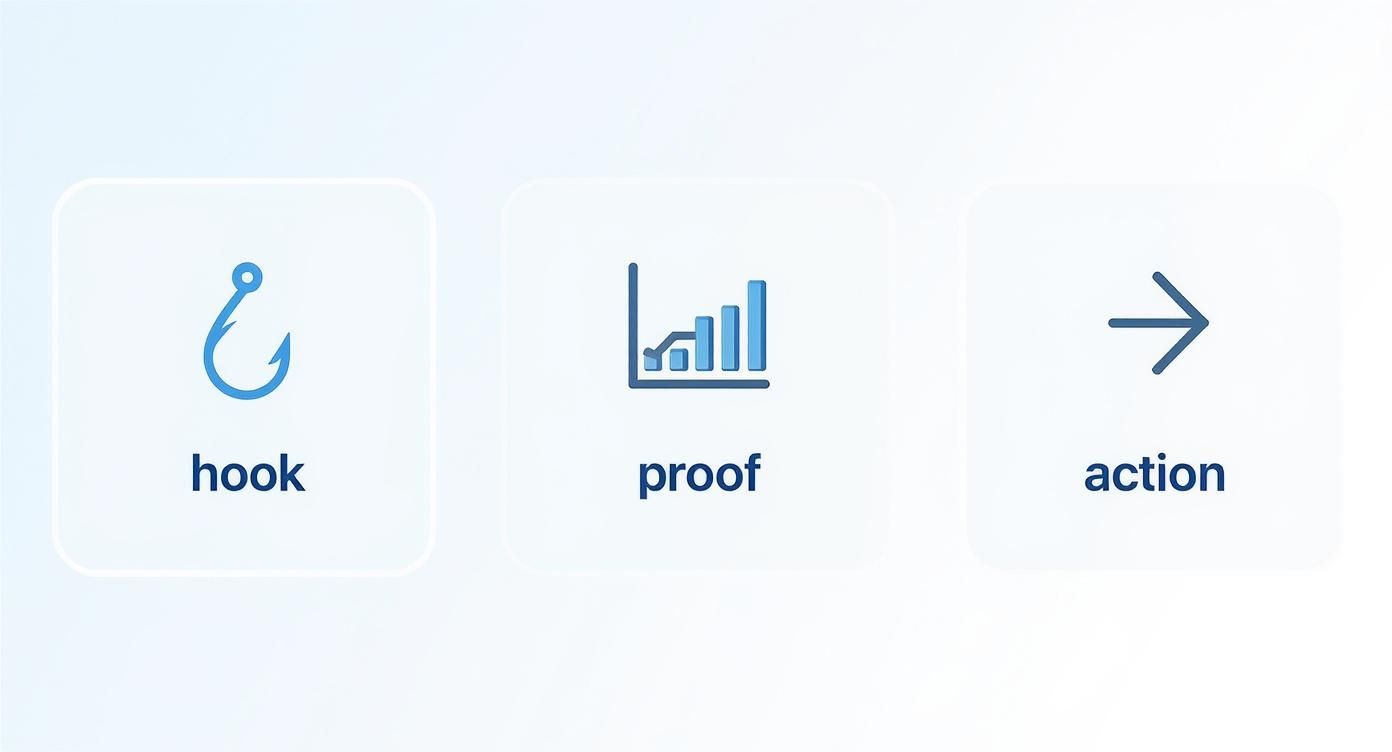
This simple framework helps you slot your tailored points in logically, making sure your most impressive, relevant achievements get the spotlight they deserve, no matter the role.
Tax Accountant: Compliance and Planning
When you're gunning for a Tax Accountant role, two words should be your north star: compliance and strategy. Your cover letter has to prove you have a deep, practical understanding of tax law, top-notch research skills, and a proactive mindset toward tax planning. You need to show them you can save the company money while keeping it completely above board.
Zero in on your expertise in:
- Tax Preparation and Filings: Get specific about your experience with federal, state, and local tax returns for different types of entities (S-corps, LLCs, etc.).
- Tax Research: Share a quick story about a time you dove into a complex tax issue and found a favorable, legally sound solution.
- Strategic Tax Planning: Give a concrete example of how you identified a tax-saving opportunity that others might have missed.
Try something like this:
"My research into R&D tax credits at XYZ Inc. led to us identifying $120,000 in previously unclaimed credits. I'm skilled at navigating complex IRS regulations and am confident in my ability to manage your corporate tax compliance while proactively finding strategic savings."
Auditor: Objectivity and Risk Assessment
For an Auditor role, it’s all about objectivity, professional skepticism, and a rock-solid grasp of internal controls and risk. Your cover letter needs to radiate a strong ethical core and an analytical mind that’s wired to spot and mitigate financial risks.
Your story should be about assessing risk and communicating your findings in a clear, constructive way. It’s also vital to show you understand what they're looking for. A great way to do this is to ensure your skills perfectly align with their needs. If you want to go deeper on this, you can learn more about how to perfect your resume and job description match to make sure you're hitting all the right notes.
Here’s how to frame it:
"As an auditor at Global Assurance, I designed and executed audit plans for clients in the manufacturing sector, with a heavy focus on inventory and COGS. My work uncovered a critical weakness in their inventory tracking system. The new control process I recommended was adopted and ultimately reduced their inventory shrinkage by 10% within six months."
Getting Past the Robots: Using Keywords to Beat the ATS
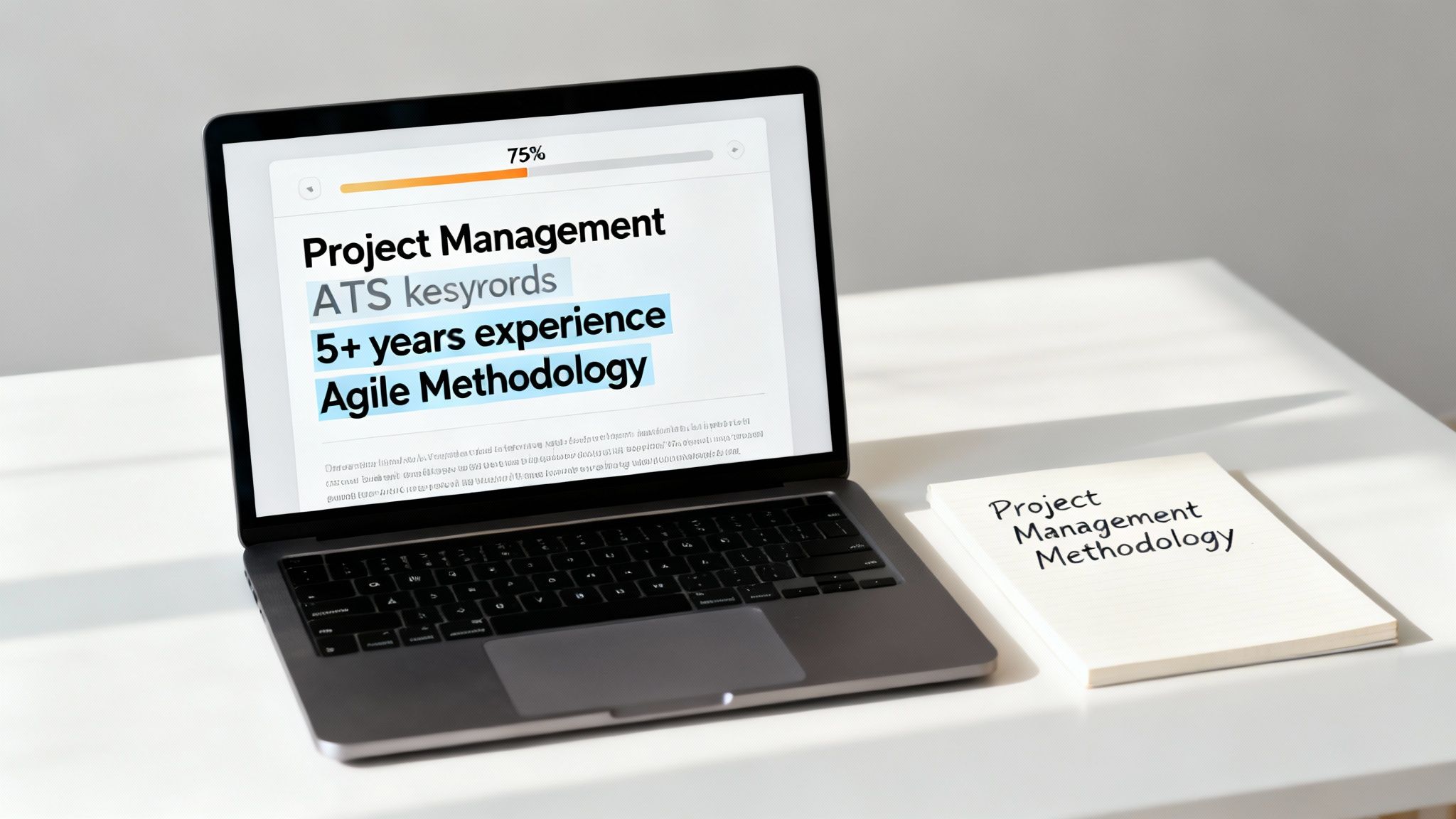
Before a real person ever lays eyes on your accountant cover letter, it has to get past the digital gatekeeper: the Applicant Tracking System (ATS). It’s a harsh reality, but a staggering 75% of large companies use this software to pre-screen applications.
This means your first reader isn’t a hiring manager—it’s an algorithm. And that algorithm doesn’t care about your well-crafted narrative. It’s hunting for keywords.
If your cover letter doesn't have the right terms pulled from the job description, it could be tossed into the digital rejection pile without a second thought. Think of the ATS as a bouncer at an exclusive club. If your name’s not on the list (meaning, you don’t have the right keywords), you're not getting in.
Mining the Job Description for Gold
So, where do you find these magic keywords? They’re hiding in plain sight: right in the job description. That document is your treasure map. Your first task is to dissect it like you would a complex financial statement.
I always tell people to print it out or copy it into a separate document. Then, grab a highlighter.
Start marking up anything that looks important:
- Hard Skills: These are your non-negotiables. Look for specific software like SAP, QuickBooks Enterprise, Oracle, or mentions of Excel skills (like VLOOKUPs and Pivot Tables). Also, flag accounting standards like GAAP, SOX compliance, or IFRS.
- Action Verbs: What will you actually be doing? Hunt for verbs that describe the core functions, like reconciled, audited, forecasted, and analyzed.
- Soft Skills: Don't ignore these. The ATS often scans for them, too. Keep an eye out for terms like collaboration, problem-solving, communication, and especially attention to detail.
Once you’re done, you’ll have a master list of the exact words the ATS is looking for. If you want to go even deeper on this, we've got a whole guide on how to find the best resume keywords to use.
Weaving Keywords into Your Story
Now for the important part. You can't just dump all these words into your cover letter and call it a day—that’s called “keyword stuffing,” and it reads terribly. The art is in weaving them naturally into the stories of your accomplishments.
This approach works because it satisfies both the robot and the human who will eventually read your letter.
Instead of saying: "I am proficient in variance analysis and forecasting."
Try this: "In my previous role, I conducted detailed variance analysis to pinpoint budget discrepancies, which directly improved our team's forecasting accuracy by 15% in the following quarter."
See the difference? The second version doesn't just list a skill; it shows the skill in action and quantifies the result. You're not just checking a box for the ATS—you're proving your value.
By speaking the language of both the software and the recruiter, you give your application the best possible chance of landing at the top of the pile.
Showcasing Your Value with Numbers

Listing your old responsibilities is probably the fastest way to get your cover letter tossed. A hiring manager already knows an accountant "managed expense reports" or was "responsible for month-end close." What they're dying to find out is how well you did it.
This is where the numbers come in.
Quantifying your wins is the single most powerful thing you can do to prove your value. It completely shifts the conversation from what you did to the real-world impact you had. It turns you from someone who just checks boxes into a strategic asset who delivers a measurable return.
From Vague Duties to Concrete Achievements
To nail this, I always think in terms of a simple formula: Action + Task + Measurable Result. It’s a foolproof way to connect your work to a specific, valuable outcome that a hiring manager can instantly grasp.
Let’s look at a couple of quick before-and-afters. It makes a world of difference.
-
Before: "Managed accounts payable processes." (Okay, but this is just a duty, not an achievement.)
-
After: "Overhauled the accounts payable process by implementing a new digital invoicing system, which reduced payment errors by 25% and accelerated vendor payment cycles by four days."
-
Before: "Involved in budgeting and forecasting." (This is way too vague. What was your actual contribution?)
-
After: "Collaborated with department heads to develop the annual budget, improving forecast accuracy and achieving a budget variance of less than 2% for two consecutive years."
See what I mean? The “after” versions are packed with context, show initiative, and use hard numbers to prove you're effective.
The goal is to make your achievements impossible to ignore. A statement like "saved the company money" is forgettable. But "Identified $75,000 in annual cost savings by renegotiating vendor contracts"? That’s the kind of line that gets you the interview.
Finding Your Numbers
Sometimes digging up the right metric feels tough, but trust me, there's always a number you can use to tell your story. You just have to know where to look.
Try to quantify your work using things like:
- Percentages: "Cut reimbursement processing times by 40%."
- Dollar Amounts: "Managed a departmental budget of $1.2 million."
- Time Saved: "Streamlined the month-end closing process, saving 10 hours of manual work each cycle."
- Volume or Scale: "Reconciled over 300 client accounts monthly with 99.8% accuracy."
Even your soft skills can be backed by data. It's a huge deal to employers—in fact, recent data shows that 91% of them prioritize applications that highlight soft skills alongside the technical stuff.
Showing how your problem-solving led to a quantifiable outcome—like slashing processing time by 30% or saving $500,000—makes an incredibly powerful impression.
When you pack your cover letter with metrics, it stops being a simple letter and becomes a compelling business case for hiring you. For more great ideas on this, check out this guide on effectively showcasing your skills. At the end of the day, it’s not just about what you’ve done—it’s about the value you created.
Answering Your Biggest Cover Letter Questions
You've done the hard work, polished your letter, and you're ready to go. But wait—a few last-minute questions always seem to creep in and cause a bit of doubt.
Let's tackle some of the most common sticking points I see with accountant cover letters. Getting these right will give you the confidence to hit "send" without a second thought.
"The Application Says a Cover Letter is Optional. Do I Still Need One?"
Yes. Absolutely, unequivocally, yes.
When you see "optional," don't read it as "not required." Read it as an opportunity most other candidates will ignore. This is your chance to immediately stand out from the pack. The person who skips it is just another applicant; the person who writes one is a serious contender.
Think about it: an optional letter is a blank canvas to:
- Share the story behind your resume's numbers.
- Draw a direct line from your skills to their specific problems mentioned in the job ad.
- Show them why you want this job, not just any accounting gig.
Trust me, that "optional" letter can be the very thing that moves you from the “maybe” pile straight into the “let's get them in for an interview” list.
"How Long Should It Be?"
Keep it short, sweet, and powerful. Your goal is to make a strong impression, not assign them a reading project. The sweet spot is always a single page.
Aim for 250 to 400 words. That's enough real estate for three or four tight paragraphs. You can introduce yourself, highlight a couple of your best, most quantifiable wins, and show some genuine excitement for the role—all while respecting the hiring manager's packed schedule. Every single sentence needs to earn its spot.
"What Are the Most Common (and Deadly) Mistakes?"
In a field built on precision, small mistakes can have a huge impact. Your cover letter is the first test of your attention to detail, and you don't want to fail it.
Steer clear of these classic blunders:
- The Generic, One-Size-Fits-All Letter: We can spot a copy-and-paste job from a mile away. It shows a lack of effort and, frankly, a lack of real interest.
- Just Repeating Your Resume: Your cover letter isn't the movie trailer; it's the director's commentary. It should add context and a human element, not just rehash the bullet points they’ve already seen.
- Typos and Bad Grammar: This is the kiss of death for an accountant. If you can't get your own letter right, how can they trust you with their books? Proofread. Then have someone else proofread.
- Forgetting to Quantify: Saying you "improved processes" is one thing. Saying you "implemented a new reconciliation process that reduced month-end closing time by 15%" is what gets you the interview. Let the numbers do the talking.
Avoiding these simple slip-ups is the easiest way to make sure your first impression is a great one.
Tired of juggling countless applications and customizing every document from scratch? Eztrackr is the all-in-one job application manager designed to organize your job hunt. With AI-powered tools for cover letters and resumes, a kanban board to track your progress, and powerful analytics, you can stop drowning in admin work and start focusing on what really matters—acing the interview. Get started with Eztrackr today!