What is skills assessment and How It Boosts Your Career
Let’s be honest, resumes only tell part of the story. A skills assessment is how a company moves past what you say you can do and gets a real look at what you can actually do.
It’s less of an exam and more of a practical tryout—a way for you to show off your talent instead of just listing it on a piece of paper.
Understanding The Core Of A Skills Assessment

Think of it as a dress rehearsal for the job. Companies are tired of guessing, and a skills assessment gives them an objective way to see your abilities in action. This is a huge reason they’ve become so common—it helps them pinpoint the right person for the role with a lot less guesswork and bias.
For you, the job seeker, this is fantastic news. It’s your chance to shine. An assessment levels the playing field, making your actual abilities more important than where you went to school or the brand name of your last employer.
What Do They Really Measure?
Skills assessments aren't one-size-fits-all. They’re built to measure the specific things you’ll need to do on day one.
This usually breaks down into a few key areas:
- Hard Skills: These are the concrete, technical skills the job demands. Think coding languages for a developer, data analysis for a marketer, or using specific design software. We dive deeper into this topic in our guide on what are hard skills and their examples.
- Soft Skills: This is all about how you work with others. They’re looking at your communication style, how you collaborate with a team, your leadership potential, and the way you tackle problems.
- Cognitive Abilities: Some tests look at your raw brainpower—how you think through problems, work with numbers, and apply logic under pressure.
A great real-world example is the case study, which is common in consulting and business roles. To see how that works, check out this excellent breakdown of what is a case study interview.
Knowing what kind of skills are being tested helps you prepare and put your best foot forward.
To keep it simple, here's a quick summary of what these assessments are all about.
Skills Assessment at a Glance
| Aspect | Description |
|---|---|
| Purpose | To objectively measure a candidate's job-related abilities and potential for success. |
| Format | Can include online tests, work simulations, presentations, or situational questions. |
| Focus | Moves beyond self-reported experience to verifiable, demonstrated skills. |
| Benefit for You | Provides a chance to prove your value and stand out in a competitive applicant pool. |
Ultimately, these assessments are designed to give both you and the employer a clear, honest picture of whether the role is the right fit.
Why Skills Assessments Are Reshaping How We Hire
Let's be honest, the old way of hiring is broken. For decades, we've relied on resumes and cover letters, but more and more companies are waking up to the fact that a slick resume doesn't guarantee someone can actually do the job.
This is where the game is changing. We’re seeing a massive shift toward what’s called skills-first hiring. It’s a simple but powerful idea: prioritize what a candidate can do over where they went to school or who they worked for last.
For companies, this is a no-brainer. It gives them a much clearer, more objective way to predict who will be a top performer. By focusing on proven abilities, they cut through unconscious bias and start building teams that are not just more diverse, but flat-out more capable. It’s no longer about the name on the resume; it's about the skills behind the name.
And for you, the job seeker? This is incredibly empowering. It means the practical skills you've spent time building—whether through past jobs, personal projects, or online courses—are now your most valuable currency. A skills assessment is your chance to shine, leveling the playing field and letting your talent speak for itself.
The Numbers Don't Lie
This isn't just a trendy topic on LinkedIn; it's a huge, data-driven movement. The market for skills assessments was already worth $2.3 billion in 2022, and it’s on track to explode to $7.4 billion by 2032.
Why the rapid growth? Because it works. A recent report showed that 73% of businesses are now using skills-based hiring methods, a huge jump from just 56% the year before. You can get more details on this hiring evolution in the full report from Allied Market Research.
This intense focus on provable talent has become a cornerstone of modern Human Resource Management (HRM), influencing everything from who gets an interview to how employees grow within a company.
This approach moves beyond simply matching keywords on a resume. It’s about verifying capabilities, ensuring a better fit for the role, the team, and the company culture.
What This Means for Your Job Search
So, how do you navigate this new world? The first step is to change your mindset. When a company asks you to take a skills assessment, don't see it as a hurdle. See it as an opportunity—your stage to prove what you’re made of.
Here’s how to adapt and come out on top:
- Identify the Core Skills: Read job descriptions like a detective. Figure out the exact skills they're going to test and make those your focus.
- Practice with a Purpose: Don't just cram. Find practice tests or build small projects that force you to use and sharpen those specific abilities.
- Show, Don't Just Tell: Your portfolio is your best friend. Be ready to walk through concrete examples that bring your expertise to life.
By embracing this skills-first reality, you're not just keeping up; you're getting ahead. You're aligning yourself with the future of work and giving yourself a serious edge in a crowded job market.
A Look at the Different Types of Skills Assessments
To really get what a skills assessment is, you have to know they're not all the same. Think of it like a chef's kitchen—you wouldn't use a bread knife to peel a potato. In the same way, employers use a whole toolkit of different assessments to get a clear picture of what you can do.
Most of these tests fall into a few key categories. Each one is designed to highlight a different part of your professional self, from your raw technical talent to how you navigate the tricky dynamics of a team.
Hard Skills Tests
This one is as straightforward as it gets. A hard skills test is all about measuring your specific, technical know-how for the job. It’s designed to answer one crucial question: can you actually do the core tasks this role requires?
For a software developer, this might mean a real-time coding challenge. A graphic designer? They might be asked to create a mock-up logo using Adobe Illustrator. It’s a direct, practical test of your craft. No fluff.
Soft Skills Evaluations
If hard skills show what you can do, soft skills evaluations show how you'll do it. These tests dig into your people skills—the stuff that’s essential for working well with others, leading projects, and just generally being a good teammate.
One of the most common formats you'll see is the situational judgment test (SJT). You'll be given a realistic workplace problem—like a conflict with a coworker or a looming deadline—and asked how you’d handle it. This gives a hiring manager a window into your communication style, your problem-solving instincts, and how you collaborate. Getting good at showing these skills is a big deal for your career, and our guide on how to develop soft skills is a great place to start.
This growing focus on skills is part of a much bigger shift in how companies hire.
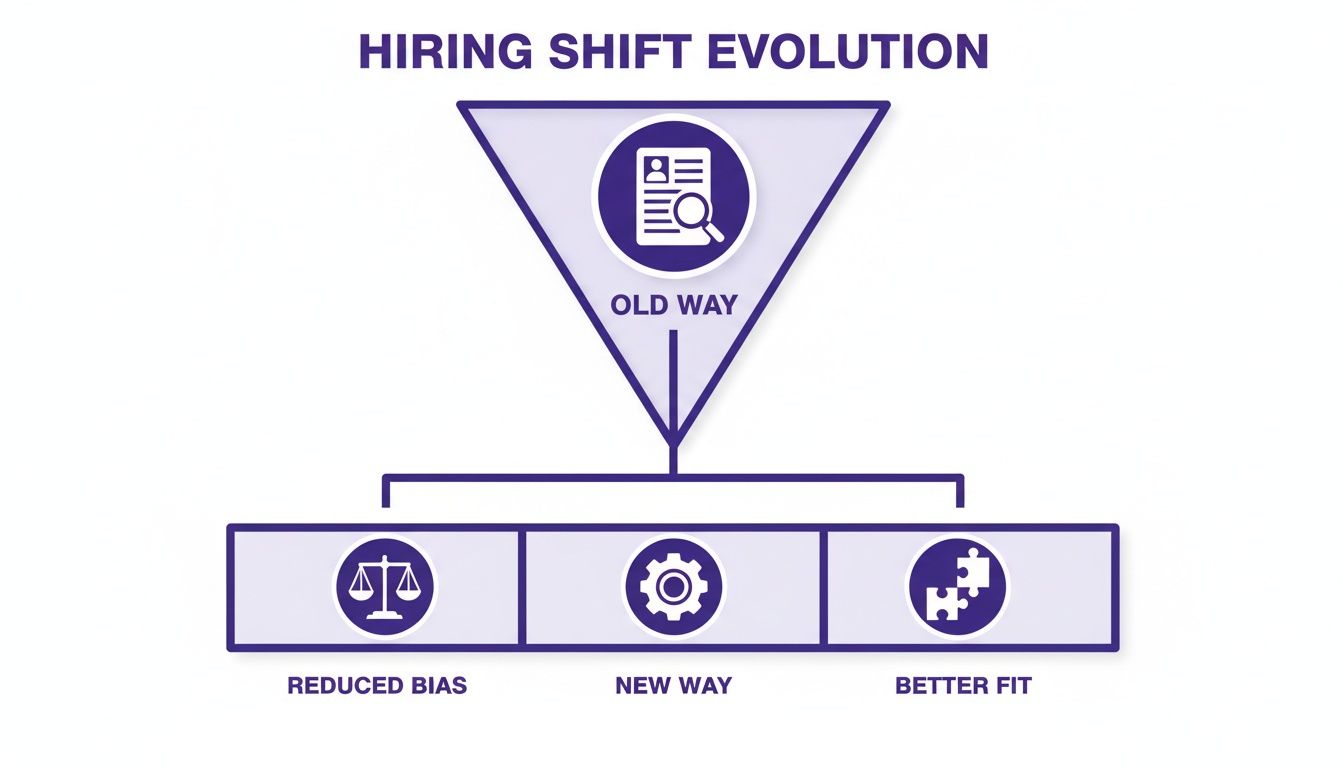
We're moving away from just scanning resumes and toward a smarter, skills-first approach that helps find the right person for the job while cutting down on bias.
Common Skills Assessment Types Compared
To make this even clearer, let's break down the most common tests you're likely to encounter. This table gives you a quick side-by-side look at what each one measures and when you might see it.
| Assessment Type | What It Measures | Example Scenario |
|---|---|---|
| Hard Skills Test | Technical proficiency and job-specific knowledge. | A content writer is asked to write a 500-word blog post on a given topic in one hour. |
| Soft Skills Evaluation | Interpersonal abilities like communication, teamwork, and leadership. | A sales candidate responds to a simulated angry customer email. |
| Cognitive Ability Test | Reasoning, problem-solving, and the ability to learn new things. | An analyst candidate is given a set of data to identify trends and draw conclusions. |
| Personality Assessment | Work style, motivations, and cultural fit. | An applicant answers questions about how they prefer to work—collaboratively or alone. |
Each test provides a different piece of the puzzle, giving employers a much more complete view of a candidate than a simple resume ever could.
Other Key Assessment Types
Beyond the big two, a couple of other assessments help round out the picture.
- Cognitive Ability Tests: These are less about what you know and more about how you think. They measure your knack for things like logical reasoning, numerical problem-solving, and spotting patterns. Essentially, they help predict how quickly you'll be able to learn on the job and tackle complex challenges.
- Personality Assessments: These aren't about right or wrong answers. Instead, they explore your work style, what motivates you, and how you might vibe with the existing team culture. Think of it as a tool for checking alignment between you and the company.
How Skills Assessments Benefit Your Career Development
It’s easy to think of a skills assessment as just another hoop to jump through during the hiring process. But that's a bit like looking at a map and only seeing a single town. In reality, that map shows you the entire landscape of your professional abilities—not just where you are, but all the possible roads you can take to grow.
Each assessment gives you a clear, objective snapshot of your strengths. Even more valuable, it shines a spotlight on the areas where you have the most room to improve. This isn’t about passing or failing; it's about getting honest feedback.
Turning Feedback into a Growth Plan
When you really look at your performance on an assessment—even for a job you didn’t land—you get priceless intel. Did you get stuck on a certain type of problem-solving question? Was a technical task tougher than you thought it would be? That’s your personal roadmap for what to work on next.
By pinpointing these specific skills gaps, you can stop guessing and start making a real plan. It’s a proactive way to grab the wheel of your career. Instead of just waiting for the right opportunity to come along, you start building the skills to create your own.
An assessment is more than a test of what you know; it's a guide for what you should learn next. It transforms professional development from a vague goal into a concrete, actionable plan.
This kind of insight is the perfect foundation for mapping out your next steps. You can learn more about turning these discoveries into a solid strategy by checking out our guide on building a career development plan template.
The Global Push for Continuous Learning
This idea of constantly and purposefully learning isn't just a smart personal move; it’s a global trend. All over the world, people are looking for ways to prove and expand their skills to keep up with what employers need.
You can see this demand in the explosion of professional certifications, which often validate the very skills these assessments measure. According to Coursera's 2023 Global Skills Report, which pulled data from 124 million learners, the hunger for skills-based credentials is off the charts. Year-over-year growth for these certificates hit a staggering 80% in Sub-Saharan Africa, 69% in the Asia-Pacific region, and 53% in North America.
This shows that professionals everywhere are using skills validation to get ahead. When you treat assessments as a learning tool, you’re aligning yourself with this forward-thinking mindset. It ensures you stay competitive and ready for anything, no matter how the job market shifts. Every test becomes another stepping stone to your next big career move.
Navigating the Skills Gap in a Changing Job Market
It feels like the ground is constantly shifting under our feet in the job market, doesn't it? New technologies pop up all the time, completely redrawing the map of what skills matter. This creates a pretty noticeable gap between what companies are desperate for and what skills most people actually have.
This is what everyone calls the skills gap, and it’s a huge deal right now.
But this isn't a reason to panic. For anyone trying to build a career, it's actually a call to action. Standing still just isn't an option anymore. The real game is about continuous learning and being smart about adapting your skillset to what’s in demand.
Why Strategic Upskilling Matters More Than Ever
Let's be clear: this isn't just some passing trend. Automation and AI are transforming entire industries, and the need for new skills is picking up speed. Think of a skills assessment as your personal compass in this new territory. It shows you exactly where you are and points you in the right direction.
First, you have to get a real handle on what you can do right now. The next step is figuring out how those abilities stack up against the skills that are becoming more valuable. Our guide on how to identify skill gaps can walk you through that exact process, helping you turn that knowledge into a real plan for growth.
The modern career isn't a straight ladder to climb; it's a dynamic journey of learning and adaptation. A skills assessment provides the clarity needed to make your next move the right one.
This forward-thinking approach is what will give you long-term career security. Companies aren't just looking for people to fill today's roles; they're actively searching for talent with future-proof skills. And skills assessments are the main tool they use to find them.
The Data Behind the Demand
The scale of this shift is just massive. The World Economic Forum has thrown out some startling numbers that really highlight the urgency. By 2030, they predict a whopping 59% of the global workforce will need major reskilling.
That breaks down into:
- Nearly a third of all workers needing to upskill just to keep their current jobs.
- Almost 20% needing to shift into entirely new roles.
This isn't some far-off future, either. It’s already happening. In 2023 alone, 63 million new jobs were created, but 83 million were eliminated. That's a net loss of 14 million roles. You can discover more insights about these skills shortages and see how it's shaking up the job market.
By using skills assessments, you can get ahead of these changes. It's not just about surviving—it's about positioning yourself to thrive, making sure your abilities stay relevant and in high demand.
How to Prepare for and Ace Your Next Skills Assessment

Walking into a skills assessment with confidence isn't about luck; it's about preparation. When you've done your homework, you don't just perform better—you send a clear signal to the employer that you're serious about the role. Honestly, acing these tests is less about raw genius and more about having a smart, focused strategy.
Think of yourself as a detective. Your first mission is to comb through the job description. What skills are they really looking for? Is it a data-heavy role that screams Excel and SQL, or is it all about project management frameworks? Figuring out what a skills assessment for that specific job will likely cover is your first win.
Next, get the logistics sorted. Don't be shy about asking the recruiter what to expect. Is it a multiple-choice quiz? A timed coding challenge? A case study you need to present? Knowing the format ahead of time kills the element of surprise and lets you practice what actually matters.
Sharpen Your Skills with Targeted Practice
Once you know the "what" and the "how," it's time to get your hands dirty. Reading about a skill is one thing, but actually doing it is what builds confidence.
- Find Relevant Practice Tests: A quick search online will turn up practice assessments for just about any industry or role. Getting a feel for the format and timing is a huge advantage.
- Work on Small Projects: If the assessment is technical, spin up a mini-project. It solidifies your skills, builds that crucial muscle memory, and gives you something tangible to talk about in an interview.
- Review Fundamentals: Always go back to basics. A strong foundation in the core principles of your field will help you tackle any curveball questions they throw your way.
Use AI for a Smarter Approach
You can also use modern tools to give yourself a real edge. Instead of just guessing what's important, you can analyze job descriptions to see exactly what skills employers are prioritizing.
This is where Eztrackr's AI Skill-Match Analyzer comes in. Just paste in the job description, and it instantly breaks down the most important skills needed for the role.
Getting this kind of data-driven checklist means you can stop guessing and start focusing your prep time on what the hiring manager actually wants to see.
Got Questions About Skills Assessments? We’ve Got Answers.
Even after getting the rundown on skills assessments, you probably have a few practical questions buzzing around. Let's tackle the big ones head-on.
Think of this as your personal FAQ to demystify the process and help you walk in with confidence. These tests aren't meant to trip you up; they're designed to let you show what you can do.
Are Skills Assessments Actually Fair?
In a word, yes—at least, they're designed to be. In fact, one of the main reasons companies use them is to cut down on the unconscious bias that can easily sneak into a traditional interview.
A well-built assessment doesn't care about your name, where you went to school, or your background. It zeros in on objective, job-related skills. This helps create a more level playing field where your actual abilities get to be the star of the show. The best ones are professionally validated to make sure they’re relevant and bias-free.
What if I Bomb the Assessment?
First thing's first: don’t panic. It’s so easy to see a low score as a failure, but it’s much more productive to view it as a learning moment. Seriously.
Take a step back and think about what happened. Was it a specific coding language you need to brush up on? A type of problem-solving question you'd never seen before? Use that insight to figure out exactly what you need to work on next. When you follow up with the company, you can still express your interest and point to other strengths, which shows them you’re proactive and resilient.
An assessment that doesn't go your way isn't a final verdict on your talent. It's just a data point, giving you a crystal-clear map of where to focus your energy next.
How Do I Talk About My Results in an Interview?
If you crushed it, definitely bring it up! You don’t have to brag, but you can casually mention it. Something like, “I really enjoyed the logic puzzle in the assessment—it’s similar to the kind of strategic thinking I love to do in my work.”
What if they don’t mention it? You can still guide the conversation toward the skills they tested. Have a few stories ready from your past jobs that prove you've got the chops in those key areas. Concrete examples are always more powerful than just a test score.
Can I Ask for Feedback on How I Did?
You can always ask, but it’s smart to keep your expectations in check. Many companies are swamped with applications and just don't have the bandwidth to give detailed feedback to every single person.
The best way to go about it is to be polite and professional in your thank-you email. Try something like: “I found the assessment really insightful and would be grateful for any general feedback you’re able to share.” This shows you have a growth mindset and leaves a great impression, whether they can give you detailed notes or not.
Ready to stop guessing what skills matter and start acing your applications? Eztrackr’s AI Skill-Match Analyzer gives you an instant breakdown of any job description so you can focus your preparation where it counts. Try it today and land your next opportunity faster.