What Is a Resume Title and How to Write a Great One
Think of a resume title as the one-line pitch for your entire career. It’s that short, punchy phrase sitting right at the top of your resume, designed to immediately tell a recruiter or hiring manager who you are and what you bring to the table. It's not just your job title; it's the headline for your professional story.
Your Resume Title Is More Than Just a Job Title
Let's use an analogy. If your resume were a movie trailer, the resume title would be that explosive opening shot that hooks you in and makes you need to see the rest. It’s a tiny, strategic brand statement built for maximum impact in the few seconds you have to make an impression.
And trust me, those seconds count. This single line has become absolutely critical in the modern job search. Why? Because recruiters are drowning in resumes. Study after study shows that hiring managers spend a mere 6 to 8 seconds on their first scan. A sharp, clear resume title acts as an instant filter, signaling that they’ve found a potential match.
A great resume title doesn't just list what you've done; it declares what you can do next. It's the difference between saying "I was a marketer" and "I am a Digital Marketing Specialist who drives growth with SEO and PPC."
The Anatomy of a Powerful Title
So, what goes into a title that actually works? A killer resume title is a fusion of your professional identity and your unique value. It’s more of a compact sales pitch than a simple label. Breaking it down helps.
- Target Job Title: This is your foundation. It needs to mirror the exact role you're applying for, using the keywords straight from the job description.
- Key Specialization or Skill: This adds the crucial context. Adding something like "B2B SaaS," "Supply Chain Logistics," or "Agile Methodologies" instantly clarifies your niche.
- High-Impact Qualifier: This is your secret sauce. It could be a key certification (PMP, CPA), a specific software proficiency (Salesforce, Adobe Creative Suite), or a standout achievement that makes you unique.
This little graphic really helps visualize how these pieces fit together. Your title is built on your core job function but gets its real power from the brand statement and skills you layer on top.
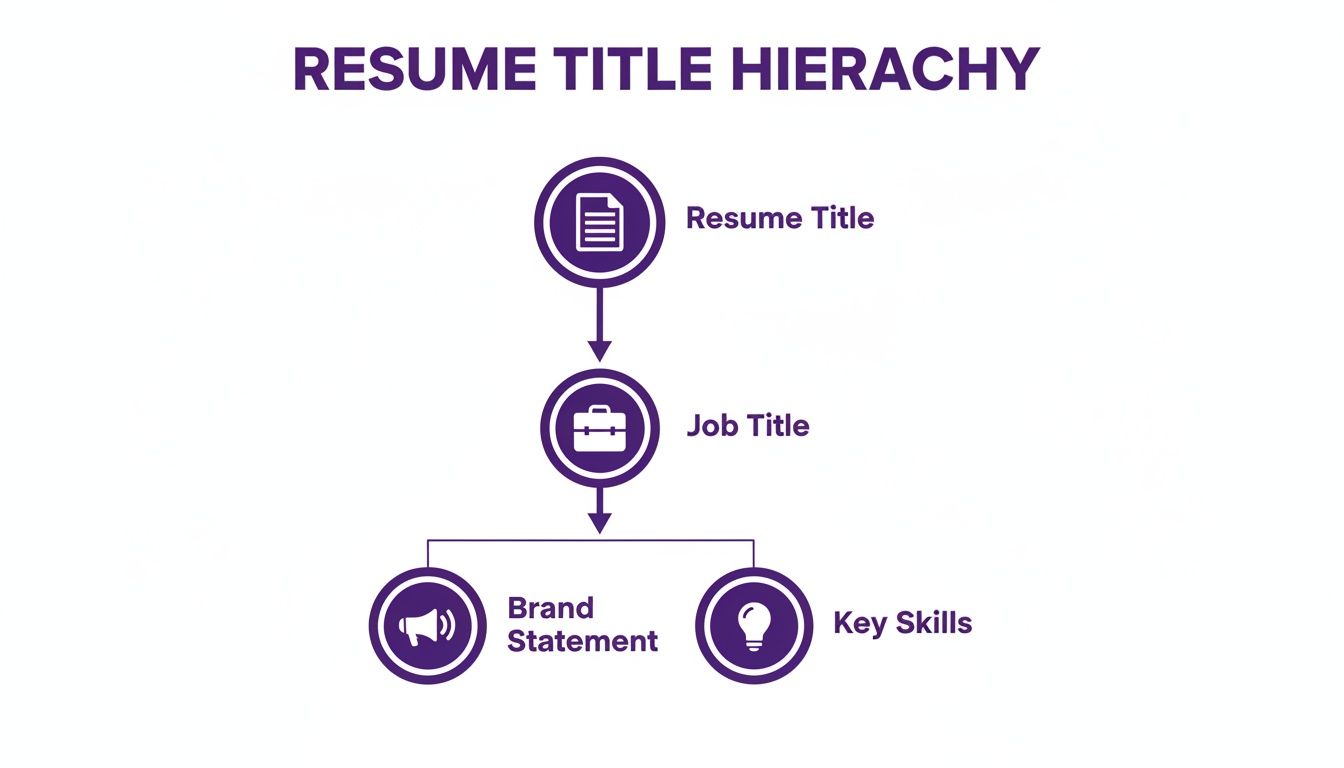
As you can see, it sits right at the top, setting the stage for all the other categories on a resume that follow. It’s the first thing they read, and it frames how they interpret everything else.
To see this in action, let's look at how a simple tweak can transform a title from forgettable to fantastic.
Resume Title Transformation Before and After
| Element | Weak Title Example ('Experienced Professional') | Strong Title Example ('Senior Product Manager | FinTech & B2B SaaS') |
| :— | :— | :— |
| Clarity | Vague and generic. What kind of professional? In what industry? | Immediately communicates role, seniority, and industry specialization. |
| Keywords | Contains no searchable keywords for ATS or human recruiters. | Packed with keywords: "Senior Product Manager," "FinTech," "B2B SaaS." |
| Impact | Fails to grab attention or convey specific value. | Instantly positions the candidate as a specialized expert in a high-demand area. |
The difference is night and day, right? The strong example doesn't just say what the person does; it screams competence and relevance for a very specific type of role, making it impossible for the right recruiter to ignore.
Why Your Resume Title Is a Secret Weapon for ATS

Think of Applicant Tracking Systems (ATS) as the bouncers at an exclusive club. These software programs scan every single resume that comes in, looking for specific keywords and phrases that match what the company wants. If your resume doesn't have the right stuff, you're not getting in. It might get tossed before a human ever lays eyes on it.
This is where a sharp, well-crafted resume title becomes your VIP pass. When you pack your title with the exact job title and key skills from the posting, you’re basically waving a big, bright flag at the ATS. The software immediately sees a match, which can boost your ranking and shove your application right to the top of the virtual pile.
Making the Human Connection
But it's not all about the bots. Once your resume makes it past the ATS, it lands in front of a real person—a recruiter or hiring manager who is likely swamped. They've got dozens, maybe hundreds, of applications to sift through.
A crystal-clear resume title makes their job infinitely easier. They don’t have to play detective, digging through your work history to figure out if you're even a potential fit for the role.
Your resume title does the heavy lifting for the recruiter. In a sea of generic applications, a title like "Senior Accountant | CPA | SEC Reporting & SOX Compliance" instantly says, "I am exactly who you are looking for."
That immediate clarity makes a powerful first impression. It shows you’ve actually read the job description, you understand what they need, and you respect their time. You're not just another random applicant; you're a serious contender who tailored your approach. For more on this, check out our guide on applicant tracking system resume tips.
Staying Ahead of Modern Recruitment Trends
The job search world is always changing, and AI screeners are becoming the new norm. These systems still lean heavily on keywords and role alignment, so a specific title like “Frontend Engineer – React & TypeScript” can be the deciding factor that gets you past that initial screening.
It’s no surprise that technology is shaping how we apply. A recent survey found that a whopping 68% of workers have used AI to help write their resumes. A powerful, targeted title ensures you’re ready for both the ATS of today and the AI-driven recruitment of tomorrow. It’s a small tweak that delivers a huge return, making sure both robots and recruiters see you as a top candidate from the get-go.
How to Craft the Perfect Resume Title Step-by-Step
Building a resume title that truly grabs attention isn't some mystical art form. It's actually a pretty straightforward process of lining up what you offer with what an employer desperately needs.
Let's walk through how to build a powerful title from the ground up, step by step.
Step 1: Analyze the Job Description
Before you even think about writing, you need to put on your detective hat. The job description is your treasure map, loaded with clues that point directly to what both the hiring manager and the ATS are looking for.
Go through the entire posting with a fine-tooth comb and pull out these key details:
- The Exact Job Title: Is it "Software Engineer," "Senior Software Developer," or "Full Stack Engineer"? The specific phrasing is critical.
- Essential Skills and Technologies: Pinpoint the tools, software, or methodologies they mention over and over again. Think "Salesforce," "Python," "Agile," or "SEO."
- Key Responsibilities and Qualifications: Take note of phrases that get to the heart of the job, like "B2B sales," "supply chain management," or "digital content creation."
This initial legwork is the bedrock of a title that will actually get you noticed.
Step 2: Use a Proven Formula
With your keywords and insights in hand, it's time to build your title. There's a simple, incredibly effective formula that makes sure you hit all the right notes, making your title scannable and packed with value.
Here’s the core formula:
[Target Job Title] + [Key Specialization] + [High-Impact Skill or Qualifier]
Let's break that down. The Target Job Title is the non-negotiable anchor you found in step one. Your Key Specialization adds crucial context about your niche or industry. And the High-Impact Skill is the knockout punch—that specific, valuable thing that makes you stand out.
Pro Tip: Think of your title like a headline for a news article about your career. It has to be factual, short, and interesting enough to make someone want to read the full story.
This structure guarantees your title is loaded with keywords that catch the eye of both automated screeners and human recruiters.
Step 3: Brainstorm and Tailor for Each Application
Okay, time to put it all together. Using the formula and the notes you took, brainstorm a few different versions. The goal isn't to create one perfect title to use everywhere—it's to craft a unique, laser-focused title for each job you apply for.
For instance, if you're a marketer, your brainstorming list might look something like this:
- Base Title: Digital Marketing Manager
- Specializations: B2B SaaS, E-commerce, Content Strategy
- High-Impact Skills: SEO & SEM, HubSpot Certified, Google Analytics
With this list, you can mix and match to create tailored titles. A job focused on analytics could get "Digital Marketing Manager | SEO & SEM | Google Analytics." A role that’s all about content might get "Content Marketing Manager Specializing in B2B SaaS."
And remember, your professional brand doesn't stop at your resume. It's just as important to craft a winning LinkedIn profile headline that reinforces your expertise and makes you more visible to recruiters online.
This customization is a game-changer. A recent analysis found that resumes using the exact job title from the posting were over 10 times more likely to land an interview. Spending just a few extra minutes tailoring your resume title can dramatically boost your chances of getting seen and moving to the next round.
Resume Title Examples for Every Career Path

Theory is one thing, but seeing how these titles work in the real world is where it all clicks. To help you nail yours, I’ve put together a collection of solid examples for different industries and career levels.
Think of these less as rigid rules and more as plug-and-play templates you can tweak for your own job search. You'll notice they all go a step beyond a basic job title. They pack in specializations, key skills, and industry keywords that catch the eye of both recruiters and the ATS bots.
Examples for Tech and IT Professionals
Tech moves at the speed of light, so your resume title needs to instantly signal your specific, high-demand skills. A generic title like "Software Developer" just won't cut it anymore; it gets lost in the pile.
- Senior Software Engineer | Java & Spring Boot | Microservices Architecture
- Why it works: This immediately flags seniority, names the exact tech stack (Java, Spring Boot), and points to a valuable specialization (Microservices). No guesswork needed.
- Cybersecurity Analyst with CISSP & Network Security Focus
- Why it works: It perfectly blends the role with a must-have certification (CISSP) and a clear focus, targeting specialized security jobs.
- Cloud Solutions Architect | AWS Certified | Infrastructure as Code (IaC)
- Why it works: This one shouts expertise by featuring a top-tier certification (AWS) and a modern skillset (IaC), branding the candidate as a current and relevant expert.
If you're in a newer field, it pays to see what titles are actually being used. A quick browse through platforms listing current job titles in the Web3 space can give you some great ideas.
Examples for Marketing and Sales Experts
In marketing and sales, it's all about the results. Your resume title is your very first pitch, so it needs to hint at the value you bring to the table—whether that’s driving revenue or growing a brand.
- Digital Marketing Manager Specializing in SEO & Content Strategy
- Why it works: It zeros in on two of the hottest areas in marketing right now, showing a clear specialty that directly ties to a company's growth.
- B2B SaaS Account Executive | Salesforce Certified | Enterprise Sales
- Why it works: This is loaded with industry-specific language (B2B SaaS, Enterprise Sales) and a critical tool proficiency (Salesforce), making it incredibly targeted.
A strong resume title acts as the first sentence of your professional summary. It sets the stage for the narrative you're about to present, making every subsequent detail more impactful. If you need help with the next part, our guide offers excellent resume summary of qualifications examples to build on your title's momentum.
Examples for Finance and Healthcare Professionals
For heavily regulated fields like finance and healthcare, it’s all about precision, certifications, and compliance. Your title needs to reflect that by leading with your most important credentials and areas of expertise.
- Certified Public Accountant (CPA) with Big Four Audit Experience
- Why it works: The title leads with the gold-standard credential (CPA) and adds a powerful qualifier (Big Four) that screams high-level experience and training.
- Registered Nurse (RN) | BSN | Emergency Department & Trauma Care
- Why it works: This clearly lays out the license (RN), education (BSN), and a critical specialization, instantly telling a hiring manager you’re qualified for high-pressure situations.
Industry-Specific Resume Title Templates
To make this even easier, here's a quick-reference table. Just find your industry and use the formula to build a title that stands out.
| Industry | Template Formula | Example |
|---|---|---|
| Technology | [Job Title] | [Primary Skill/Tool] | [Specialization] | **Data Scientist |
| Marketing | [Role] with Expertise in [Skill 1] & [Skill 2] | Content Marketer with Expertise in B2B SEO & Video Strategy |
| Sales | [Seniority Level] [Role] | [Industry] | [Key Skill] | **Senior Account Manager |
| Finance | [Certification] | [Role] | [Area of Experience] | **CFA Charterholder |
| Healthcare | [License] ([Abbreviation]) | [Degree] | [Specialty] | **Physical Therapist (PT) |
| Creative | [Role] | [Specialty] | [Key Tool/Software] | **Graphic Designer |
| HR | [HR Role] Specializing in [Function] & [System] | HR Generalist Specializing in Talent Acquisition & Workday |
These templates are a fantastic starting point. Mix and match them with the specifics from the job description to create a title that’s perfectly tailored for the role you want.
Common Resume Title Mistakes You Need to Avoid

It’s easy to get your resume title wrong. A small misstep here can sabotage your entire application before a recruiter even gets to your experience section. You're trying to make a great first impression, not send your resume straight to the "no" pile.
Let’s walk through the most common traps people fall into. The biggest one? Using vague, fluffy phrases that sound nice but say absolutely nothing. A title like "Experienced Team Player" or "Hardworking Professional" is just wasted space. It tells the recruiter zero about what you actually do.
Another classic blunder is simply copying your last job title and calling it a day. Sure, it feels accurate, but it's lazy. It shows you haven't bothered to customize your resume for the specific role you're after, which is a major red flag for hiring managers.
Vague Titles Versus Specific Titles
A vague title makes the recruiter work to figure out who you are. A specific one does the work for them. It’s the difference between a blurry photo and a crystal-clear headshot.
- Before: Results-Driven Professional
- After: Senior Project Manager | PMP Certified | Agile & Scrum
See the difference? The "After" example is packed with keywords a recruiter might be searching for. It instantly communicates your level, qualifications, and core skills. It’s a direct answer to the question, "Is this person qualified?"
The goal of your resume title is to eliminate ambiguity. A recruiter should know exactly who you are and what you do within three seconds of looking at your resume.
Overstuffing and Irrelevance
On the flip side, don't try to cram your entire life story into one line. A title that’s too long and cluttered is just as bad as one that’s too vague. It becomes an unreadable mess that just overwhelms the reader. Pick your top two or three most powerful qualifications and stick with those.
Along the same lines, keep it relevant. If you're applying for a data analyst position, your past experience in social media event planning has no business being in your title. Only include what matters for this specific job.
The job market moves fast. Research shows that about one-third of in-demand skills today weren't even on the radar three years ago. This makes static, old-school job titles less and less meaningful. A winning resume title has to blend the target role with the modern skills they're looking for. You can learn more about how resume formats are evolving to meet these demands.
Avoiding Common Pitfalls
If you can steer clear of these common mistakes, your title will do its job: grabbing attention and getting you noticed. Run your own title through this quick audit:
- Is it specific? Ditch the generic fluff like "go-getter."
- Is it tailored? Does it mirror the language and keywords in the job description?
- Is it concise? Is it a single, easy-to-scan line?
- Is it relevant? Does it highlight skills that directly apply to the role?
If you can answer "yes" to all of these, you’re in great shape. You've crafted a resume title that doesn't just sit there—it actively works to open doors for you.
Work Smarter, Not Harder: Supercharge Your Job Search
Knowing how to write a killer resume title is one thing, but actually doing it for every single job you apply to? That can get exhausting, fast. This is where modern job search tools come in, bridging the gap between knowing what to do and actually getting it done efficiently.
Think about AI-powered resume builders. Instead of you having to painstakingly read through a job description and pick out keywords, these tools can scan the whole thing in seconds. They’ll pinpoint what matters most and suggest a powerful, ATS-friendly title built specifically for that role. It takes the most tedious part of tailoring your resume off your plate.
Stop Guessing, Start Measuring
Technology doesn’t just help you create titles; it helps you perfect them. Skill-matching tools can instantly show you how well your resume—title included—stacks up against a job’s requirements. You get immediate feedback on what keywords you might be missing.
Job trackers like Eztrackr take it to the next level. They let you save and manage different versions of your resume. This means you can easily test out various titles across your applications and see which ones actually get a response.
This completely changes the game. Your job search goes from a shot in the dark to a data-backed strategy. You can literally see which titles are landing you interviews and focus your energy on what works. It’s all about working smarter.
Want to see what else you can automate? Check out our guide on using an AI resume summary generator. At the end of the day, using these tools frees up your time for what really counts: prepping for interviews and landing that amazing new job.
Got Questions About Resume Titles? We've Got Answers.
Even after you've got the basics down, a few tricky questions always seem to pop up when you're trying to get your resume title just right. Let's clear up some of the most common ones so you can move forward with confidence.
Should My Resume Title Match My LinkedIn Headline?
Think of them as cousins, not twins. They should definitely be consistent, but they don't have to be identical. Your LinkedIn headline can be a bit more expansive to cast a wider net for different kinds of opportunities.
Your resume title, on the other hand, needs to be laser-focused. It should be tailored specifically for the job you're applying for, grabbing keywords straight from that job description to make an immediate connection.
Where Does the Resume Title Go?
Put it right at the top, directly under your name and contact info. It should be one of the very first things a recruiter or hiring manager sees, sitting just above your professional summary. This spot ensures it immediately frames who you are and why you're a great fit.
Think of the placement as an unmissable billboard for your career. It sets the stage for everything else on the page, positioning you as the ideal candidate from the first glance.
How Long Should a Resume Title Be?
Short and sweet is the name of the game. You're aiming for a single, impactful line—not a full sentence.
A good rule of thumb is to keep it between 5 to 15 words. The goal is instant clarity. A simple formula like ‘Target Job Title | Key Skill 1 | Key Skill 2’ works wonders because it’s easy to scan and packed with value.
Ready to stop guessing and start getting noticed? The AI tools inside Eztrackr can help you craft optimized resume titles, analyze your resume against job descriptions, and track your application success all in one place. Take control of your job search by visiting https://eztrackr.app today.